Skip to content
DevMeme
5423 of 7435
The Extreme Reaction to Suggesting Java on the Frontend
Languages Post #5945, on Mar 28, 2024 in TG

The Extreme Reaction to Suggesting Java on the Frontend

Why is this Languages meme funny?

Level 1: Wrong Tool, Big Tantrum

Imagine two friends want to build a treehouse. One friend suddenly suggests using spaghetti noodles instead of wooden planks to make the floor. The other friend is so upset by this silly idea that they jokingly shout, “I’d rather jump out of the tree than use spaghetti for building!” It’s a huge overreaction, which makes it funny. In the meme, someone suggested using the wrong tool (a programming language called Java) to do a job it isn’t meant for (making the stuff people see and click on). The other person hates that idea so much, they act like it’s the end of the world. The joke is that the idea is obviously bad, and the reaction is crazy exaggerated, kind of like kids having a big fight over something ridiculous.

Level 2: Java Loves Servers, Not Screens

Let’s break down why this fake headline is funny for those newer to the coding world. First, know that Java is a very popular programming language, but it’s mainly used on the back-end – meaning it runs on servers behind the scenes. Companies use Java to handle stuff like business logic, talking to databases, or powering the core of applications. On the other hand, the front-end is what users actually see and interact with, like buttons, forms, and webpages in their browser or the UI of an app. Front-end code is usually written in languages/environments better suited for making things look good on screen, such as HTML, CSS, and JavaScript (or frameworks built on those, like React, Angular, or Vue).

So why did this suggestion of “Java on the front-end” spark a (faux) violent reaction? It’s because it sounds like using the wrong tool for the job. It’s a bit like someone suggesting, “Hey, let’s use a hammer to draw a picture.” Could you? Maybe in theory – a hammer can make marks – but it’s absolutely not the best way, and anyone with basic art skills would think you’re joking or crazy. In tech terms, saying “we should do our user interface in Java” goes against the grain of how modern software is built. It ignores the whole ecosystem of tools made for front-end development.

There’s also some confusion for newcomers between Java and JavaScript. Despite the name similarity, they are completely different languages with different purposes. JavaScript (along with HTML/CSS) is the de-facto language that runs in web browsers to make web pages interactive. If someone says they’re a frontend developer, they’re almost certainly working with JavaScript (or a language that transpiles to it). Java, in contrast, runs on the server or inside heavier applications. Using Java for a web front-end is very uncommon today – it would mean every user needs to run Java applets or a Java-powered application to see the interface, which is old-school and impractical. (In the past, there were Java Applets that ran in browsers, but those have died out for security and usability reasons. There are also Java desktop GUI frameworks like Swing and JavaFX for making standalone apps, not web pages).

Now, within some companies, there’s a notion of being a “Java shop,” meaning they try to solve every problem with Java because that’s the skill their developers have. If an entire team only knows Java, someone might ignorantly suggest, “Why don’t we also build the UI with what we know – Java?” But to a young developer or anyone following current best practices, this idea is cringeworthy. It’s like a chef trained in Italian cuisine being told to make sushi with spaghetti – it just doesn’t fit. Modern front-end development has evolved a huge toolchain separate from Java, and mixing them up is a recipe for frustration.

The meme’s sub-headline even quotes the younger developer saying, “I prefer death to doing screen in Java.” While over-the-top, this line highlights how strongly devs can hate a particular technology for a task. Building a “screen in Java” likely refers to using Java’s UI libraries (like Swing) to design a graphical interface. Many find that approach cumbersome. For example, laying out buttons and text fields in Swing involves writing a lot of boilerplate code and dealing with things like layouts and pixel coordinates by hand. In contrast, front-end developers using HTML can place elements much more intuitively, and they have CSS for styling and flexible design. So a junior dev who’s learned modern web development would dread having to make a UI with Java’s old style methods – to them it feels like moving backwards, or using a very inefficient, outdated tool.

This brings up the idea of language wars and tech stack debates, which juniors might not have experienced deeply yet, but they soon will in any team setting. Developers often have favorite languages or frameworks, and sometimes discussions about “what should we use for this project?” become heated. It’s common office humor that developers argue about trivial things (like which text editor is best, or whether tabs or spaces should be used for code indentation). Here the argument is about using a backend language (Java) to do a frontend job, which is unconventional. The meme pushes it to an extreme to get a laugh: co-workers pulling knives on each other, which of course doesn’t literally happen in real offices! The knife fight is just symbolic of how intense and ridiculous these arguments can feel.

Corporate culture also plays a role. In some workplaces, a suggestion that breaks from norm (like introducing a different tech) can cause conflict. Maybe the person suggesting Java on the front-end is out of touch with modern development, and the young intern’s dramatic refusal is a way of saying “that idea is absolutely unacceptable.” It’s an exaggerated scenario, but it’s making fun of how developers can react strongly when someone proposes something that goes against industry practices or their own hard-earned knowledge. Even if you’re new, you might relate if you’ve ever seen a group of programmers groan in unison at a bad idea in a meeting. This meme just dials that reaction up to 11 for comedic effect.

In short, the headline is a joke about a tech stack dispute. Key terms: Java (backend programming language), Front-end (user interface code, usually not Java), LanguageWars (folks arguing over programming languages). The humor comes from knowing Java is a square peg for the round hole of front-end work – and imagining coworkers going mad about that suggestion. As a new developer, it’s a glimpse into dev team dynamics: everyone has opinions on the “right” tool for the job, and sometimes those opinions clash in dramatic ways (minus the actual knives, hopefully!).

Level 3: Swinging Knives Over Swing

In this satirical IT News headline, two developers nearly reenact a scene from Fight Club over a tech stack suggestion. The trigger? One co-worker proposes using Java on the front-end, a suggestion so heretical in programming circles that it’s basically asking for a language war. The meme exaggerates it to a knife fight, poking fun at how absurdly passionate developers can get about tech choices.

At its core, this humor targets seasoned devs who remember the Backend vs Frontend turf battles. Java is a powerful, object-oriented language traditionally living on the server-side (think heavy-duty business logic, databases, and backend services running on the JVM). On the other hand, modern frontend development is typically the domain of JavaScript, HTML, CSS, and specialized UI frameworks like React or Angular. Suggesting to do UI screens in Java is like suggesting to build a spaceship out of wood – theoretically possible, but practically begging for trouble.

Why such visceral opposition? Historically, Java’s attempts at front-end were… clunky at best. Seasoned devs bear scars from Java Applets (deprecated browser plugins requiring a JRE install), Swing (Java’s old GUI toolkit for desktop apps), and even JavaFX (a newer UI framework). These technologies let you create graphical interfaces in Java, but with significant pain. A simple login form in Swing might involve writing dozens of lines of code to create windows, panels, layout managers, and buttons manually:

// Java Swing example: building a basic login form (lots of boilerplate)
JFrame frame = new JFrame("Login");
frame.setDefaultCloseOperation(JFrame.EXIT_ON_CLOSE);

// Create a panel and UI components
JPanel panel = new JPanel();
panel.setLayout(new GridLayout(3, 2));
panel.add(new JLabel("Username:"));
panel.add(new JTextField(15));
panel.add(new JLabel("Password:"));
panel.add(new JPasswordField(15));
panel.add(new JButton("Submit"));

// Assemble and display the frame
frame.add(panel);
frame.pack();
frame.setVisible(true);

In contrast, a modern web frontend dev might spin up a quick HTML/CSS form or use a React component with far less ceremony. The thought of returning to Swing’s verbose, pixel-tweaking ways can induce PTSD in developers who’ve tasted the sweet freedom of the web. No wonder the 21-year-old comp-sci student in the meme quips "I prefer death to doing screen in Java" – it’s an overly dramatic way to say “I hate that idea with every fiber of my being.”

This "news article" mocks how tech debates can escalate. One colleague’s offhand idea – “Hey, why don’t we just do the front-end in Java?” – is perceived by the other as pure blasphemy, tantamount to a personal attack on modern software craftsmanship. In real life, developers don’t literally pull knives over framework choices (thankfully), but the passion and ire you see in design meetings, code reviews, or on Stack Overflow can feel that intense. The meme plays on the trope that in some dev shops, suggesting the "wrong" technology is a career-limiting move (or at least a fast track to heated Slack arguments). Corporate culture often has unwritten rules about tech stacks: if your team has standardized on a Java + Spring backend and, say, an Angular frontend, proposing a full-stack Java solution will raise eyebrows or outright laughter.

There’s also an undercurrent of generational tech clash. The character described as a 21-year-old Computer Science student is likely an intern or junior developer. Fresh out of college or bootcamp, they’re more familiar with lightweight web frameworks and might view Java UI as archaic or “enterprise-y” in the worst way. Meanwhile, whoever suggested Java for the UI could be an old-school senior or a misinformed manager remembering the Swing era, or they might confuse Java with JavaScript (a common point of confusion for non-developers). This mismatch in perspective fuels the dark comedy: it’s the ultimate “OK Boomer” tech moment, with the junior dev so appalled that they’d sooner face a knife than Eclipse’s drag-and-drop UI designer.

The tags java_on_frontend and swing_vs_javafx hint at notorious debates. Even if you insisted on Java for a GUI, there’s infighting about which Java UI toolkit to use – classic Swing or the newer JavaFX? It’s like arguing about what color to paint a sinking ship. Most modern devs would choose “none of the above, let’s use web tech instead”. So the meme doubles down on absurdity: not only is someone pushing Java into the browser realm, but the debate could spiral into Swing vs JavaFX knife fight round two. It satirizes how developers sometimes fight over minutiae (like what framework or naming convention to use) while possibly missing the bigger picture (e.g. delivering value to users).

In summary, this meme lands with experienced developers because it caricatures a truth of developer culture: engineers can be intensely tribal about programming languages and tools. There’s a long history of “LanguageWars” where suggesting the wrong stack in the wrong context is like stepping on a landmine. FrontendHumor often highlights this divide – ask a room of devs whether to use tabs or spaces, or Angular vs React, and you’ll get playful jabs and maybe a few reddening faces. Here, the forbidden suggestion of using Java (a backend stalwart) to build a user interface (traditionally the realm of JavaScript and friends) is so inflammatory that it’s depicted as literal combat. It’s absurd, it’s hyperbolic, but it riffs on reality: in dev land, even TechHumor carries a grain of truth about our collective quirks and stubborn loyalties.

Description

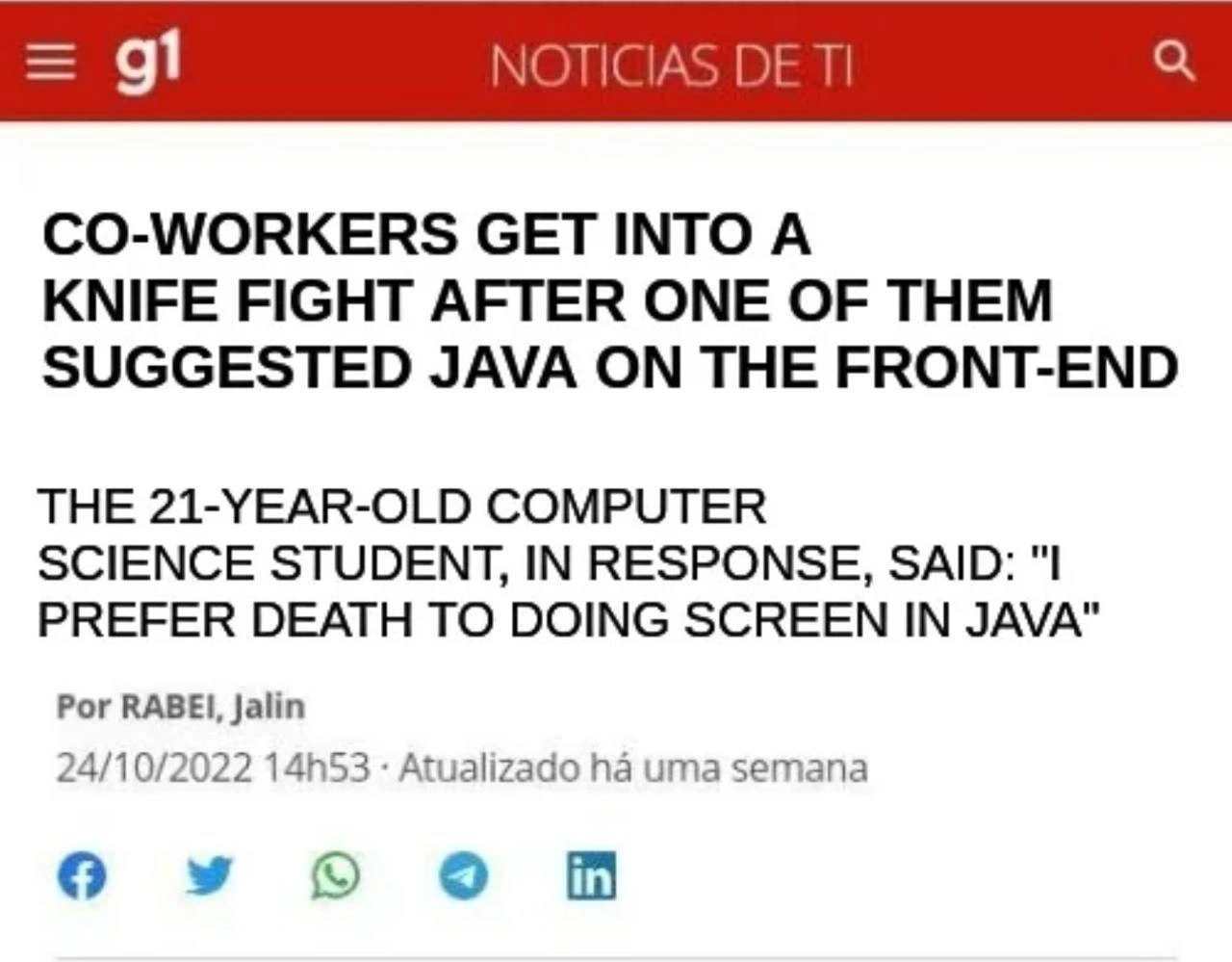
A screenshot of a fake news article formatted to look like the Brazilian news portal 'g1'. The red header displays the 'g1' logo and the section 'NOTICIAS DE TI' (IT NEWS). The main headline in bold, black text reads, 'CO-WORKERS GET INTO A KNIFE FIGHT AFTER ONE OF THEM SUGGESTED JAVA ON THE FRONT-END'. A sub-headline follows: 'THE 21-YEAR-OLD COMPUTER SCIENCE STUDENT, IN RESPONSE, SAID: "I PREFER DEATH TO DOING SCREEN IN JAVA"'. The meme humorously exaggerates the strong, negative sentiment many developers hold against using Java for client-side, front-end development, a practice largely abandoned in favor of JavaScript-based frameworks. The joke lands with experienced engineers who remember the era of Java Applets and understand the visceral reaction to such an unconventional and outdated architectural suggestion


Comments

17
Anonymous ★ Top Pick Proposing Java on the front-end today is less of a technical choice and more of a corporate threat intelligence test to see who on the team is a flight risk
  1. Anonymous ★ Top Pick

    Proposing Java on the front-end today is less of a technical choice and more of a corporate threat intelligence test to see who on the team is a flight risk

  2. Anonymous

    Utter “Java on the front-end” and every engineer who survived applets, AWT, and GridBagLayout simultaneously reaches for the incident-response runbook - still faster than the Event Dispatch Thread ever managed

  3. Anonymous

    The real crime here isn't the knife fight - it's that someone in 2022 still remembers Java applets fondly enough to suggest them. The 21-year-old probably wasn't even born when we collectively decided to bury Swing UI deeper than Jimmy Hoffa

  4. Anonymous

    The real tragedy isn't the knife fight - it's that someone actually suggested Java Swing for a modern frontend in 2022. The student's response of preferring death is honestly the most reasonable reaction to being asked to build UIs with AWT layouts and repaint() calls when React, Vue, and Angular exist. This is what happens when you confuse 'full-stack Java developer' with 'Java everywhere developer' - some architectural boundaries exist for everyone's safety

  5. Anonymous

    Suggesting Java for frontend? That's not a paradigm shift - it's a paradigm stab

  6. Anonymous

    Pitch Java on the front end and you’ve reinvented applets with CI/CD; the only thing rendering is the postmortem

  7. Anonymous

    Java on the front end? Great - if your idea of “responsive” is scaling heap under sticky sessions and every 8px tweak ships as a Maven release

  8. @deerspangle 2y

    And this is why everything is electron apps. Writing front end code in anything else blows

    1. @trainzman 2y

      I've never heard more dense troll

      1. @deerspangle 2y

        Glad you like! :3

  9. @callofvoid0 2y

    people who use java frameworks for making games : heh

  10. @Sp1cyP3pp3r 2y

    в чём он неправ?

    1. @sylfn 2y

      Please use English in this chat

  11. @Box_of_the_Fox 2y

    Android devs be like

  12. @SamsonovAnton 2y

    Why din't they do it like civilized men and just arrange a knife fight on cs_office? 🤓

    1. @azizhakberdiev 2y

      in old cs 1.6 on pc from 90s

  13. Deleted Account 2y

    GWT?

Use J and K for navigation