Skip to content
DevMeme
5424 of 7435
The Overly Eager Junior Developer's Massive Pull Request
CodeReviews Post #5946, on Mar 29, 2024 in TG

The Overly Eager Junior Developer's Massive Pull Request

Why is this CodeReviews meme funny?

Level 1: One Huge Favor

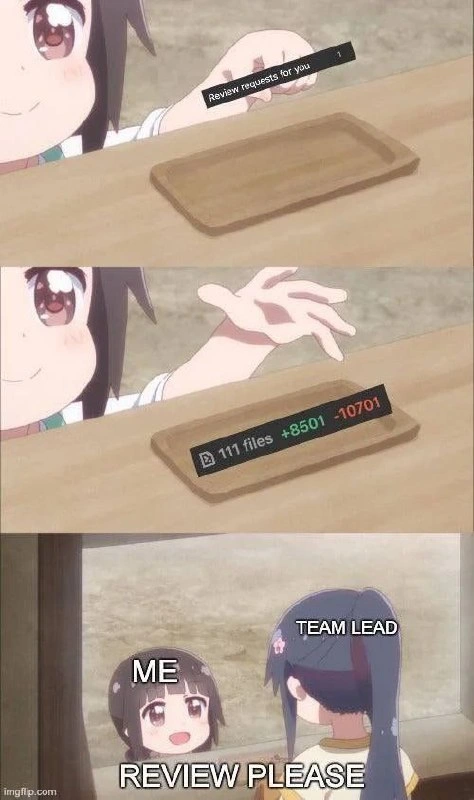
Imagine your friend says, “Hey, I have a favor to ask. Could you check something for me? It’s just one little thing.” You agree, thinking it will be quick. Then your friend hands you a giant book with 111 pages and says, “Can you read this and tell me if it’s okay?” 😮 That’s what’s happening in this meme! The small tray in the first picture is like the friend saying “it’s just one request,” and the huge block in the second picture is like the giant book you’re actually given. The little character labeled “ME” is the person asking for the favor, and the taller “TEAM LEAD” is the friend who now has to do a lot of work. The caption “REVIEW PLEASE” is the polite ask – like saying “pretty please, can you do this for me?”

It’s funny because it’s a huge ask disguised as a small one. In simple terms, one person is innocently asking another to help with something really big, acting like it’s no big deal. We laugh because we’ve all been in that situation: someone hands us way more work than we expected and we’re left thinking, “This is going to take forever!” The meme uses a cute cartoon style to make it lighthearted, but the joke is basically about biting off more than someone else can chew and still smiling as you ask them to chew it.

Level 2: Pull Request Overload

Now let’s break down the situation in more straightforward terms. This meme is about code reviews in a team using Git (a version control system). A Pull Request (PR) is when a developer asks to merge their code changes into the main codebase and requests teammates to review those changes. In the image, the developer (“ME”) is asking the team lead to review a PR. But there’s a twist – it’s a huge PR! The text on the tray in panel 2, 111 files +8501 -10701, is exactly how a Git hosting platform (like GitHub or GitLab) shows the scope of changes:

  • 111 files changed – that means the developer modified 111 different files in this one PR. That’s an awful lot; imagine trying to open 111 documents and read through all the changes.
  • +8501 lines added (in green text) – the developer wrote 8,501 new lines of code.
  • -10701 lines removed (in red text) – they also deleted 10,701 lines of code.

Those plus and minus numbers are often called the diff insertions and deletions. Many code review tools summarize a PR with these stats so reviewers know what they’re in for. Here, the summary is practically screaming, “This is a gigantic change!” To put it in perspective, even a PR that changes, say, 10 files with a net of a few hundred lines added/removed is considered moderate. 111 files with ~18,000 lines touched is off the charts. 😅 It’s the kind of PR that might make a junior developer ask, “Uh, is this okay?” and make a senior dev immediately reach for a strong cup of coffee before starting the review.

So why is this a problem? Well, in code review, one person (or multiple people) have to read through all the changes to understand them, find bugs or issues, suggest improvements, and ultimately approve the code to be merged. If the PR is very large, it:

  • Takes a long time to read and review: Reviewing 8,000+ new lines could take hours if done properly. It’s easy to lose track or get confused when changes span 111 files.
  • Can hide bugs or design problems: Important details might slip through because the reviewer is overwhelmed. It’s like proofreading a 100-page essay – you’re bound to miss some typos.
  • Delays feedback: A team lead might postpone reviewing such a PR because it’s so daunting. This means the code sits unmerged longer, slowing down the project. In team communication, this is a bottleneck.

The meme shows the developer looking cute and pleading “review please,” which is funny because it’s such an innocent ask for something that’s actually a huge undertaking. The “TEAM LEAD” character has their back turned in the image, which one could imagine represents them being stunned, or at least silently contemplating the enormity of that request. It’s a relatable situation in developer culture: newbies might not realize it, but dropping a massive chunk of code on your lead or peers for review is kind of a faux pas. It’s often better to split changes into smaller PRs. That way, your reviewers can actually give good feedback and not feel like they’re drowning in code.

Let’s clarify a few terms from the tags and context:

  • Git: This is the version control system being used. It keeps track of code changes. When you make a PR, Git can show a diff (difference) of your changes. In fact, if we were to replicate what happened in the meme on the command line, it might look like:
$ git diff --stat origin/main...my-feature-branch
 111 files changed, 8501 insertions(+), 10701 deletions(-)

This --stat output from Git is exactly where the meme’s text comes from. It tells us how many files were changed and the total lines added/removed.

  • CodeReviewPainPoints: This refers to common frustrations in the code review process. A huge PR is a prime example of a pain point because it’s hard for everyone involved.
  • Review fatigue: The tiredness or overwhelm a developer feels when reviewing too much code at once. Imagine reading code for an hour straight – your eyes glaze over! Now imagine reading 111 files worth – your brain would protest.
  • ManagementHumor / Team lead duties: Often team leads (a senior developer in charge of the team’s technical guidance) have the duty of reviewing others’ code. It’s a bit of management mixed with technical work. This meme is humorous to leads because it’s exactly the kind of scenario they dread (and joke about with fellow leads): getting stuck reviewing a monster PR on a Friday evening.

For a junior developer or someone new to collaborative coding, the advice hiding behind this meme is: try to make your PRs reasonably sized. It’s a form of good communication with your team. Instead of one PR with 111 files, maybe you could have made 5 PRs with ~20 files each, or commit and merge more frequently. Smaller chunks are kinder to your reviewers. When you do hand someone a gigantic PR, doing it with a cute “please 😊” (like in the anime panel) is basically acknowledging, “Yes, I know this is huge, sorry, but could you help anyway?” It’s both funny and a little cringe-worthy because the situation is so common in development teams – hence why it’s a popular relatable humor meme among programmers. Everyone remembers the first time they either sent or received an overgrown PR and learned the hard way what “PR overload” means!

Level 3: Code Review Avalanche

At the highest level, this meme satirizes the avalanche of changes dropped on a code reviewer when a developer opens a Pull Request (PR) that’s way too large. The first panel’s tiny black rectangle saying “Review requests for you: 1” seems innocent enough – it’s the normal notification a team lead might see in their code review queue. But then panel 2 humorously reveals the real payload: 111 files changed, +8501 -10701. That’s an enormous diff – 111 files modified with over 8,500 lines added and 10,700 lines removed! 😱 In the world of code reviews, those numbers are nightmarishly high. The juxtaposition is hilarious to seasoned developers: one moment you think you’ve got a small review to do, the next moment you realize it’s a code review from hell.

This scenario highlights a well-known anti-pattern in software development: massive PRs. Experienced engineers immediately recognize the pain:

  • Review Fatigue: Reading through tens of thousands of line changes across a hundred files is mentally exhausting. It’s like trying to debug an entire codebase in one sitting. Reviewers often hit a wall where their concentration fades, increasing the odds of missing bugs or important details. This is review fatigue personified.
  • Poor PR Sizing: Best practices in modern Git workflows encourage small, focused PRs. Ideally, a PR addresses one feature or bug fix and maybe touches a few files, not an entire project. Why? Because smaller PRs are easier to review thoroughly, discuss, and approve. A 111-file PR is the polar opposite – it’s so big that it practically begs for a rubber-stamp approval (or an outright “please break this up”) because who has time to scrutinize everything?
  • Team Dynamics and Guilt: The meme’s final panel has the developer (labeled “ME”) sweetly asking “REVIEW PLEASE” to the taller “TEAM LEAD.” This nails the dynamic: the dev knows they’re asking for a huge favor. The team lead, often already juggling management duties and coding tasks, now must slog through this monster review. In many teams, leads or senior devs feel obligated to review junior devs’ code, so they can’t just ignore it. The humor (tinged with horror) comes from that shared understanding – no one wants to review a giant PR, but someone’s gotta do it.

From an experienced perspective, this single meme panel packs in multiple CodeReview pain points. The combination of the cute anime style and the absurdly large diff is ironic comedy: it’s a relatable humor precisely because every senior developer has either submitted an oversized PR and meekly said “please review,” or been the weary reviewer on the receiving end. The anime chibi character’s cheerful face contrasts with the dread such a PR evokes in real life. It’s like sprinkling sugar on a bowl of hot peppers – the sweetness can’t mask the burn.

Why do such massive PRs happen despite everyone knowing they’re trouble? There are systemic reasons:

  • Last-Minute Crunch: Perhaps the developer worked on a feature branch for weeks (or months 😅) and is only now merging it. Deadlines or procrastination can lead to one colossal dump of code instead of iterative merges.
  • Scope Creep & Refactoring: The PR might have started as a simple change but ballooned. Maybe they decided to refactor core classes or rename a widely-used function, touching many files. One thing led to another, and suddenly it’s a kitchen-sink PR.
  • Lack of Process: Some teams lack guidelines on PR size, or code reviews might not be happening regularly. In such environments, it’s easy for a single PR to grow unchecked until it’s huge. The lead in the meme might well be thinking, “How did we let it get this far?”
  • Tool Limitations: Even with modern tools (GitHub, GitLab, etc.), reviewing 111 files is unwieldy. Web UIs start to bog down, and your browser might struggle with such a large diff. The meme exaggerates it visually: that big black rectangle literally won’t fit on the tray. In real life, it might not fit in one screen or one brain!

This all contributes to a shared understanding: code_review_hell is reviewing a gargantuan PR. There’s an unwritten rule in many teams (often joked about in DeveloperHumor) that if your PR is too large, you’ll get some PR size shaming comments. (“Did you rewrite the whole app? 😂”) It’s management and developer humor rolled into one: managers (team leads) despairing at developers who dump a whole project in one go, and developers nervously laughing knowing they’re guilty.

In summary, at this deep level we see that the meme is funny because it’s true. It captures the DeveloperExperience (DX) when communication and process break down: a polite request hiding a mountain of work. The team lead duties here involve herculean patience. The senior-level chuckle comes from hard-earned wisdom: next time, make smaller PRs or face the code review avalanche!

Description

A three-panel anime meme format known as 'Wataten! An Angel Flew Down to Me'. In the first panel, a cute anime girl offers a tray with a small, manageable item labeled 'Review requests for you' with a '1' notification, representing a single, simple pull request. In the second panel, the item on the tray is suddenly replaced by a huge one showing a massive diff from a version control system: '111 files +8501 -10701', symbolizing an enormous and overwhelming code change. The third panel shows a smaller, hopeful-looking anime character labeled 'ME' eagerly asking a taller, unamused character labeled 'TEAM LEAD' for a 'REVIEW PLEASE'. The meme humorously captures the common software development scenario where a team member, often a junior, submits a massive, hard-to-review pull request, much to the dread of the senior or team lead responsible for maintaining code quality. It highlights the importance of small, atomic commits and PRs
Comments

7
Anonymous ★ Top Pick The fastest way to get your PR ignored is to make the diff scroll longer than the Epic it's supposed to resolve. At that point, the 'Approve' button is less a sign of quality and more a leap of faith
  1. Anonymous ★ Top Pick

    The fastest way to get your PR ignored is to make the diff scroll longer than the Epic it's supposed to resolve. At that point, the 'Approve' button is less a sign of quality and more a leap of faith

  2. Anonymous

    Relax, it’s just 8.5 k additions - 7 k are regenerated protobufs; the real trick is spotting the two lines of actual logic I’m calling a “quick review.”

  3. Anonymous

    "I'll just approve it and hope the integration tests catch whatever I missed in those 8,901 lines... which is everything after line 50."

  4. Anonymous

    When your team lead asks for a 'quick review' of a PR that touches 111 files with 19,202 net line changes, you know someone just merged three months of feature branches, two refactoring initiatives, and probably a dependency upgrade into a single commit. At this point, the only honest review comment is 'LGTM' followed by updating your résumé - because either this passes and production explodes, or you spend the next week doing archaeology on code that should have been 47 separate PRs with proper context and incremental reviews

  5. Anonymous

    That Schrödinger's PR: '11 files' in the summary, 111 files and 6k LOC in the diff - until the team lead observes it

  6. Anonymous

    111 files +8501/-10701 - that isn’t a PR, it’s a program increment wearing a GitHub badge; you don’t need reviewers, you need an ADR, a change window, and hazard pay

  7. Anonymous

    At 111 files changed, code review becomes a distributed system - please shard your PR until reviewers regain strong consistency

Use J and K for navigation