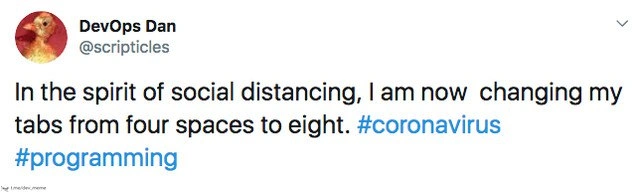
Social Distancing in Code: Tabs Set to 8 Spaces
Why is this CodeQuality meme funny?
Level 1: Give Code Some Space
Imagine writing a story and deciding to start each new paragraph much further from the margin than usual — just to pretend the words are "keeping apart." That’s basically what this joke is about! In early 2020, everyone was told to stay a safe distance away from each other so we don’t spread germs (that’s social distancing). A funny developer said: “Hey, I’ll do the same with my code!” Normally, when we write code, we indent (push in) lines a little to show structure. It’s like a group of friends standing in a line: some step forward to show they belong together in a subgroup. Usually they step forward by 4 little spaces. This person joked that now they’ll step forward by 8 spaces — doubling the gap, just like people standing farther apart in real life.
Why is it funny? It mixes something serious with something very silly and geeky. We know keeping humans apart is about safety. But keeping lines of code far apart doesn’t actually do anything – code lines can’t cough on each other! The humor is in the pretend-play: treating code formatting like it’s subject to health rules. It also hints at how programmers fuss over details like spacing a lot. In plain terms, the tweet is saying: “Since we all have to give each other more personal space these days, I’ll give my code extra space too!” That’s the whole joke. It made programmers chuckle during a tough time, because it’s a light-hearted way to connect their everyday coding routine with the unusual world situation. In short: even code got to “stay safe” by spreading out a little more!
Level 2: Spacing Out Code
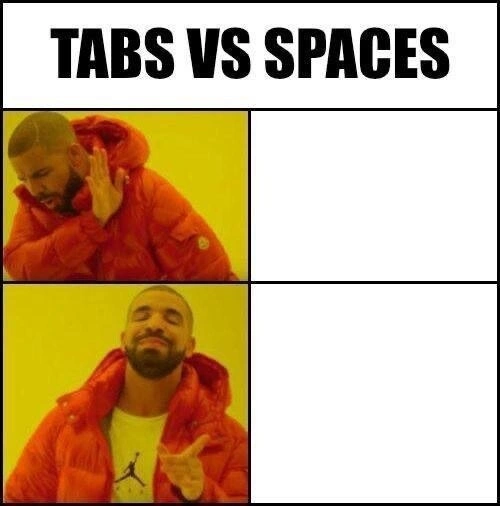
For newer developers, let’s break down the pieces. Code indentation means adding blank space at the beginning of a line to show structure. For example, inside an if statement or a loop, we indent the inner lines to make the code hierarchy clear. You can indent with either the Tab key or the Space bar. The long-running "tabs vs spaces" debate is basically a friendly war over how to create those indents:
- Tabs: One press of the Tab key inserts a special
\tcharacter. By default, many editors and terminals display a tab as a certain width (often 4 or 8 columns wide, though it can vary). - Spaces: Instead of a tab character, you press the space bar multiple times (usually 4 times for a typical indent). Many modern code editors actually insert spaces when you hit Tab, if configured that way.
The meme specifically says “changing my tabs from four spaces to eight.” This assumes the developer was using 4 spaces per indent level, which is very common in languages like Python, JavaScript, and Java (it’s in style guides and makes code easy to read). Now, in a joking nod to social distancing guidelines, they announce switching to 8 spaces per indent — effectively doubling the indentation width. To visualize: normally you might see code like this with 4-space indents:
function greet() {
console.log("Hello!"); // 4 spaces indented inside the function
}
If you used 8-space indents, the same code block would look like:
function greet() {
console.log("Hello!"); // 8 spaces indented – looks quite far in!
}
See how the second example’s console.log is much further to the right? It’s as if each nested block of code is physically farther apart. That’s the “social distancing” joke applied to code. It doesn’t make the program run any differently, but it sure makes the formatting noticeably wide.
Now, why is this funny or noteworthy? In early 2020, everyone was talking about social distancing due to COVID-19. People were keeping apart; lines on the grocery store floor were spaced out, events were canceled. Developers, being their geeky selves, started making jokes that compare these new social norms to programming scenarios. This tweet by "DevOps Dan" is one such example. It’s basically saying: “To honor social distancing, I’ll make all the lines in my code twice as far apart (by indenting with 8 spaces instead of 4).” It’s a playful metaphor — of course, code lines don’t spread viruses, but he’s riffing on the idea anyway.
In practical terms, changing your indentation from 4 to 8 spaces is just a setting in your IDE or code editor. For instance, Visual Studio Code, IntelliJ, Sublime Text, etc., all let you configure the tab size or whether the Tab key inserts spaces. Many projects include a config file (like .editorconfig) or use linter tools (like ESLint, Prettier, or Pylint) to enforce consistent indentation, because mixing styles can cause chaos. Imagine if half your team uses 4 spaces and the other half uses 8 or actual tab characters — the code would look misaligned on different machines, and version control diffs would be full of whitespace changes. That’s why teams agree on one style. So normally, a developer wouldn’t randomly change from 4 to 8 spaces one day; it would break the code style guide. But as a joke, saying “I’m doing this in the spirit of social distancing” is funny because it’s intentionally breaking the norm for a lighthearted reason. It also hints at how seriously devs usually treat such settings — as if doubling your indent size is a grand, newsworthy gesture (just like the serious tone we use for pandemic precautions).
Finally, those hashtags #programming and #coronavirus show the tweet is meant as a crossover joke. It’s tagging into a global conversation about the virus while also flagging it as coding humor. Around that time, there were many memes with developers humorously integrating COVID-19 jargon into code life (like variables named covid19 or jokes about remote work Git commits). This meme stands out because it cleverly uses an age-old coding argument (indentation width) and gives it a timely twist. For a junior dev, the main takeaway is: this is a joke about code formatting quirks being compared to real-world distancing. It highlights how even something as small as how many spaces you use can be a popular topic among programmers — often talked about with a wink and a nod.
Level 3: Indentation Distancing
At first glance, this meme merges pandemic etiquette with a classic programmer holy war: the tabs vs spaces debate. In March 2020, "social distancing" (keeping people ~6 feet apart to slow COVID-19) became a universal mantra. Here, a developer jokester applies that to code by doubling indent width from 4 spaces to 8 spaces—as if each line of code needs extra personal space to stay safe. It’s a tongue-in-cheek take on code style guides and how seriously devs treat them. Veteran engineers grin because they've seen code formatting spark surprisingly passionate debates in dev communities (sometimes more heated than design reviews!). Using 8-space indentation is an absurdly literal interpretation of “give me some space” in code. This exaggeration lands as humor precisely because every experienced coder knows that 4 spaces is a de facto standard in many projects (for example, Python’s PEP 8 recommends 4-space indents, and most teams fiercely stick to consistent formatting for readability). So switching to 8 is a playful over-correction—a bit like wearing two masks and a face shield when one mask would do.
Under the hood, the meme pokes fun at how developers obsess over whitespace. The tweet’s author (DevOps Dan) ironically spins a global crisis (#coronavirus) into a coding context, highlighting our tendency to filter the world through a tech lens. Seasoned devs recall countless flame wars on forums about whether pressing the Tab key (which can insert a \t character) or using a specific number of spaces is the One True Way™ to indent code. It’s a trivial issue turned cultural: entire companies enforce one or the other in style guides for consistency. The joke here is that by “social distancing” the code, the developer is doubling the gap each indent creates. This conjures images of extremely spaced-out code where nested blocks drift far to the right of the screen. Every senior developer can imagine opening a file indented with 8 spaces per level – it’s comically wide. Deeply nested logic would end up in no-man’s land off the screen, causing horizontal scrolling nightmares. In real life, that kind of extreme indent is often discouraged because it reduces readability (and is kind of a code smell – too much nesting). But in the spirit of distancing, the dev jokingly sacrifices practicality for pandemic-themed laughs.
Beyond the silliness, there's an insider nod here: the bikeshedding phenomenon, where teams spend disproportionate time on trivial issues like naming conventions or indentation width. In a serious meeting, no one may volunteer opinions on system architecture, but everyone has something to say about curly brace placement or "tabs vs spaces." By referencing social distancing, the meme also captures a moment in history – early pandemic lockdowns – when developers were isolated at home, likely stressed, and coping through humor. Many tech folks flooded Twitter with programming twists on quarantine life. This tweet stands out by perfectly mixing an ongoing coder feud (indent style) with a timely global event. The hashtags #programming and #coronavirus encapsulate that crossover of worlds. For veteran devs, the comedic payoff comes from recognizing that something as mundane as indent style is being treated with the grave importance of a public health measure. It’s a classic example of developer humor: taking a serious real-world concept and reimagining it in the context of code, highlighting both our passion for code quality and our penchant for geeky jokes.
Description
A screenshot of a tweet from the user 'DevOps Dan' (@scripticles). The profile picture is a circular image of a yellow duckling. The tweet text reads: 'In the spirit of social distancing, I am now changing my tabs from four spaces to eight. #coronavirus #programming'. The hashtags are highlighted in blue. The humor comes from applying a major real-world public health concept, social distancing during the COVID-19 pandemic, to a trivial and long-debated topic in software development: code indentation style (tabs vs. spaces, and the width of indentation). The joke is that increasing the visual space in a code editor is a meaningless gesture in the fight against a virus, but it hilariously connects to the pedantic details that programmers often care about. It's a perfect blend of a current event with a timeless developer in-joke

Comments
7Comment deleted
My linter now enforces social distancing. Any PR with less than 8-space indentation is flagged as a 'high-density commit' and sent to quarantine
Moved the team to eight-space indents for code-level social distancing - git blame now tags me as patient zero for 12,347 “changed” lines
Next thing you know, Python developers will be claiming their significant whitespace was actually a public health measure all along
Ah yes, the pandemic-era solution to the eternal tabs vs spaces war: just double the spacing and call it 'social distancing for your code.' Next up: microservices so distributed they need their own VPN, and pair programming sessions conducted via carrier pigeon. Though I suppose if we're being consistent, we should also be sanitizing our git commits and maintaining six feet of separation between our nested callbacks
Eight spaces: the one config change that turns every merge commit into a social distancing exercise for your diffs
Switched to 8‑space indents for “social distancing”; YAML resigned, Python complained, and the only thing actually decoupled was git blame from meaningful history
Setting tabstop=8 for “social distancing” - the only policy that makes Makefiles happy, Prettier furious, and git blame utterly useless