Your Team Lead During a Network Outage in 2020
Why is this RemoteWork meme funny?
Level 1: No Internet, Boss Shows Up
Imagine you’re doing your homework on the computer, and suddenly the internet goes out. You can’t send your work to your teacher or talk to your friends online about the assignment. Now picture that your teacher is so worried about not knowing if you did your homework, they put on a big protective suit (like they’re going to the moon or handling something really dangerous) and knock on your door to ask, “So, how’s your homework going?”
It sounds silly, right? Normally, if the internet breaks, everyone just waits until it comes back. But in this joke, the boss (like the teacher in our example) couldn’t wait. The boss shows up in person, dressed in a funny safety outfit, just to check on the work. It’s funny because it’s an over-the-top reaction. It’s like using a giant hammer to crack a tiny nut – way more effort than needed! The boss in the picture looks like a character from a disaster movie, but all they’re doing is asking about project progress (kind of like homework).
So the big joke is: work has stopped because the internet is down, but instead of being patient or understanding, the boss does something extreme and goofy. They come in person (which nobody does in remote work, especially if there’s a real-life reason to stay away like a sickness going around) and they even wear a crazy hazmat suit to do it. It’s as if not having the internet is treated like a hazardous emergency. This makes us laugh because it shows how dependent we are on the internet for work and how some people might panic when they can’t check on things in the usual way. The emotion at the core is a mix of surprise and absurdity: you laugh at how ridiculous the scene is, and maybe you feel a tiny bit of “oh no!” for the poor worker who now has their boss at their door. It’s a playful way of saying, “Isn’t it ridiculous how work falls apart without the internet, and how some bosses might freak out and do anything to keep tabs on you?”
Level 2: Micromanagement IRL
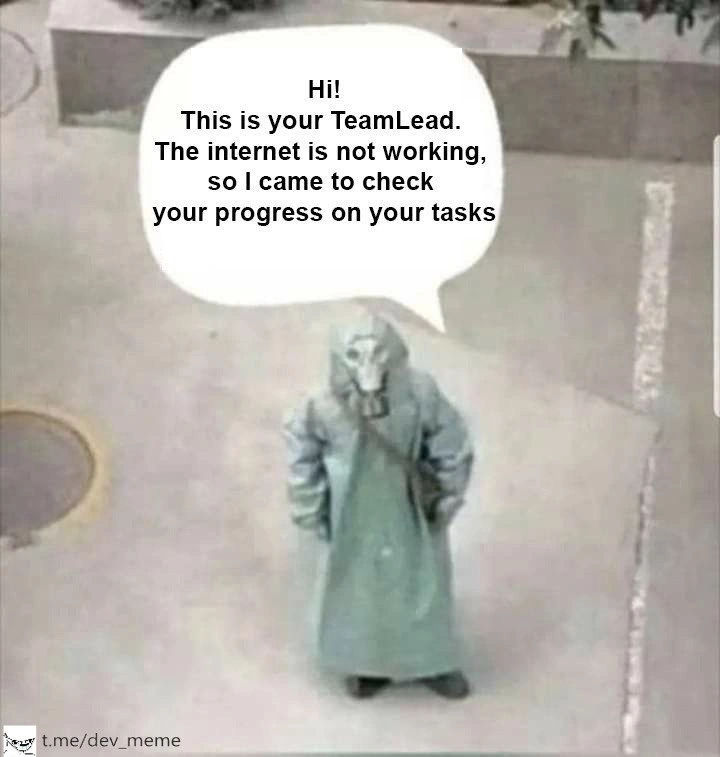
Let’s dial it down a notch and explain the key pieces for a newer developer or someone early in their career. This meme shows a situation in a remote work setting where things go wrong and a boss overreacts by appearing in real life (IRL). The image has a person in a green hazmat suit with a gas mask (the kind of full-body protective outfit you’d see in dangerous chemical environments, or famously during pandemic times) standing in a courtyard. That person is supposedly the “Team Lead” – essentially the manager or lead developer in charge of a team.
The big speech bubble in the image says:
“Hi! This is your TeamLead. The internet is not working, so I came to check your progress on your tasks.”
Let’s break down the terms and context:
- VPN dies / Internet is not working: A VPN, or Virtual Private Network, is a secure connection that many companies use to let employees access the company’s internal network from home. Think of it like a special tunnel through the internet that connects you to the office network. If the VPN “dies,” it means you’ve lost that connection. In simpler terms, the internet link to work is down. In a remote work situation (like many of us experienced in 2020’s COVID lockdowns), losing your internet or VPN access is a big deal – it’s basically an internet_outage for your work. Suddenly you can’t use work chat (e.g., Slack or Microsoft Teams), can’t access the code repository, can’t update or view the task tracker (like JIRA), and you might even lose email or video call ability. Knowledge work (programming, writing, design) often completely halts without connectivity because everything we do is online. It’s not like you can easily “switch to offline mode” when so much of coding involves Googling errors, pushing code to remote servers, or collaborating through cloud services.
- Team Lead appears in person: A Team Lead is typically a person who leads a software team – they might coordinate tasks, do people management, and keep track of who’s doing what. Usually, a team lead checks on progress via daily meetings (stand-ups), emails, or project management tools. In a RemoteWork scenario, this all happens through the internet. If the network is down, normally a team lead might just wait or call IT. But here the meme joke is that the team lead actually “appears in person.” That means they physically go to wherever the team member is. Given the hazmat suit, it implies maybe everyone was working from home during a pandemic (hence the protective gear), and the team lead literally drove to the employee’s house or a neutral outdoor spot to ask about work. This is extremely unusual! In modern offices, especially during something like COVID-19, managers wouldn’t actually travel to meet you face-to-face just because the Wi-Fi broke. That’s what makes it funny – it’s a huge overreaction.
- Hazmat suit (protective gear): The person is wearing a hazmat suit, which is full-body protective clothing meant for handling dangerous biohazards or chemicals. In early 2020, seeing people in serious protective gear became a bit more common due to the coronavirus outbreak. In this context, the suit exaggerates how “dangerous” the situation is. It’s comedic: the team lead treats the environment as if even showing up is risky (hence dressed like they’re walking on Mars) – but they do it anyway, just to check on work. The hazmat suit could also symbolize how out-of-place and over-the-top this manager’s action is. It’s like saying, “I know it’s crazy out there – maybe even toxic – but I MUST know if you finished that feature!” It underscores the CorporateCulture joke: some bosses will brave anything (even deadly germs!) to micromanage.
- “Check your progress on your tasks”: This line is classic manager-speak. In tech teams, we break work into tasks or user stories, often tracked on a board or an app (like JIRA, Trello, etc.). Managers or team leads keep an eye on these to know how the project is moving. Normally, a team lead would just look at the online tracker or ask for an update in the team chat or a meeting. But if “the internet is not working,” they can’t do any of those normal things. So the joke is they resort to literally walking up to you to ask “how’s that task going?” It’s a progress_check in the most direct, literal way.
- Micromanagement: This term refers to a management style where the boss closely observes or controls the work of their subordinates or team members to an excessive degree. Instead of trusting the team to work independently, a micromanager will want constant updates and often feels the need to oversee every little step. In the meme, the team lead coming in person during an internet outage is a textbook micromanagement_joke. It implies the team lead can’t endure not knowing what everyone is doing at every moment. They could have just waited until things got back online or trusted that the team would continue where possible, but no – they had to show up and get a status report in person. This is funny (especially to developers) because it’s an exaggerated reminder of bosses we might have had who just can’t let us work in peace. It highlights a CommunicationGap and lack of trust: the manager’s default should be "If the internet is down, of course progress is stalled, no need to blame the devs." But instead the attitude here seems like "Internet or not, you better be working, and I'm going to confirm it."
- Remote Work Culture vs. Old Habits: In a healthy RemoteWorkCulture, managers measure output by actual work results, not by physically seeing someone at their desk. The pandemic in 2020 forced a lot of traditionally-minded managers to adapt to not seeing their employees all day. Many did adapt, but this meme pokes fun at the stereotype of a manager who just cannot handle not seeing the team. The result? The moment their digital surveillance (like online status, frequent pings) is cut off, they panic and revert to an in-person check, even though it’s arguably unsafe or at least very inconvenient. It’s the manager equivalent of blowing a fuse. For a junior dev, this highlights how some company cultures struggle with remote work. Good managers will give breathing room, bad ones might do weird things like this!
So, seen through a junior developer’s eyes: the meme exaggerates a situation where the boss goes to crazy lengths (hazmat suit and all) to ensure the team is still working, even when an internet outage has halted normal work communication. It’s making fun of ManagerExpectations that work must always be happening and TeamCultureBuilding gone wrong (because doing this is terrible for team morale – it shows the boss doesn’t trust the team at all).
The imagery is also humorous in a visual sense: imagine you’re coding in your living room, the Wi-Fi cuts out, and instead of your team lead messaging your phone or just waiting, they ring your doorbell dressed like a ghostbuster or an astronaut. 😄 It’s so over-the-top that you have to laugh. It also subtly reminds everyone that without internet, a lot of high-tech work literally stops; we feel a bit useless, and apparently, so do our managers, who might freak out without their precious online dashboards.
In summary, Level 2 understanding: the meme is a WorkplaceHumor snapshot about remote work challenges. It shows an overly worried boss (team lead) doing something ridiculous (visiting in person in a hazmat suit) to check on work because the normal way of communicating (internet/VPN) is down. It’s funny because it’s a wild overreaction that combines two stressful things – an internet outage and a pandemic-like scenario – into a silly Communication fiasco. And it lightly ribs those managers who don’t quite “get” remote work and feel the need to physically see the work happening to believe it.
Level 3: Manual Ping
At the senior engineer level, this meme highlights a perfect storm of remote work fragility and micromanagement. When the VPN – that lifeline of the remote office – dies, it’s like pulling the plug on an entire team’s productivity. Suddenly, all those fancy asynchronous tools (Slack, JIRA, Git repos, CI/CD dashboards) go dark. In a well-architected system, we’d build in redundancy or fallbacks for single points of failure, but here the single point of failure is the internet connection itself. And when that fails, the failover apparently is… the Team Lead driving over in person. This is the human equivalent of a fallback server coming online!
Why is this funny to seasoned devs? It lampoons the gap between modern distributed work ideals and old-school management instincts. In a healthy remote culture, if the network is down, you trust your team to continue what work they can (writing code offline, drafting docs) and resolve the outage calmly. But our intrepid Team Lead in the meme doesn’t trust the process – or the people – to work without oversight. Instead, they initiate a literal “manual ping”: physically knocking on a developer’s door to check on task status. It’s an absurdist take on monitoring. We’ve gone from ping -t developer.work.local failing to the boss showing up as a walking ping packet in a hazmat full protective suit.
This image screams ManagementHumor and RemoteWorkCulture. The Team Lead’s biohazard getup exaggerates the situation to dark comedy: it’s presumably March 2020 (indeed the post date, early pandemic) when physical presence is actually hazardous. So the boss appears looking like a Cold War era sci-fi character – all to ask “Hey, got that ticket done?”. Senior devs recognize the subtext: a communication gap so bad that the manager treats an internet outage like a biohazard emergency, complete with PPE (Personal Protective Equipment). The CorporateCulture being mocked here is one where management’s need for control outweighs trust or practicality. It’s a classic micromanagement_joke: instead of accepting that work has stalled due to infrastructure issues (which everyone is aware of), an overly anxious leader takes drastic action, disrupting developer flow even more.
Let’s break down the scenario technically and culturally:
- VPN (Virtual Private Network): Companies require VPNs for secure remote access to internal resources. When the VPN “dies,” developers are effectively locked out of the tools and code repositories needed to do their jobs. No code can be pushed, no build can run, no stand-ups happen on Zoom – it’s a total _internet_outage for work stuff.
- Asynchronous Tooling Breakdown: Modern dev teams rely on asynchronous communication: chat apps (Slack/MS Teams), issue trackers (JIRA, Trello), git for code, continuous integration systems. All these assume network connectivity. A senior dev has lived through that eerie silence when Slack stops pinging – it’s panic-inducing for some managers. The usual remote dashboards and pings that team leads use to check progress go blank. Our meme’s Team Lead basically says, “Dashboard’s down, time for hazmat suit and field ops.”
- Physical Progress Check: The speech bubble reads, “Hi! This is your TeamLead. The internet is not working, so I came to check your progress on your tasks.” This is something out of an dystopian office comedy. The leader’s urgency to see “progress on your tasks” suggests a lack of trust in the team’s self-management during downtime. Instead of maybe calling on the phone or just waiting an hour for IT to fix things, they’ve gone full Mission Impossible and appeared IRL. Senior folks chuckle here because they’ve met that manager: the one who can’t let go of control. It’s ManagerExpectations on overdrive — expecting productivity to continue in-person by sheer force of oversight, even when all enabling infrastructure is kaput.
- Cultural Clash: There’s also a cultural mismatch being poked at. Developers often cherish uninterrupted “flow” time, and remote work (when the internet works) can enhance that by reducing random office pop-ins. But this Team Lead represents the old habit of “butts in seats” management, where seeing is believing. In 2020’s world of RemoteWork, that mentality doesn’t fit — showing up physically (and comically over-protected) to get a status update is the opposite of RemoteWorkCulture best practices. It’s like trying to do a stand-up meeting by literally standing up at someone’s desk when Zoom is offline, rather than acknowledging the situation and giving breathing room.
- Fragile Infrastructure: Seasoned engineers also appreciate the ironic jab at how fragile our high-tech workflows really are. We use cutting-edge cloud services, distributed version control, agile boards, but if the network goes down, we’re basically dead in the water. There’s an unwritten rule: if the tools are down, progress is largely frozen. This meme exaggerates an alternative: what if management just refuses to accept that freeze? The “team lead in person” is like using a Sneakernet solution — in older times, “Sneakernet” meant transferring data by physically moving drives or printouts when networks failed. Here, the boss is effectively running a sneakernet progress_check: physically walking to each developer to gather status because digital tracking failed. That’s hilarious because of how impractical and extreme it is (especially with one person in a suit visiting multiple devs, presumably).
In summary, at the expert level this meme is TechHumor about a communication gap under pressure. It roasts both the technical dependency on connectivity and the ManagerExpectations that work should continue uninterrupted. The hazmat suit imagery cranks up the satire: management treating an internet outage with the gravitas of a lethal virus outbreak. Long-time devs have seen versions of this. Maybe not a literal hazmat-clad boss, but bosses storming into the dev area when Jenkins goes down, or pinging every channel possible when GitHub is offline, desperately seeking some reassurance of progress. It’s the “I don’t see activity, therefore there must be none – I better intervene!” mindset. The humor is both in the absurdity (no one would actually do this… right? 😅) and in the uncomfortable truth that some organizations still equate physical presence with productivity. As a battle-scarred engineer, you laugh, but also maybe cringe a little, remembering that one time a VP walked into the server room during an outage “just to check in” while you were already frantically fixing the issue. This meme is cathartic because it nails a real tension in modern software teams: high-tech remote workflows versus low-tech managerial overreach.
Description
A meme showing a person in a full, grey-green hazmat suit with a gas mask, standing on a paved surface. A large, white speech bubble points to the person, containing the text: 'Hi! This is your TeamLead. The internet is not working, so I came to check your progress on your tasks'. The image has a slightly grainy, dystopian feel. The humor stems from the collision of ordinary tech workplace management with the extraordinary circumstances of the early COVID-19 pandemic. It satirizes the idea of a manager who is so committed to checking on tasks that they would physically visit an employee in full protective gear during a global lockdown, highlighting the absurdity of micromanagement in a remote work context

Comments
7Comment deleted
Our business continuity plan for a network outage is apparently a manager in a hazmat suit performing a physical health check on the Jira board. The definition of a single point of failure
VPN’s down, so we’ve auto-failed over from Prometheus scraping to TeamLead-in-a-hazmat doing 1:1 health checks - latency’s human-scale, but the alert noise is just his respirator
The same manager who insisted we didn't need redundant ISP connections because "what are the odds of an outage during critical sprint work" is now discovering that physical presence doesn't compile code any faster than Slack messages
When your team lead treats a network outage like a containment breach and shows up in full PPE to verify you're not just playing video games. Because clearly, the only thing more dangerous than COVID-19 is a developer with unsupervised downtime and no VPN connection to prove they're 'working.'
VPN down, so the TL chose CAP’s CP mode - migrated the coordinator to your doorstep and implemented SneakerNet polling; great for consistency, catastrophic for throughput
Jira velocity now measured in sieverts per sprint - TL approaching critical mass
Internet's down, so the TeamLead deployed air-gapped stand-ups: PPE-based auth and manual polling. Amazing how micromanagement still achieves five nines