Skip to content
DevMeme
3492 of 7435
Court Blesses Decompiling To Fix Bugs
Debugging Troubleshooting Post #3828, on Oct 17, 2021 in TG

Court Blesses Decompiling To Fix Bugs

Why is this Debugging Troubleshooting meme funny?

Level 1: Fixing the Locked Toy

This is funny because it is like buying a toy robot that stops walking, but the company will not give you the instructions. A court says that, in some cases, you are allowed to open the robot carefully just to fix the broken part. Programmers like that idea because broken things are much less scary when you are allowed to look inside.

Level 2: Opening the Locked Manual

Reverse engineering means studying something to understand how it works from the outside in. In software, that may mean observing behavior, inspecting files, reading network traffic, analyzing a binary, or using tools to recover structure from compiled code.

Decompilation is a specific kind of reverse engineering. It tries to turn compiled software back into a more readable form. The result usually does not look like the original source code, but it can be good enough to understand logic, find defects, or see where a program is failing.

Proprietary software is software whose source code is not usually available to users. If it has a bug, the normal fix is to ask the vendor. That works when the vendor responds, understands the issue, and can ship a patch quickly. It works less well when the bug blocks your system and the vendor says the next maintenance window is somewhere between "later" and "please renew your contract."

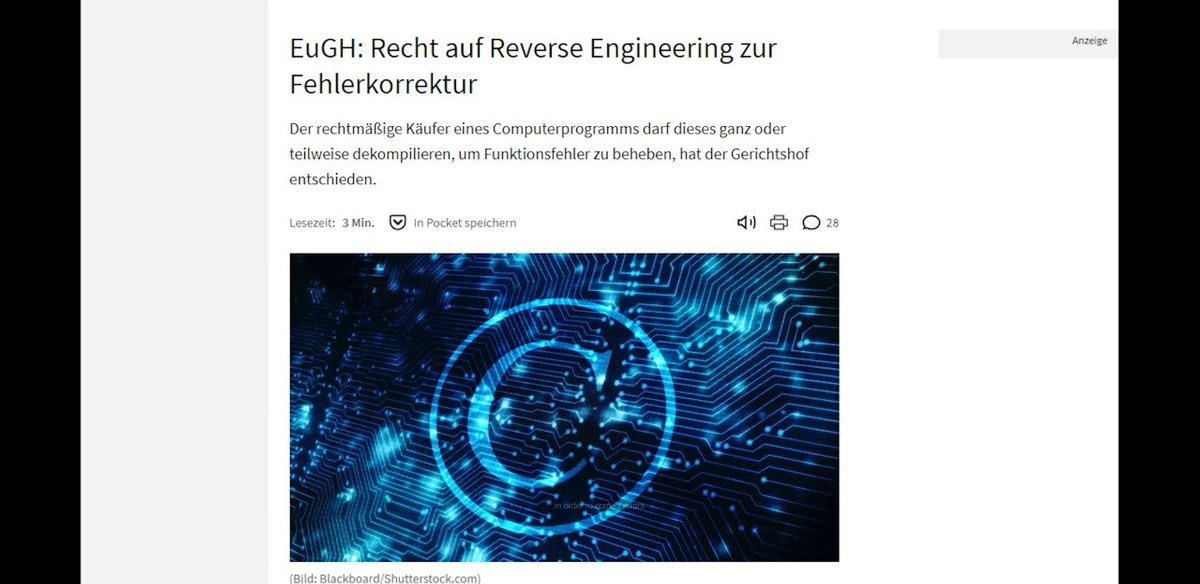
The screenshot is funny because it turns a legal decision into a developer survival story. It suggests that if you lawfully have the software and need to correct an error, there may be situations where inspecting the compiled program is allowed. That is not the same as copying the product or sharing its internals. It is closer to opening a sealed machine you own because it is broken and nobody gave you the repair manual.

Level 3: Lawyer-Approved Debugging

The humor comes from treating a serious European court headline as if it were a developer productivity feature. The visible article is not a typical meme panel; it looks like sober tech news, complete with reading time, sharing icons, and a stock image of circuitry. But to anyone who has maintained closed-source, abandoned, vendor-locked, or legacy software, the translated message is deliciously chaotic: yes, under the right conditions, you may take the black box apart to fix the bug.

This is ReverseEngineering and BugFixing humor with an unusually real institutional backdrop. Most debugging assumes source access. You set breakpoints, read stack traces, inspect variables, run tests, and patch the code. Closed-source software breaks that workflow. If the vendor is slow, gone, uncooperative, or contractually insulated, the user may be stuck with a production defect in a program they legitimately bought but cannot inspect in the normal way.

That is where SoftwareMaintenance becomes less glamorous than architecture diagrams suggest. Long-lived systems often depend on proprietary components whose original authors have moved on, whose support contracts are expensive, whose APIs were documented by a PDF last updated during a different geological era, or whose behavior is "working as designed" only because nobody can find the design. When such a component fails, the practical maintainer's question is not philosophical. It is: can we understand enough of this thing to stop it breaking payroll, transport, billing, medical scheduling, public administration, or the one batch job that apparently holds civilization together every Thursday night?

The headline's force is that it separates legitimate repair from piracy panic. Developers often hear "reverse engineering" and think of malware analysis, cracks, DRM bypasses, cheat engines, or security research. Those are real domains, but reverse engineering is also a maintenance tool. It can reveal why a function rejects valid input, why an integration crashes after a version change, why a binary looks for a file in the wrong place, or why disabling one broken function lets a larger application operate correctly.

The senior-developer reading is cautious celebration. This does not make decompilation easy, cheap, or magically safe. You still need expertise, tooling, legal boundaries, and a strong reason. Decompiled code can mislead you. Patching binaries can create support nightmares. The vendor relationship may become frosty enough to store ice cream. But the meme's appeal is obvious: some bugs are so closed-source that even the stack trace needs permission.

Level 4: Decompiling the Black Box

The screenshot headline says:

EuGH: Recht auf Reverse Engineering zur Fehlerkorrektur

and the subheading says:

Der rechtmäßige Käufer eines Computerprogramms darf dieses ganz oder teilweise dekompilieren, um Funktionsfehler zu beheben, hat der Gerichtshof entschieden.

The technical depth behind the meme is that decompilation is not simply "open the source code, but harder." Compilation throws away or transforms huge amounts of human intent. Variable names, comments, formatting, abstractions, generic type information, module boundaries, and clean control structures may disappear or be aggressively rewritten. Optimizers inline functions, remove branches, fold constants, reorder instructions, specialize paths, and convert friendly source into artifacts designed for machines, not maintainers.

A decompiler tries to recover quasi-source from compiled code by reconstructing control flow graphs, identifying functions, inferring types, recognizing calling conventions, and translating lower-level instructions back into higher-level structures. That output can be useful, but it is usually not the original program. It is the fossil imprint of the program after the compiler, linker, optimizer, and runtime conventions have finished stepping on it.

That is why the legal distinction matters. The ruling referenced by the screenshot is not a blanket blessing for copying proprietary software, redistributing decompiled code, or treating every license as optional decoration. The important idea is narrower: a lawful purchaser may decompile all or part of a program when that is necessary to correct errors affecting its operation, and the resulting information is constrained to that purpose. In developer terms, the court is recognizing a practical maintenance reality: sometimes the only way to fix a functional defect in software you are allowed to use is to inspect the machine-facing form because the human-facing source is unavailable.

There is a grim elegance here. Copyright law protects expression, but running, maintaining, and correcting software often require technical acts that look like reproduction or translation. Decompilation sits exactly in that uncomfortable seam: it can be necessary for legitimate repair, but it can also expose protected implementation details. The meme is funny because the headline sounds like every frustrated maintainer's fantasy: the debugger has finally obtained legal counsel and is ready to proceed.

Description

A screenshot of a German tech article is shown on a white page with the headline "EuGH: Recht auf Reverse Engineering zur Fehlerkorrektur." The subheading says the lawful buyer of a computer program may fully or partly decompile it to fix functional errors, and the page also shows "Lesezeit: 3 Min.," sharing/print/comment icons, and a blue circuit-board image with a circular copyright-like symbol. The post metadata provides the English translation: the European Court of Justice decided that a rightful software buyer is allowed to decompile a program fully or partially to correct errors, making the technical joke less about piracy and more about legally sanctioned debugging when source is unavailable.

Comments

11
Anonymous ★ Top Pick Some bugs are so closed-source that the debugger needs a lawyer before it gets a stack trace.
  1. Anonymous ★ Top Pick

    Some bugs are so closed-source that the debugger needs a lawyer before it gets a stack trace.

  2. @wolfltd 4y

    Wow I love this

  3. Deleted Account 4y

    But I'm no longer under the ECJ jurisdiction 😭

  4. @semjonsona 4y

    This is in fact fantastic!

  5. @DetOfVice 4y

    YEAAAAAH!

  6. @ZgGPuo8dZef58K6hxxGVj3Z2 4y

    Wait wait wait wait.... So now I am officially allowed to decompile windows 10 mobile and fix its bugs? Can I redistribute those patches?

    1. @SamsonovAnton 4y

      Here in Russia, we always had this right (to modify legitimately owned software in any way necessary to be able to run it), however for personal use only - no redistribution allowed.

      1. @sylfn 4y

        redistribution of what? modified sources, modified executables, how-to guides?

        1. @SamsonovAnton 4y

          The subject of copyright, that is program code in any form (binary, source) and/or other resources. Whether a how-to may infringe some copyright, is a topic for another law, I guess. But as long as it only covers patching for newer hardware or bug fixes, it is less likely to attract copyright holder layers attention, unless they purposely introduce defects to older versions getting out of support to force the customers to upgrade.

          1. @sylfn 4y

            > unless they purposely introduce defects to older versions getting out of support to force the customers to upgrade. This should be illegal

      2. @ZgGPuo8dZef58K6hxxGVj3Z2 4y

        Oh thats actually cool

Use J and K for navigation