Organized Crime's Digital Transformation
Why is this Security meme funny?
Level 1: Bad Guys Work from Home
Imagine a group of bad guys who normally commit crimes out on the streets. They’re like bank robbers or gangsters you see in movies. Now picture them all sitting around a table in a meeting, wearing suits and talking seriously. Why? Because there’s a dangerous virus going around, and they don’t want to get sick. So the boss of the bad guys says, “For health and safety, we’ll do our crimes on the computer now instead of in person.” It’s a funny idea because we expect criminals to be tough and not follow rules, but here they are worried about staying germ-free! Essentially, the comic is joking that even robbers and gangsters decided to work from home during the pandemic, just like everyone else. Instead of robbing banks with masks and guns, they’ll try to steal money by hacking on a laptop. It’s like seeing villains do a workplace Zoom call and plan email scams, all so they can be safe and healthy. This makes us laugh because it’s so unexpected: even the “bad guys” are behaving a bit responsibly (avoiding the virus) while still being bad in a new, sneaky way on the internet.
Level 2: Pivot to Phishing
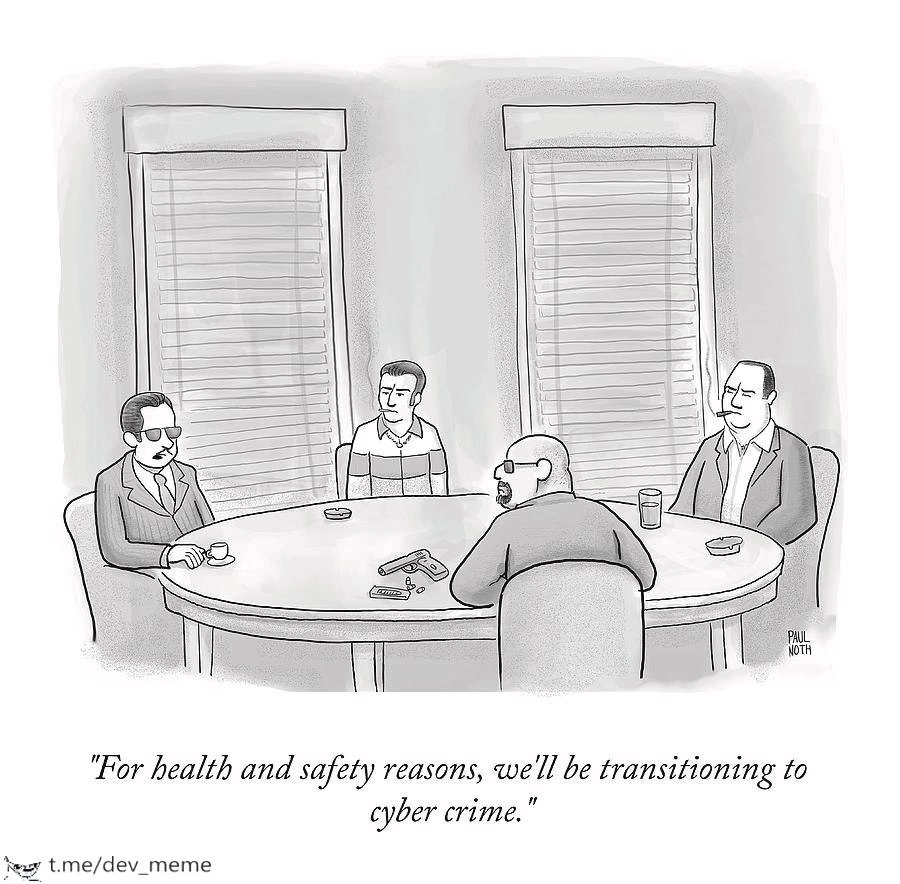
For a newer developer or someone less familiar with security jargon, let’s break down the joke. At its core, this cartoon mash-up is about security and corporate culture. We see what looks like a serious business meeting – executives at a table – but they’re actually gangsters (notice the handgun and bullets on the table, very much not a normal office item!). The big boss says, “For health and safety reasons, we’ll be transitioning to cyber crime.” This is funny because cyber crime means committing crimes using computers and the internet, and it sounds like they’re treating crime like a company that needs to keep its employees safe from COVID-19. In 2020, due to the pandemic, real companies were indeed saying “for health and safety, we’re going remote.” So here the criminals are doing the same: avoiding in-person crime (like robberies or physical intimidation) to prevent spreading a virus, and instead doing their “bad guy” work online. This is a perfect example of boardroom_satire – using a formal meeting setting to highlight something absurd.
Let’s clarify some terms and ideas mentioned:
- Pivot: In business, to pivot means to change your strategy or focus. A lot of companies “pivoted” during the pandemic – for example, a restaurant pivoting to delivery, or an office pivoting to remote work. Here the crime boss is pivoting their “business” from traditional crime to cyber crime.
- Cyber crime: Crime that happens using computers or networks. Instead of stealing something in person or using force, cyber criminals hack systems, steal data, or trick people via the internet. It’s like the difference between a thief breaking into a store versus hacking into an online bank account.
- Health and safety reasons: This phrase was very common in 2020 when COVID-19 started. Companies would cite health and safety to justify closing offices, cancelling events, or moving to online work. Hearing a mob boss use it is funny because we don’t expect criminals to care about health guidelines. It’s an ironic contrast – they ignore laws but follow pandemic rules!
- Phishing: A common type of cyber crime. Phishing usually means sending fraudulent emails or messages that look legitimate in order to trick people into giving up passwords, credit card numbers, or installing malware. For example, a hacker might send an email that looks like it’s from your bank, but it’s actually a trap to steal your login info.
- Ransomware: A scary form of malware (malicious software) that cyber criminals use. When ransomware infects a computer or network, it encrypts (locks) all your important files so you can’t access them. The criminals then demand a ransom (money, often via Bitcoin) to unlock the files. It’s like a digital hostage situation. During the pandemic, there were many ransomware attacks on hospitals and companies, because criminals knew those organizations were desperate and more vulnerable.
- Exploits: These are methods or pieces of code that take advantage of vulnerabilities (flaws or bugs) in software. If a program has a security bug, an exploit lets a hacker break in or do something unintended, kind of like finding an unlocked side door into a system. In the context of “cyber crime,” the gang might use exploits to hack into servers or databases remotely, rather than using crowbars or guns to break into a building.
The cartoon basically says: even gangsters are going remote and online. The men at the table are dressed like corporate executives because they’re running crime like a business. This ties into CorporateCulture humor: the idea that even criminals would have a formal meeting with a fancy phrase like “transitioning to cyber.” For developers, the scenario also hints at a real concern: with more of life and work online (especially during the pandemic), crimes have also moved online. SecurityAwareness became super important as phishing attempts and hacking incidents spiked. Developers had to help secure systems knowing that attackers were adapting quickly. In a way, the meme is a funny reminder that “bad guys” update their tactics just like companies do.
We can compare what these gangsters used to do (traditional crime) with what they plan to do in digital crime strategy:
| Traditional Crime Tactics | Cyber Crime Tactics (Online) |
|---|---|
| Armed robbery – e.g. using a gun to rob a bank vault | Bank hacking – using malware or hacking to steal money from bank accounts |
| Extortion by physical threats – “Pay us or else!” | Ransomware attacks – encrypt files and demand payment (digital extortion) |
| Face-to-face con jobs (scams in person) | Phishing scams via email or text – trick people remotely into giving up info |
| Getaway car to escape after a heist | Using a VPN or anonymous network to hide the criminal’s location online (escape tracking) |
As you can see, cyber crime lets the gang do the same kinds of bad things – stealing money, scaring people, running scams – but from behind a computer screen. They don’t need a getaway car if they can mask their IP address and avoid being traced on the internet. It’s “safer” for them in terms of not getting caught in person or not catching a disease.
For a junior developer or anyone new to IT, the meme is also highlighting a big concern: when everything went online in the pandemic, criminals took advantage. Companies held Meetings on Zoom, did business over the web, and people were distracted and stressed. Hackers (or cyber mobsters in this joke) saw an opportunity to strike via computer instead of face-to-face. That’s why you might’ve heard about more email scams or why your company’s IT department keeps warning about suspicious links. The cartoon uses humor to deliver that message. It’s essentially saying: “Even the mafia is updating its business model to version 2.0 – watch out!” For someone learning about security, it underlines the importance of staying alert because threats evolve with circumstances. And on a lighter note, it’s just a funny image: mob bosses doing an earnest presentation about going digital, as if crime is just another industry undergoing a tech innovation. It’s MeetingHumor meets SecurityAwareness in one witty captioned drawing.
Level 3: From Bullets to Bytes
Seasoned developers and security engineers will smirk at this darkly comic boardroom_satire. It depicts old-school gangsters adopting a pandemic_business_pivot just like any legitimate company: digital transformation, but for organized crime. The bald exec in sunglasses declares, “For health and safety reasons, we’ll be transitioning to cyber crime,” blending corporate Meetings jargon with HackerCulture menace. The two shuttered windows and the handgun with loose bullets on the table scream traditional mob tactics—think organized_crime_meets_IT where a pistol used to settle debts is now replaced by malware and phishing kits. The absurdity is that these mobsters are discussing strategy like a tech startup’s board meeting, complete with literal bullet points on the table (the gun and bullets) instead of a PowerPoint. They’re treating crime like a business that needs to adapt its digital_crime_strategy for COVID-19.
For those in CyberSecurityMemes circles, the humor cuts close to reality. In early 2020, as the pandemic spread, everyone went remote—including threat actors. Physical bank heists and in-person extortion became impractical or “too high-risk” (even criminals worry about a virus, apparently), so organized crime pivoted to online scams. We actually witnessed a surge in phishing emails and ransomware attacks exploiting pandemic chaos (e.g. fake “COVID-19 relief” sites that were really malware traps). It’s the “innovate or die” mantra twisted for crime: bank robbers swapping ski masks for zero-day exploits, and getaway cars for encrypted VPN tunnels. The meme lands so well with experienced devs because it echoes a real shift in the threat landscape. Security teams in 2020 saw a spike in attacks as criminals realized cyber crime can scale globally and safely from a keyboard. So when the cartoon mob boss mentions health and safety, it’s a sardonic nod to how even the underworld had to follow pandemic safety protocols — no more crowded shakedowns, better to run a botnet from home.
The contrast between corporate culture formalities and gangster violence is the punchline. “Health and safety reasons” is a phrase we heard from every HR department and CEO last year, but coming from a mob boss in a suit, it’s laugh-out-loud incongruous. It implies this criminal enterprise has an HR policy or a safety officer recommending masks and social distancing, as if OSHA guidelines apply to organized crime. CorporateCulture collides with HackerCulture: these mob executives talk about strategy and risk mitigation like CISOs in a security briefing. It’s a clever jab at how any organization, even a crime syndicate, needs to modernize its operations. Today’s mafia don might hire developers or rent cloud servers for ransomware campaigns rather than pistoleros for bank jobs. The meme resonates with senior devs and infosec pros because it exaggerates a truth: digital transformation comes for everyone, even the mafia. And ironically, from a security perspective, a criminal mob going digital is scarier than them staying analog — you can’t guard the vault with armed guards if the theft is happening via ssh and a zero-click exploit.
To put it in tech terms, this cartoon is depicting a criminal “system upgrade” in response to new threats (or rather, a biological one). We see an enterprise pivot where the “business requirements” (make money through crime) remain the same but the implementation changes from physical to digital. It’s a bit like refactoring a legacy application to a new platform: same functionality (crime) delivered via a new medium (cyber). In practice, that means these gangsters will trade their crowbars and guns for laptops and malware. They’ll switch from blowing open safes to brute-forcing passwords, from kidnapping CEO’s to stealing credentials and conducting CEO fraud via email. A senior dev with security experience recognizes each element of this joke:
- Pivot to cyber: referencing how startups pivot, here it’s criminals shifting to hacking and fraud as a service.
- Health and safety reasons: the polite corporate preamble to justify big changes – hilariously applied to criminals avoiding a biological virus while they themselves are a human virus on the network.
- Magazine removed from gun: a subtle detail – it’s disarmed. Perhaps a tongue-in-cheek symbol that they’re literally disarming their operation in favor of cyber weapons.
Even the meeting setting feels authentic — how many times have devs sat in a stuffy boardroom (or a Zoom call) listening to higher-ups announce a “strategic pivot” for the company? Here the higher-ups just happen to be mobsters, and the “new business model” is cybercrime. It’s a brilliant SecurityAwareness gag too: reminding us that when circumstances change, attackers adjust tactics. As a fun technical aside, one could imagine their action plan in pseudo-code form:
# Gang's strategic pivot pseudo-code
if global_pandemic:
crime_method = "cybercrime" # switch from physical heists to online hustles
else:
crime_method = "traditional_crime"
execute(crime_method)
In short, the meme tickles veteran developers by mixing MeetingHumor with genuine infosec insight. It’s saying: even mobsters have to adopt remote work and “digital-first” strategies now. Seasoned pros appreciate this on multiple layers — the absurd image of gangsters on Zoom doing phishing, the reminder of 2020’s reality of spiking cyber attacks, and the underlying truth that security is a constantly moving target. The result is equal parts funny and chilling: you laugh, then you double-check your server logs, just in case some “remote gangster” is probing your ports.
Description
A single-panel, black-and-white cartoon by artist Paul Noth, in a style reminiscent of The New Yorker. Four men with the appearance of stereotypical mobsters are sitting around a circular table. One man wears sunglasses, another smokes a cigar. On the table, there is a handgun with a clip of bullets next to it, ashtrays, a coffee cup, and a glass of water. The caption below the drawing reads: "For health and safety reasons, we'll be transitioning to cyber crime." A small watermark for "t.me/dev_meme" is present in the bottom-left corner. The humor arises from the ironic application of corporate jargon ('health and safety reasons', 'transitioning') to the world of organized crime. For senior developers, this resonates as a satire of the universal push for 'digital transformation,' suggesting that even the most traditional, physical enterprises are moving online, reframing dangerous cybercrime as a safer, more modern career path

Comments
7Comment deleted
Our ransomware-as-a-service model has a much lower TCO and better risk profile than the old lead-pipe-as-a-service
Executive takeaway: we’re sunsetting the legacy bullet-based intimidation stack and rolling out a cloud-native ransomware pipeline - same revenue, zero muzzle flash, and it even passes the SOC 2 audit
Finally, a ransomware business model where the only thing encrypted is the actual business logic behind why we're doing this in the first place
When the CISO said we needed to adopt a 'zero trust' security model and embrace 'offensive security,' this probably wasn't what the board had in mind - though the ROI on ransomware-as-a-service does look compelling in the quarterly projections
Trading bullets for buffer overflows: finally, a threat model where 'remote' means zero physical TTPs
Even the mob figured out cloud economics: less on‑prem risk, more RaaS MRR - yet our execs still debate turning on MFA
Crime syndicate roadmap: “Stickups have terrible MTBF and OSHA exposure; we’re pivoting to ransomware - same extortion model, better SLOs, and negotiations happen over API.”