Skip to content
DevMeme
1112 of 7435
2020 Escalation: GitHub Goes Down
VersionControl Post #1245, on Apr 3, 2020 in TG

2020 Escalation: GitHub Goes Down

Why is this VersionControl meme funny?

Level 1: One More Bad Surprise

Think of a time when you were already having a really bad day. Maybe you spilled your breakfast, and then your favorite toy broke in the morning. You felt like nothing else could possibly go wrong. But then, in the afternoon, the power goes out right when you wanted to watch your favorite show. That feeling of “Oh no, not this too!” is exactly what this meme is joking about. In 2020, a lot of big bad things were happening in the world (it was a tough year for everyone). People said, “It can’t get any worse.” But then in April, for people who write code, something frustrating (and a bit funny in hindsight) happened: the website they use every day to save and share their code (GitHub) suddenly wasn’t working. It was like one more bad surprise on top of everything else. The meme makes us smile because it’s using humor to deal with a bad situation – when so many things go wrong, all you can do is shake your head and maybe laugh a little. It’s as if the meme is saying, “Just when we thought we’d seen it all, here comes another problem!” Even though it was annoying at the time, looking back, seeing the cute cartoon on that error page and its big “Ooops” message, we can chuckle at how absurd that moment really felt.

Level 2: When GitHub Goes Down

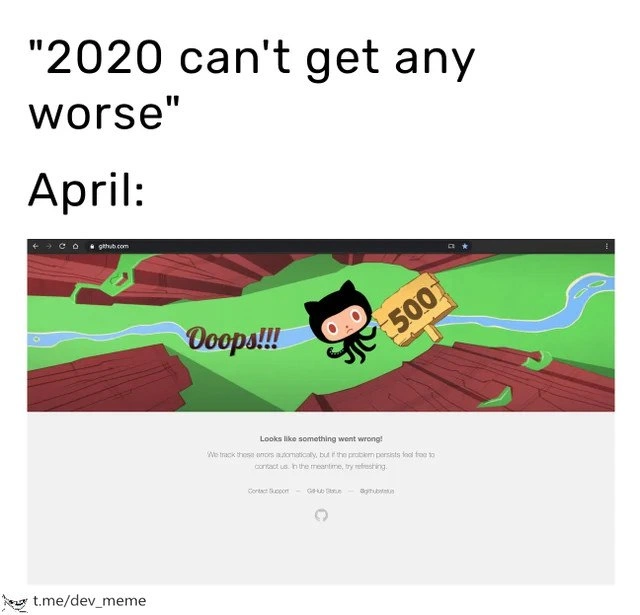
Imagine you’re a new developer pushing code on a typical day, and suddenly GitHub’s site stops responding. For context, GitHub is a huge online platform for version control – basically, a place where developers store code and track changes using a system called Git. It’s like a central hub for coding projects (where people collaborate on code, review changes, etc.). Now, when GitHub "goes down," it means something has gone wrong on their end and the site or its features aren’t working. In the meme’s image, you see GitHub’s mascot (the Octocat, a cat-octopus character) holding a “500” sign in a cartoon landscape. Right above it, the error message says “Looks like something went wrong!” and mentions a 500 Internal Server Error.

So what does a "500 error" mean? In web terms, servers send numeric HTTP status codes to tell your browser if things went right or wrong. A 200 means “OK, here’s your data,” a 404 means “Not Found” (like when a page doesn’t exist), and a 500 means “Internal Server Error” – essentially the server saying “Oops, that’s on me, something broke on the server side.” It’s a generic error code for when the server encounters an unexpected condition or bug that prevents it from fulfilling a request. In our GitHub scenario, maybe a database query failed or some code crashed – the result is that everyone’s requests are coming back with this 500 error page.

For a junior developer, encountering a GitHub 500 error can be puzzling and frustrating. You might wonder, “Did I do something wrong?” But the page’s text “we track these errors automatically” is a hint that it’s not your fault; it’s an issue on GitHub’s side. In other words, something in GitHub’s production environment broke unexpectedly. The page even suggests refreshing your browser or contacting support if the problem persists. Those links at the bottom – Contact Support, GitHub Status, and @githubstatus – are there so you can get help or see if the outage is a known problem. GitHub Status is a webpage where the company posts real-time updates about any downtime, and @githubstatus is their Twitter account for status announcements. When a big outage happens (like the one in early April 2020 that this meme references), developers often flood those status pages and social media to confirm it’s not just them.

Now, the meme sets up a joke with the text “2020 can’t get any worse” followed by “April:” and then the GitHub error screenshot. The humor relies on the context: 2020 was already a year full of bad news globally, and by April, people were nervously joking about what next? For developers, a GitHub outage was one of those “of course this would happen now” moments. If you’re new to the concept of on-call, it means an engineer at GitHub was probably alerted the instant things went wrong. On-call engineers are those who must respond immediately to fix problems in the live site (even if it’s 3 AM). So while users saw the cute error page, behind the scenes GitHub’s team was scrambling to restore service. Meanwhile, thousands of developers around the world had to pause their work. You can’t push new code or pull updates when GitHub is down, which can be a weird experience if you’ve never seen a major service outage before. People often take that forced break to grab a coffee or post memes about the situation – it’s a bit of community coping.

In summary, the GitHub 500 error page (with the Octocat and “Ooops” sign) means something went wrong on GitHub’s servers and the site is temporarily unavailable. Even big, reliable platforms have the occasional hiccup. The meme ties this technical hiccup to the larger feeling of “oh great, another disaster in 2020”. For a newer developer, it’s a reminder that even the best systems can have bad days – and that developers often use humor and memes to get through those frustrating downtimes.

Level 3: Murphy's Law as a Service

Murphy’s Law as a Service sums it up perfectly. By early 2020, developers were already dealing with a global pandemic disrupting work, and then out of nowhere our primary code forge (GitHub) coughs up a 500 error. It's the classic “things can’t get any worse”“hold my beer” scenario. Any senior engineer recognizes the jinx: never say “it can’t possibly fail”, because that's exactly when it will. In ops folklore, the moment you declare “it’s finally stable,” the universe schedules an outage. Here, 2020 itself was the infamous instigator. The meme shows “2020 can’t get any worse” and then bamApril brings a GitHub meltdown. Every dev reading that had a half-smile, half-grimace: Of course the year of disaster finds a way to take down GitHub, too.

For those of us who have been on on-call duty, a GitHub outage triggers flashbacks. We know somewhere, some GitHub SRE’s pager is screaming at 3 AM, and a bleary-eyed engineer is scrambling through logs and dashboards to figure out why the world’s largest code hosting service just face-planted. It's a mix of horror and commiseration: horror that a critical service is down, and commiseration because we've all been that person firefighting a production issue. The meme leverages that shared experience among developers – we dread the production issues that always seem to happen at the worst possible times (often late on a Friday, because why not ruin the weekend?). In fact, April 3, 2020 was a Friday, which makes the joke even juicier: some poor soul probably deployed right before the weekend, and the universe promptly said “Ooops.”

From an industry perspective, this highlights the risk of putting all our eggs in one basket. GitHub is such a central hub for code (repositories, CI pipelines, project boards) that when it hiccups, thousands of teams around the globe grind to a halt. It's a single point of failure for a huge part of the software world. Sure, Git itself is distributed – we each have local copies of our code – so it’s not like our work vanishes. But good luck collaborating or deploying new changes when the central platform is down. Pull requests, CI/CD builds, issue trackers – all inaccessible. Many of us have learned to keep an eye on official GitHub Status pages or Twitter feeds for the dreaded confirmation: “Yes, it’s down. It’s not just you.” The meme perfectly captures that collective dread and cynical humor: by 2020, even critical developer tools were joining the parade of calamities.

And yet, as frustrating as it was, devs coped the way we often do – through memes and jokes. It’s a form of techie gallows humor. What can you do when a 500 Internal Server Error pops up on the platform you need to do your job? You share a screenshot and quip about how it’s the cherry on top of an already terrible year. (The GitHub error page itself is intentionally whimsical, with a tumbling Octocat adventurer, to defuse panic.) Seasoned devs appreciate that touch, but we’re also cynically muttering “refresh, refresh… come on, refresh” while internally screaming. We’ve survived gnarly outages and late-night deploy disasters before, but 2020 had a special talent for stretching our patience. This meme made us laugh because it told a truth every experienced dev knows too well: no matter how bad things are, there’s always room for one more critical bug.

Level 4: Chaos at Scale

At the most technical level, this meme highlights the fragility of complex distributed systems when faced with chaotic conditions. A 500 Internal Server Error on GitHub isn't just a simple bug — it's often the final symptom of a chain reaction deep in the infrastructure. GitHub's platform operates at massive scale with many layers: load balancers, application servers, caches, databases, and microservices all orchestrated to handle millions of Git operations and web requests. Usually, these layers have redundancies and fail-safes. But when an unexpected condition arises (say a database cluster goes out of sync or a critical service crashes in an unusual way), it can trigger a cascading failure. Imagine one microservice timing out, causing dependent services to queue up requests, which in turn exhausts thread pools on the web servers — eventually the whole pipeline backs up and starts erroring out. The result is what every developer dreads seeing: a browser full of HTTP 500 error pages.

Under the hood, GitHub likely has global exception handlers that catch unhandled errors and display the friendly Octocat error page. That "Ooops!!!" message is a friendly wrapper for an error — essentially the system openly admitting it encountered something it didn’t know how to handle. When you see an Internal Server Error, it means the server’s logic reached a breaking point where it couldn’t safely recover or provide a proper response. At GitHub’s scale, even a small glitch can magnify: an innocent-sounding software bug might only appear under extreme load or a specific rare condition, but given millions of users, those "rare" conditions eventually pop up. The architecture is built to be resilient — multiple data centers, replication, and load balancing to handle surges — but there are always edge cases or compound failures that slip past those defenses.

Site Reliability Engineering (SRE) teams try to prepare for such chaos by implementing monitoring, auto-scaling, and even running chaos engineering experiments (like Netflix’s famous Chaos Monkey) to simulate failures. The GitHub error page itself says “we track these errors automatically,” hinting at an extensive monitoring system: every 500 incident likely sends alerts to dashboards and pages the on-call team. But as robust as your systems and processes are, Murphy’s Law finds a way. In 2020, as if the world wasn’t turbulent enough, even our most trusted developer tools got stress-tested by reality. It’s like the universe was running an unauthorized chaos experiment on production systems. The meme’s core technical irony lies in this: no matter how advanced our architecture or how many nines of uptime we aim for, a big chaotic event (or a combination of small failures) can still bring the whole operation to a halt. In other words, complex systems fail in complex ways — and sometimes they all decide to fail right when you’d least like them to.

Description

A two-part meme. The top part features the text, "'2020 can't get any worse'", followed by "April:". The bottom part displays a screenshot of a GitHub 500 Internal Server Error page. The screenshot shows GitHub's Octocat mascot looking sad in a desert canyon, holding a wooden sign that reads "500". Large text on the page says "Ooops!!!" and smaller text below reads, "Looks like something went wrong!". The browser address bar clearly shows github.com. A watermark for "t.me/dev_meme" is in the bottom-left corner. This meme leverages the popular '2020 couldn't possibly get worse' format to humorously portray a major GitHub outage as the next catastrophe in a year already defined by crisis. For the developer community, a GitHub failure is a significant event, halting development workflows, breaking CI/CD pipelines, and effectively stopping work, making it a fittingly dramatic punchline


Comments

7
Anonymous ★ Top Pick In 2020, even my git commits started to require social distancing from the main branch
  1. Anonymous ★ Top Pick

    In 2020, even my git commits started to require social distancing from the main branch

  2. Anonymous

    2020: “Nice multi-region, self-healing microservices.” April: *GitHub 500s* - turns out the whole ‘distributed’ system is just an expensive façade over one SaaS monolith we don’t even own

  3. Anonymous

    The one time we actually needed distributed version control to be distributed, and GitHub reminded us we'd all been using it as a centralized system the whole time

  4. Anonymous

    Nothing quite captures the existential dread of 2020 like discovering GitHub is down right when you need to push that critical hotfix. At that moment, every developer simultaneously realized we'd built an entire industry on a single point of failure - and that our local git repos were suddenly very, very lonely. The 500 error became the perfect metaphor: we thought things couldn't get worse, but then the one service holding our collective sanity together decided to take a break

  5. Anonymous

    GitHub's 2020 outage: The ultimate SRE reminder that even distributed VCS has a fat-finger single point of failure

  6. Anonymous

    April returned HTTP 500 and we learned our “cloud‑agnostic, multi‑region” architecture has a single point of failure named github.com - CI stalled, OAuth flapped, and the status page was eventually consistent

  7. Anonymous

    Git is distributed; our process isn’t - one GitHub 500 and half the industry discovers their monorepo, CI, and approvals share a single global SPOF and a very negative error budget

Use J and K for navigation