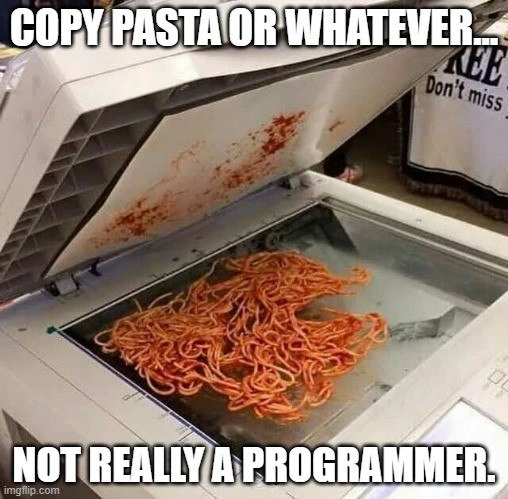
A very literal interpretation of 'copypasta'
Why is this CodeQuality meme funny?
Level 1: Copying Homework
Imagine you have a friend who did their homework, but their work is super messy with scribbles and maybe even ketchup stains on it. 📄🍝 Now, instead of doing your own homework, you just photocopy your friend’s messy paper and write your name on it. Do you think the teacher will be impressed? Probably not! You didn’t actually solve the problems yourself, and the homework you turned in is messy and hard to read. This meme is joking about a similar idea, but with computer code. It shows someone trying to photocopy a plate of spaghetti as if that would magically create a good meal. Of course, that’s a silly idea – you just end up with a mess (and a photocopier full of tomato sauce!). In the same way, if a programmer only copies someone else’s code without understanding it (kind of like copying homework), they might get something that runs, but they won’t really know how it works and it’s likely to be messy and full of problems. It’s funny because it’s obviously a lazy, wrong way to do things. The picture makes it ridiculous on purpose so we can all laugh and think, “Yeah, trying to copy-paste your way through programming is as goofy as trying to photocopy spaghetti. Maybe I shouldn’t do that!” The core idea is simple: just copying stuff might seem easy, but it’s not how you truly learn or create something good.
Level 2: Spaghetti Code 101
So, what’s going on here? This image is making fun of a certain kind of bad coding practice. First, know that “copypasta” is internet slang for text (or code) that gets copied and pasted around a lot (the word itself mashes up “copy/paste” with “pasta” for fun). In programming, copy-paste coding means taking code written by someone else (often from a site like Stack Overflow, where developers share answers) and inserting it into your own project without writing it yourself. It’s like borrowing a paragraph from someone’s essay to put in your own paper. It might save time, but if you do it blindly, you might end up with a jumble of styles or even errors you don’t understand.
Now, “spaghetti code” is a nickname for code that is really unorganized and tangled. Why spaghetti? Think of a plate of spaghetti noodles – a big tangle where it’s hard to follow one strand from start to finish. Spaghetti code is just like that: lots of twists and turns (like goto statements, deep nested logic, or copy-pasted bits) that make it confusing to follow. If a program’s flow jumps all over or each part is dependent on random other parts with no clear structure, developers say “this code is spaghetti.” It’s not a compliment! Spaghetti code tends to happen when people write code in a hurry or pile on fixes over time without cleaning up. Each quick fix is like throwing another noodle into the mix. Eventually, you have a messy blob that no one fully understands.
The meme literally shows cooked spaghetti on a photocopier as a joke. “Copypasta” sounds like “copy pasta,” so they put pasta on a copier. It’s visual wordplay. The idea is that a programmer who just copies and pastes code is doing something as silly as trying to photocopy spaghetti to make more pasta. The top text “COPY PASTA OR WHATEVER…” mimics a dismissive attitude – like the person doesn’t care and will just copy whatever code they find. The bottom text “NOT REALLY A PROGRAMMER.” is saying: if you work that way (just copying code), you’re not really programming. Real programming means you understand the code and create structure, not just assemble random pieces. It’s harsh humor – of course those who copy code can technically be programmers, but the joke implies they’re lazy or unskilled.
Let’s break down why this is bad in a real dev scenario. Suppose you have a problem to solve. You search online and find someone’s code that looks like it might work. You paste it into your project. If you don’t fully understand it, you might misuse it or be unable to fix it if it breaks. Also, that code was written for someone else’s situation, which might be slightly different. For example, maybe the code snippet sorts a list in a certain way, but your situation needs a special case – you might not realize that and introduce a bug. Or imagine you need the same kind of functionality in two places, and you copy the same chunk twice. Now if you find a mistake in that code, you have to remember to fix it in both places. That’s double the work and easy to forget – classic recipe for bugs. The better approach would be to write a single function and call it twice (so you fix it once in the future) – that’s the DRY (Don’t Repeat Yourself) principle in action. Copy-pasting is literally repeating yourself, which we try to avoid because it makes code maintenance harder.
There’s also the concept of Technical Debt. This is a metaphor: like taking on debt (a loan) gives you money now but you have to pay it back with interest later, taking a shortcut in code (like copying without cleaning it up) solves your problem now but “interests” you with more work later. Lots of quick-and-dirty solutions build up technical debt. One day, when you try to add new features or debug, you “pay” that debt by facing a lot of complications. For instance, all those pasted bits might make it really time-consuming to change one thing, because the same code is scattered everywhere. The developer experience (DX) of working with such code is pretty poor – it’s frustrating and slow. Clean, well-structured code is easier and happier to work with; spaghetti code is a headache. This meme is a light-hearted critique of what we call “lazy programming shortcuts.” Instead of doing the thoughtful work of designing a clean solution, a programmer took a shortcut by copying others’ code snippets arbitrarily. It might work initially, but it leaves behind a mess. And guess who deals with that mess? Other developers (or future you) who have to modify or debug the code later. They’ll be scratching their heads, much like someone looking at a spaghetti-sauce-smeared copy machine wondering “what in the world happened here?!”
In short, CodeQuality suffers when people copy-paste without care. It’s fine to use resources like Stack Overflow to learn, but good developers use those answers as guidance, not as literal plug-and-play solutions (at least, not without adapting and understanding them). The meme uses humor to teach a simple lesson: just copying code is not real coding. Real coding involves thinking about the problem, writing or adapting code in a clean way, and avoiding turning your codebase into a tangled mess.
Level 3: Stack Overflow Driven Development
At a practical level, this meme hits home for any experienced developer who’s waded through a nightmare codebase. It’s pointing at the copy-paste programming culture – what we jokingly call “Stack Overflow-driven development.” The top caption, > “COPY PASTA OR WHATEVER...”, perfectly captures that blasé attitude of a coder who isn’t really writing code so much as googling it. And the bottom line, “NOT REALLY A PROGRAMMER,” is a snarky smackdown: if all you do is photocopy others’ code (or in this case, literal pasta), can you call it programming? The humor cuts close to the bone because many of us have encountered (or admittedly been) that developer who, under pressure, just grabs a snippet from the internet and slaps it in the code. Sure, it compiles and runs, but under the hood it’s as elegant as a pile of oily spaghetti. 🤢
The photocopier with spaghetti visual is absurd, but it’s a spot-on metaphor for copypasta coding. We call tangled, poorly structured code “spaghetti code,” and here someone is literally trying to copy pasta. It’s basically screaming: “Look! Copy-pasting this mess doesn’t make it any better!” Every time code is duplicated without thought, you’re photocopying the mess along with its sauce stains. Those red sauce splatters on the copier’s lid? They symbolize the bugs and context-specific quirks that get transferred when you copy code blindly. TechnicalDebt accumulates with each pasted snippet. Maybe that copied code works in one scenario, but in your project it introduces a subtle bug (like a sauce stain in the mechanism) that will cause a paper jam at 3 AM release night. The meme elicits that pained laughter from senior devs who have torn their hair out maintaining such systems: “Yep, we’ve cleaned up someone’s spaghetti splatter before.”
There’s a rich vein of shared experience being poked at here. CodeQuality suffers when shortcuts are taken, and we all know it. Yet, reality often intervenes – tight deadlines, newbie teams, or sloppy habits mean copy-paste solutions sneak into production. We’ve seen projects where half the functions are slight variations of each other because someone kept doing Ctrl+C, Ctrl+V instead of writing a reusable module. A seasoned engineer can open a file and immediately smell the copypasta: inconsistent indentation, variables named foo2 or copyOfFoo, odd comments like “// found on StackOverflow”. It’s both hilarious and cringe-worthy. This meme’s DeveloperHumor lands so well because it exaggerates that scenario to an insane visual: as if a dev literally tried to photocopy spaghetti to duplicate code. The “not really a programmer” punchline reflects a bit of gatekeeping humor in tech – implying that real developers craft solutions, whereas copy-pasters just duct-tape someone else’s code. Of course, in truth even veteran developers occasionally grab a snippet from Stack Overflow, but the difference is understanding. A pro will integrate and refactor it, while a lazy programming shortcut artist will just drop it in wholesale.
Let’s be real: Stack Overflow is an amazing resource, but it’s not supposed to replace learning. Yet, “StackOverflow-driven dev” is an all-too-common anti-pattern. The meme calls out that culture of quick fixes. It’s the kind of thing seniors joke about when reviewing junior code:
“Why do we have three functions doing almost the same thing?”
“Oh, because Bob copy-pasted it thrice with slight tweaks.”“This module has variables in Spanish and Hungarian notation mixed in… wait, was this code copied from two different sources?”
The fallout of such CopyPasteCoding is a maintenance hell. When something breaks, you’re not debugging a coherent program; you’re untangling a clump of noodles. Each noodle (code fragment) came from a different kitchen (author) with its own spice (context). No wonder the whole dish tastes off when reheated. The technical debt metaphor becomes very real in these moments: those time-saving pastes turn into time bombs that future you (or some other poor soul) has to defuse under pressure. The experienced devs laugh at this meme with a wince because we’ve all paid that price. We’ve spent late nights refactoring a 5,000-line single function (true story) that grew from years of copy-paste accretion. We’ve answered panicked calls because production went down due to an overflow caused by a snippet that “worked fine in the tutorial”. This meme perfectly skewers those painful realities with a visual pun. It’s equal parts catharsis (“Ugh, I’ve seen this”) and schadenfreude (“Glad it’s not my copier that’s full of spaghetti sauce”). In short, it humorously spotlights a real industry problem: the proliferation of spaghetti code through unchecked copy-paste habits, and the eternal struggle of real programmers to clean up that mess.
Level 4: The Big Ball of Mud
In the grand saga of software engineering, copy-paste coding is a well-known villain. It's essentially how a Big Ball of Mud architecture forms: countless quick fixes and snippets thrown together without coherent structure. Decades ago, legends like Edsger Dijkstra warned against unstructured spaghetti code (his famous essay “Go To Statement Considered Harmful” in 1968 targeted tangles of jumps in code). Spaghetti code gets its name because the program’s flow is as twisted and looped as a bowl of pasta. When a developer slaps a pre-cooked chunk of code into a codebase without fully digesting it, they’re serving up a fresh plate of spaghetti logic. Over time, each copy-pasta “shortcut” hardens into TechnicalDebt – a term coined by Ward Cunningham to describe how kludgy solutions accrue interest in the form of future complications. Blindly duplicating code multiplies that debt fast.
From a theoretical perspective, copy-pasting violates core design principles. The DRY principle (“Don’t Repeat Yourself”) is meant to keep the codebase lean by having a single source of truth for any piece of logic. Copypasta does the opposite – it repeats code all over, leading to inconsistencies. In fact, code clone analysis is an active area in software engineering research: tools scan codebases to detect duplicate code blocks because they’re strongly correlated with bugs and maintenance headaches. Imagine a bug discovered in one copied function – if that code was copy-pasted 5 times, you now have to hunt down and patch all 5 clones (and hope you find them all). Mathematical inevitability kicks in here: the software entropy increases. Left unchecked, the system’s complexity grows until it collapses under its own weight – the Big Ball of Mud, where everything is so entangled that no clear architecture remains. This meme literalizes that phenomenon by putting actual spaghetti (the epitome of tangled complexity) on a photocopier, churning out duplicate messes. It’s a nod to how lazy programming shortcuts undermine the elegant, modular designs we strive for. Even advanced static analysis tools like SonarQube flag high copy-paste ratios as a serious CodeQuality issue, because such duplication is essentially a breeding ground for bugs. And let’s not forget cargo cult programming – a concept where developers imitate patterns (often via copy-paste) without understanding. The photocopier covered in noodles is a tongue-in-cheek illustration of this: mimicking code by photocopying spaghetti, hoping to magically get a working program. In reality, of course, all you get is a bigger mess. This deep-cut humor resonates with senior engineers because it echoes long-standing lessons in software theory: abstraction over duplication, understanding over haste, and how ignoring those tenets leads to chaotic systems that academics aptly compare to spaghetti or mud.
Description
A meme showing a photocopier with its lid open, revealing a messy pile of spaghetti with red sauce spread across the scanner glass. The inside of the lid is also stained with sauce. The image has top and bottom captions in a bold, white, impact font. The top text reads, 'COPY PASTA OR WHATEVER...' and the bottom text says, 'NOT REALLY A PROGRAMMER.' This is a multi-layered pun for a technical audience. It plays on 'copypasta,' internet slang for a block of text that is repeatedly copied and pasted, and 'spaghetti code,' a term for unstructured and hard-to-maintain source code. The humor comes from the absurdly literal interpretation of 'copying pasta,' suggesting that the person who did this has heard the slang but completely missed the technical context, hence they are 'not really a programmer.'
Comments
9Comment deleted
This must be the legacy codebase everyone warned me about. It's not just spaghetti; it's un-compilable, has sauce-related stains on the documentation, and the whole thing is clearly a copy-paste job
When the SCA scanner throws a gluten alert, you know the “copy-pasta” integration pattern has officially graduated from tech debt to food safety violation
After 20 years in the industry, I've seen codebases where the actual pasta in this photocopier would be easier to untangle than the dependency graph created by junior devs who treat Stack Overflow like a buffet line
This is what happens when you take 'Don't Reinvent the Wheel' too literally - you end up with a tangled mess that technically works but nobody wants to maintain. The real tragedy isn't the spaghetti on the scanner; it's that we've all shipped code that looks exactly like this internally, complete with the sauce stains of hastily applied 'fixes' and the lingering smell of desperation. At least actual pasta has the decency to throw a compilation error when you try to run it through a Xerox
When juniors feed copy-pasta into the scanner instead of abstracting into reusable modules
Copy - pasta ships fastest - until SonarQube flags 14 near-duplicates and your one-line fix turns into diffing marinara across five services
Copy/paste “reuse”: when your CI is a photocopier and the output is twelve git forks of spaghetti code - marinara-level coupling, mysterious licenses
That looks like a spaghetti lover Comment deleted
is that a spaghetti code ? Comment deleted