Skip to content
DevMeme
2183 of 7435
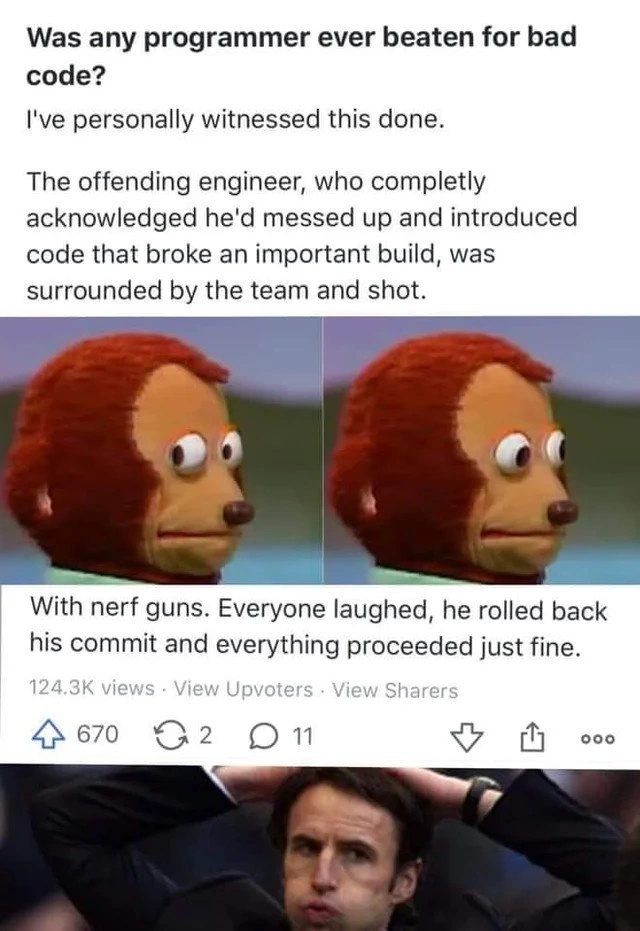
The appropriate corporate punishment for breaking the build
CorporateCulture Post #2435, on Dec 9, 2020 in TG

The appropriate corporate punishment for breaking the build

Why is this CorporateCulture meme funny?

Level 1: All in Good Fun

Imagine you and your friends are building a big LEGO tower together. You’re all excited, stacking pieces carefully. But oops – you accidentally put in a wrong piece and the whole tower tumbles down. For a moment, you freeze and worry that your friends will be really mad at you for messing up the project. Instead, they all grab soft foam balls (like the ones from a Nerf toy) and playfully start tossing them at you while laughing. They’re not really angry – this is their funny way of saying “silly you!” You laugh too, feeling relieved that they’re not upset. Then you all quickly gather the LEGO bricks and rebuild the tower, fixing the mistake. In the end, nothing is broken for long, and everyone is smiling. The message? Even if you make a mistake that causes a problem, a good team will forgive you with a bit of playful joking, and then you’ll all fix it together. It’s all in good fun, and everything ends up just fine.

Level 2: When the Build Goes Red

Let’s break down what’s happening in this meme. In software development, a “build” is the process that takes all the code, compiles it (if it’s a compiled language), runs automated tests, and packages the software. Modern teams use Continuous Integration (CI) systems – like Jenkins, CircleCI, or GitLab CI – to do this automatically whenever someone merges in new code. When everything is working, the build passes (often shown in green). But if the new code has a bug or doesn’t play nice with existing code, the build fails (often shown in red). Developers call this “breaking the build.” It’s a big deal because a broken build means the latest code can’t be safely used or deployed – in a CI/CD pipeline, that blocks progress for everyone. Picture all your coworkers unable to get a new version of the app because one person’s change caused an error. That’s why breaking the build triggers some deploy anxiety for the person who caused it. They know they’ve stalled the assembly line and everybody’s waiting on them to fix the problem.

In the meme, someone asked: “Was any programmer ever beaten for bad code?” That sounds severe! The answer (formatted like a Q&A post with upvotes and view counts, similar to a Quora screenshot) shares a story: Yes, the writer has seen a programmer get “beaten” for making a bad code change… but not in a truly violent way. The post explains that the engineer who wrote the faulty code completely acknowledged he’d messed up – he admitted his coding mistake caused an important build to fail. So what did the team do? They surrounded him and shot him with Nerf guns! Nerf guns are toy dart guns that shoot soft foam darts, popular in many offices for fun. This was a silly office team prank or informal “punishment.” Everyone laughed, including the guy who messed up. Crucially, he then rolled back his commit – meaning he used the version control system (like Git) to undo his change. In Git, this is often done with a git revert command, which creates a new “anti-change” that cancels out the bad code. Rolling back quickly restored the code to a working state. Soon the build was working again, and work continued as normal (“everything proceeded just fine”). The upvote count (670 upvotes) and comments show that lots of other developers found this story funny and relatable. It’s a form of WorkplaceHumor and DeveloperMemes that rings true to life.

The two pictures of the red-haired side-eye puppet at the bottom visually convey the story’s twist. This puppet image is a well-known reaction meme used to express awkward tension or shock. In the first image, the puppet’s eyes are wide and he’s side-eyeing nervously – representing the moment you hear “the team surrounded him and shot him…” Wait, shot him?! That sounds alarming, as if he was going to be literally punished for the broken build. In the second image, the puppet looks a bit more at ease (or at least no longer as startled). That’s the feeling of relief when you hear “…with Nerf guns.” Oh! It was just a joke. The meme uses these two frames to take the reader from suspense to relief, just like the engineer went from fearing real anger to realizing it’s all in good fun. Essentially, the puppet is us, the readers (and developers) imagining ourselves in that situation: first dreading the consequences of a serious build breakage, then realizing the team handled it with humor and everything is okay.

So, what lessons does a junior developer or newcomer take from this? First, breaking the build is something to avoid if you can – it usually means you introduced a bug in the software or forgot to include something, and now the continuous build/test process has failed. But if it happens, don’t panic: it’s a common mistake in software development. You should promptly fix it, often by rolling back or patching the offending code. Second, good teams have a culture of blameless recovery – they won’t literally “beat” you for bad code. Instead, they might tease you to acknowledge the goof. It’s a playful way of saying “Yep, you goofed, now fix it and we’re cool.” The Nerf gun punishment in this story is one team’s quirky tradition. Your team might have its own: maybe ringing a bell, wearing a funny “I broke the build” hat, or just a running joke about buying coffee for everyone. The key is that everyone collaborates to maintain the software, and when someone slips up, it’s treated as a learning moment (perhaps with some gentle ribbing). The end result: the commit was reverted, the build pipeline went back to green, and no feelings were hurt – except maybe the engineer’s pride, just a little. But he earned a funny story to tell, which in tech is practically a badge of honor.

Level 3: Build Broken, Shots Fired

When a continuous integration (CI/CD) build pipeline suddenly fails due to a bad commit, it can feel like walking into a firing squad – in this case, a Nerf gun firing squad. This meme highlights a classic DeveloperHumor scenario: an engineer pushes a change that breaks the build (i.e., the shared code can’t compile or a test suite fails), halting the team's progress. In a fast-paced CI/CD environment, a broken build is akin to throwing a wrench in a well-oiled assembly line; everyone on the team notices immediately. The humor here comes from the team’s response: instead of blame or panic, they enact Nerf-gun justice. It’s a lighthearted form of peer accountability often seen in tech company culture, turning a BuildFailure into a bonding moment.

In this story, the offending engineer immediately acknowledges the mistake – a refreshing dose of humility that any senior developer respects. Instead of management reprimand or a harsh email, the punishment is instant and playful: coworkers surround the guilty coder and shoot foam darts at him. The famous red-haired side-eye puppet meme is shown in two frames, perfectly capturing the engineer’s emotional arc. In the first frame, the wide-eyed puppet looks nervously to the side, reflecting that “uh-oh” moment of deploy anxiety: Did I just break something important? Am I in trouble? This is the classic code push regret face that developers know all too well, when you realize your last commit might have wreaked havoc. In the second frame, after it's revealed he was only shot with Nerf guns, the puppet’s expression eases – a sigh of relief. The tension deflates into laughter. Everyone is amused, no real harm done, and the continuous integration build system is quickly back on track once the code is fixed.

This kind of ritual is actually a positive sign of Team Collaboration and a blameless culture. It’s common in many dev teams to have a fun tradition for whoever breaks the build: maybe they have to wear a goofy hat, display a rubber duck of shame on their desk, buy doughnuts for the team, or, as here, face a team prank firing squad of toy darts. Such WorkplaceHumor serves a dual purpose: it gently reminds developers to be careful with their commits (nobody wants to be under Nerf fire twice!) and it keeps the atmosphere supportive rather than punitive. In a way, those foam darts are a softer form of peer review – a quick, physical code review comment saying “Hey, that commit wasn’t great, but we’re all still friends.” Everyone gets a laugh, the message is delivered, and morale stays intact. It’s DeveloperMemes culture imitating life: we make fun of our BugsInSoftware and CodingMistakes, turning them into inside jokes so we don’t cry. Better a rain of Nerf darts than a rain of angry emails or a 3 A.M. rollback in production!

Importantly, after the laughter, the engineer rolled back his commit to undo the bad change. In version control tools like Git, a rollback (often done with a git revert or similar command) creates a new commit that undoes the changes of the faulty one. In this case, rolling back instantly fixed the build breakage – the codebase returned to its last known good state, and the CI pipeline turned green again. The phrasing “everything proceeded just fine” indicates that once the bad code was reverted, the team could continue merging code and deploying as normal. In a robust CI/CD setup, failed builds block new changes from being released, so a quick build fix rollback is crucial. Experienced devs understand that swift action is key: the sooner you revert or fix the bug, the sooner the whole team is unblocked. The meme’s popularity (note the “124.3K views” and hundreds of upvotes on the post) shows how relatable this scenario is — practically every programming team has a story of BuildPipeline chaos and subsequent comic relief.

To put it in pseudo-code, the team’s response algorithm might look like:

# Pseudo-code of the "Nerf Gun Justice" build fix process
if build.status == "FAILED":  
    team.shoot(engineer, weapon="Nerf gun")   # playful punishment  
    version_control.revert(bad_commit)        # roll back the offending code change  
    build.status = "FIXED"                    # build is green again  

The result? The codebase is back to stable, the engineer has learned a lesson (and maybe earned a new nickname), and the whole team has a fun story to share. This meme brilliantly compresses all that – the BuildSystems_CICD drama, the anxiety, and the camaraderie – into one Q&A-style joke and a pair of puppet reaction images. It’s a too real reminder that in software, things will go wrong, but how your team handles mistakes makes all the difference.

Description

A multi-layered meme built around a story about a programmer's mistake. The meme starts with the question, 'Was any programmer ever beaten for bad code?' and a story about an engineer who broke an important build and was 'surrounded by the team and shot.' This dramatic statement is immediately followed by two images of the 'Awkward Look Monkey Puppet' meme, creating suspense. The story then resolves with the punchline: 'With nerf guns. Everyone laughed, he rolled back his commit and everything proceeded just fine.' The narrative is presented as a screenshot from a social media platform like Quora or Reddit. A final, separate reaction image at the bottom shows a stressed-looking man, implying a 'they had us in the first half' reaction from the reader. The meme humorously contrasts the high-stress situation of breaking a build with a positive, healthy team culture that uses playful antics to diffuse tension rather than assign blame. It resonates with experienced developers who understand the importance of psychological safety in a team
Comments

7
Anonymous ★ Top Pick In a healthy culture, breaking the build gets you shot with Nerf darts. In a toxic one, it gets you added to a post-mortem meeting scheduled over your lunch break
  1. Anonymous ★ Top Pick

    In a healthy culture, breaking the build gets you shot with Nerf darts. In a toxic one, it gets you added to a post-mortem meeting scheduled over your lunch break

  2. Anonymous

    We cut build-break MTTR from hours to milliseconds: Jenkins posts the failure, then the SREs deliver a low-latency Nerf-powered post-mortem directly to the author - turns out foam has better observability than Slack

  3. Anonymous

    The real punishment was having to explain to the VP of Engineering why the team's Nerf gun budget exceeded the AWS bill that month

  4. Anonymous

    The real punishment wasn't the nerf guns - it was having to explain in the post-mortem why the CI/CD pipeline didn't catch it before merge, why there were no feature flags, and why the rollback took longer than the actual fix. The nerf guns were just the team's way of saying 'we still love you, but please run the integration tests next time.'

  5. Anonymous

    Nerf ambushes: the only prod incident response faster than auto-rollback, and way cheaper than SRE therapy

  6. Anonymous

    We run foam-driven development: if CI turns red, the RTO is 5 minutes or 50 Nerf darts - whichever lands first

  7. Anonymous

    Blameless culture in practice: break main, eat a Nerf barrage, then learn - faster than any onboarding - that git revert beats fix‑forward when the CI light turns red

Use J and K for navigation