Skip to content
DevMeme
2185 of 7435
The Hypocrisy of 'No Math Needed' in Programming
Interviews Post #2437, on Dec 9, 2020 in TG

The Hypocrisy of 'No Math Needed' in Programming

Why is this Interviews meme funny?

Level 1: No Math? Just Kidding!

Imagine your teacher tells you, “Don’t worry, joining the school’s game club doesn’t need any math skills. It’s all fun and games.” Yay, that sounds great! But then, on the first day in the club, the instructor suddenly gives you a math puzzle to solve as your entrance test. 😮 You’d probably stop and say, “Hey, wait a minute – I thought you said no math was needed!” You might feel confused and a bit tricked.

That’s exactly what this programming joke is about. People often say “you don’t need math to be a programmer” to make coding sound friendly and not scary. But when you go for a programming job interview, they might still quiz you with a math-like question (for example, asking how fast your solution is, which is a little bit of math logic). It feels just like being promised no math and then getting a surprise math test. It’s funny in the same way a prank is funny – once you get over the shock, you can chuckle at the contradiction. The meme is pointing out that surprise with a knowing laugh: They said no math… but surprise, there was math anyway!

Level 2: Complexity 101

So, what exactly are they talking about in that tweet? Let’s break down the terms for a newer developer. Big-O notation is a way to describe how an algorithm’s run time grows as the input size (n) grows. It’s a part of basic algorithm complexity analysis. Think of it as measuring how quickly the “work” increases when you have more data. For example, if you have a loop that goes through n items once, we say it’s O(n) (pronounced “oh of n”), meaning the time grows linearly with the number of items. If you have a double loop (loop inside a loop) that goes through n items n times, that’s O(n^2) (quadratic) because doubling the items roughly quadruples the work. Big-O gives a high-level way to compare algorithms’ efficiency without getting bogged down in exact timings. It’s a key part of CS fundamentals because it helps you reason about what might be efficient code vs. code that could slow down dramatically with more data.

Now, a recursive function is a function that calls itself to solve a problem. It’s like a self-referential definition. For instance, computing a factorial can be done recursively: to get factorial(5) you compute 5 * factorial(4), and so on, until factorial(1). Recursion breaks problems into smaller sub-problems. However, analyzing a recursive function’s efficiency can be a bit tricky – you have to count how many times it calls itself and how much work happens at each call. This is where that “math” part sneaks in. It often involves recognizing a pattern or formula for the number of calls. Don’t panic, though: it’s usually basic arithmetic or geometric growth, not advanced calculus. It might feel like solving a puzzle.

For example, consider a classic recursive function that calculates Fibonacci numbers (a famous sequence) naively:

def fib(n):
    if n <= 1:
        return n
    return fib(n-1) + fib(n-2)  # Each call spawns two more calls!

This little function is easy to understand, but if you try to run fib(30) or fib(40), you’ll notice it gets very slow. That’s because the number of recursive calls explodes as n grows. In fact, each call above splits into two more calls, so the total work roughly doubles for each increment of n – making it about O(2^n) time complexity (exponential growth). In plainer terms, if n goes up by just 1, the work might almost double. Yikes! On the other hand, a nicely designed recursion (or an iterative loop) that only calls itself once per step might be O(n), which scales much more gently. Interviewers love to ask about examples like this to see if you notice how the work grows. They might prompt you: “What’s the time complexity of fib(n) here?” and expect the answer “exponential, roughly O(2^n).” That’s the algorithmic_complexity_question the meme refers to.

Why do interviews ask this? Well, in a technical interview, after you write a solution, it’s common for the interviewer to ask about its efficiency. They want to know if you can evaluate your code’s performance and identify bottlenecks. It’s a way to ensure you understand what you wrote and that you have some grasp of efficiency — a core part of programming beyond just “making it work.” This is part of the standard TechnicalInterviewProcess. You might have heard people say math_in_programming isn’t huge for many software jobs (which is often true — you might rarely do algebra or calculus when, say, making a website). That’s why they tell beginners “you don’t need super advanced math to program.” But algorithm complexity analysis is like a small dose of math that is pretty important: it’s more about logic and counting steps than about solving equations. It’s taught in most introductory CS courses because it helps you write better code.

So if you’re a new coder: don’t be discouraged! You can absolutely be a great programmer without being a math wizard. However, you’ll eventually bump into CSFundamentals topics like Big-O, especially during interviews or when optimizing code. It’s a good idea to get comfortable with the basics: know that a single loop is linear, nested loops are quadratic, and something like that naive Fibonacci recursion is exponential (i.e., very slow for big n). The tweet is funny because it highlights a truth you learn with experience: There’s a bit of a gotcha in the journey. You’re told “coding is mostly about thinking logically, not doing math,” which is true day-to-day, but then you hit an interview and suddenly you’re asked to analyze something mathematically. It can feel like a surprise quiz. The reassuring part is that this “math” is learnable and not as scary as it sounds once you practice a few examples. It’s all part of bridging the gap between just writing code that works and understanding the algorithmic complexity of that code.

Level 3: The Big-O Betrayal

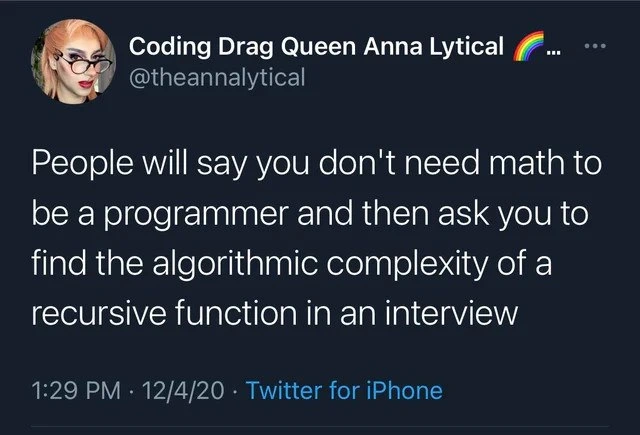
“People will say you don’t need math to be a programmer and then ask you to find the algorithmic complexity of a recursive function in an interview.”

This tweet nails a classic tech interview irony that senior devs know all too well. On one hand, the industry loves to chant “Programming isn’t about math, it’s about problem-solving and using tools.” On the other hand, the TechnicalInterviewProcess often feels like a pop quiz from your algorithms class. The humor comes from this interview_expectations_gap: newbies are reassured that heavy math isn't required to build apps, yet in a high-stakes interview they’re suddenly asked to analyze a tricky recursive algorithm’s Big-O notation by hand. It’s like promising no one will get wet and then holding the job interview in a swimming pool.

Why does this happen? Historically, many coding interviews (especially at big tech companies) are rooted in CS_Fundamentals. Interviewers love questions about algorithmic complexity because they reveal whether you understand how code scales. So they’ll ask something like, “What’s the time complexity of this recursive function?” Calculating that is a quintessential algorithmic_complexity_question. It requires recognizing patterns (does the recursion branch out? shrink the problem size? how many calls?). In other words: a dab of math and formal reasoning. It’s not solving integrals or doing advanced calculus, but it is the kind of logical math taught in computer science courses. The tweet’s author is poking fun at how we often tell aspiring devs “Don’t worry, you won’t need hardcore math for everyday programming,” yet the InterviewHumor reality is that those same devs get grilled on things like recursive runtime complexity or data structure performance the minute they’re in a technical interview.

Every experienced developer has seen this disconnect. You might spend your workdays using frameworks, building UIs, gluing APIs – hardly ever writing out equations. Yet, to get that job offer, you’re expected to recall academic concepts from algorithms class. TechnicalInterviews have a reputation for focusing on puzzles and theory (reversing linked lists, traversing binary trees, and yes, finding complexity of recursive algorithms) that you might never explicitly calculate again on the job. It’s almost a rite of passage. We chuckle (or groan) because it’s true: you could be an excellent coder who rarely touches formal math, but you’ll still need to know how algorithm complexity analysis works to survive many interview panels. It’s a shared industry joke that even though “you don’t need math to program” makes coding sound friendly, somebody forgot to tell the interviewers who live and die by Big-O. The meme resonates as a form of commiseration – we’ve all been there, memorizing $\log n$ runtimes and recurrence solutions just to prove we can code. It’s equal parts frustrating and funny that the same folks who downplay math in programming often uphold it as a hiring gatekeeper.

To put it bluntly, the hiring process has a double standard:

What They Promise (to New Devs) What Actually Happens (Interview)
“You don’t need a lot of math to code.” “Quick, analyze the complexity of this recursive algorithm.”

Yep, that’s the interview_expectations_gap in a nutshell. The humor works because every developer who has been through a few interviews can relate. We laugh (maybe with a touch of sarcasm) at how an innocent recursive_function on a whiteboard can turn into an unexpected math test. It’s a coping laugh, acknowledging that technical interviews often test knowledge that everyday programming doesn’t regularly require. And under the laughter, there’s a tiny acknowledgement: understanding that mathy stuff like Big-O might not be needed every day, but it sure can decide if you get the job. In short, the tweet is funny because it’s painfully accurate – the industry says one thing to welcome you in, then flips the script at the interview. Surprise! Time to do some math after all.

Level 4: Asymptotic Irony

Deep under the hood of that innocuous interview question lies some serious discrete math. Algorithm complexity analysis comes straight from theoretical computer science, which itself borrows from mathematics. Big-O notation was originally a mathematical notation (thanks to number theorists like Bachmann-Landau) to describe how functions grow. In computing, we repurposed it to measure how an algorithm’s running time or memory usage grows as the input size increases. When an interviewer asks for the complexity of a recursive_function, they’re really asking you to formulate and solve a recurrence relation – essentially a mathematical equation describing the function’s performance. For example, a simple recursion might lead to an equation like:

T(n) = T(n-1) + O(1) 

which solves to T(n) ∈ O(n). In contrast, a nasty recursion that spawns multiple calls (like the Fibonacci sequence) gives something like:

T(n) = T(n-1) + T(n-2) + O(1)

which expands exponentially (around O(2^n)). To figure that out, you’d typically use mathematical tools – unrolling the recurrence, the Master Theorem, or induction. It’s a dose of academia in the middle of a job interview. There’s an almost poetic irony here: the math_in_programming that many day-to-day developers rarely explicitly use is inescapable when reasoning about an algorithm’s efficiency. The fundamental reason is rooted in physics and hardware limits – as input grows, no matter how clever you are, an algorithm that’s O(2^n) will outgrow any machine’s capabilities fast. Interviewers (especially those with a traditional CS background) treat these math-heavy fundamentals as a proxy for problem-solving skills. So the meme isn’t exaggerating – even if you don’t do calculus while coding web pages, the CS_Fundamentals of performance analysis will hunt you down during interviews. In theory, it separates elegant solutions from infeasible ones. In practice, it often separates prepared candidates from the flustered ones.

Description

A screenshot of a tweet from the user 'Coding Drag Queen Anna Lytical' (@theannalytical) on a dark mode interface. The tweet reads: 'People will say you don't need math to be a programmer and then ask you to find the algorithmic complexity of a recursive function in an interview.' The user's profile picture features a person with styled hair and makeup, wearing glasses. This meme points out a significant contradiction in the tech industry. While it's often said that advanced math isn't necessary for most day-to-day programming jobs, the technical interview process frequently relies on computer science theory, such as Big O notation and analyzing recursive algorithms, which are fundamentally mathematical. This creates a frustrating gatekeeping scenario where the skills required to pass the interview differ from the skills used on the job, a sentiment that deeply resonates with experienced developers who have navigated this disconnect throughout their careers

Comments

16
Anonymous ★ Top Pick Sure, you don't need math to be a programmer, until the interview requires you to derive the Master Theorem on a whiteboard to prove you're qualified to update a legacy jQuery plugin
  1. Anonymous ★ Top Pick

    Sure, you don't need math to be a programmer, until the interview requires you to derive the Master Theorem on a whiteboard to prove you're qualified to update a legacy jQuery plugin

  2. Anonymous

    After two decades scaling microservices, the only exponential I still see is the interviewer’s faith that knowing the Big-O of toy recursion predicts my ability to debug a 3 AM Kubernetes cascade

  3. Anonymous

    After 20 years, I've realized the only math that matters in production is calculating how many story points it takes to convince product that O(n!) is "basically the same" as O(n) for our use case

  4. Anonymous

    The tech industry's version of 'no experience required, must have 5 years experience' - where we tell juniors 'you don't need math, just learn to code!' then immediately hit them with 'So, what's the amortized time complexity of this recursive Fibonacci implementation, and can you prove it using the substitution method?' It's the bait-and-switch that keeps LeetCode Premium subscriptions thriving and impostor syndrome flourishing

  5. Anonymous

    “You don’t need math to code,” until the interview asks for Big‑O of T(n) and production asks for Big‑O of $. Master Theorem meets MasterCard when fan‑out + retries accidentally go exponential

  6. Anonymous

    Love when a panel grills you on T(n)=2T(n/2)+n, then ships an N+1 ORM query behind a GraphQL resolver chain and wonders why p95 latency spiked

  7. Anonymous

    No math needed - until they drop a recursive tree traversal and expect O(log n) analysis mid-meltdown

  8. @lord_nani 5y

    You need gender studies for sure

  9. @waterpasta 5y

    no cap

  10. @metya 5y

    but it is not a math

    1. Deleted Account 5y

      just a simple chart

  11. @metya 5y

    so they're right

  12. Kademlia 5y

    Remember when basic coding was still sfw?

  13. @Withouthatewithoutfear 5y

    Lol recursivec functions avoid them they show code down It's only if the function is called over and over again it should call it's self. Otherwise stick to while loops

  14. @mvolfik 5y

    Lol i read it as meth and didn't even question it

  15. Deleted Account 5y

    i'll have you know that a full drag getup is an essential part of coding and forgoing it is illegal in over 289 countries

Use J and K for navigation