Skip to content
DevMeme
122 of 7435
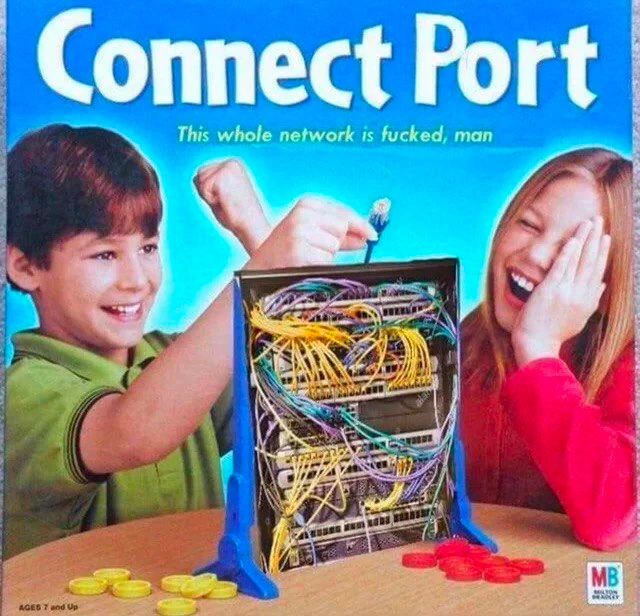
Connect Port: Childhood training for future network cabling disasters everywhere
Networking Post #155, on Feb 21, 2019 in TG

Connect Port: Childhood training for future network cabling disasters everywhere

Why is this Networking meme funny?

Level 1: The Knot Drawer, Framed

You know that drawer at home full of mystery cables, where everything is tied into one giant knot and nobody knows what any of them charge anymore? Imagine that knot stood upright, framed, and sold as a children's board game — like Connect Four, but instead of dropping checkers into a grid, you plug wires into a hopeless tangle. The kids on the box are laughing their heads off, which is the joke: the grown-ups who actually deal with these wire-spaghetti cabinets at work want to cry, not play. Putting cheerful game-box smiles on everyone's least favorite mess is like selling "Clean Your Room: The Game." Fun for ages 7 and up; despair included free.

Level 2: Patch Panels and the Spaghetti Lifecycle

The hardware being parodied:

  • A patch panel is a rack-mounted strip of female Ethernet ports. Wall jacks throughout a building terminate on its back; short patch cables on the front connect each port to a switch. It exists specifically to make cabling neat and re-routable.
  • RJ45 is the plastic clip connector on Ethernet cable ends — the "game piece" the boy is dropping in.
  • A server rack is the standardized metal frame holding panels, switches, and servers in a network closet or datacenter.

The intended workflow is tidy: every cable labeled at both ends, ports documented in a spreadsheet or DCIM tool, cables routed through guides with correct lengths. The real-world workflow is the box art: someone needs port 14 connected to switch B right now, grabs whatever three-meter cable is lying around for a half-meter run, drapes the slack across twelve other cables, and labels nothing because "it's temporary."

Your first on-site networking task will likely be tracing one cable through such a tangle. Tools that help: port link lights (unplug and watch which LED dies), a cable toner (sends a tone you trace with a probe), and switch management commands like show mac address-table that reveal what device is on which port. Lesson learned early: ten minutes of labeling saves ten hours of archaeology — a trade nobody makes until they've paid the ten hours.

Level 3: Undocumented Topology as a Family Pastime

The craft here is immaculate: authentic Milton Bradley box art — the MB logo, the "AGES 7 and Up" corner stamp, two children mid-cackle — except the Connect Four grid has been swapped for a real rack-mounted patch panel vomiting tangled yellow, blue, purple, and white Ethernet. The boy triumphantly drops an RJ45 connector into the top like a checker. The tagline abandons all family-friendly pretense:

This whole network is fucked, man

Every sysadmin laughs, then winces, because the parody describes their actual Tuesday. The rack on the box isn't exaggerated — it's recognizable. Network closets reach this state through a completely rational sequence of locally sane decisions: an urgent cross-connect during an outage ("we'll dress it later"), a contractor who patched forty drops the day before go-live, a "temporary" link that survived three office reorganizations, and the gradual extinction of anyone who remembers which cable feeds the CFO's VoIP phone. Cable management is the physical-layer version of technical debt: invisible in the sprint, catastrophic in the audit, and never funded because tidy cabling produces zero feature velocity.

The game mechanics map onto the job with disturbing fidelity. Connect Four is about dropping a piece and tracing lines; rack archaeology is about pulling a piece and praying about lines. Without labels or an up-to-date patch schedule, the only diagnostic methods left are the tone generator, the link-light wiggle test ("wiggle it... WIGGLE IT"), and the high-stakes empirical approach — unplug it and see who screams. That last one is genuinely how undocumented ports get identified in the wild, which is why the tagline isn't hyperbole; it's the official network diagram. The kids' joy is the meme's darkest layer: the girl covering her face is every senior engineer watching a junior yank a cable in production, and "AGES 7 and Up" quietly asserts that the skill ceiling for creating this disaster is, in fact, seven.

There's also a sly competitive truth: in real Connect Four somebody wins. In Connect Port, the network always wins.

Description

Parody board-game cover styled like Milton Bradley’s Connect Four. Huge blue background headline reads “Connect Port”; underneath, smaller yellow text states “This whole network is fucked, man.” Two children (faces blurred) sit at a table, dropping Ethernet connectors into a vertical frame that is actually a miniature rack: two 24-port switches stuffed with a chaotic tangle of yellow, green, purple, and blue patch cables. Red and yellow plastic discs from the original game are scattered on the tabletop, with small print “AGES 7 and Up” in the lower left and an MB logo in the lower right. The meme lampoons catastrophic cable management and Layer-1 chaos, turning a nightmare patch panel into a child’s toy - a relatable joke for network engineers and sysadmins who inherit spaghetti racks

Comments

7
Anonymous ★ Top Pick Connect Port: the only game where you drop a cable, pray STP reconverges, and lose if you’re the first one paged
  1. Anonymous ★ Top Pick

    Connect Port: the only game where you drop a cable, pray STP reconverges, and lose if you’re the first one paged

  2. Anonymous

    The winning move is always finding the one cable that takes down production, but nobody knows which color it is because the documentation just says "temporary fix - 2008."

  3. Anonymous

    Ages 7 and up, because tracing an unlabeled cable through that rack takes about that many years

  4. Anonymous

    When the previous network admin's documentation was 'just follow the yellow cables' and you realize they're ALL yellow cables. This is what happens when 'it works, don't touch it' becomes the entire disaster recovery plan - except now you're the one holding the tweezers at 3 AM trying to trace which cable goes where while the entire production environment hangs in the balance. Bonus points if the labels fell off five years ago and nobody thought to update the network diagram since the Clinton administration

  5. Anonymous

    Finally, a family game that teaches Layer‑2: take turns patching until STP blocks half the tree, DHCP jumps VLANs, and PagerDuty declares the winner

  6. Anonymous

    Layer 1 CAP theorem: no Consistency, dubious Availability, inevitable Partition - by coffee spill

  7. Anonymous

    Connect Port: layer-2 Jenga with STP disabled, everything on VLAN 1, and a Visio last updated in 2009

Use J and K for navigation