Skip to content
DevMeme
121 of 7435
When a dev meltdown gets the classic "you’ll be OK" response
MentalHealth Post #154, on Feb 21, 2019 in TG

When a dev meltdown gets the classic "you’ll be OK" response

Why is this MentalHealth meme funny?

Level 1: Becoming Fine the Hard Way

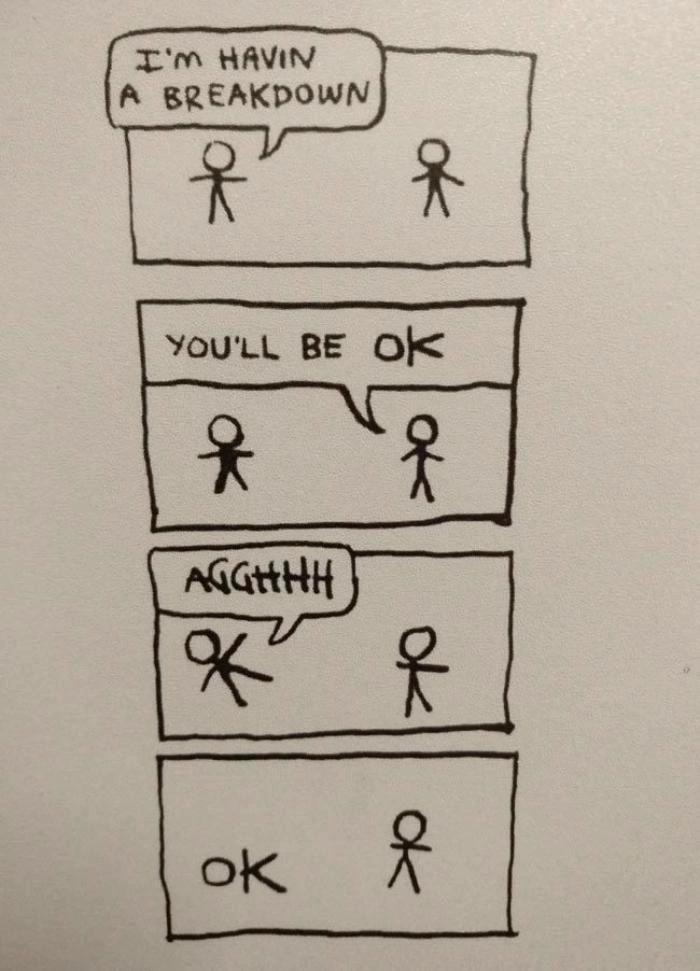
A little stick person tells a friend, "I'm falling apart!" The friend says what friends always say: "You'll be OK." Then the little person screams, twists up like a pretzel — and turns into the actual letters O and K, standing there on the page. The friend was right, in the most ridiculous way possible: they became OK. It's funny like when someone asks "are you okay?" and you say "I'm fine" through gritted teeth — the word is true, but only the word. Sometimes "ending up OK" doesn't mean you got better; it just means that's what the sign on the outside says now.

Level 2: Health Checks, Status Pages, and Saying You're Fine

The tech metaphor everyone reads into this comic comes from how software reports its own condition:

  • 200 OK is the HTTP status code meaning "request succeeded." It says nothing about how close to disaster the server was while succeeding.
  • A health check is a tiny endpoint (often literally /health returning {"status": "ok"}) that load balancers and orchestrators poll to decide whether a service is alive:
app.get('/health', (req, res) => {
  // crashed twice this morning, memory at 97%, but right now?
  res.status(200).send('OK');
});
  • Crash-and-recover is normal operation in modern infrastructure: Kubernetes restarts a dying container, the restart succeeds, the status returns to green. The "AGGHHH" panel happened; the dashboard only shows panel four.

Early in your career you'll learn that "the service says OK" and "the service is okay" are different claims — and that the same applies to teammates. The first time a system you own melts down at night and is mysteriously green by morning standup, you'll feel exactly like the second stick figure: technically your reassurance came true, but you're not entirely sure what you're standing next to anymore.

Level 3: Returns 200 OK, Root Cause Unknown

Four hand-drawn panels, maximum economy. One stick figure announces "I'M HAVIN A BREAKDOWN"; its friend offers the all-purpose consolation "YOU'LL BE OK"; the first figure screams "AGGHHH", limbs contorting mid-transformation; and in the final panel the figure has literally become the letters OK — the prophecy fulfilled by way of total structural collapse. Look closely at panel three and the contortion is already legible as a half-formed O and K: the breakdown and the becoming are the same motion.

What makes this comic land hard in engineering circles is how precisely it maps onto how we report system and human state. Every on-call engineer has watched a service thrash through a meltdown — OOM kills, restart loops, screaming in the logs — and then settle into a health check that cheerfully reports 200 OK, as if nothing happened. The check passes because health checks measure shape, not history. The stick figure is, in the most literal sense possible, shaped like OK now. Whether anything inside survived the transformation is out of scope for the probe. No postmortem is filed; the dashboard is green; everyone moves on.

The human reading is darker and just as accurate. "You'll be OK" is the workplace's favorite null-op response to burnout — syntactically supportive, semantically empty. And the comic's grim insight is that the person does end up "OK," in exactly the way the system does: the visible status normalizes while the underlying structure has been permanently rearranged by the scream. Anyone who has answered "how are you doing?" with "fine" during their third consecutive incident week recognizes the final panel as a self-portrait. It's the difference between recovering and merely passing the readiness probe — a distinction observability tooling can't see and standups don't ask about. The friend's posture in panel four, standing placidly beside the letters that used to be a person, is every retro where the action item was "monitor the situation."

The hand-drawn crudeness is load-bearing, too: a polished render would make this whimsical, but wobbly marker lines on paper give it the energy of something sketched during the meeting it describes.

Description

Black-ink, four-panel stick-figure comic on a white background. Panel 1: two figures face each other; the left one says in a speech bubble, “I’M HAVIN A BREAKDOWN”. Panel 2: the right figure replies, “YOU’LL BE OK”. Panel 3: the left figure flails and screams, “AGGHHH”, while the right figure remains still. Panel 4: both stand calmly and the left figure now simply says, “OK”. The minimalist drawing humorously captures the abrupt emotional cycle many engineers experience when code, deadlines, or on-call incidents push them toward burnout and a teammate offers the most generic reassurance possible

Comments

7
Anonymous ★ Top Pick Me: “I’m in a full-on CrashLoopBackOff.” Manager: “You’ll be ok.” Ah, the human version of setting restartPolicy: Always and calling it resilience
  1. Anonymous ★ Top Pick

    Me: “I’m in a full-on CrashLoopBackOff.” Manager: “You’ll be ok.” Ah, the human version of setting restartPolicy: Always and calling it resilience

  2. Anonymous

    The four stages of debugging a race condition: denial, false hope, existential dread, and then realizing it was a missing volatile keyword the whole time

  3. Anonymous

    Classic incident lifecycle: catastrophic failure, brief screaming, then the health check returns OK and everyone moves on without a postmortem

  4. Anonymous

    This is the emotional equivalent of a production incident where someone says 'just restart the service' while the entire distributed system is cascading into failure. The reassurance 'you'll be OK' works about as well as telling a developer with 50 merge conflicts and a Friday 5pm deployment that 'it's probably fine.' By panel four, we've achieved what systems engineers call 'catastrophic failure' - where the original problem has escalated beyond recovery and now you're just documenting the postmortem. The real kicker? The person offering comfort is still standing there saying 'OK' like they've successfully resolved a P0 incident, while their colleague has essentially segfaulted out of existence

  5. Anonymous

    Classic prod firefight: alert storm -> 'recheck config' -> AGHHH (it's the cache again) -> rollout restart -> ok

  6. Anonymous

    Classic SEV‑1: dashboards insist on 200 OK while the on‑call screams; even the reassurance breaks down into the next frame - like our error budget

  7. Anonymous

    Prod: “I’m having a breakdown.” /health: “You’ll be 200 OK.” On-call screams while the status page stays green

Use J and K for navigation