Skip to content
DevMeme
123 of 7435
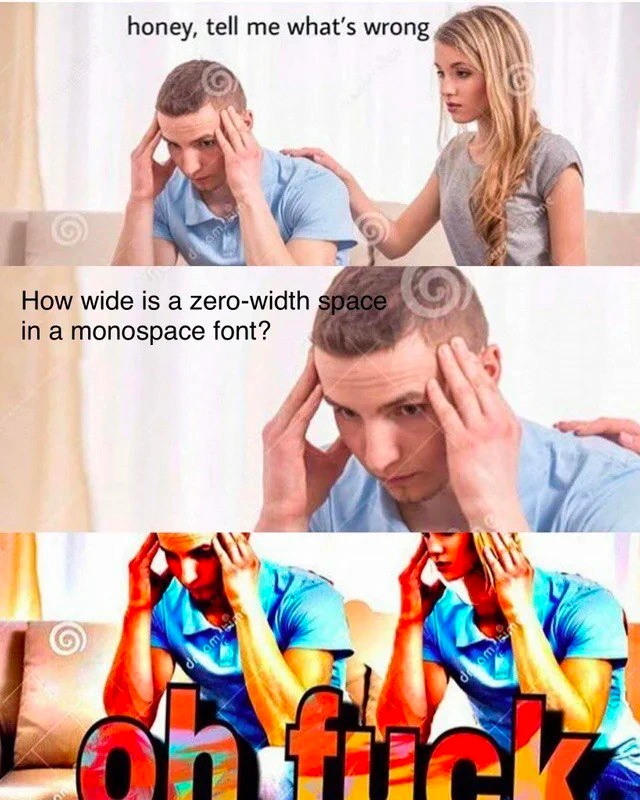
When zero-width spaces break the certainty of your monospace font assumptions
DataFormats Post #156, on Feb 21, 2019 in TG

When zero-width spaces break the certainty of your monospace font assumptions

Why is this DataFormats meme funny?

Level 1: The Invisible Brick

The man on the couch is wrecked because he asked himself a question with no comfortable answer, like "what does the color blue taste like?" In computer-land, there's a special typed character that's completely invisible and takes up no room at all — and there are also special typewriter-style letters where every character is supposed to take up exactly the same amount of room. So what happens when the invisible no-room character shows up at the typewriter? Both rules can't be the boss. It's like asking how much an invisible brick weighs in a store where everything costs exactly one dollar. By the last panel, even his girlfriend has caught the headache — because once you hear the question, you can't unhear it.

Level 2: Invisible Characters, Visible Consequences

Definitions for the panels:

  • Monospace font: a font where every character is the same width — i and W occupy identical space. It's what code editors and terminals use so things line up.
  • Unicode: the standard assigning a number (codepoint) to every character in every writing system — plus many characters that aren't really "characters," like control and formatting marks.
  • Zero-width space (U+200B): an invisible character that takes up no space. Its legitimate purpose is telling text layout "you may break the line here" inside long unbroken strings.

The classic junior-dev encounter:

>>> s = "hello​"
>>> s == "hello"
False
>>> len(s)
6        # but it *looks* like 5 characters
>>> print(s)
hello    # looks completely normal

You'll meet this the first time a copy-pasted API key "doesn't work," an environment variable comparison mysteriously fails, or a username exists twice in the database while looking identical. The fix ritual: print the repr(), check byte lengths, strip or normalize input (unicodedata.normalize, or filtering zero-width codepoints) at the boundary. Once burned, you never trust pasted text again — which is, honestly, the correct lesson.

Level 3: Schrödinger's Glyph in Production

The meme's format — the "honey, tell me what's wrong" stock couple collapsing into a deep-fried "oh fuck" final panel — is the canonical vehicle for questions that look like shower thoughts and turn out to be load-bearing. Because U+200B isn't a typography trivia question for working developers; it's an incident category.

Zero-width characters are invisible in every place you'd look for them: editors render nothing, terminals render nothing, code review diffs render nothing. Yet they're there — copied in from a Slack message, a Word doc, a website that injects ZWSPs to control line wrapping or to fingerprint copied text. Then "admin" === "admin​" is false, the config key doesn't match, the JSON parser is fine but the lookup fails, and someone spends four hours bisecting a bug whose root cause occupies zero pixels. It's the perfect crime: the evidence is literally invisible. Security folks know the darker cousins — zero-width joiners in homograph spoofing, invisible characters smuggled into identifiers (the "Trojan Source" genre of attack) — which is why linters and editors eventually grew "render invisible Unicode" warnings, an admission that humans cannot be trusted to see nothing and conclude nothing is there.

The joke's deeper resonance is the paradox collision itself: monospace is the one typographic promise developers organize their entire visual world around — aligned columns, ASCII art, indented code — and zero-width is the one character that politely declines the premise. The question "how wide is a zero-width space in a monospace font?" has the same structure as "what happens when an unstoppable force meets an immovable object?", except this one ships in your dependency tree.

Level 4: wcwidth() and the Lie of the Grid

The question torturing this poor man has a real answer, and it lives in one of computing's grubbiest corners: the gap between characters, glyphs, and display cells. Monospace rendering is built on the terminal-era fiction that text is a grid where every character occupies exactly one cell. Unicode shattered that fiction decades ago, and the wreckage is administered by functions like POSIX's wcwidth(), which assigns each codepoint a column width of 0, 1, or 2 (or -1 for non-printable). Combining accents get 0; most characters get 1; East Asian "wide" characters get 2 per the Unicode East Asian Width annex. The zero-width space, U+200B, is formally a Cf-adjacent oddball — a Zs-defying format-ish character whose entire job is to mark a legal line-break opportunity while contributing zero advance width.

So the pedantic answer is: zero columns, even in a monospace font — a monospace font's invariant only ever applied to glyphs with positive advance width, and ZWSP has an advance width of 0 by definition. But here's where the existential dread is justified: that answer holds only if every layer of the stack agrees. Font fallback can swap in a font where the codepoint is missing and render a tofu box (width 1!). Terminal emulators disagree with wcwidth() versions compiled years apart, which is why your TUI app misaligns columns on one machine and not another. String length APIs disagree with all of them: "a​b".length is 3 in JavaScript (UTF-16 code units), the rendered width is 2 cells, and the visual appearance is 2 characters. Width is not a property of a character — it's a negotiation among the codepoint, the font, the shaping engine, and the renderer. The man's headache is the correct physiological response to learning that the grid was never real.

Description

Three - panel meme using a stock photo of a worried man and a consoling woman on a couch. Panel 1 shows the couple with the caption, “honey, tell me what’s wrong.” Panel 2 zooms in on the man’s stressed face with the question, “How wide is a zero-width space in a monospace font?” Panel 3 applies an over-saturated, glowing filter to the same scene and overlays huge red and black text reading, “oh fuck,” conveying instant panic. The joke hinges on the Unicode ‘zero-width space’ - an invisible character that contradicts expectations of fixed-width glyphs in monospace fonts - highlighting real-world bugs caused by unseen characters in code, logs, or diffs that derail debugging sessions for developers

Comments

7
Anonymous ★ Top Pick Zero-width spaces: the only character that sails through code review, survives the linter, passes CI, and still takes prod down by silently gaslighting your grep
  1. Anonymous ★ Top Pick

    Zero-width spaces: the only character that sails through code review, survives the linter, passes CI, and still takes prod down by silently gaslighting your grep

  2. Anonymous

    This is the same bug that made me spend three hours debugging why our terminal-based monitoring dashboard was misaligned, only to discover someone had helpfully added zero-width joiners to make the emoji in our status messages render correctly

  3. Anonymous

    It's Schrödinger's glyph: zero columns wide until it breaks your terminal alignment, your diff, and a string comparison in production

  4. Anonymous

    This is the kind of question that makes you realize your entire understanding of typography is built on a foundation of convenient lies. In theory, a zero-width space should occupy exactly zero pixels. In practice, monospace fonts need every character to occupy the same width for alignment. So what happens? The rendering engine has an existential crisis, your layout breaks in Safari but not Chrome, and you spend three hours debugging why your perfectly aligned ASCII art looks like it went through a blender. The real answer? It depends on the browser, the font, the phase of the moon, and whether the rendering engine's developers had already encountered this paradox and decided to just pick a number and move on with their lives

  5. Anonymous

    Zero by spec, but nukes your PR diff alignment like a stealthy merge conflict ninja

  6. Anonymous

    Zero‑width space in a monospace font: everything lines up, git diff shows nothing, and the HMAC still fails - Unicode’s reminder that “monospace” is a UX promise, not a parsing invariant

  7. Anonymous

    My pre-commit bans trailing whitespace, but the zero‑width space’s lawyer argued it isn’t whitespace - and production agreed

Use J and K for navigation