Skip to content
DevMeme
1817 of 7435
A 64th Birthday, Represented in Off-By-One Binary
CS Fundamentals Post #2025, on Sep 8, 2020 in TG

A 64th Birthday, Represented in Off-By-One Binary

Why is this CS Fundamentals meme funny?

Level 1: One Candle Trick

Instead of putting 64 candles on the cake (one for each year of Mom’s age), Dad used a little secret code with the candles. He lined up eight candles and only lit one of them, because that one lit candle in the right spot means “64” in computer language. It’s like a clever shortcut: imagine if you had a special set of signal flags where just raising one particular flag tells a whole number by itself. To most people, it just looked like only one candle was burning, but to those who know the code, it said “Happy 64th Birthday!” This made everyone laugh because it’s such a geeky dad thing to do – using a computer-style trick in a simple birthday party. In the end, Mom got to blow out just one candle, but she still knew it stood for all 64 years, and that made the celebration both easier and extra fun.

Level 2: Binary Candle Counting

At its core, this meme is all about binary, the way computers count using only two symbols: 0 and 1. In everyday life we count in decimal (base-10), using ten symbols (0-9). But computers use base-2, where each place value is a power of two. A bit (short for binary digit) is each individual 0 or 1 – basically a tiny Boolean flag that can either be true (1) or false (0). When you line up multiple bits, each position in that binary number represents a certain value. From the rightmost bit representing 1, each bit to the left doubles in value: 1, 2, 4, 8, 16, 32, 64, 128, and so on. So with eight bits in a row, you have place values of 1 through 128. This is why eight bits (a byte) can represent numbers up to 255. It’s like each candle on that cake was assigned a value: the rightmost candle counts for 1 year, the next one counts for 2 years, then 4, 8, 16, 32, 64, and the leftmost would be 128 years. By turning a candle “on” (lighting it), Dad is saying “count this many years!”, and leaving a candle “off” means “don’t count those years.”

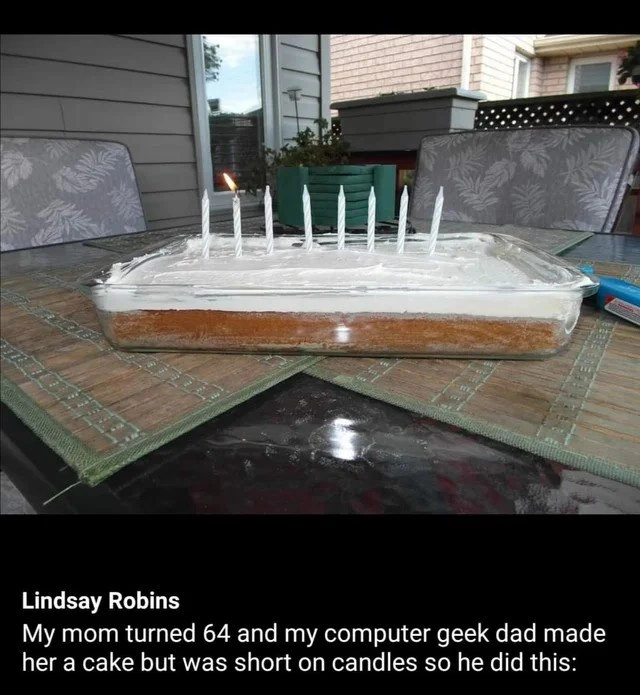
In the photo, eight slim candles are arranged in a row on the cake, acting like eight binary digits. Only the second candle from the left is lit; the other seven are unlit. Let’s label the candles from left (highest value) to right (lowest value) with their year values:

  • 1st candle (leftmost) – 128 years
  • 2nd candle – 64 years
  • 3rd candle – 32 years
  • 4th candle – 16 years
  • 5th candle – 8 years
  • 6th candle – 4 years
  • 7th candle – 2 years
  • 8th candle (rightmost) – 1 year

Lighting a candle means we include that many years in the total age. So if only the 2nd candle is lit, we count 64 years and nothing else (128 is off, 32 is off, etc.). Add them up: 64 + 0 + 0 + ... + 0 = 64. That matches the mom’s age exactly! In binary, this pattern of one lit and the rest unlit is written as 01000000 (where 0 means an unlit candle and 1 means a lit candle). This pattern is essentially a bit mask with just the 64-value bit set to 1. If you’re new to the term, a bit mask is just a specific configuration of bits used to pick out certain values; here the configuration is “only count the 64”. It’s like highlighting one column in an abacus or one dial on a combination lock while ignoring the others. The dad basically said, “I only need the 64 out of all these place values,” and lit that one accordingly.

This clever candle trick is an application of basic Boolean logic and binary math in a real-world setting. Each candle was a binary switch: on = yes, include this number; off = no, skip this number. By choosing which candles to light, you can represent any age up to 255 with just 8 candles. For example, if mom had turned 65 instead, dad could light the 64-year candle and the 1-year candle (that would be 01000001 in binary: 64 + 1 = 65). If she were 63, he’d light the candles for 32 + 16 + 8 + 4 + 2 + 1 (which all add up to 63, a pattern 00111111 with six candles lit). The fact that 64 only needs one specific candle lit (because 64 is exactly one of those power-of-two values) made the joke extra perfect. It’s a lot more efficient than lighting 64 individual candles, right? It’s the same reason we don’t usually count to 64 on our fingers by raising 64 fingers (impossible!) – instead, we use place value systems to represent big numbers with a limited set of positions. In daily life, we might use two digits "6" and "4" to make 64 in decimal. Here Dad just used a different base system.

For a newcomer to computing, the takeaway is that computers count in this on/off, yes/no fashion because it maps perfectly to how hardware works (electricity flowing or not, switches open or closed). This binary birthday cake is a fun demonstration of that concept. The dad found a creative problem solving workaround for not having enough candles by tapping into his computer science knowledge. And in doing so, he turned a normal birthday tradition into a little geeky lesson. It’s a bit like a DeveloperHumor inside joke: if you understand binary, the sight of one lit candle among seven unlit ones immediately clicks as “64”. If you don’t, it just looks like a weird mistake until someone explains it. But once explained, even those unfamiliar with binary can appreciate how clever (and slightly silly) this solution is. After all, why use sixty-four candles when a few bits of information suffice? It’s a real-world example of thinking outside the box (or rather, thinking inside the byte). The humor works on a wholesome level too: it shows how proud the family is of the dad’s geekiness, turning what could have been a shortage into a memorable, code-inspired celebration.

Level 3: Byte-Sized Celebration

The dad in this meme basically turned a birthday cake into an 8-bit number display. He lined up eight candles like bits in a byte, and lit only one of them – the exact pattern for 64 in binary. In standard binary notation, 64 (decimal) is 01000000 (that's one bit set to 1 and the rest 0 in an 8-bit sequence). By lighting just the second candle from the left and leaving the others unlit, he encoded the number 64 on the cake. Essentially, he treated each candle as a binary digit (either on or off, like a Boolean value of true or false). The single lit candle is the 2^6 place (the 64-value bit) turned on, and all other candles represent 0. It’s as if the cake had an 8-bit register and he loaded the value 0b01000000 into it, proudly presenting 64 in frosting and flames. To any geek, seeing that one lonely flame is immediately recognizable as the bit mask for 64.

In programming terms, what he did is like using a bitwise trick to save resources. Normally, age 64 would require 64 individual candles (one per year) if you go literally. That’s the unary 64 (like counting with 64 tally marks or ++++... in code). But this engineer dad applied a binary representation – a fundamental concept from computer science – to drastically optimize the candle count. One lit candle out of eight conveys the same information as 64 lit candles out of 64. This is a perfect example of compression and creative problem solving: he had limited candles (limited resources), so he encoded the data (the age) efficiently into a smaller bit field. Much like a seasoned developer packing flags into a single byte, he found a way to express a large number with minimal materials. And of course, it had the side benefit of giving mom a much easier task when blowing out the candles – just a single bit-flip from 1 back to 0 (lit to blown out)!

This joke hits home for many in the tech community because it merges everyday life with nerdy CS fundamentals. The dad literally spoke in the language of computers at a birthday party. Each candle’s state (lit or unlit) is a piece of Boolean logic, exactly how bits in computer memory represent a number. The humor comes from the absurd practicality of it: only a computer geek would think, “No problem, I’ll just express her age in binary!” It’s the same kind of logic that leads programmers to label birthday milestones as 2^5 years old (32) or 0x3F years (63 in hex) for fun. In this scenario, turning 64 is extra perfect because 64 is a power of two – a round number in binary – meaning it’s represented by a single '1' bit followed by zeros. If mom had been turning 63 or 65, dad’s binary candle solution would have needed multiple flames lit (63 is 00111111₂ with six candles lit!; 65 is 01000001₂ with two candles lit). But age 64 is 2^6, a clean power of two, so one one and seven zeros does the job. It’s as if the universe conspired to give him the most elegant binary birthday possible.

Beyond the math, this scene is dripping with DeveloperHumor and wholesome GeekHumor. We have a father who just had to inject a bit of computer-science cleverness into a family tradition. It’s funny because it’s true – many engineers can’t resist solving even trivial problems with a wink to their work. Didn’t have 64 candles? No worries: use the same mindset that solves coding puzzles to solve a candle shortage. The result is a cake that doubles as a little computer science demo. You can imagine the family chuckling (or groaning) as Dad explains that single lit candle isn’t a mistake, but actually a “64 in binary.” It’s a classic ComputerScienceHumor moment where the punchline requires knowing the inside rules of binary number systems. Those in the know get a good laugh and maybe a nostalgic flashback to early coding classes where you first learned how bits and powers of two work. Those who don’t get it immediately have a quick “aha!” moment once it’s explained – and then they see just how nerdy (and brilliant) Dad’s idea was.

This post also shows how MemeCulture in developer circles often celebrates such inside jokes. A snapshot of an ordinary birthday turned into a geeky gag gets shared around because it’s relatable to programmers. We love a good bitwise gag – it’s like a secret handshake among coders. In fact, the image caption from Lindsay Robins reads, “My mom turned 64 and my computer geek dad made her a cake but was short on candles so he did this:” which perfectly sets the stage. That line itself became part of the meme, spreading on social media and tech forums. It’s the kind of story colleagues might forward in chat saying “Haha, this is something you’d do!” The BooleanLogic of lit vs. unlit candles to signify a number taps into core CS knowledge, making it instantly shareable as a nerdy joke. And it’s heartwarming, too – behind the humor is a sweet gesture of a dad speaking his own love language (binary!) to celebrate mom’s birthday. In the world of tech inside jokes, this binary_candles cake is a lighthearted example of how our problem-solving mindset and passion for bit math can pop up in the most domestic situations. It’s both a celebration of a 64th birthday and a celebration of the enduring bit-level nerdiness that unites developers everywhere.

Description

The image shows a homemade rectangular cake with white frosting in a glass pan, sitting on an outdoor table. On top of the cake are eight birthday candles arranged in a line. The leftmost candle is lit, while the other seven are unlit. Below the photo is a caption from 'Lindsay Robins' which reads: 'My mom turned 64 and my computer geek dad made her a cake but was short on candles so he did this:'. The humor is intended for a tech-savvy audience who will recognize that the candles are being used to represent the age 64 in binary. In an 8-bit system, lit candles are '1's and unlit are '0's. The number 64 in binary is 01000000. However, the candles on the cake represent 10000000, which is binary for 128. This mistake is ironically the core of the joke for experienced developers, as it perfectly represents a classic 'off-by-one' or 'zero-indexing' error, a common bug in programming, making the dad's geeky gesture even more authentic and relatable


Comments

7
Anonymous ★ Top Pick It's not a mistake, it's a tribute. He's celebrating the day she'll complete her second 64-year-long sprint
  1. Anonymous ★ Top Pick

    It's not a mistake, it's a tribute. He's celebrating the day she'll complete her second 64-year-long sprint

  2. Anonymous

    “I didn’t forget 63 candles - I just set the 0x40 flag. QA (a.k.a. Mom) still filed a bug: ‘Why do I render as an @ sign?’”

  3. Anonymous

    After 20 years of explaining why arrays start at 0 and defending semicolons, you realize the true senior engineer flex is getting your family to appreciate that 1000000 in binary is just as valid as 64 candles - and significantly more efficient on the candle budget

  4. Anonymous

    There are 10 types of people in this world: those who understand binary birthday candles, those who don't, and those who realize this dad just optimized candle usage from O(n) to O(log₂n) while simultaneously ensuring his wife's age is now immutable and stored in the most space-efficient format possible. Peak engineering: when you're short on resources but long on bit manipulation skills

  5. Anonymous

    Unary candles for 64? Nah, binary positions nail it with 7 - log₂(64)+1, because geeks refactor birthdays too

  6. Anonymous

    Classic refactor: replaced unary candle encoding with binary; mom’s age now uses 7 bits instead of 64 - finally some logarithmic scalability

  7. Anonymous

    Out of candles, he set 1<<6 and shipped a 64-bit birthday - big-endian, of course

Use J and K for navigation