The Dev-to-QA Handoff: A Study in Disbelief
Why is this QA meme funny?
Level 1: Mom Checks Your Work
Imagine you’ve just finished cleaning your room and you proudly tell your mom or dad that you’re done. You feel pretty satisfied because, at a glance, everything looks clean to you. Now your mom comes in to inspect. She picks up the first thing she sees – maybe a crumpled shirt you shoved under the bed or a corner you forgot to dust – and gives you a look of “Really? This is what you call clean?” Her eyebrow goes up, and you realize you might have missed a spot (or many spots!). In that moment, you thought you were completely finished, but your mom quickly found something you overlooked.
That’s exactly what’s happening in this meme. The developer is like you, thinking the job is done and handing over the “finished” work. The QA team is like the mom, double-checking the work. The developer hands over the software just like you handed over the idea of a clean room. But the QA person immediately spots a problem and makes a confused “Uh oh” face, just like your mom finding that mess under your bed. It’s funny because the developer didn’t expect the response – they thought everything was perfect, and the QA (like a parent checking your work) instantly shows it isn’t.
In simple terms, the meme is joking that when you give something you made to someone whose job is to find mistakes, they will find one – fast! It’s like turning in your homework and the teacher immediately noticing a big mistake on page one. The developer’s feelings in that moment are a mix of hope and worry (just like you hoping your mom wouldn’t notice the mess). The QA’s raised eyebrow means “I found a bug!” which is like your mom saying “You missed a spot.” We laugh because we’ve all been on one side or the other: either thinking “I did great!” and then hearing “Not so fast…”, or being the one who checks someone’s work and quickly spots an error. It’s a playful reminder that no matter how confident we are, a careful checker can always catch something we missed.
Level 2: Works on My Machine
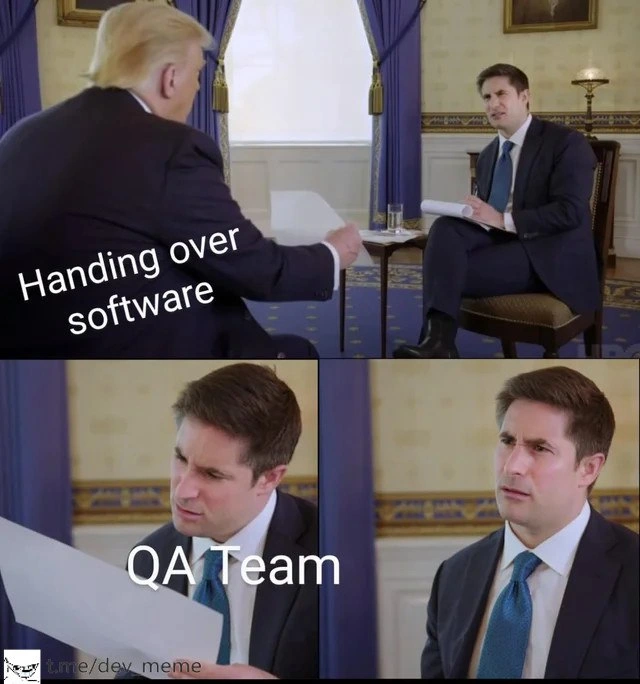
When software developers finish writing new code, they usually pass it to a Quality Assurance (QA) team for testing. Think of QA as the dedicated testers who try to use the software in all sorts of ways to make sure it actually works. The handoff in the meme – where one suited person gives a paper to another – represents a developer giving their program or feature to QA. The text “Handing over software” on the paper is basically saying, “Here’s the code, it’s ready for you to test.” The next part of the meme shows the QA Team member’s face scrunching up in confusion or disbelief as he reads it. This is labeled “QA Team” to make it clear that the person reacting is the tester. That facial expression is the joke: the QA looks immediately puzzled, as if something is very wrong or surprising in the handoff.
Why would QA react that way? In real life, when a dev says “I’m done, it works on my machine,” the QA often discovers that on a different computer or in a different scenario, it doesn’t work. “Works on my machine” has become a tongue-in-cheek phrase among programmers – it’s what a developer might say when a tester finds a bug that the dev didn’t catch. It implies, “Well, it worked fine where I built it, so maybe the problem is on your side.” Of course, that’s not a real excuse; the whole point is to make it work everywhere, not just on the developer’s computer. The meme exaggerates this interaction: the developer hands over the code confidently, but the QA’s confused look says “Uh oh, what is this? This software might have issues.”
Let’s clarify some terms. A bug is a mistake or problem in the code that makes the software act unexpectedly or incorrectly. For example, clicking a button is supposed to save your data, but due to a bug it might crash the app instead. The QA team’s job is to find these bugs in the software before users do. They’ll try all kinds of things with the program: entering unusual data, clicking things in the wrong order, using it on different browsers or devices – all to see if something breaks. This practice is part of the QA process in software development. It’s a crucial phase in any release: we call it the testing phase or QA phase of the release cycle.
The meme is labeled with QA, Bugs, Testing because it highlights the moment those three come together. The developer (who wrote the code) might have done some basic testing – they probably ran the program a few times to check the main features. But a dedicated QA tester will do more thorough testing. They often follow test plans or checklists and also get creative to catch edge cases the developer never thought about. For instance, if the developer only tested with valid inputs, QA might try entering invalid inputs (like typing letters where a phone number is expected) to see if the software can handle it or if it breaks. When something goes wrong, that’s flagged as a bug for the developer to fix. This back-and-forth can repeat for several rounds: code handoff to QA, bug discovered, code fixed, code handed back to QA, and so on, until the software is stable enough.
So in this meme’s story, the developer finally hands the code to QA, feeling pretty good – maybe thinking “I bet they won’t find much, it seems solid!” The QA person no sooner starts looking at it and… their eyebrows go up, as if they’ve already spotted a glaring bug or something confusing in the very first moments. That “skeptical QA” expression is funny because it rings true: often QA finds an issue almost immediately, even something the developer overlooked entirely. Maybe the login crashes if the password field is left blank, or the new feature doesn’t handle an outside timezone correctly – whatever it is, the tester is like, “Hold on, there’s a problem here.”
For someone new to development, this meme is a lighthearted reminder that testing is an essential part of making good software. Developers and QA might sometimes seem at odds (one builds it, the other tries to break it), but they actually have the same goal: releasing a product that doesn’t frustrate or fail on the user. The developer in the meme has to trust the QA team, even if it’s a bit embarrassing when they find issues. And the QA team, with their perplexed look, isn’t actually angry – they’re doing what they’re supposed to do: assure quality by catching those pesky bugs. It’s all part of a healthy QA testing cycle, even if it leads to a few awkward “whoops” moments for the developer along the way. In short, developers give code to QA because fresh eyes will catch problems that the original coder might miss. And as every junior dev learns, having QA find a bug before real users do is actually a relief, not an insult. Better a teammate finds the mistake now than a customer finds it later!
Level 3: The QA Gauntlet
When a developer triumphantly hands off their code to QA, it’s often with a mix of relief and release anxiety. In this meme’s top panel (a famous interview scene repurposed for TestingHumor), the developer figure confidently extends a “finished” piece of software (represented by a paper) across the table – essentially a developer-to-QA handoff. The next panels capture the QA team reaction: a raised eyebrow and skeptical frown, as if saying, “Really? You think this is ready?” This skeptical confused face response is pure DeveloperHumor gold because every experienced engineer recognizes that no code survives first contact with QA unscathed.
The humor here comes from the classic dev vs. QA dynamic. Developers often feel like their work is done when they hand over software, but for QA, the work (and the fun) is just beginning. The engineer might be thinking, “It ran on my machine, so it must be fine,” while the QA tester is already sharpening their proverbial red pen. It’s a ReleaseAnxiety moment: the developer hopes the QA process won’t uncover serious BugsInSoftware, yet knows deep down that some bug is lurking. In real life, this is the point where feature specs meet real-world use cases. The unsuspecting QA team in the title is ironic – good QA engineers are never truly unsuspecting. They actively assume something will be wrong. As the saying goes in testing circles, the job of QA is to “trust, but verify” every claim the code makes.
This meme resonates with anyone who’s been through a crunch-time release cycle. Perhaps the dev was up against a deadline and skipped a few unit tests, hoping QA wouldn’t notice. But of course, the QA team will notice – it’s literally their job. There’s a mild gotcha undertone: the developer treats the handoff like a software hand-off of a perfectly crafted document, but the QA immediately spots the first flaw, much like that journalist in the original interview noticed something off in the charts he was handed. In software terms, the QA might glance at the “document” (the release notes or the build) and instantly think of an edge case that wasn’t handled. Their incredulous look says, “Did you even test this beyond the ‘happy path’?”
To a senior developer, this scenario is painfully familiar. Handing features to QA can feel like running a gauntlet of critique – hence The QA Gauntlet. By the time you’re seasoned, you’ve learned hard lessons: a feature isn’t truly “done” until QA has tried to break it, and bugs you never imagined will surface within minutes of that handoff. There’s even a notorious proverb in our industry:
“Testing can show the presence of bugs, but never their absence.” — Edsger W. Dijkstra
In practice, that means no matter how confident you are in your code, a thorough tester can always find one more issue. The meme nails this truth. The dev’s perspective (“I’ve completed my task”) collides with the QA’s mandate (“Let’s validate this thoroughly”), and the result is the QA’s face of almost amused disbelief. It’s funny because it’s true: developers delivering to QA often get that exact facial expression in return, metaphorically if not literally. It’s a mix of “Are you kidding me?” and “Challenge accepted.”
Let’s break down the two mindsets at play when handing over software:
| Developer’s Expectation | QA Tester’s Reality Check |
|---|---|
| “Finally, it’s all done and works (on my machine)!” | “I bet I can make it break in five minutes.” |
| “All the features are implemented as requested.” | “Some edge case or input is going to knock this over, guaranteed.” |
| “No obvious bugs jumped out during my quick tests.” | “I already see a scenario in which this crashes or misbehaves.” |
| Feeling: Proud but nervous – hope it passes QA. | Feeling: Skeptical yet eager – time to hunt bugs. |
In a robust Agile team, devs and QA collaborate daily, but even then, that formal moment of handing off a build for dedicated testing is suspenseful. The meme’s paper_interview_meme_format highlights this suspense comically. The elegant room and formal handoff (almost like signing a peace treaty) contrasts with the QA’s bewildered expression, as if they found a hidden clause (“there’s a memory leak on page 2!”). It captures a truth in the software industry: no matter how gilded the environment or process, that final review by QA often reveals things that make everyone pause. And if the code is really buggy, the QA Team’s face in the meme says it all: “We’re going to be here all night fixing this, aren’t we?”
Ultimately, this meme pokes fun at the QA/developer tension to which any seasoned engineer or tester can relate. It’s a cornerstone of TestingHumor because it takes a real scenario – the developer_to_QA_handoff – and exaggerates the reactions just slightly. But only slightly! In truth, many QA folks will recognize their own raised eyebrow in that image, and many devs have worn the same uneasy half-smile as they slide their “finished” code across the table. Everyone laughs because everyone’s been there: that exact moment of “Here goes nothing” from the dev, and “Oh, here we go...” from QA.
Description
A three-panel meme using the popular format from an Axios interview with Donald Trump and journalist Jonathan Swan. In the top panel, Trump, seen from the back, hands a document to Swan. This action is labeled 'Handing over software'. The bottom two panels are close-ups of Swan's reaction. The bottom-left panel, labeled 'QA Team', shows him looking down at the document with an expression of intense confusion and scrutiny. The bottom-right panel shows him looking up with a face of pure, unfiltered disbelief and bewilderment. The meme humorously captures a classic moment in the software development lifecycle: the handoff from the development team to the Quality Assurance (QA) team. The QA team's horrified reaction implies that the software they've just received is buggy, incomplete, or fundamentally flawed, a relatable scenario for any engineer who has been on the receiving end of a 'finished' product that is anything but
Comments
7Comment deleted
The QA team's face when the commit message says 'fixed a typo' but the diff shows 3,000 lines of refactored authentication logic
Me, handing over the build: “All tests are green - I just @Ignored the flaky ones.” QA, raising an eyebrow: “Ah, Schrödinger’s release - both perfectly stable and catastrophically broken until I look at it.”
The QA team's face when they realize the 'minor refactor' touched 47 microservices, the integration tests were commented out 'temporarily' six months ago, and the only documentation is a Slack message saying 'it works on my machine' - but hey, at least the sprint velocity looked great!
That moment when the QA team receives the 'production-ready' code and their facial expression perfectly encapsulates the unspoken truth: they know exactly how many undocumented edge cases, race conditions, and 'works on my machine' scenarios are lurking in those pristine-looking documents. The formal handover ceremony is just the calm before the storm of bug tickets, each one meticulously documented with steps to reproduce that somehow the dev team will still claim they 'cannot replicate.'
Dev handover to QA: 'It works on my machine' meets the edge-case apocalypse
Handing the build to QA: their look says, “Nice charts - now let’s add real latency and retries and watch your ‘idempotent’ endpoint bill twice.”
Announcing 'feature complete' pre-QA is like asserting linearizability on an eventually consistent cluster - the first P0 repro will refute you