Skip to content
DevMeme
1816 of 7435
Lisp: The Beauty vs. The Parenthetical Nightmare
Languages Post #2024, on Sep 8, 2020 in TG

Lisp: The Beauty vs. The Parenthetical Nightmare

Why is this Languages meme funny?

Level 1: Secret Language

Imagine your friend made up a secret language and wrote a message using it. They can read it and think it's the most beautiful, sensible message ever. You, on the other hand, look at the same page and it just looks like a bunch of strange squiggles – you have no idea what it means, and it even makes you a little scared or frustrated. This meme is like that: one person understands the "secret" way it's written and sees something meaningful and clear, but someone else just sees random symbols and feels lost. It's showing how the exact same writing can feel lovely to someone in-the-know but totally overwhelming to someone who isn't.

Level 2: Parenthetical Pandemonium

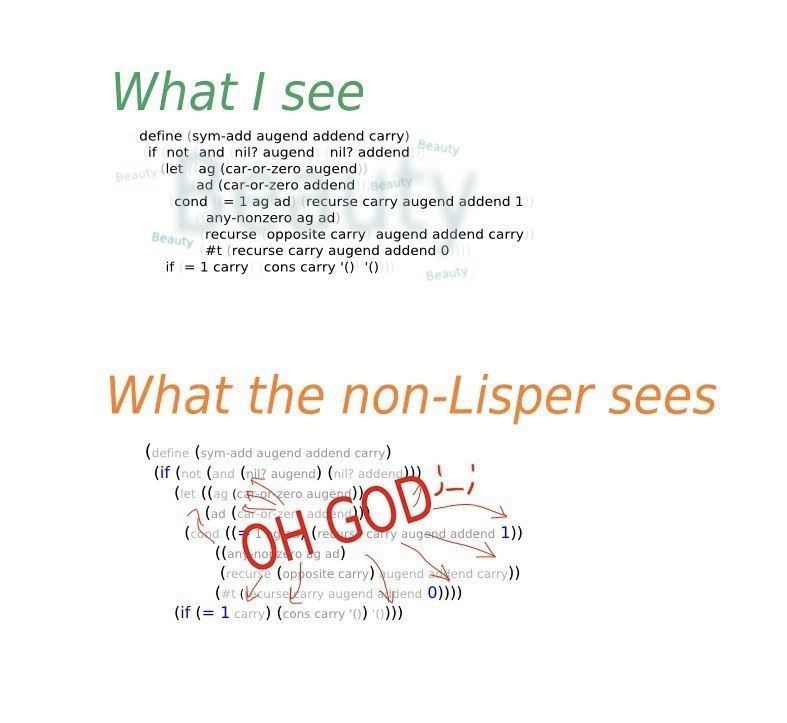
If you've never seen Lisp code before, it can look like a parenthesis overload at first. The meme shows the same piece of Lisp code from two viewpoints. At the top, "What I see" represents a programmer who knows Lisp, and they see the logic behind all those parentheses (hence the faint words "Beauty" around it). At the bottom, "What the non-Lisper sees" is someone unfamiliar with Lisp who just sees a confusing mess (hence the big red OH GOD ;_;, which is an emoticon for crying in panic). Let's demystify what's going on in that code so it doesn't seem so terrifying.

First, Lisp is a programming language (one of the oldest, actually) that stands for LISt Processor. It's known for being a functional programming language, which means it often uses functions and recursion instead of loops. One of Lisp's quirks is its syntax: instead of using lots of different punctuation (like {}, ;, etc.), Lisp uses parentheses for almost everything. Every time you call a function or write an operation, you put it in parentheses, with the name first and the arguments after. For example, in Lisp you'd write (+ 2 3) to add 2 and 3 (the + comes before the numbers, inside the ()), whereas in many other languages you might write 2 + 3 without so many parentheses. This uniform style is very powerful, but it takes some getting used to.

Let's look at the snippet from the meme. Here's how the Lisp code might appear when properly indented (spacing the lines to show which parts are inside which):

(define (sym-add augend addend carry)
  (if (not (and (nil? augend) (nil? addend)))
      (let ((ag (car-or-zero augend))
            (ad (car-or-zero addend)))
        (cond ((= 1 ag ad)       (recurse carry        augend addend 1))
              ((any-nonzero ag ad) (recurse (opposite carry) augend addend carry))
              (#t                  (recurse carry       augend addend 0))))
      (if (= 1 carry)
          (cons carry '() '()))))

That still looks like a lot, but formatting it this way helps us see matching parentheses lined up vertically. Every time a new block opens (with (), we indent the next lines, and when a block closes ()), we un-indent back. This makes the structure clearer. Now, here's what that code is doing in simpler terms:

  • Define function: The first line (define (sym-add augend addend carry) ...) means we are defining a function named sym-add with three parameters: augend, addend, and carry. (Augend and addend are just fancy terms for the two numbers we want to add, and carry is the leftover carry-over value, like the extra 1 you carry when you add 9 + 1 in grade-school addition.)
  • If condition: The next part (if (not (and (nil? augend) (nil? addend))) ... ) is an if statement. It checks not (and (nil? augend) (nil? addend)). In plain English: "if NOT(both augend and addend are nil)", which means "if at least one of the input lists still has a value". nil in Lisp represents an empty list (or false), and nil? is a question-function that checks if something is nil. So this condition is deciding whether there's still some addition to do (when inputs aren't both empty) or if we're done.
  • Let binding: Inside the true branch of that if, there's a (let ...) form. This creates some local variables. It sets ag to (car-or-zero augend) and ad to (car-or-zero addend). Likely, car-or-zero is a helper that takes the first element (the "car" in Lisp terms) of a list or uses 0 if the list is empty. Essentially, this pulls out the next digit (or bit) from each number we're adding, defaulting to 0 when one list is shorter than the other.
  • Cond (multiple cases): Next comes the (cond ...) which is like a multi-branch if (think of it as "cond"ition or a switch/case). It has a few possible cases nested inside:
    • ((= 1 ag ad) (recurse carry augend addend 1)): If ag and ad are both 1 (imagine we're adding binary digits 1+1), then it calls recurse (which likely calls sym-add again) and passes 1 as the new carry. In other words, 1 + 1 produces a carry of 1.
    • ((any-nonzero ag ad) (recurse (opposite carry) augend addend carry)): If one of ag or ad is 1 (but not both), then it calls recurse with opposite carry. This suggests it might flip the carry bit if one input has a 1 and the other has a 0. (Details aside, it's handling the case of 1 + 0 or 0 + 1, where the sum is 1 if carry is 0, or 0 if carry is 1.)
    • (#t (recurse carry augend addend 0)): #t in Scheme means "true" (used here as an "else" catch-all). This covers all other cases (probably both bits are 0). It calls recurse keeping the carry the same and setting the new result digit to 0. (0 + 0, plus whatever the carry was.) Each of these lines is one condition and the action to take. Notice each condition-action pair is in its own parentheses within the cond.
  • Finishing up: After that big if (which handled the case where there's still work to do), we see the false branch: (if (= 1 carry) (cons carry '() '())). This runs when the addition is done (i.e., when both augend and addend were nil, meaning no more digits left to add). It checks if (= 1 carry), which means "if the carry is 1 at the very end". If so, it uses cons to put that carry into a list. cons in Lisp takes an element and a list and returns a new list with that element at the front. So (cons carry '() ) would produce a list containing the carry (like adding a new most-significant digit if there's an overflow). If the carry isn't 1, this would effectively return an empty list or no extra digit. In short, this is just handling the case where an extra "1" is needed at the leftmost side of the sum (like how 99 + 1 = 100 adds a new digit).

That was a lot of detail, but the key idea is: Lisp code uses parentheses to mark every structure and operation. In the snippet above, every ( has a matching ) that ends that part of the code. To someone experienced with Lisp, this structure is very clear – they can quickly spot the define at the top, see the big if, then inside it the let and cond, and so on. The code reads step-by-step: define the function, check the base condition (are we done yet?), prepare the values for this digit, handle different cases of addition, recursively process the rest, and finally handle any leftover carry. Each set of parentheses is like a pair of invisible hands holding a piece of that logic together.

However, to a non-Lisper (someone who hasn't learned Lisp), all those parentheses can look like a wall of text. It's hard to tell where the logic breaks are because everything is enclosed in ( ). A newcomer might lose track of which parentheses correspond to which part – it's like trying to match dozens of opening and closing quotes in a sentence. It's easy to get lost if you're not used to it, kind of like trying to read a sentence where every word is inside its own pair of brackets (it [can [get [confusing] ] fast]). The bottom half of the meme with the "OH GOD ;_;" is dramatizing that overwhelmed feeling. The person sees the code and just thinks "What is all this?!"

The funny (and insightful) thing here is that nothing about the code itself changed between the two views – only the perspective changed. The experienced Lisp developer sees beauty because they understand the pattern and the simplicity behind the syntax (they know each parenthesis is there for a reason and they mentally group them). The newcomer just sees chaos because they haven't learned that pattern yet. In time, if that newcomer studied Lisp, those parentheses would start to make sense. Many people who stick with Lisp eventually stop being bothered by the parentheses at all; they focus on the logic and let the editor/IDE highlight or auto-format the code to keep it readable.

So, this meme is highlighting a common scenario in programming: the exact same code can look gorgeous to one developer and like gibberish to another, all depending on who's familiar with that language. Lisp just happens to be an extreme example because of its parentheses. If you're new to it, the code might look intimidating, but if you stick with it, you might end up thinking it's not so bad — you might even find it kind of pretty in its own weird way!

Level 3: Eye of the Lisp-Holder

Beauty vs chaos in code is truly in the eye of the beholder, and this meme nails that contrast. On the top half, a seasoned Lisp programmer looks at the snippet and sees elegance: the solution is laid out in a logical, recursive structure that makes perfect sense to them. The faint blue "Beauty" floating around the code isn't just for show – it represents how some developers genuinely admire Lisp's purity. If you've spent time in the world of functional programming, you might even find this code snippet soothing. Every parenthesis is exactly where it should be, each nested level doing its part. To a Lisp veteran, sym-add is presumably a function adding two numbers (perhaps as lists of digits) recursively. They glance at the cond and if expressions and immediately recognize the pattern of a classic recursive addition with a carry. In their eyes, the code reads almost like English: if not both inputs are nil (empty), do this; each cond branch handles a special case; finally, combine results with a cons at the end to build the output list. It's logically tidy. They might even appreciate the symmetry of all those parentheses enclosing each operation – like an ornate frame around a beautiful painting. For someone who "speaks" Lisp, this is clean code.

Now look at the bottom half: "What the non-Lisper sees." Here lies the punchline of this developer humor. An uninitiated programmer (perhaps one used to Python or Java) sees that exact same code and practically has a panic attack. The meme artist amplifies this with swirling red arrows pointing at every nested ) and a gigantic red OH GOD ;_; stamp of despair. This is a pretty accurate portrayal of the first reaction many have when encountering Lisp's syntax. Instead of seeing logical structure, the non-Lisper's brain gets stuck on the surface – "Why are there so many parentheses?!". It's as if the code is written in an alien language. They can't tell where one part ends and the next begins. It feels like parentheses overload, a whirl of punctuation with no obvious pattern. The humor is that two developers can look at the exact same snippet: one sees a serene forest of logic, and the other sees a tangled jungle of symbols.

Many experienced programmers chuckle at this meme because they've lived both sides of it. There's a well-known joke that LISP actually stands for "Lots of Irritating Superfluous Parentheses." That's what people say when Lisp's syntax overwhelms them. Those who have battled with Lisp (maybe in a college class or a side project) remember the early days of counting parentheses, desperately trying to match each ( with the correct ) without losing their mind. The meme's use of the crying emoticon and the OH GOD stamp perfectly captures that dread. It's a shared war story in programming culture: "I opened some Lisp code, and I thought my eyes were going to bleed from all the symbols!"

Yet, the other side of that story is the Lisp guru calmly watching the newbie spiral into despair, thinking "What's the big deal? It's just code." As developers gain experience with Lisp, something almost magical happens: the parentheses fade into the background. They see the structure through the symbols. It's like solving a puzzle so many times that you no longer notice the individual puzzle pieces – you just see the picture they form. In fact, many Lisp developers use editors that highlight matching parentheses or automatically indent code in a consistent way. With the right tools and a bit of habit, a block of Lisp code has a clear shape, and those parentheses are more like scaffolding – they hold the code together, but you don't focus on each one. The top half's perspective is what you get once you've internalized the Lisp way of thinking. You start to find a kind of beauty in that uniformity. The code becomes predictable and consistent, almost soothing in its lack of surprises. All those ) that once felt chaotic now just politely signal the end of each thought, nice and orderly.

This meme also pokes fun at the perennial language wars. Every programming language has its little quirks. C and Java have curly braces everywhere, Python uses whitespace and colons, and Perl is infamous for line-noise punctuation. Lisp's quirk is, of course, its heavy use of parentheses. And in typical syntax humor fashion, the meme exaggerates this trait to get a laugh. The non-Lisper is depicted as literally overwhelmed by brackets, while the Lisper is in paradise. It's funny because it's rooted in truth: plenty of developers have groaned "Oh no, not Lisp, my brain hurts!" upon seeing code like this, even as devoted Lisp fans swear by the clarity and power that exactly that same syntax affords them. The title of this level says "Eye of the Lisp-Holder" – a play on "eye of the beholder" – and it really fits. The code itself hasn't changed at all, but your background and mindset completely change how it looks. What appears chaotic to one can look beautifully logical to another.

This meme gets a laugh (and a knowing nod) because it highlights a real divide in perspective. It's not really saying one side is right or wrong – it's just observing, with some humor, how familiarity makes all the difference. In programming, we've all been that person staring at someone else's "beautiful code" and seeing nothing but nonsense. And we've also been the person who finds something elegant that outsiders deem crazy. So the next time you hear a developer rave about how gorgeous their Lisp (or Haskell or regex or any acquired-taste tech) code is, remember this meme. It's a chuckle-worthy reminder that in software, one person's elegant solution can be another person's terrifying tangle – and that sometimes, the only difference is who learned to read the "secret syntax" and who hasn't (yet).

Level 4: Homoiconic Harmony

In Lisp, those endless nested ( parentheses ) aren't just random clutter – they embody a deep concept called homoiconicity. This fancy term means code and data share the same structure. A Lisp program is essentially a list of lists (an S-expression) written out explicitly. Each parenthesis in that snippet is delimiting a list, which represents a function call or a logical grouping. To the initiated, this isn't noise at all – it's the raw abstract syntax tree (AST) of the program laid bare. In Lisp, code is data; that symphony of parentheses is actually the program "thinking out loud" in its simplest, structured form.

This uniform structure comes straight from mathematical logic. Lisp was inspired by the λ-calculus (the theoretical foundation of functional programming), where every function application is fully parenthesized. While languages like C or Java rely on operator precedence rules and lots of syntax variety, Lisp takes a minimalist route: everything goes in parentheses, explicitly indicating evaluation order and scope. This minimal grammar makes Lisp parsers almost trivial – if you can match parentheses, you can parse Lisp. There's a certain elegance to that simplicity. Seasoned Lisp developers often say Lisp has no syntax at all, only structure, because there are no infix operators or arcane rules – just that one, consistent list notation repeated.

The beauty an experienced Lisper sees is partly due to this theoretical elegance. The code snippet in the meme might look like a jumble to outsiders, but a Lisper recognizes it as a perfectly balanced hierarchical form. Every ( opens a new level of logic; every ) closes one, like a matched pair in a well-formed mathematical proof. They see harmony in how the parentheses nest, revealing the shape of the computation. It's like looking at the source code of the program's mind: meticulously parenthesized, symmetric, and explicit.

Homoiconicity also unlocks Lisp's legendary metaprogramming powers. Those parentheses allow Lisp to treat its own code as a manipulable data structure. For instance, Lisp macros can generate and transform code on the fly, because creating a new piece of code is as simple as building a list of symbols (with parentheses naturally representing the structure of that code). This is something devotees admire: the language is inherently extensible in ways others aren't, thanks to its uniform syntax. What seems like "parenthesis overkill" to a newcomer is actually what allows Lisp to be so malleable and expressive at a fundamental level.

Ironically, the very thing that terrifies the non-Lisper – a thicket of parentheses – is exactly what gives Lisp its elegant simplicity and power in the eyes of its enthusiasts. A veteran Lisp developer doesn't literally see a wall of ) – they see a structured tree of expressions, as clear to them as a neatly factored equation or a well-indented outline. The meme humorously contrasts this deep appreciation with the confusion of someone who hasn't internalized that structure yet.

Description

A two-panel meme comparing the perception of Lisp code between a seasoned Lisp programmer and an outsider. The top panel, titled 'What I see' in a calm green font, displays a block of Lisp code for a symbolic addition function `(define (sym-add augend addend carry) ...)`. The code is visually clean, with the word 'Beauty' faintly watermarked over it, suggesting the viewer finds it elegant and clear. The bottom panel, titled 'What the non-Lisper sees' in a more alarming orange font, shows the exact same code. However, this version is chaotically annotated with hand-drawn scribbles, arrows pointing to the numerous parentheses, and the phrase 'OH GOD' scrawled in large red letters, conveying a sense of overwhelming confusion. The humor is rooted in Lisp's notorious syntax, which relies heavily on nested parentheses (S-expressions). For proponents, this homoiconicity (code as data) is a source of power and elegance. For developers unfamiliar with the paradigm, it often appears as an intimidating and unreadable 'parenthesis hell.'

Comments

7
Anonymous ★ Top Pick A non-Lisper sees a dozen nested parentheses and panics. A Lisper sees a dozen nested parentheses and thinks, 'Ah, a macro is about to be born.'
  1. Anonymous ★ Top Pick

    A non-Lisper sees a dozen nested parentheses and panics. A Lisper sees a dozen nested parentheses and thinks, 'Ah, a macro is about to be born.'

  2. Anonymous

    Funny how folks flinch at Lisp’s parentheses, then calmly indent 200-line Kubernetes YAML - congratulations, you’ve reinvented s-expressions without a parser

  3. Anonymous

    After 20 years in the industry, you realize the real recursion isn't in the Lisp code - it's explaining to management why rewriting everything in a 'simpler' language will actually make it more complex, then watching the next architect have the same conversation three years later

  4. Anonymous

    This perfectly captures why Lisp developers insist their editor's paren-matching is a 'feature, not a bug' - because without syntax highlighting and auto-indentation, even they would be frantically counting parentheses at 2 AM wondering if that's a cons cell or an existential crisis. The real joke? After 20 years of Lisp, you stop seeing the parens entirely and just perceive the AST directly... which is exactly what a non-Lisper fears they'll become

  5. Anonymous

    Non‑Lispers panic at the parentheses; Lispers only panic when they all balance - because that’s when the bug’s hiding in macroexpand

  6. Anonymous

    Lisp code review is just verifying the paren stack stays balanced - while the macro shipped the feature before you finished counting

  7. Anonymous

    Lispers balance parens like a well-architected monolith; non-Lispers see the fractal descent into eternal nesting

Use J and K for navigation