Skip to content
DevMeme
1749 of 7435
C Programming and the Perils of Pointing
Languages Post #1954, on Aug 23, 2020 in TG

C Programming and the Perils of Pointing

Why is this Languages meme funny?

Level 1: Stay In Bounds

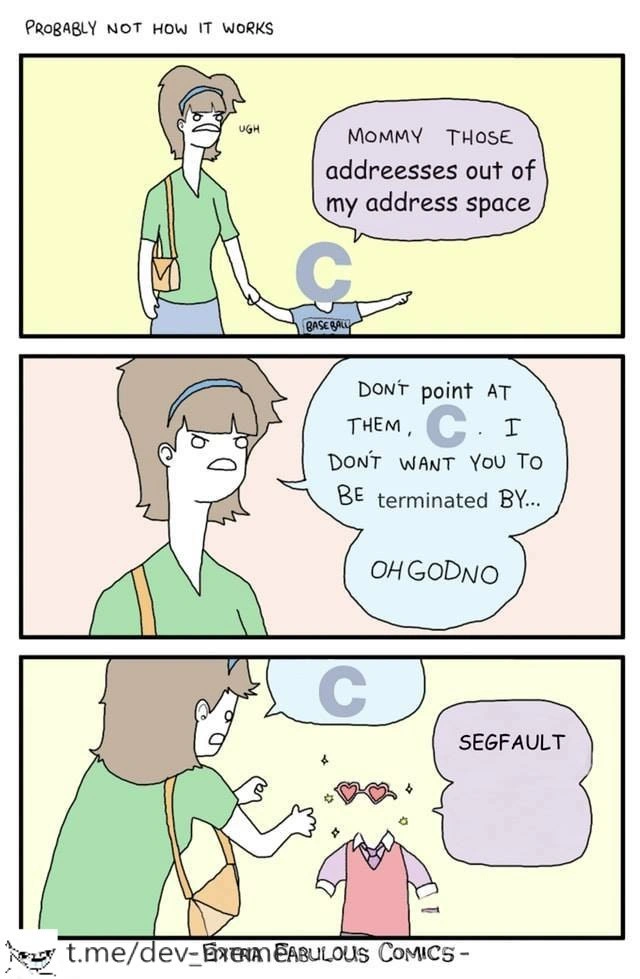
Imagine you have a play area that’s safe for you to play in, and there are warning signs at the edges saying “Do not go beyond this point.” Now picture a little kid who sees something interesting beyond the fence – maybe in the neighbor’s yard – and starts pointing at it and trying to run over there. The child’s parent immediately shouts, “Don’t go there, it’s not safe!” But the kid doesn’t listen and steps past the boundary. Poof! In a flash, the kid disappears as if magically zapped for crossing the line. The parent is left panicking, saying “Oh no!” In this story, the play area is like a program’s allowed memory, the curious kid is a C program’s pointer, and the neighbor’s yard is memory that doesn’t belong to that program. The sudden disappearance? That’s the program getting stopped by the computer for breaking the rules. It’s a funny-cartoon way to show that when a C program “points” outside its allowed zone, it gets in serious trouble – game over, just like a kid who ignored the safety fence. The moral: stay within the safe boundaries, or unexpected (and very bad) things can happen!

Level 2: Pointer Crash Course

Let’s break down the joke in simpler terms. In the C programming language, a pointer is a variable that holds a memory address. Think of it like a street address pointing to a house – except the houses are bytes in your computer’s memory. In C, pointers are powerful but dangerous: the language doesn’t automatically check if the address is valid or “within your territory.” The address space is basically the range of memory addresses that a program is allowed to use. When the child in the comic says “those addresses [are] out of my address space,” it means the pointer is seeing addresses that the program doesn’t own or shouldn’t touch.

The mom’s warning “Don’t point at them, C. I don’t want you to be terminated” translates to a very real caution in programming: “Don’t even try to access memory that isn’t yours, or the program will crash.” In computing, a Segmentation Fault (often shortened to segfault) is exactly that crash. It’s a runtime error that happens when you try to read or write memory outside of the area the program is allowed to access. This could happen because of a bug like an invalid pointer dereference (using a pointer that isn’t properly set to a valid address), or going past the end of an array (a classic out-of-bounds error). Essentially, the computer’s memory has strict boundaries, and stepping outside them is not allowed – the operating system will instantly stop the program as a protective measure. That stoppage is what we see as a segmentation fault. On Windows, you might hear it called an "Access Violation", but it’s the same idea.

In the comic, C (the child) is effectively a pointer variable that just did something like this in code:

int *ptr = NULL;         // ptr doesn't point to a valid address (NULL = 0)
*ptr = 42;               // BOOM! Dereferencing NULL (address 0) causes a segfault

Here, ptr is like our little child pointer. Setting it to NULL means it’s pointing at memory address 0, which is out of bounds – no program is allowed to touch address 0 (operating systems reserve it to catch errors like this). When the code tries *ptr = 42; (which means “store 42 at the memory location ptr points to”), the system notices you’re pointing at a forbidden address (zero, in this case) and triggers a segmentation fault. In a running program, that usually produces a message like "Segmentation fault (core dumped)" and halts the program right there.

So the mom in the comic freaking out “I don’t want you to be terminated by... OH GOD NO” is analogous to a developer (or the OS) going “I warned you, pointer, that address is off-limits!” The next thing that happens is the child disappears with a “SEGFAULT” bubble – meaning the pointer’s program got terminated abruptly. The child’s clothes dropping to the floor is a funny image for the program’s process being killed and nothing left but a “core dump” (a memory dump file) as evidence. The little floating hearts are just the comic’s silly way to show the child pointer’s gone to pointer heaven perhaps.

For someone new to this, it’s important to know this is referencing a common bug. MemoryManagement in C is manual: if you have an array or allocate memory, you’re responsible for staying in the lines. If you have 10 elements (indices 0 through 9), accessing element 10 or beyond is an error the language itself won’t catch for you – but the OS likely will, by crashing the program. That’s why C (and C++) programmers have to be very careful and use tools or extra checks to avoid these mistakes. The comic highlights the concept of MemorySafety (or lack thereof) in a lighthearted way. It’s a core part of CS_Fundamentals to understand why something like SegmentationFault happens. In short: a segmentation fault is a crash caused by a program trying to touch memory that it shouldn’t. The meme just anthropomorphizes it: a kid pointer got curious about “stranger” addresses and got zapped for it. It’s funny to developers because we’ve all been there – one moment your program is running, the next it just vanishes with a segfault because of one tiny wrong pointer. Lesson learned: stay in bounds!

Level 3: SIGSEGV Strikes Again

Every seasoned C developer has encountered the dreaded segmentation fault – it’s practically a rite of passage in LowLevelProgramming. This meme takes that shared trauma and turns it into dark humor. We see a child wearing a shirt emblazoned with “C”, standing on a tiny base labeled “baseball.” That C isn’t just for show – it represents the C programming language itself (and possibly the child is a pointer variable or just “Little C”). The kid is pointing at "those addresses" beyond his address space, which is coder-speak for memory that doesn’t belong to him. Seasoned devs immediately recognize the scenario: a pointer wandering where it shouldn’t. The mother’s panicked reply, “Don’t point at them, C. I don’t want you to be terminated by… OH GOD NO,” perfectly captures a senior engineer’s internal scream when they realize their code just referenced memory it shouldn’t have. The humor here leans on personification – treating a pointer as an overly curious child and a segfault as the grim reaper.

For a veteran developer, the phrase “Mommy, those addresses out of my address space” translates to “I just tried to read an invalid memory address.” We’ve all been that “mom,” watching in horror as our innocent-looking code does something precarious with pointers. The SegmentationFault (often abbreviated segfault) is essentially the program getting “terminated” on the spot – just like the comic child vanishes, leaving only a pile of clothes and a couple of heart symbols (a morbidly cute touch by the comic artist). Those floating hearts might be a visual gag: in cartoons, hearts sometimes symbolize a soul or life; here it’s as if the pointer’s life literally got blown out of its address space.

The senior perspective sees multiple layers of classic BugsInSoftware being referenced: invalid_pointer_dereference, PointerArithmetic gone wrong, and generally the nightmare of UndefinedBehavior. In C, if you compute an address incorrectly or use a pointer after freeing memory, you might end up “pointing” at some random part of memory that your program has no business touching. If you’re lucky, the OS immediately halts your program with a segmentation fault – that’s the best-case scenario, because it prevents further damage. (If you’re unlucky, the program might continue running with corrupted data, which can be even worse – a silent memory corruption bug!). This meme gets a laugh because it dramatizes that immediate smackdown outcome in a parental scolding scenario. It’s RuntimeErrors meets slapstick comedy.

Notice how the mother figure in the comic effectively plays the role of a cautious senior engineer or the OS itself: “Don’t even look at those forbidden addresses or you’ll get terminated!” – How many times have experienced devs wanted to shout that at a wild pointer in their code? 🤦‍♂️ The “OH GOD NO” as the pointer-child disappears is exactly how it feels when you run your program and suddenly see Segmentation fault (core dumped) in the terminal. Cue the facepalm and the scramble to check your pointer logic in the code.

From a debugging standpoint, the scenario is painfully real. Maybe you forgot to allocate enough array size, or you mis-indexed by off-by-one, or you freed memory and still tried to use it. The result: UndefinedBehavior struck, and typically a segfault ensues. The comic’s title “PROBABLY NOT HOW IT WORKS” is tongue-in-cheek, since this is basically how it works, just not with an actual mom and child. Instead of a parent yanking the child away from danger, we have the OS killing the process. For a C programmer, that termination often comes with a blunt message like “Segmentation fault (core dumped)” – which is tech-speak for “your program tried to touch memory it shouldn’t, and it got the axe.”

This meme resonates with devs because it highlights the MemorySafety pitfalls of C. Unlike safer languages that would throw an exception or prevent the action, C lets you shoot your foot off with a pointer and then just says “Welp, you’re done.” Many of us have spent late nights troubleshooting why our program mysteriously crashes, only to find a tiny pointer mistake. It could be as simple as arr[10] instead of arr[9], or using a pointer that turned out to be NULL or garbage. The humor is in how relatable this panic is – the moment of realization (“DON’T POINT THERE!”) and the inevitable crash (“OH NO, SEGFAULT”). In real life, a bug like this might send you on a deep Debugging_Troubleshooting session with tools like gdb or Valgrind or modern sanitizers to trace that invalid access. The experienced dev knows that behind this cute comic is the harsh reality of LowLevelProgramming in C: if you stray out of bounds, even once, the system will make you pay. The meme is essentially a lighthearted warning and a shared wink among systems developers: “We’ve all been that kid pointer, and we’ve all been terminated by the segmentation fault.” At the end of the day, MemoryManagement in C is powerful but unforgiving – as this comic says, Probably not how it works, but actually exactly how it feels.

Level 4: Virtual Memory Vigilance

At the deep OS level, this meme pokes fun at how memory protection works in modern computing. In C (and other CFamilyLanguages), a pointer is just a raw memory address with no built-in checks. The operating system establishes an address space for each running program – essentially a sandbox of memory addresses that the program is allowed to access. The child’s complaint "those addresses out of my address space" literally refers to memory addresses outside the range the OS allotted to the process. When a C program tries to access an address beyond its sandbox (an address_space_violation), the Memory Management Unit (MMU) and OS step in with virtual memory enforcement. The CPU’s MMU, acting like a strict playground monitor, translates virtual addresses to physical memory and knows which addresses are off-limits. The moment our little pointer attempts to dereference an invalid address, the hardware detects the breach – there’s no valid page in the process’s page table for that address, or the memory isn’t in the allowed segment. This triggers a processor exception that travels to the OS kernel. The kernel, in turn, sends a signal (on Unix-like systems it’s SIGSEGV, short for “Segmentation Violation”) to the offending process. By default, that signal terminates the program, because wandering into someone else’s memory is a serious no-no. Historically, the term "segmentation fault" comes from early memory-management architectures that used segments: if you pointed outside a segment, you’d get a fault. Today even with flat memory models and paging, the name stuck around for any invalid memory access. The comic dramatizes this: as soon as the child (the pointer) “points” outside its allowed memory segment, an unseen force (the OS’s memory protection) nukes the process – poof, segfault. Essentially, the joke illustrates fundamental CS_Fundamentals of memory safety: you can’t just go poking around arbitrary addresses. It’s a playful reminder (with a dark twist) of how LowLevelProgramming must respect MemoryManagement rules enforced by hardware and the OS. This vigilance by the OS is crucial – without it, a stray C pointer could corrupt the entire system or other programs. So while the comic text says “probably not how it works,” it’s actually pretty close – the UndefinedBehavior of an out-of-bounds pointer does often result in a swift and merciless termination of the program, courtesy of virtual memory guardians.

Description

A three-panel comic strip titled 'PROBABLY NOT HOW IT WORKS' personifies the C programming language as a small child. In the first panel, a mother figure looks exasperated ('UGH') as the child, with a 'C' on its shirt, points and says, 'MOMMY THOSE addressees out of my address space'. In the second panel, the mother panics, yelling, 'DON'T point AT THEM, C. I DON'T WANT YOU TO BE terminated BY... OH GOD NO'. In the final panel, the child has vanished, leaving only a pile of clothes and heart-shaped glasses. A speech bubble with 'C' hovers over the clothes, while another from an unseen source declares 'SEGFAULT'. The comic humorously illustrates a segmentation fault, a common and fatal error in C programming. It occurs when a program attempts to access a memory location it's not allowed to (pointing 'out of its address space'), causing the operating system to terminate it immediately. The mother represents the developer, trying in vain to prevent the volatile 'child' (the C program) from self-destructing
Comments

7
Anonymous ★ Top Pick In other languages, you get a polite NullPointerException with a stack trace. In C, the operating system just takes your program out behind the woodshed
  1. Anonymous ★ Top Pick

    In other languages, you get a polite NullPointerException with a stack trace. In C, the operating system just takes your program out behind the woodshed

  2. Anonymous

    C parenting tip: keep your little pointers inside the sandbox - once they wander off-heap, the OS slaps them with SIGSEGV and you’re explaining to prod why the kid exited 139

  3. Anonymous

    After 20 years in the industry, you realize the real horror isn't teaching kids about pointers - it's explaining to the board why your Rust rewrite will prevent the quarterly segfault that takes down production, only to have them ask if we can just 'add more try-catch blocks' to the C code

  4. Anonymous

    The comic brilliantly captures every C programmer's existential dread: that moment when you realize your pointer arithmetic was off by one, and now you're about to meet SIGSEGV - the universe's way of saying 'you should have used Rust.' The anthropomorphization of C as a mischievous child pointing at forbidden memory addresses is painfully accurate; C gives you enough rope to hang yourself, then watches with innocent eyes as the kernel delivers swift justice. At least the segfault is deterministic - unlike those Heisenbugs that only appear in production when the VP of Engineering is watching your deployment

  5. Anonymous

    Protecting the family address space since K&R - because free() isn't always enough

  6. Anonymous

    Parenting in C: one stray pointer and the OS sends SIGSEGV instead of a timeout - ASan is the baby gate we should’ve installed

  7. Anonymous

    Parenting in C: point outside your address space, the MMU page-faults, the kernel sends SIGSEGV, and we still call it a segfault like it’s 1995

Use J and K for navigation