Coinbase's Understated Multi-Billion Dollar Data Breach
Why is this Security meme funny?
Level 1: Half-Secret, Whole Headache
Imagine you have a big box of secrets, and a sneaky thief managed to peek inside. You had cleverly covered up some of the really important bits – like if it were a list of your friends’ phone numbers, you hid all but the last 2 digits of each number. The thief didn’t see everything, but they still saw a lot: names, addresses, and even copies of your school ID cards. Now, that thief is trying to bully the school by saying, “Give me money or I’ll tell everyone these secrets.” The school refuses to pay, so now they have to own up and tell all the students and parents what happened.
This is funny in a shaking-your-head way because the school’s announcement sounds oddly calm and precise, like a neat laundry list: “Don’t worry, the thief only got the last bit of the secret codes, some ID photos, and some notes from the principal’s desk…”. They say it like it’s no big deal, but everyone who hears it is thinking, “Uh-oh, that’s actually pretty bad.” Even though the thief didn’t get the whole secret (like not the entire phone numbers or full confidential files), having pieces of it is enough to cause a lot of trouble. It’s like someone knowing just the last few letters of your password – not the whole thing, but maybe enough to guess or misuse, especially if they also know your name and have your photo. So in simple terms, Coinbase (a big digital money company) had a thief peek at their sensitive files. They masked/hid parts of those files (like only showing some digits), but it doesn’t matter – even a half-revealed secret can give you a whole headache. The situation is both a bit humorous and scary: humorous because of how the company presents the news so matter-of-factly, and scary because, well, nobody wants their personal info in a stranger’s hands, even if a few pieces were covered up.
Level 2: PII Exposure 101
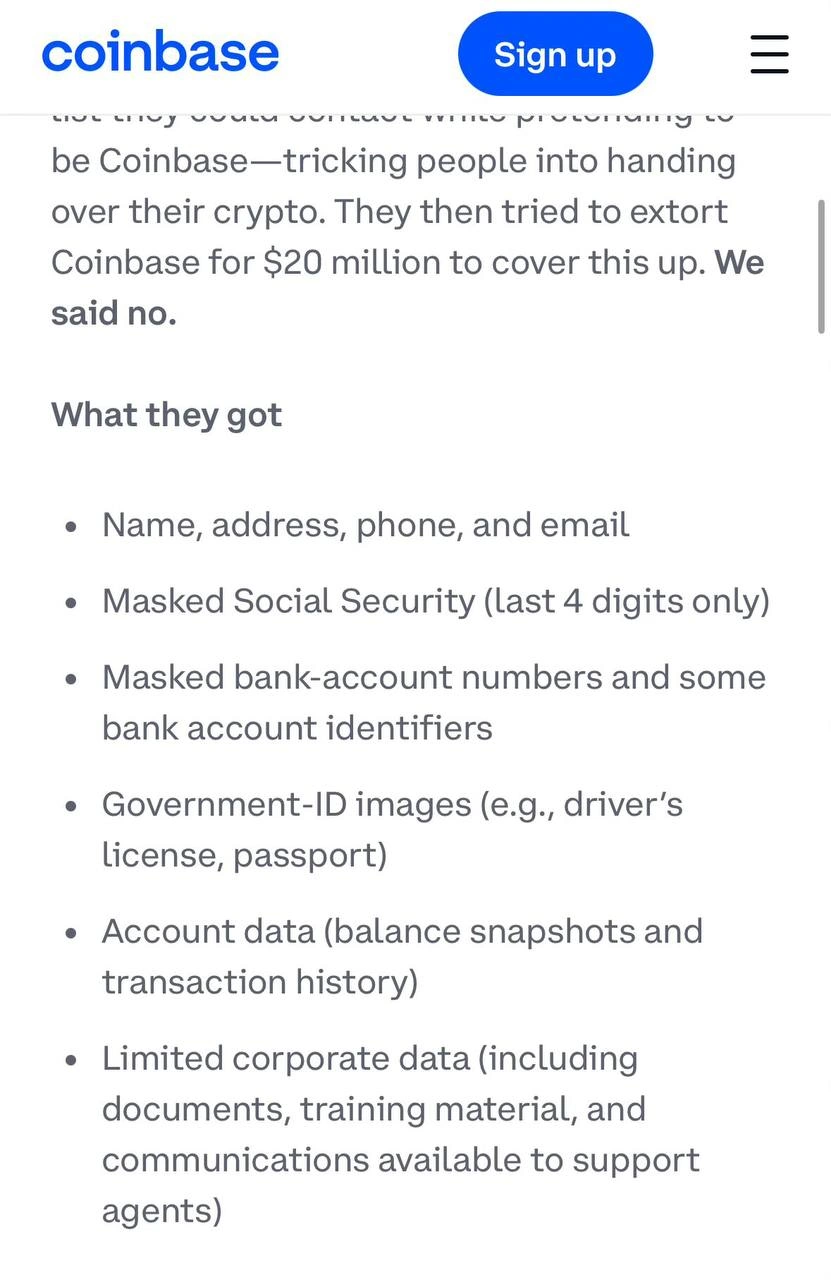
Let’s break down what’s going on in simpler terms. This image is essentially an official breach report from Coinbase, a huge cryptocurrency exchange (think of it like a bank but for Bitcoin and digital money). The report lists “What they got,” meaning what the bad guys managed to steal. When you see things like “Name, address, phone, and email”, that’s classic personal info – in tech lingo, PII (Personally Identifiable Information), basically details that identify you. Now, why is that a big deal? Because with those contact details, scammers can pretend to be Coinbase (or another company) and phish you – sending you convincing texts or emails to trick you into giving up passwords or even your crypto coins.
The list also mentions “Masked Social Security (last 4 digits only)”. A Social Security number (SSN) is a super sensitive ID number for U.S. individuals – usually 9 digits. Saying “masked, last 4 only” means Coinbase did not reveal or store the full number visibly; they only keep the last four digits on hand (the rest might be hidden as **** or stored encrypted). Companies do this so employees can verify you (“What are the last 4 of your SSN?” is a common ID check) without needing the full SSN. It’s a security measure: even if hackers get that database, they supposedly don’t have your entire SSN, just a piece of it. However, as the meme hints, just those last 4 digits can still cause security headaches. A lot of institutions foolishly treat those 4 digits as a way to prove your identity (“Oh, you know the last 4 of Alice’s SSN, you must be Alice!”). So a SensitiveDataExposure of last-4-only is still problematic. It’s like the thieves didn’t get the whole key, but they got a unique piece of it that can help pick the lock.
Next in the list: masked bank-account numbers and some bank account identifiers. Similar idea here – only part of your bank account number was shown, probably just the tail end. But even partial bank info can be misused. For instance, the last few digits of your card or account are often used to confirm which account you’re talking about. If a scammer calls you and knows, “your account ending in 5678,” you might believe they’re legit. That’s why the meme calls this “partial redaction theatre” – it’s a bit of a show to mask things, and it helps, but it doesn’t make the problem go away if a breach happens.
Then we have “Government-ID images (e.g., driver’s license, passport)”. This one’s huge. Coinbase, being a regulated FinTech/Blockchain company, has to follow KYC (Know Your Customer) rules. That means users often upload a picture of their ID (driver’s license, passport) to verify their identity. The thieves got those images. Essentially, they have photocopies of people’s IDs. That’s really bad because with an ID scan plus the personal details above, a criminal can attempt identity theft – like applying for loans or credit cards pretending to be you. It’s the kind of data breach that keeps Security folks up at night. If you’re a junior dev, imagine the severity: losing a password is one thing (you can ask users to reset it). Losing an ID document is a whole other level – you can’t just change your date of birth or easily get a new passport number. This is permanent info out in the wild.
We also see “Account data (balance snapshots and transaction history)”. So the hackers could see how much money (crypto) people had at certain times and their transaction logs. While this might not directly let them steal money (they’d typically need passwords or keys for that), it’s sensitive financial info. It’s like someone seeing your bank statement – they know how much you have and what you’ve been up to, which is uncomfortable and could make you a target (e.g., a user with a big balance might get more phishing attempts: “Hey, big spender, click here to secure your account...”).
Finally, “Limited corporate data (including documents, training material, and communications available to support agents)”. This implies the breach might have started from or included internal systems – maybe the attackers tricked a Coinbase support employee or found a weakness in a support portal. “Limited corporate data” is a vague catch-all, but examples given (training material, support communications) suggest things like internal FAQs or maybe email threads. While that might sound less critical, it can still be sensitive. Internal docs might outline how Coinbase’s customer support verifies users or handles security checks. If hackers have that, they can craft even more convincing scams (coinbase_extortion_attempt indeed!). Also, any internal communications leaked could contain API keys or internal URLs by accident, which is another risk.
Now, about that extortion bit: the description says attackers tried to extort $20 million from Coinbase to cover it up, and Coinbase said no. Extortion in tech breaches is when hackers say, “We stole your data; pay us or we’ll release it / use it / harm your customers with it.” Coinbase refusing to pay is a strong stance (paying is often discouraged because it funds crime and doesn’t guarantee hush-up anyway). But it does mean Coinbase had to go public and tell everyone about the breach. By law (like GDPR in Europe), they have to notify users and regulators after such a SecurityIncidents. That’s why this list exists on their site – it’s their public confession and explanation. And that little addendum “We said no.” frames them as the good guys standing up to criminals, which is part PR, part genuine principle.
For a junior developer or someone new to DataPrivacy, the take-home is: breaches are about more than just passwords. Here, no mention of passwords or crypto keys being stolen at all – it’s all personal and meta-data. Yet this kind of info can be just as damaging. When working on systems, you’ll encounter practices like masking data, encrypting sensitive fields, and strict access controls for internal tools. This Coinbase story is a case study in why those measures exist and how they can fall short. The attackers exploited human trust (either by phishing users to get credentials or tricking an employee), proving that even with great blockchain security, you have to guard the people and processes just as tightly. And if you ever find yourself on an incident response team, expect to follow a detailed checklist: identify what was accessed, cut off the breach, figure out how it happened, and communicate responsibly. It’s a stressful fire-drill that every seasoned engineer prepares for but hopes never to experience. Now you see why the engineers are having “unmasked headaches” – the data might be partially masked, but the fallout is fully real.
Level 3: Data Breach Fine Print
Zooming out to a senior engineer’s perspective, this meme hits home as a too-familiar scenario in modern SecurityIncidents. The bullet-point loot list reads like every data breach disclosure ever, distilled into a minimalist UI: Personal Identifiable Information (PII), some financial account snippets, a dash of internal docs – essentially the worst-case shopping list for any hacker. The humor (tinged with pain) comes from how routine and clinical this breach report sounds, despite the unmasked headaches it causes behind the scenes. It’s written in that polished “here’s what they got” tone, the kind of fine print no company ever wants to publish but must as part of incident response transparency (and GDPR compliance). Seasoned devs have seen variants of this list in press releases, always attempting to soften the blow: “only the last 4 digits” or “limited data” – as if partial exposure is totally fine. We all know it’s not fine; it’s just the breach disclosure playbook in action, trying to balance honesty with reassurance.
The meme’s context tags like pii_breach_fine_print and masked_ssn_not_security reflect a collective eye-roll among experienced engineers. We’ve learned (often the hard way) that masking a few digits is more about compliance checkboxes and user optics than actual safety. When a DataBreach happens, DataPrivacy laws kick in: under regulations like GDPR or California’s privacy acts, even losing “masked” personal data requires swift notification. The gdpr_notification_clock was ticking the moment this breach was confirmed – likely giving Coinbase 72 hours to report to authorities. You can almost hear the on-call security team groaning, “There goes the weekend,” as they scramble through the incident_response_checklist: contain the breach, start forensic logs analysis, reset credentials, engage legal and PR teams, draft user notifications. It’s chaos under a calm corporate blog post. The post’s defiant line “We said no.” (to a $20M extortion) is bold but also deeply telling. A senior dev recognizes the subtext: the company had to choose between paying ransom or going public and dealing with the fallout. They chose the ethical (and frankly, legally inevitable) route of disclosure. In doing so, they basically broadcasted: “Yes, attackers got in. Here’s exactly what they took.” And that transparency is double-edged – good for trust, rough on the engineers who now have to answer a million questions from auditors and users about how this happened at a $60B company. (That snarky “60b$ company btw” in the post message succinctly captures the irony that even industry giants with massive valuations can get tripped up by a crafty phishing scheme or a misconfigured server.)
What really sells the humor here to a veteran developer is the contrast between Coinbase’s sleek, confident branding (that coinbase logo and Material Design crispness) and the gritty reality of a SensitiveDataExposure. In fintech and BlockchainTechnology, companies love to project cutting-edge security – “We’re a safe fortress for your crypto assets!” – yet here we have a textbook phishing breach, reminder that the humans and their data are often the soft underbelly. Attackers didn’t break some fancy blockchain encryption or exploit a zero-day in the Bitcoin protocol; they posed as Coinbase and fooled people, and/or infiltrated internal tools. It’s a tale as old as tech: why crack the safe when you can trick someone into handing you the keys? CoinbaseExchange being high-profile means the trove of DataExfiltration (names, addresses, IDs) is a gold mine for further scams. The engineers know that once this data is out in the wild, there’s no putting the genie back – users will be targets of phishing emails for years, and Coinbase’s support will be cleaning up the mess with identity theft cases and password resets.
The laugh-through-the-pain punchline for devs is how the breach details are presented so matter-of-factly, as if to say, “Look, it’s not that bad – mostly stuff we can recover from.” Meanwhile, every bullet on that list gives a security engineer heartburn: Names and emails (phishing galore!), phone numbers (hello SIM swapping attacks), last 4 of SSN (there goes identity verification), bank info (time to watch for fraud), government IDs (identity theft just got real), and even internal documents (potentially exposing how their support system works or internal processes, which hackers can weaponize in future attacks). It’s basically a checklist of nightmare scenarios. Each item triggers a cascade of remedial tasks: force password resets, advise users to freeze credit, work with banks to monitor suspicious transfers, coordinate with law enforcement – the works. The meme cleverly captures a facepalm moment for the industry: even the biggest crypto platform isn’t immune to old-school data breaches, and the aftermath is an all-hands-on-deck slog for those poor security engineers. In short, the humor here is equal parts schadenfreude (“Glad it’s not my on-call this time!”) and camaraderie (“I feel your pain, Coinbase ops team”). It underscores that in Security and DataPrivacy, there’s often a gulf between flashy tech and messy reality – and cleaning up that mess is where the real work (and dark comedy) lives.
Level 4: Redaction’s Residual Entropy
At the most granular level, this breach exposes the illusion of masking as a security measure. Even though Coinbase insists only partial identifiers were exposed (e.g. last 4 digits of SSN), a seasoned security engineer knows that partial data still carries significant information entropy. In information-theory terms, revealing 4 digits of a 9-digit identifier leaves roughly $\log_2(10^4) \approx 13.3$ bits of information — not trivial when combined with other personal data. Attackers adept at data correlation can perform re-identification attacks, cross-referencing these supposedly “masked” fragments with other leaks or public records to infer the whole. It's a sobering example of how pseudonymization (like storing or displaying only last four digits) is not the same as encryption or true anonymization.
From a cryptographic standpoint, truly securing something like a Social Security number or bank account means tokenizing or hashing the sensitive fields so that even a breach yields gibberish. If Coinbase’s systems followed PCI-DSS-style best practices (common in FinTech), the full bank account numbers might be stored encrypted or replaced with tokens, leaving only a non-sensitive portion (last 4) visible. That’s presumably why the attackers ended up with just masked values – the backend wasn’t handing out the full secrets. However, the presence of Government ID images in the loot list hints that raw sensitive files were accessible, likely decrypted on-the-fly for support purposes. This exposes a classic trade-off between security and usability: support agents need to verify user identities (hence access to ID scans and last-4 SSNs), but that very access becomes a pivot point if compromised. Modern zero-trust architectures and the principle of least privilege aim to minimize such damage by tightly restricting who or what can view decrypted PII at any time. Yet here we are – one compromised support interface and the attackers walked away with a trove of KYC data.
It’s a paradox every security engineer knows too well: masking digits provides theater for users and regulators (“See, we don’t show full SSNs!”), but under the hood the system still holds the keys to the kingdom. If an attacker can trick or coerce the system (or its human operators) into handing over data, those little black dots and asterisks offer zero protection. In theoretical terms, any data exfiltration event like this becomes a study in “residual risk.” The masked_ssn_not_security mantra exists because revealing even a subset of a sensitive field can drastically reduce the search space for an attacker. Combine a victim’s name, address, birth date (often derivable from ID images) and last 4 SSN, and you've practically authenticated yourself as that person in many legacy systems. So while Coinbase’s post is emphasizing that some data was partially redacted, a security researcher will dryly note that the mosaic effect (assembling a full identity from fragments) means the breach’s impact is only marginally reduced by those masks. In summary, the technical underpinnings of this meme highlight a hard truth: partial secrecy isn’t security. Whether you expose 4 digits or 40, the math doesn’t lie – what’s revealed can often be leveraged to unveil what’s hidden.
Description
A screenshot of a mobile webpage from the cryptocurrency exchange Coinbase. The header shows the Coinbase logo, a 'Sign up' button, and a hamburger menu icon. The visible text describes a security incident where attackers tried to extort Coinbase for $20 million, to which the company 'said no.' Below this, a heading 'What they got' is followed by a bulleted list of compromised data, which includes highly sensitive personally identifiable information (PII) like names, addresses, masked social security and bank account numbers, government ID images, account data, and internal corporate data. The meme's humor is derived from the caption '60b$ company btw', which sarcastically juxtaposes the company's massive valuation with a severe data breach that the official communication seems to downplay. It's a cynical take on corporate damage control and the recurring security lapses seen even in major tech and fintech companies
Comments
27Comment deleted
Their public statement reads like a change log where the breaking change is 'customer_trust' and the commit message is 'Minor refactor of our security perimeter.'
Sure, the hackers only got the last four of our SSNs - because in fintech threat modeling, security through partial printing is totally a defense-in-depth strategy
The attackers demanded $20 million in hush money, but Coinbase chose the cheaper option: letting their legal team handle the class action lawsuits while their engineers frantically rotate every API key and wonder if 'masked' SSNs with only 4 digits hidden really counts as 'secure' when there's only 10,000 possible combinations
When threat actors demand $20M to cover up a breach, Coinbase's response is the security equivalent of 'git push --force' to production on a Friday: bold, principled, and guaranteed to make everyone in the industry simultaneously respect and nervously laugh. Most companies would quietly pay and hope nobody notices - like sweeping technical debt under the rug - but Coinbase chose full transparency, proving that sometimes the best incident response is refusing to negotiate with attackers and letting your customers know exactly what happened. It's the 'we don't negotiate with terrorists' approach to cybersecurity, except now everyone knows your KYC data got pwned and you're hoping your breach disclosure game is stronger than your perimeter defense was
Nothing like a KYC-heavy data model to make 'limited corporate data' sound cute - when the $20M extortion email lands, the IR runbook deploys its strongest control: string_literal('We said no')
Nothing says "defense in depth" like masking SSNs and account numbers while leaking KYC scans, balances, and contact info - the exact inputs every IVR "security question" asks for; congrats, you've built the attacker's CRM
Hackers breach the DB demanding ransom; Coinbase drops a redacted schema dump instead - peak incident response transparency over opacity
government ID of all users ? Comment deleted
some users Comment deleted
https://www.coinbase.com/blog/protecting-our-customers-standing-up-to-extortionists Comment deleted
as someone who has implemented veriff.com for a site, they can see all Comment deleted
webhooks with parsed data Comment deleted
images of the documents and you Comment deleted
even better, often times the "take a picture" part is actually a video, with sound and all Comment deleted
that's crazy Comment deleted
ikr, made me way more careful when verifying lol Comment deleted
I exclusively do ID verifications in the nude with well placed mirrors to make sure that if a human has to look at it, they regret it Comment deleted
+unshaved* Comment deleted
I use Coinbase 😭 Comment deleted
They say it's an inside job https://www.msn.com/en-us/money/markets/coinbase-says-scammers-bribed-insiders-to-steal-customer-data-and-it-could-cost-the-crypto-exchange-400-million/ar-AA1EQhi2 Comment deleted
Hi there, please, use English around devmeme, תודה מראש Comment deleted
the hell came last ? Comment deleted
this is Martian. Reads "toda merosh", translates "thanks in advance". Comment deleted
mea culpa. Fixed. Comment deleted
Thankfully I didn't get an email Comment deleted
Coinbase is a pain in the ass to use, literally anything else is more reliable. Its much more worth your time going through a crypto ATM then using coinbase. Comment deleted
Using coinbase is literally just setting yourself up to eventually getting simswapped. Comment deleted