Skip to content
DevMeme
Choosing Your Kafka: Literary Despair vs. Distributed Data
DistributedSystems Post #100, on Feb 12, 2019 in TG

Choosing Your Kafka: Literary Despair vs. Distributed Data

Why is this DistributedSystems meme funny?

Level 1: Same Name, Different Famous

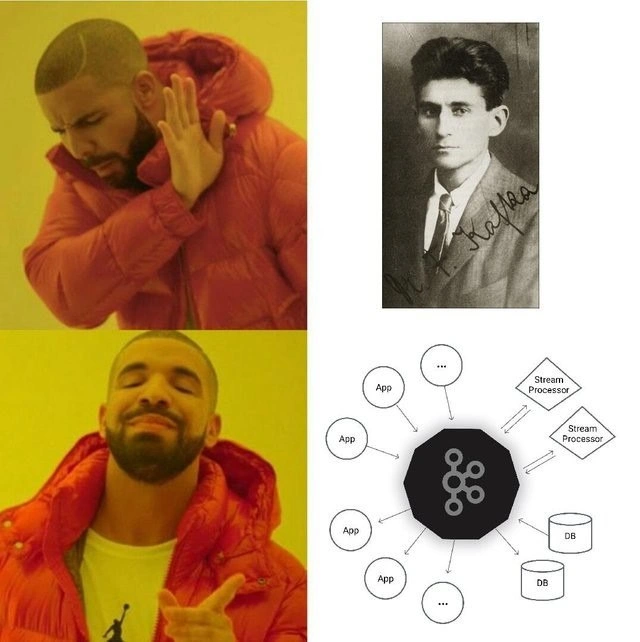
The joke is a simple mix-up made on purpose. Hear the name "Kafka" and there are two possible pictures: a serious old-fashioned writer your literature teacher loves, or a piece of plumbing that computer companies use to move messages around. The man in the orange jacket turns his face away in disgust from the writer — ugh, homework — and smiles happily at the plumbing diagram. It's funny the way it's funny when someone hears "Mercury" and thinks of the car instead of the planet, except here there's a wink hidden inside: the writer was famous for describing giant confusing systems nobody can understand... and ask any engineer at 3 AM, that's a pretty fair description of the plumbing too.

Level 2: Meet Both Kafkas

  • Franz Kafka (top panel, the signed black-and-white portrait): early-20th-century writer famous for stories where ordinary people are crushed by absurd, unexplainable bureaucracies. His name became an adjective — Kafkaesque — for any system that's powerful, opaque, and indifferent to you.
  • Apache Kafka (bottom panel, the octagon diagram): open-source software that acts as a central pipeline for data. Applications called producers publish events ("user clicked buy"), and consumers — apps, stream processors, databases, all visible as the circles, diamonds, and cylinders in the diagram — read those events when they're ready. This is pub/sub (publish/subscribe): senders and receivers never talk directly, the log in the middle decouples them.
  • Stream processor: a program that transforms events as they flow — counting, filtering, joining — instead of waiting for a nightly batch job.

Why it matters: at companies like LinkedIn (where Kafka was born), thousands of services need the same events without tangling into a web of point-to-point connections. One durable log in the middle turns integrations into n. For a junior engineer, the meme doubles as a job-interview pun-detector: if someone mentions Kafka and you picture the octagon instead of the author, the industry has finished onboarding you.

Level 3: Two Kafkas, One Bureaucracy

The Drake format is doing precise cultural work here: rejecting the signed portrait of Franz Kafka — novelist, prophet of incomprehensible bureaucracy — in favor of a pub/sub architecture diagram is the purest possible self-portrait of an industry that names its tools after things it hasn't read. (The naming is genuinely intentional: Kafka's creator chose the name partly because the system is "optimized for writing." That pun has outlived most of the startups that adopted it.)

The joke's second layer is that the rejection is self-defeating, because choosing Apache Kafka is choosing Franz Kafka, operationally:

  • You wake up one morning and find your consumer group transformed — The Metamorphosis, but it's a rebalance storm triggered by one slow consumer's missed heartbeat.
  • You petition the cluster to explain why lag is growing on partition 7. The cluster does not answer. The cluster has never answered. There is a dashboard, but the dashboard is also a question.
  • Configuration is a castle with hundreds of rooms (retention.ms, log.segment.bytes, max.poll.interval.ms), and the committee that decided the defaults has long since adjourned.

There's also a sharper industry satire underneath: Kafka became a résumé keyword and an architecture status symbol, deployed by teams whose throughput could be handled by a Postgres table with a processed column. Event streaming is transformative at the scale it was invented for; below that scale it's a three-node operational burden purchased for conference-talk reasons. The meme's Drake — embracing the diagram because it looks impressive — is the hype cycle in a puffer jacket. Meanwhile the rejected author panel quietly suggests the real bit: the people who'd most appreciate the absurdist literature are the ones on call for the cluster.

Level 4: The Log Is the Trial

The diagram Drake approves of — apps, stream processors, and databases orbiting a black octagon — is a remarkably faithful sketch of the idea that made Apache Kafka a foundational piece of distributed infrastructure: the log as the system of record. Kafka's core abstraction is an append-only, partitioned, replicated commit log. Producers append; consumers read at their own offsets. That one design choice elegantly sidesteps several classic distributed-systems problems while creating exquisite new ones:

  • Ordering: Kafka guarantees total order only within a partition. Cross-partition ordering doesn't exist, which is less a limitation than physics — imposing a global order across independent nodes requires consensus on every message, and consensus (Paxos, Raft, or Kafka's historical dependence on ZooKeeper, since replaced by its own Raft implementation, KRaft) is exactly the coordination cost the partitioned log was built to avoid.
  • Delivery semantics: the eternal trilemma of at-most-once, at-least-once, and "exactly-once" — the last achievable only as a carefully scoped illusion built from idempotent producers, transactional offset commits, and the consumer's solemn promise to keep its side effects inside the transaction. Outside that boundary, the FLP impossibility result and unreliable networks reassert themselves, and you're back to deduplication keys like everybody else.
  • Replication and truth: each partition has a leader and in-sync replicas; durability is a negotiation between acks=all, min.insync.replicas, and how lucky you feel. The CAP theorem doesn't disappear — it's just relocated into configuration parameters with misleadingly calm names.

The irony worthy of the meme: the literary Kafka wrote about individuals petitioning vast, opaque systems and never learning their status. A Kafka consumer group mid-rebalance — every member frozen, partitions revoked, status unknowable, guilt unassigned — is The Trial with heartbeat timeouts.

Description

A classic two-panel 'Drake Hotline Bling' meme. In the top panel, Drake, in his orange puffer jacket, holds up a hand in rejection towards a black-and-white portrait of the author Franz Kafka. In the bottom panel, Drake is smiling and pointing in approval at a system architecture diagram. The diagram shows a central octagonal icon representing Apache Kafka, receiving data from several circles labeled 'App' and feeding data to 'Stream Processor' and 'DB' (database) components. The meme is a clever pun on the name 'Kafka.' It contrasts the writer Franz Kafka, whose name is synonymous with nightmarishly complex and illogical systems ('Kafkaesque'), with the Apache Kafka software, a distributed event streaming platform designed to handle high-throughput data streams in complex architectures. For senior engineers, the joke is layered: it's a simple name pun, but also an ironic nod to the fact that while Apache Kafka is a solution for managing complexity, it can be notoriously complex to set up and manage, creating its own 'Kafkaesque' challenges
Comments

8
Anonymous ★ Top Pick The only thing more Kafkaesque than reading 'The Metamorphosis' is trying to debug a rogue consumer group in a production Kafka cluster
  1. Anonymous ★ Top Pick

    The only thing more Kafkaesque than reading 'The Metamorphosis' is trying to debug a rogue consumer group in a production Kafka cluster

  2. Anonymous

    Franz Kafka wrote about oppressive bureaucracy; Apache Kafka reenacts it every time the controller broker GC-pauses and 800 partitions rebalance at 2 a.m. - ask my pager which Kafka matters

  3. Anonymous

    Franz Kafka wrote about existential dread and bureaucratic nightmares, but Apache Kafka just lets you experience them firsthand when you're debugging why your consumer group rebalanced at 3 AM

  4. Anonymous

    Fitting that we named the message broker after Kafka: you wake up one morning to find your consumer group transformed into a giant rebalancing loop, and no one can explain why

  5. Anonymous

    When your architecture meetings involve debating whether to embrace Kafka the streaming platform or Kafka the existentialist author - one helps you process millions of events per second, the other helps you process the existential dread of on-call rotations. Both involve transformation, but only one requires ZooKeeper (well, until KRaft mode anyway). The real metamorphosis is watching your monolith turn into a distributed nightmare at 3 AM when partition rebalancing decides to have an identity crisis

  6. Anonymous

    Yes to the Kafka with partitions and idempotent producers; no to the Kafka where acks are allegories and the offset commit never happens

  7. Anonymous

    I prefer the Kafka with partitions, ISR, and consumer groups - the other one only rebalances your soul

  8. Anonymous

    Rejecting Kafka's infinite trials for Go's goroutines - because distributed consensus is just a channel away from escaping bureaucracy

Use J and K for navigation