The Ascended State of Code Documentation
Why is this Documentation meme funny?
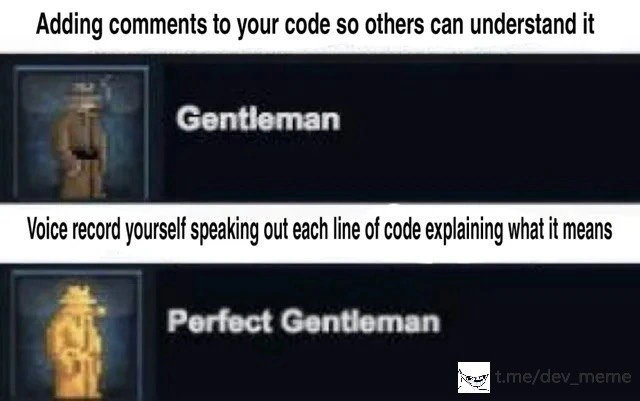
Level 1: At Your Service
Imagine you borrowed a very complicated toy from a friend. Your friend wants to make sure you know how to use it. A normal helpful friend might attach a note to the toy with some tips or instructions (that’s like adding comments in code). But now imagine a super polite friend – instead of just a note, they also send you a voice recording of themselves explaining every little detail while you play: “Okay, now open the box… good. See that red button? Press it and the toy will start. Great! Next, you’ll see a lever…” and so on. They’re basically walking you through step by step in audio. It’s a really kind gesture, almost like a personal tour, but it’s also a bit funny because it’s more help than anyone would expect!
This meme is laughing about that kind of extreme helpfulness. Writing comments in code is like leaving helpful notes for others, which is considerate. Recording your voice to explain each line of the code is like reading a story to someone and explaining every sentence – it’s above and beyond what people normally do. The idea is sweet (you really want the other person to understand!), but it’s also silly because it’s so over-the-top. The humor comes from that surprise: normally, we just do the equivalent of a polite note, but here the developer is acting like a perfect gentleman servant, saying “At your service, I shall explain everything to you.” It’s funny because it shows someone being too helpful in a charming way.
Level 2: Guided Code Tour
Let's break down why this meme is funny in simpler terms. It’s comparing two ways of helping others understand your code:
Code comments: These are short notes you write in the source code itself. They might look like this in code:
# Calculate the total price with tax total = price * 1.2 # 1.2 includes a 20% tax rateA comment usually starts with a special symbol (like
#in Python,//in Java/JavaScript/C++, etc.) and the computer ignores it when running the program. Comments are for humans to read, not machines. They explain what the code is doing or why it’s doing something, especially if it's not obvious from the code alone. Adding good comments is considered a polite, professional thing – it’s part of writing documentation and shows you care about communication with other developers. When the meme calls this the mark of a "Gentleman," it’s joking that writing comments is a courteous behavior, like holding the door open for the next programmer. It definitely improves the developer experience for anyone reading or maintaining that code later. New developers (and even experienced ones) appreciate clear comments when they’re trying to figure out how a piece of code works.Voice-recorded code walkthrough: This is the crazy step up the meme jokes about. It suggests literally recording your voice explaining every single line of the code. So instead of just writing
// increment ias a comment, you’d have an audio file or voice note saying, “Now we increment i by one.” Imagine scrolling through code and alongside each line, you could hit "play" to hear the original developer narrate what’s happening. That’s what the meme calls the "Perfect Gentleman" move – basically the ultimate act of being considerate. This is overkill commentary because nobody actually does this in real life; it would take a huge amount of time and would be really unusual! It’s a form of a code walkthrough, which usually means explaining code to someone, but here it’s taken to an extreme by pre-recording the explanation. There are times developers do walkthroughs together (like in pair programming or code review meetings) where someone might orally explain the code, but they wouldn’t normally record it as part of the project documentation.
So why is this humorous? Developers often struggle just to write simple comments or docs — many projects have sparse comments, or outdated README files, etc. The meme exaggerates this task to a ridiculous degree: if adding some comments is good, then adding a narrated audio track must be fantastic, right? It’s poking fun at our habits. On one hand, we know good documentation is important for team communication and onboarding (so others can understand your work without guessing). On the other hand, we also know that suggesting audio explanations for each line is laughably impractical. It’s a joke about documentation practices: commenting code is like the basic level of helpfulness, and doing an audio commentary is portrayed as leveling up to an almost superhero level of helpful developer behavior. This ties into Developer Experience (DX) because it’s all about making life easier for developers who will read the code later. Better DX means the code is easy to read, understand, and modify. Comments contribute to that. An audio guide would too… but it’s so over-the-top that it becomes documentation humor. The communication gap between developers is real – often we read someone else’s code and scratch our heads. Comments help bridge that gap by giving extra clues. The meme jokingly suggests bridging the gap with not just clues, but a complete guided tour.
For a junior developer or someone new to coding, it’s useful to know: generally, writing clear code is priority one, and adding comments to explain non-obvious parts is good practice. You might even write longer explanations in a separate documentation file or wiki. But you won’t be recording your voice for each line – that’s just the meme being silly. In fact, if you tried this at work, people would probably be very surprised (and maybe amused). 🤣 It’s a playful reminder that while we strive to be helpful and clear (the way a true “gentleman” coder would), there’s a point where it becomes over-documentation. And usually, beyond a certain point, more documentation yields diminishing returns and more maintenance hassle. Still, the image of a programmer who cares so much that they explain their code out loud and save it as audio – that’s both endearing and comical. It’s like the programmer saying, “Don’t worry, I’ll hold your hand through this code, line by line,” which is both very kind and very extra at the same time.
Level 3: Comments vs Commentary
In the software world, code comments are like the basic politeness of programming – leaving little notes in the source so others (or future you) can understand tricky logic or remember why something was done. It's part of good code quality and documentation practices to make the next developer’s life easier. The meme humorously frames this as a "Gentleman" move – a modest, respectable achievement unlocked by adding comments for clarity. But then it ups the ante to voiceover documentation: actually voice recording yourself explaining each line of code. That's portrayed as the shiny "Perfect Gentleman" badge – an absurdly courteous act in a developer's communication arsenal. This contrast is funny because it exaggerates the lengths one might go for great developer experience (DX). Most senior engineers have seen how rare thorough documentation can be; half the time we're lucky if a function has a one-line docstring. So the idea of a dev going beyond written comments to provide a full-on audio tour of the codebase is both hilariously over-the-top and a wistful dream. It’s basically converting a static comment into a guided code walkthrough, almost like a director’s commentary track for your program. (Picture a calm narrator saying, “Here we call the processData() function – a truly riveting moment.”*)
From a seasoned perspective, this meme pokes at the eternal communication gap in tech teams: code might be clear to the author, but opaque to others without context. We often say “let the code speak for itself,” but here the code literally speaks for itself (through the author's recorded voice!). It’s an ironic twist on knowledge sharing. Experienced devs chuckle because they've felt the pain of inheriting undocumented legacy code and thought, "I wish the original coder could sit here and explain this." This "Perfect Gentleman" solution is a tongue-in-cheek fantasy of exactly that scenario. It’s also a riff on over-documentation. In practice, too many comments (especially stating the obvious) or elaborate documentation that drifts out-of-sync with code can be a form of overengineering. A voice narration for every line would be documentation overkill – imagine trying to maintain that! If you refactor the code, now you have to re-record the audio commentary too, doubling your work. The meme's humor lands because every developer recognizes the kernel of truth (we should write helpful comments) wrapped in an absurd escalation (audio narrating each line, seriously?!). It satirizes our guilt about not documenting enough by proposing a comically overkill commentary approach that no one would realistically do. It’s classic developer humor: taking a best practice to a ridiculous extreme.
There’s also a nifty nod to the idea of code as literature. In the 1980s, Donald Knuth promoted literate programming, where code and explanation are interwoven so code reads like a well-documented essay. The "perfect gentleman developer" is like a modern, exaggerated spin on that – not just writing prose around the code, but orating it. Seasoned devs also recall rubber duck debugging (explaining code out loud to a rubber duck to find problems). This meme feels like rubber-ducking taken to production: the developer narrates the code for everyone else! 😄 Underneath the laughter, there's an implicit truth seniors know: good documentation and clear communication are gold, but there's a practical limit. We strive for self-documenting code with meaningful names and just enough comments. The Perfect Gentleman meme humorously blows past that limit, envisioning a world where a considerate coder leaves behind an audiobook of the code. It tickles us because it’s so unnecessary yet oddly kind. In reality, of course, no CI/CD pipeline is set up to deploy .mp3 explanation files, and no one has time to be the Morgan Freeman of code narration. But for a moment, imagining that level of thoughtful hand-holding is both sweet and comical. It highlights the gap between what we say we want (knowledge sharing, maintainability) and what we actually do (often scramble through uncommented code). Every senior dev can relate to that pang of “gee, maybe I should comment more… but record myself? Ha, good one.”
Description
A two-panel meme that humorously escalates the concept of code documentation. The format is taken from the video game 'Gunpoint,' showing achievement-like notifications. The first panel says, 'Adding comments to your code so others can understand it,' and labels this achievement as 'Gentleman,' showing a pixelated character in a trench coat. The second panel presents a far more extreme idea: 'Voice record yourself speaking out each line of code explaining what it means,' and labels this as 'Perfect Gentleman,' with a glowing, golden version of the same character. The joke satirizes the debate around code documentation by presenting a ridiculously impractical method as the pinnacle of consideration. For experienced developers, it's a funny take on the spectrum of documentation efforts, from helpful to absurdly over-engineered, and the eternal quest for perfectly clear, maintainable code
Comments
37Comment deleted
I submitted a PR with audio commentary, but it got rejected. The reviewer said my explanation of the regex was just 15 seconds of uninterrupted weeping
Real gentleman development: commit the code, the ADR, and a narrated director’s-cut .mp3 - then fail CI if the transcript drifts from git blame
Finally, a documentation strategy that combines the searchability of comments with the clarity of that one architect who explains everything through interpretive dance at standup
Ah yes, voice-recorded code documentation - because nothing says 'maintainable codebase' like a 47-minute audio file explaining why you chose that particular regex pattern at 3 AM. Bonus points if you include the existential crisis you had while debugging the edge cases. Future developers will surely appreciate hunting through your spoken-word album to understand why `getUserData()` actually deletes users on Tuesdays
Audio comments stored in Git LFS: fantastic context until a Sev1, when grep returns a 40‑minute monologue and git blame links to Past Me’s podcast
Voice docs: because future maintainers deserve to hear the regret in your voice behind every unchecked TODO
Tried upgrading comments to a 40‑minute voice-over; PR came back: looks fine, but we can’t grep an MP3 - write an ADR, not a podcast
cumment Comment deleted
real men use codes that belong to 30 years ago without any comment Comment deleted
real men code in assembly Comment deleted
real men code. Comment deleted
real men . Comment deleted
real Comment deleted
̣ Comment deleted
That dot outside of text scares me Comment deleted
Lol Comment deleted
̣̣̣̣̣̣I can make it brighter somehow look: ̣ vs ̣̣̣̣̣̣̣̣ Comment deleted
alt-gr+shift+ö on my keyboard, but idk if it's on english keyboards as well Comment deleted
People who work at unicode standards are bored af Comment deleted
How this works lol Comment deleted
just name your fucking variables properly Comment deleted
Wtf Comment deleted
That's actually a good idea Comment deleted
Real men directly program hard drive with a magnet Comment deleted
Real men just hit the computer until it does what they want Comment deleted
real men dont use hard drive, they use ssd Comment deleted
real men don't use persistent storage, they use RAM Comment deleted
real men don't use storage at all, they directly insert electron into the CPU pins Comment deleted
scrap that, real men calculate everything in their head Comment deleted
Writes code Shuts down computer Loses it Leaves *Chad image* Comment deleted
have you ever heard about persistent OSes? ah no they use persistent storage... Comment deleted
If you use them you aren't a real man Comment deleted
Pussies use ssd Comment deleted
real men use floppy Comment deleted
real men are women Comment deleted
They punch holes in cardboards with their colt Comment deleted
real men use paper and pen Comment deleted