Skip to content
DevMeme
2918 of 7435
Spaghetti Servers for Your Spaghetti Code
Infrastructure Post #3224, on Jun 12, 2021 in TG

Spaghetti Servers for Your Spaghetti Code

Why is this Infrastructure meme funny?

Level 1: Tangled Noodles

Imagine you have a big box where you toss all your charging cables, earbuds, and wires without ever organizing them. After a few years, it turns into one giant tangled ball of wires. Now, imagine a mess like that, but ten times worse, and each of those wires is super important because it keeps big computers and websites running. That’s what this picture is showing – a bunch of computer cables all jumbled up like a bowl of spaghetti. It’s funny to look at because it’s so messy and crazy that you almost can’t believe anyone can work with it. It’s like if you had a pile of cooked spaghetti and someone told you to find one specific noodle in it – you’d probably just laugh because it seems impossible! People who take care of computer systems see this and laugh (or cry a little) because they know how hard it would be to fix any problem in that tangle. The joke is basically, “Wow, these wires are as mixed up as a big plate of noodles!” – and anyone who’s tried to untangle Christmas lights or headphones can understand that feeling. The takeaway is simple: whether it’s toys, cables, or noodles, when things get too tangled, it becomes a big headache to sort out. This meme just shows that idea in a super extreme (and silly) way, which is why it’s amusing even if you’re not a tech expert.

Level 2: Cable Management 101

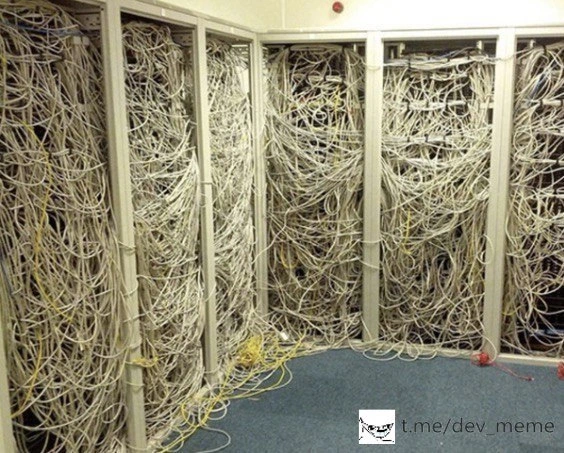
What you’re seeing in this meme is a server rack (actually five racks side by side) filled with network cables that have been allowed to tangle and sprawl everywhere. Let’s break down why this is such a big deal in plain terms. In a typical server room or data center, you have racks that hold servers, switches, and other equipment. These devices need to be interconnected with cables – often Ethernet cables (those are the common grey, blue, or yellow cables with RJ45 connectors that look like overgrown phone plugs). Normally, there’s a practice called cable management which is all about organizing these cables neatly: you bundle related cables together, run them along the sides of the rack or through cable trays, keep excess length under control, and especially label them so you know what each cable is for. Good cable management is like keeping a tidy desk: everything is in its place and easy to find.

In the meme photo, all those rules went out the window. The result is sometimes jokingly called “spaghetti cabling.” Just like a plate of spaghetti where all the noodles are tangled, here all the network cables are intertwined in a chaotic heap. If someone new walks into this server room, they would feel totally lost. Imagine being asked to replace one cable in that snarl – it’s like being asked to find a specific noodle in a bowl of pasta! This is where the meme’s caption comes from: an “archaeological dig of Ethernet spaghetti.” It implies that fixing or tracing anything in this rack would require digging through layers and layers of cables, almost like an archaeologist carefully excavating an ancient site. There might even be “fossilized” cables at the bottom – old wires that aren’t even in use anymore but were never removed. Removing unused cables is a basic part of maintenance, but clearly it hasn’t been done here for years, possibly decades. Each time someone added or changed something, they likely just ran a new cable over the old ones because it was faster in the moment. That quick fix approach is what we call technical debt in tech: you save time now by doing things the easy (sloppy) way, but later it creates a bigger problem you’ll have to pay for (with lots of extra work). Here, technical debt took the form of hundreds of cables with no arrangement, and now the “interest” on that debt is the massive headache for whoever has to sort it out.

Let’s clarify some terms and why they matter here:

  • Ethernet Cable: This is the standard network cable used to connect computers and servers to each other and to the internet. It usually has a connector that clicks in place (RJ45). In modern offices and data centers, these cables often come in different colors to tag different uses (for example, yellow might be for a certain network or purpose). In the image, most cables are grey or white, with a few yellow ones. They’re all the same type of cable functionally, but the color coding that could have been useful is effectively lost in the sheer volume of the tangle.

  • Server Rack: A tall, metal frame that houses servers (powerful computers) and networking gear (like switches, which distribute network connections). In the photo, you see the racks are open frames and you can normally mount equipment inside them. Typically, the front or back of a rack will have patch panels or switch ports where cables plug in. Here it looks like the front of the racks (or what we see) might actually be where cables are just routed. We can’t even see the servers or switches because the cabling is so dense. It’s like vines completely covering a structure – the actual machines are hidden somewhere behind the “vines” of cable.

  • Patch Panel: This is a board with rows of ports used for cable organization. Think of it as a hub where internal cabling from the building meets the shorter cables that go to each server. Patch panels make it easier to manage connections without having one long cable run directly from a server to a distant switch – instead you patch (connect) a short cable from the server to the panel, and the panel connects onward. In a well-managed rack, you’d see a patch panel at the top or bottom and nice straight cable runs into it. In the meme’s scenario, either they didn’t use patch panels properly or the patch panels are completely buried under that mess. People often refer to a “cable spaghetti” mess like this as a patch_panel_nightmare because if you look behind the patch panel, instead of neatly arranged ports and cables, you’d see something like this photo – a nightmare to work on.

  • Cable Labels: A simple but critical thing – each cable should have a little tag or label at both ends, saying exactly what it’s connected to (for example: “Server 5 -> Switch A, port 12”). In a spaghetti situation, often there are no labels. That’s like having none of the wires behind your TV labeled and trying to figure out which one goes to the DVD player versus the game console by just yanking and hoping – except multiply that difficulty by a hundred for this case. Without labels, fixing or changing anything means manually tracing the cable’s route by hand through the tangles, which is slow and error-prone.

  • Spaghetti Code vs Spaghetti Cabling: Spaghetti code is a term newbies might have heard. It describes program code that is so tangled and unstructured that it’s hard to follow – like a bowl of spaghetti noodles with no clear beginning or end. Now imagine that concept in physical form: spaghetti cabling. It means the cabling has no clear organization or structure. Just as spaghetti code is hard to debug, spaghetti cabling is hard to troubleshoot. The meme’s text (“Spaghetti servers that handle your spaghetti code”) is making a joke that if your software is as messy as spaghetti code, fittingly the servers running it are connected by equally messy spaghetti cables. It’s a tongue-in-cheek way to say “mess in the software, meet mess in the hardware.” For a junior developer or someone new to IT, this highlight that writing clean code is important, and likewise, keeping hardware tidy matters too.

So why is this funny, from a junior perspective? Part of it is shock value – it’s such an extreme example of a messy server room that you can’t help but be amazed. It’s like those hoarder house photos but for computers. If you’ve just started working in tech, you might have learned about networks and seen diagrams with neat lines connecting components. This picture shows the reality you might stumble upon in some old IT department or understaffed company: things aren’t neat at all, and someone in the past maybe didn’t have the time or knowledge to do it right. There’s also a kind of camaraderie in this humor – even as a newcomer, if you ever had to untangle a bunch of cables under a desk, you can empathize a little. Multiply that minor annoyance by a thousand and you get this situation. People in the comments would “cry” together not because it’s literally sad, but because they all share the feeling of “oh no, imagine having to fix that… eek!” and laughing about it.

From a learning standpoint, this meme is practically a poster for why good cable practices matter. It teaches by exaggeration. No one wants to be the person responsible for a server rack like this. If you’re a junior IT person and your boss shows you this image, they’re likely saying, “Promise me our server room will never end up like this.” It emphasizes the basics: always label cables, keep them organized, and remove or document old stuff. Because in tech, whether it’s code or cables, cleaning up as you go saves you or the next person from a world of pain later. And if you ever walk into a new job and see something like this, you’ll immediately understand why it’s a big red flag – you’ve got some serious untangling to do (figuratively and literally).

In short, the meme uses humor to convey a lesson: Infrastructure and Networking might not be glamorous, but ignoring the fundamentals (like cable management) can lead to epic problems. It’s a funny picture, especially with the “Ethernet spaghetti” analogy, but it’s also a gentle warning. As a junior dev or sysadmin, you can chuckle at the exaggeration, but also take note: even the physical wires deserve care and attention, or they might come back to haunt you.

Level 3: Patch Panel Purgatory

This image is the nightmare scenario every seasoned systems administrator and network engineer dreads. You’re looking at five server racks engulfed by an impenetrable jungle of Ethernet cables. The chaos is so complete that it’s impossible to tell which cable goes where. In networking terms, this is physical-layer technical debt at its worst – years of neglect and quick-and-dirty fixes have accumulated into a tangled monument of suffering. Seasoned engineers will immediately recognize the dark humor here: we’ve all seen a "spaghetti cabling" situation like this, or fear that one day we will. It’s funny because it’s painfully real. The Infrastructure and Networking world has best practices for CableManagement – and this photo showcases what happens when every single one of those best practices is ignored sacrificed on the altar of urgency.

Take a closer look (if you dare): There are no visible labels on any of the cables. Good cable labeling is like leaving a map for future explorers – here, we’re left to play archaeologist, digging through layers of old wires just to find where one ends. Proper patch panels should act as organized hubs where cables neatly terminate, but in this rack, any patch panels or switches are buried deep under the mess (if they even exist). Instead of tidy horizontal and vertical cable routes along the rack, we see loops and twists going in every possible direction. Cables spill out of the racks onto the floor, creating a literal tripwire for unwary technicians. This isn’t a data center, it’s a trap. The meme calls it an “archaeological dig of Ethernet spaghetti” – and that’s spot on. Each layer of cables could represent years of makeshift expansions: new servers added in a hurry, old equipment decommissioned without removing its wires. Over time, the rack has accumulated strata of cabling like sediment in rock. You might even need to carbon-date those bottom layers of cable to guess which decade they’re from.

Why do experienced folks smirk (and shudder) at this? Because we know the troubleshooting horror awaiting anyone who has to deal with it. Imagine a critical network link is down. Which of these thousand grey noodles is the culprit? Good luck tracing it! In a properly managed rack, you’d follow a labeled cable from a server to a patch panel port in minutes. Here, you’d spend hours elbow-deep in dusty cables, muttering prayers that you don’t unplug the wrong one. It’s a sysadmin rite of passage to have at least one war story involving a mess like this: crawling behind racks at 3 AM, sweating bullets, flashlight in teeth, frantically tugging cables to find a bad connection while the CEO screams about the website being down. This meme is basically SysadminHumor 101 – it’s amusing because it triggers PTSD-flavored laughter from anyone who’s been there.

Hypothetical Overheard in the Server Room:
Manager: "Can you quickly swap out the bad cable?"
Engineer: "Sure... just as soon as I find it in this bowl of spaghetti." 😭

The term “spaghetti code” is widely used in software to describe a tangle of unstructured, messy code that’s hard to debug. Here we have the hardware equivalent: spaghetti cabling. It’s the same concept of SystemComplexity, but at the physical layer. Ironically, these spaghetti servers are literally handling your spaghetti code – a perfect storm of chaos where sloppy software meets sloppy wiring. There’s dark comedy in that symmetry. We often pour effort into sleek software architecture and high-level network design, but if you ignore the foundation (Layer 1 of the OSI model – the cables and connections), you can end up with a networking house of cards. All it takes is one accidental tug or one forgotten old cable acting as a lint magnet, and you could trigger an outage or spend days untangling the mess.

To put it bluntly, this photo is a monument to how not to run a server room. Seasoned professionals laugh (and cry) because we see the inevitable consequences of cutting corners. The humor comes with a heavy sigh of recognition. We laugh at the absurdity, and then nervously think, “Do any of our racks look like this on the inside?” It’s both cathartic and motivating – a reminder that even in high-tech infrastructure, neglecting basic cleanliness and order can lead to SystemAdministration hell. Below is a quick comparison between what should happen versus what we see in this meme’s reality:

Ideal Cable Management 🗺️ Meme Cable Management 💥
Cables are labeled at both ends (e.g. Server 12 Port 5) No labels anywhere – each cable is a guessing game
Cables bundled neatly with velcro ties or trays Cables tangled in a giant knot, looping and twisting freely
Unused cables are removed to prevent clutter Old cables left in place, forming fossil layers of past projects
Patch panels and racks are organized by rows/columns Patch panel (if present) is buried under spaghetti, completely obscured
Proper cable lengths used (no excess slack) Excess slack coils on the floor, creating spaghetti piles and trip hazards
Easy to trace one cable end-to-end in seconds Tracing one cable is an archaeological dig taking hours (and a lot of cursing)

This table might be funny, but it highlights why this meme strikes a chord. CableManagement exists for a reason: it prevents exactly this scenario. In the ideal world, every cable in a professional data center has a purpose, a label, and a designated path. In the meme world, cables breed like rabbits until the rack becomes an impenetrable thicket. The phrase "Patch Panel Purgatory" sums it up: any poor soul assigned to work on this rack is stuck in a limbo where progress is agonizingly slow and mistakes are just waiting to happen.

In summary, the humor targets the gap between infrastructure ideals and real-world shortcuts. It’s poking fun at how something as unglamorous as cable management can turn into a colossal problem when ignored. We chuckle because we’ve felt that mix of incredulity and dread when opening a cabinet to see exactly this kind of Ethernet apocalypse. And yes, we’re probably going to double-check our own racks after laughing – just in case. After all, nobody wants to end up the next maintainer-turned-archaeologist, sifting through the ethernet_jungle in search of the one cable that brings the whole system back to life. Spaghetti cabling might be hilarious in a meme, but in real life it’s the stuff of IT nightmares.

Description

The image displays the inside of a server room corner, showing multiple server rack bays completely filled with a chaotic and tangled mass of network cables, primarily white and yellow. The cables are so dense and disorganized they resemble spaghetti overflowing from the racks onto the floor, a textbook example of catastrophic cable mismanagement. There is a watermark in the bottom right corner for 't.me/dev_meme'. The visual chaos serves as a powerful and literal metaphor for 'spaghetti code' - a term for software that is unstructured, difficult to maintain, and tangled. For senior engineers, this image is a visceral representation of technical debt, where the messy physical infrastructure reflects the state of the software it runs. It’s a relatable nightmare for anyone in DevOps, SRE, or systems administration who has inherited a poorly documented or managed system

Comments

18
Anonymous ★ Top Pick That's not technical debt; it's a physical implementation of a dependency graph in a legacy monolithic application. Don't worry, it's 'self-documenting'
  1. Anonymous ★ Top Pick

    That's not technical debt; it's a physical implementation of a dependency graph in a legacy monolithic application. Don't worry, it's 'self-documenting'

  2. Anonymous

    Conway’s Law, physical edition: the org that reorged every quarter shipped itself as Ethernet - now tracing a link requires HR’s historical org chart

  3. Anonymous

    This is what happens when you tell management that refactoring the network infrastructure isn't a 'business priority' for 15 years straight - eventually you need a PhD in archaeology and a ouija board just to trace a single connection from switch to server

  4. Anonymous

    This is what happens when 'move fast and break things' meets physical infrastructure - except here, you can't just roll back a deployment. Every cable represents a production service nobody dares touch, and the only documentation is a Post-it note from 2003 that says 'DO NOT UNPLUG YELLOW CABLE (IMPORTANT).' The real horror? Somewhere in that Lovecraftian tangle is a single cable keeping the entire business running, and the only person who knew which one retired five years ago. Welcome to the physical manifestation of O(n!) troubleshooting complexity

  5. Anonymous

    IaC was invented for a reason - this rack's O(n²) trace routing is every SRE's inherited tech debt from the pre-Ansible era

  6. Anonymous

    Architecture doc says star topology; reality is a hand‑rolled service mesh - LLDP off, no patch‑panel labels, and every change window becomes a Layer‑1 DFS with rollback by scissors

  7. Anonymous

    Enterprise “service mesh” demo: every patch cord is a point‑to‑point contract; service discovery = yank a cable and see whose PagerDuty screams

  8. @thisisluxion 5y

    accurate representation of what you can find behind my pc

  9. @sashakity 5y

    geez what kind of giant spider lives in there

  10. @ZgGPuo8dZef58K6hxxGVj3Z2 5y

    This must be fake

  11. @ZgGPuo8dZef58K6hxxGVj3Z2 5y

    Not even AT&T is this messed up

  12. @JoseAngelSanchez 5y

    A web site

  13. @RiedleroD 5y

    looks like wall insulation

  14. @azizhakberdiev 5y

    Some relaxing content

    1. @Misantropo 5y

      🤢

  15. @pavloalpha 5y

    😰

  16. @Misantropo 5y

    Too perfect

  17. @disfinder 5y

    Telecom room in my building 🤦‍♂

Use J and K for navigation