Skip to content
DevMeme
4135 of 7435
The 'It's a Feature, Not a Bug' Trope
Bugs Post #4512, on Jun 21, 2022 in TG

The 'It's a Feature, Not a Bug' Trope

Why is this Bugs meme funny?

Level 1: Really Fast Calculator

Imagine you have a calculator that can add and subtract extremely fast – so fast that it can do millions or even billions of calculations in the blink of an eye. Now, if you ask this super-speedy calculator to draw a picture, you could do it by turning the picture into a bunch of numbers (for colors and positions) and letting it calculate all those values. If you ask it to play music, you turn the sound into numbers (the tones, the volume) and it calculates those. A computer is basically this really fast calculator that can follow a list of instructions. It’s doing math so quickly and in such tiny steps that it can create the illusion of videos playing, characters moving in a game, or songs playing from speakers. The funny thing about this meme is how it points out that a super advanced gadget – your laptop or phone – isn’t magical at all, it’s just number-crunching at an incredible speed. It’s like finding out that a big, exciting LEGO castle is still just made of lots of little LEGO bricks. Most people see the castle and go “Wow, a castle!” but the wise (or very simple) perspective is “Wow, that’s actually just a bunch of bricks put together.” Similarly, we usually see the cool games and videos and say “The computer is doing so many different things!” but in truth, it’s just doing math with electronic bricks (bits). The meme is funny because it shows a simple-minded character and a wise character agreeing on this basic idea, while the person in the middle is too busy thinking about the cool stuff to realize they’re all made possible by the same simple thing. In the end, a computer really is just a fast, giant calculator – one that makes awesome things happen by doing tons of math really quickly!

Level 2: Just 1s and 0s Underneath

From a junior developer’s perspective, it helps to break down what we mean by “a computer is a giant calculator.” At its core, a computer only really knows how to do a few things: it can add numbers, compare numbers, move data around, and follow simple instructions. That’s basically it! When we say everything reduces to math, we mean the computer is turning all tasks – whether it’s showing a video, playing a game, or playing music – into numbers and then doing math on those numbers.

Remember, computers use binary – those famous 1s and 0s. Each 1 or 0 is a bit, the smallest unit of information, and it’s actually just a number (1 means “on” or true, 0 means “off” or false). The magic of computers is that they encode all kinds of information into long sequences of 1s and 0s (i.e. binary numbers). For example:

  • Text is stored as numbers (each letter has a numeric code, like ASCII where “A” is 65, “B” is 66, etc.).
  • Images are stored as numbers (each pixel’s color might be represented by three numbers for red, green, blue brightness).
  • Music and sound are stored as numbers (the audio waveform is sampled into a sequence of numerical values for the speaker to output).
  • Videos are just lots of images (frames) per second, so they too are numbers, and often compressed by algorithms that are math-heavy.

The CPU (Central Processing Unit), which is the brain of the computer, processes these numbers. It’s designed kind of like a super advanced calculator: it has circuits to do addition, subtraction, multiplication, etc., and also circuits to make decisions (like “if this number is bigger than that number, do X”). When you run a program – be it a game, a video player, or a web browser – that program gets translated (by layers of software) into many simple instructions that the CPU can execute. Each instruction is typically a very basic operation (add two numbers, compare two numbers, load a number from memory, etc.). The CPU executes billions of these instructions each second, which is how it can handle very complex tasks by sheer speed and quantity of operations.

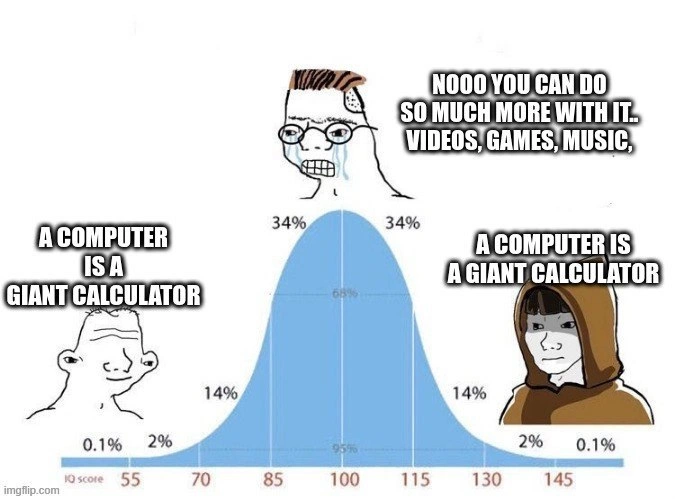
So when someone says “a computer is a giant calculator,” it sounds funny because we think of a calculator as just doing basic math or simple arithmetic problems. And indeed, a computer is doing basic math – just an astronomical amount of it behind the scenes. The meme shows one character saying you can do “videos, games, music” on a computer, which is true in terms of user experience. But the joke is that those activities – watching video, gaming, listening to music – are all enabled by math. The computer is calculating the color of each pixel on your screen many times a second to display video and games, and it’s calculating the speaker vibrations (numbers for sound waves) to play music. To us, it feels like watching a movie or playing a game, not like doing math homework, right? That’s because all that math is hidden under layers of software abstraction. An abstraction is a way to hide complexity; for example, you click an icon to play a video (high-level view) without seeing the trillions of additions and multiplications being done by the CPU to actually show that video (low-level work). But the computer scientists and engineers who work close to the hardware (writing low-level code, or designing chips) are very aware that, deep down, it’s all numbers being crunched. That’s why the characters at the far left and far right of the meme agree on the statement.

The bell_curve_meme format with the IQ distribution is being used jokingly here: it implies the person with a very simple understanding (“it’s just a calculator”) and the person with a wise understanding end up saying the same thing, whereas the person with a moderate understanding focuses on the shiny features. In plain terms, the meme is teaching a bit of computer science humor: Computers do “so much more” by doing a whole lot of simple math operations really, really fast. Once you learn about how CPUs and binary work, you come to realize this statement is pretty accurate. That moment of realization can be mind-blowing – it’s when you start to see that, under all the apps and games, the computer is just working with 1s and 0s to get everything done. It sort of demystifies the technology and makes you appreciate the power of those fundamental operations.

Level 3: No Magic, Only Math

This meme cleverly highlights a gap in perspectives about what a computer really does. On the far left of the IQ bell curve, a simple character says: “A computer is a giant calculator.” On the far right, the hooded enlightened figure echoes the exact same phrase: “A computer is a giant calculator.” But the mid-level “midwit” character (around the IQ average in the center of the bell curve) gets upset and insists, “Nooo, you can do so much more with it... videos, games, music!” This setup is poking fun at the extremes_agreement trope (where the least and most informed arrive at the same idea, while the middle misunderstands). It’s a form of developer humor: the newbie’s blunt statement and the expert’s refined understanding sound identical, even though the expert reached that conclusion through deep insight into computer_abstraction.

From a seasoned developer’s viewpoint, the meme’s joke rings true. We know that computers don’t perform “magic” – they do a massive amount of math really fast. That’s the essence of CS_Fundamentals: under all the layers of software, a computer’s CPU is moving and adding numbers (the 1s and 0s of binary). The mid-tier character’s protest (“you can do so much more – videos, games, music!”) focuses on surface-level features. Yes, a computer appears to do many diverse tasks, but an engineer who has worked close to the hardware (at the “lowest levels of computation”) will smile because they recognize that all those tasks are powered by the same basic operations as a calculator.

Think of how a senior programmer or computer scientist views, say, a video game: they see algorithms and math everywhere. Rendering a 3D scene involves linear algebra (lots of matrix multiplications and vector additions), physics engines solve equations of motion (more math), and even playing audio is done by numerical integration of waveforms. The midwit in the meme saying “videos, games, music” is identifying what a computer can do, but the wise guru is identifying how it all works underneath. The humor comes from that contrast. The “mid” person is technically right that a computer does more than a basic four-function calculator, but they’re missing the forest for the trees: all those rich activities are enabled by calculation upon calculation at the microscopic level.

In daily developer life, we often encounter this when explaining performance or debugging issues. For example, an average user might say, “This game is cool with its graphics and sound,” whereas a low-level programmer would note, “The computer is calculating millions of pixel colors and audio samples every second to make that happen.” There’s no special video-playing or game-running mechanism in the silicon – it’s the same CPU (and possibly GPU) doing arithmetic and logic operations at incredible speed to handle whatever task you throw at it. This ties into the idea of computer_abstraction layers: at a high level you talk about images, files, and internet streams, but go down a few layers and it’s all bytes and numbers being shuffled and combined. The “giant calculator” phrase is a tongue-in-cheek way experienced devs remind themselves (and others) that, fundamentally, everything is just computation.

The bell curve format also satirizes how knowledge sometimes comes full circle. A beginner might oversimplify (“computers just calculate”), an intermediate person complicates the view (“computers are multimedia interactive devices doing countless distinct tasks!”), and the expert simplifies again, but with understanding (“yes – and all those tasks are still just calculations”). It’s a playful jab at the iq_distribution of understanding: sometimes it’s the ComputerScienceFundamentals master who agrees with the “naive” statement, albeit for profound reasons. Seasoned engineers often have a moment of realization when all the CodingHumor about “it’s just ones and zeros” becomes literal truth in their work – for instance, when optimizing code in C or assembly, or when debugging how a high-level bug traces back to a low-level arithmetic error. The meme distills that epiphany into a simple, comical image. In short, it’s saying: no matter how advanced the software, at its core the computer is not an ensemble of separate magical features – it’s one powerful number-cruncher that makes those features possible. ComputerScienceHumor like this gets a chuckle from developers because it reminds us of that fundamental reality we sometimes take for granted while we’re building flashy apps.

Level 4: Arithmetic All The Way Down

At the deepest level of computer science fundamentals, a modern computer truly is just a very fast calculator. All the fancy things a computer does – displaying graphics, playing music, running programs – boil down to performing arithmetic operations on binary numbers at mind-boggling speeds. Inside the CPU, the Arithmetic Logic Unit (ALU) is constantly crunching numbers: adding, subtracting, multiplying, dividing, and performing bitwise logic. The entire digital world of videos, games, and music is encoded in numbers (streams of bits), and the processor manipulates these numbers through math. In theoretical terms, a general-purpose computer implements a universal Turing machine – it can simulate any algorithm by executing a sequence of simple operations on data. Those operations, like addition (ADD) or bitwise XOR (XOR), are the building blocks of all computation. Even Boolean logic (how computers make decisions with IF/ELSE) is just binary arithmetic in disguise (e.g. 1 for true, 0 for false, and operations like AND/OR correspond to multiplication/addition modulo 2). Modern CPUs optimize and pipeline these calculations, but fundamentally they’re doing what a basic calculator does, just on a gigantic scale and at GHz frequencies. This means that whether your program is calculating a spreadsheet or rendering a 3D game, under the hood it’s executing billions of tiny addition, subtraction, and bit-flipping operations per second. Every image is an array of pixel color values (numbers) processed by matrix math, every sound is a sequence of amplitude samples (numbers) run through numeric filters, and every video frame is decoded via algebraic transformations. The meme’s punchline – “a computer is a giant calculator” – is a nod to this elegant truth: all digital computing reduces to arithmetic. In fact, historically, the earliest “computers” (like ENIAC in the 1940s) were literally used to compute artillery tables – basically huge, fast calculators. Today’s machines are far more powerful, but conceptually, they’re extensions of the same principle. A snippet of low-level machine instructions might look like:

MOV EAX, [x]       ; Load number x into CPU register EAX  
ADD EAX, [y]       ; EAX = EAX + y (add two numbers)  
MOV [result], EAX  ; Store the result back to memory  

Every high-level operation breaks down to analogous instructions. The bell_curve_meme humorously exposes that, at the extreme ends of understanding, people recognize this computational bedrock. The wise perspective (far right of the IQ curve) circles back to the simple realization: no matter how advanced a software system seems, underneath, it’s arithmetic all the way down.

Description

This meme likely humorously depicts a developer trying to pass off a bug as an intended feature. It might use a format like the 'This is Fine' dog, or a character with a smug, knowing look. The caption would be something like, 'It's not a bug, it's an undocumented feature.' This is a classic joke in the software industry, and it resonates with developers who have, at some point, been tempted to use this line. The humor comes from the shared understanding that this is a flimsy excuse, but one that is sometimes necessary for survival
Comments

7
Anonymous ★ Top Pick The difference between a bug and a feature is the marketing. And the release notes
  1. Anonymous ★ Top Pick

    The difference between a bug and a feature is the marketing. And the release notes

  2. Anonymous

    We turned a 4-billion-ops-per-second calculator into 12 layers of YAML so marketing can click “sum” on a dashboard and ask why it isn’t real-time

  3. Anonymous

    After 20 years of building distributed systems, you realize that "videos, games, music" is just marketing's way of saying "floating point operations with fancy CSS."

  4. Anonymous

    At the end of the day, whether you're running Kubernetes clusters or streaming 4K video, you're still just flipping billions of transistors to add numbers really, really fast. The senior architect and the CS101 student both know this - it's just the middle years where we convince ourselves we're doing something more profound than arithmetic at scale

  5. Anonymous

    After enough postmortems, you realize every "platform" is just ADD, MOV, and JMP with better marketing

  6. Anonymous

    Hyperscalers provision exaFLOPS for the multiverse, users bottleneck at 'tip calculator'

  7. Anonymous

    20 years in: a computer is a giant calculator; our job is to massage I/O and cache misses until product rebrands it as "video, games, or music"

Use J and K for navigation