Skip to content
DevMeme
4645 of 7435
When lucrative COBOL contracts make you exhume decades-old enterprise code
LegacySystems Post #5093, on Jan 5, 2023 in TG

When lucrative COBOL contracts make you exhume decades-old enterprise code

Why is this LegacySystems meme funny?

Level 1: Doing It for Money

Imagine you promised yourself you’d never play with an old, broken toy in the attic because it’s dusty and a little scary up there. But then someone says, “I’ll give you a huge candy bar if you go get that toy and make it work again.” Suddenly, you’re not so worried about the dust and cobwebs – you rush right up to dig out that old thing!

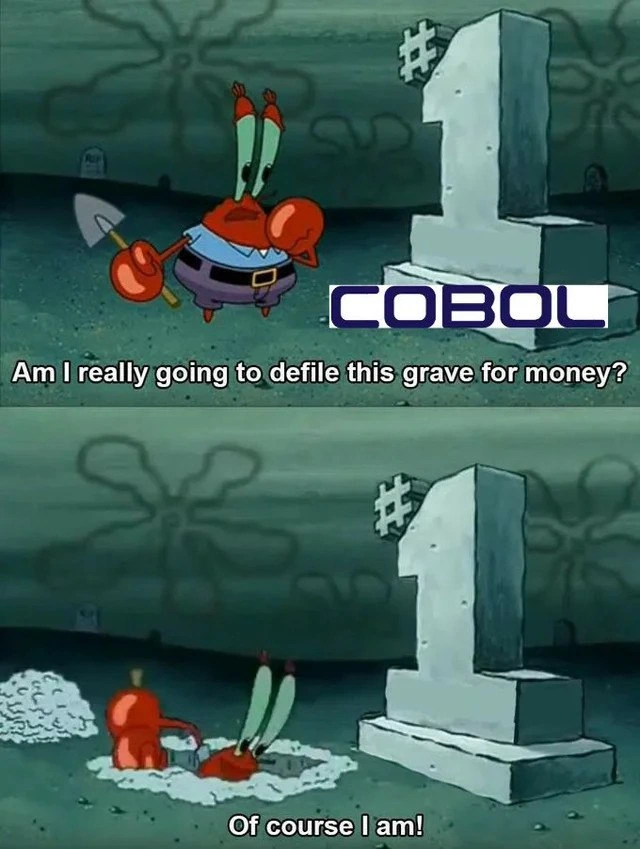
That’s what’s happening in this meme. It’s like a character saying, “I really don’t want to mess with this old stuff… oh wait, you’ll pay me how much? Okay, I’m doing it!” It’s funny because we can all understand doing something we don’t like just because the reward is big. In the picture, Mr. Krabs (a cartoon crab who loves money) is literally digging in a graveyard to get something marked “COBOL” (which is like a super old computer thing). He asks, “Do I really have to disturb this for money?” and then immediately answers, “Of course I do!”

So in simple terms: it’s joking that even if something is old or was supposed to stay buried and forgotten, people will bring it back if you pay them enough. It’s a silly way to show that money can change minds, even about things we said we’d never do.

Level 2: Old Code, Big Payday

This meme highlights how legacy code can suddenly become valuable. COBOL, which stands for Common Business-Oriented Language, is a programming language from the late 1950s/1960s era. It’s so old that many people assume it’s obsolete, almost like a language in a grave. A legacy system is basically an older software or computer system that’s still in use. Think of something built decades ago that a company never replaced because it still works (banks and governments have a lot of these!). Over time, keeping such old systems running can create technical debt – a buildup of outdated technology that’s costly or risky to change. Yet, despite being “old tech,” these systems often run core business functions (like processing payroll, handling bank transactions, or managing insurance policies). Rewriting them in a modern language would be a huge project, so many companies stick with what they have, patching it as needed.

In the SpongeBob SquarePants scene used for this meme, Mr. Krabs – a cartoon character known for being obsessed with money – is literally in a spooky graveyard digging up a grave. The grave’s headstone has “COBOL” written on it, implying that COBOL was considered dead and buried. The captions come straight from the show: first he asks, “Am I really going to defile this grave for money?” and then he answers himself, “Of course I am!”. In the original cartoon, he was digging up a buried treasure (a valuable soda drink hat) for profit. In the meme, that treasure is COBOL code.

For a junior developer or someone new to the industry, here’s what this means: People often joke that old programming languages like COBOL are “dead” because they aren’t commonly taught or used for new projects anymore. Modern developers might prefer languages like Python, Java, or JavaScript. COBOL, with its super-old-fashioned syntax and design, feels like a fossil from another era. However, some large enterprises still run huge important systems on COBOL. For example, many banks, insurance companies, and government databases were built with COBOL decades ago and still function today. These systems are deeply embedded in the organization’s operations – for instance, a COBOL program might handle all the daily transactions in a bank’s backend, or process tax returns in a government office.

The funny (and ironic) part is the money. Because COBOL is so old, fewer and fewer programmers know it. Universities don’t emphasize it much now; new developers typically learn newer languages. So when one of these legacy COBOL systems needs maintenance or an update, companies sometimes struggle to find people who can work on it. Supply and demand kicks in: there’s high demand for a rare skill, so those who do have COBOL skills (often older engineers or specialized consultants) can charge very high rates. In other words, COBOL work can pay really well. These are the “lucrative COBOL contracts” mentioned. It’s not unusual to hear about consultants being hired on short-term contracts specifically to fix or upgrade a COBOL system and being paid top dollar for that niche expertise.

Now, look at Mr. Krabs in the meme: he represents a developer or IT consultant. He’s basically saying, “Am I really going back to work on this ancient code just for money?” and then admitting “Yes, I definitely am, because the money is just that good.” It’s poking fun at how developers might claim they only want to work with the latest technologies, but when a big paycheck is on the line, suddenly working with 40-year-old code doesn’t sound so bad. This is a common joke in DeveloperHumor circles: no one enjoys wading through old spaghetti code or dealing with outdated systems (it can be frustrating and tedious), but if the enterprise (big company) is willing to pay a premium, developers will do it.

The meme also hints at the struggle between modernization and sticking with the old. Companies often talk about “Legacy Systems and Modernization” – basically, replacing old software with new systems. But modernization projects are risky, expensive, and can take years. So a lot of places end up continuing to use their legacy software while just paying experts to keep that old stuff running. It’s like if you have an old, beat-up car that a special mechanic knows how to fix – instead of buying a new car, you might keep paying that mechanic to patch it up because it’s cheaper right now (even if long-term it might not be).

In short, the top panel’s question captures a developer’s hesitation: Do I really want to mess with this old COBOL code? The bottom panel’s answer captures the reality: If the money’s good, absolutely yes. It’s a humorous take on how legacy technology sticks around. Even though COBOL is from another era, it’s still here, and it proves that sometimes “old but gold” is literally true – the old code is as valuable as gold when you need someone to work on it.

Level 3: Profitable Necromancy

The scene of Mr. Krabs digging up a grave marked COBOL hits a nerve in enterprise IT. In real life, legacy business software never quite dies; instead, it slumbers in old servers until woken by a crisis or a fat budget. COBOL (Common Business-Oriented Language) is a prime example: a 60+ year-old programming language lurking in bank back-ends and government mainframes. For decades, engineers joked it was a dead language, but it turns out you can resurrect "dead" code if you throw enough money at it. This meme nails that darkly funny truth: when critical software runs on LegacySystems and nobody’s rewritten it, companies will pay handsomely for developers to descend into the crypt of ancient code.

Where’s the humor? It comes from the absurd image of grave robbing for profit being all too relatable in tech. The top caption asks, “Am I really going to defile this grave for money?” Many senior devs have asked themselves a version of this when faced with decades-old LegacyCode—perhaps an opaque COBOL program last touched in the 1980s. The TechDebt in such systems is immense: archaic syntax, minimal documentation, and business rules fossilized in thousands of lines of code. Digging into it can feel almost sacrilegious, as if disturbing something that should be resting in peace. But then the bottom caption answers: “Of course I am!” Because, well, money talks. Those “lucrative COBOL contracts” are very real: when a critical COBOL-based system needs fixing, suddenly hiring a COBOL necromancer at triple the usual rate seems absolutely worth it. It’s developer humor highlighting a painful truth: money over modernization is often the enterprise default.

This scenario isn’t just hypothetical—it’s practically a rite of passage for seasoned engineers in banks and insurance firms. Real-world war stories abound: a state government unable to process unemployment claims because their COBOL system buckled under new demand, leading to frantic calls for anyone fluent in a language older than their parents. Or the infamous Y2K crisis at the turn of the millennium, which turned into a mass digging_up_legacy_code operation: companies shelled out huge bonuses to retirees who could patch 1970s COBOL programs and avert disaster. In each case, the grave of legacy software gets dug up for cash. It’s profitable necromancy: no one wants to maintain this old code, but the business value entombed in it is too high to ignore. Modernization projects (like rewriting everything in Java or Python) are often proposed, yet they stall or fail for complex reasons—massive cost, risk of downtime, or losing decades of bug fixes and subtle behaviors that the old system accumulated. It’s safer (and sometimes cheaper in the short run) to keep the zombie code shambling along with a few well-paid wizards to guide it.

So, enterprise devs chuckle at this SpongeBob scene because they’ve lived it. The mr_krabs_meme is a perfect avatar for a consultant or developer who, after loudly proclaiming “We should just rewrite this dinosaur system!”, is later found knee-deep in COBOL copybooks and JCL scripts because a client waved a big check. Mr. Krabs, infamously obsessed with money, makes the joke explicit: even our principles (“COBOL should stay dead!”) yield to a big payday. There’s also an irony that the tombstone is labeled #1—COBOL was once #1 in the business computing world, and in a twisted way it’s still number one in how much legacy value (and cost) it holds. Everyone in tech likes to brag about cutting-edge new languages and stacks, but when a 1960s-era LegacySoftware running on a mainframe is what’s keeping the company’s lights on, that old stuff suddenly becomes priority #1 (and often gets the biggest budget allocation when it’s in trouble). No matter how many new graduates scoff at it, COBOLProgramming stubbornly remains a valuable skill in certain corners of the industry — precisely because it’s rare and decidedly unglamorous. In other words, the less people want to touch it, the more you’ll get paid when you do touch it. 🪦💰

To put it in perspective, here’s a taste of what digging up legacy code might look like in practice. A modern Python developer might cringe, but this is the kind of syntax those high-paid consultants deal with:

IDENTIFICATION DIVISION.
PROGRAM-ID. PAYROLL-SYSTEM.
DATA DIVISION.
   WORKING-STORAGE SECTION.
   01 TOTAL-EMPLOYEES     PIC 9(5) VALUE 00000.
PROCEDURE DIVISION.
   * Calculate payroll by iterating through each employee record
   PERFORM VARYING I FROM 1 BY 1 UNTIL I > TOTAL-EMPLOYEES
       PERFORM PROCESS-ONE-EMPLOYEE
   END-PERFORM
   STOP RUN.

// COBOL code is verbose and column-oriented, a far cry from modern Python or JavaScript.

Reading and modifying such code feels like deciphering hieroglyphs – yet it still reliably processes, say, millions of bank transactions per day. Senior devs know that touching it can be risky: one wrong move and you break something that’s been quietly working for 30 years. But when the choice is between defiling the grave or letting a mission-critical system fail, businesses will always fund the grave-robbing expedition. The humor has a bit of pain mixed in with the laughter: it’s funny because it’s true. The industry collectively groans, “Of course we are!” – we’ll keep that ancient code on life support if it means the Enterprise keeps making money. After all, in tech, LegacySystemsAndModernization often advance not by bold innovation, but by begrudgingly tossing another log on the old fire and paying someone handsomely to stoke it.

Description

The meme is a two-panel SpongeBob SquarePants scene featuring Mr. Krabs in a murky green under-the-sea graveyard. In the top panel he stands beside a large stone "#1" headstone that has the word "COBOL" digitally pasted across its base, holding a small shovel. A subtitle under the image reads, "Am I really going to defile this grave for money?" In the bottom panel Mr. Krabs is already waist-deep in a freshly dug hole beside the same headstone, and the subtitle says, "Of course I am!" The joke plays on developers (or consultants) eagerly returning to supposedly dead legacy languages like COBOL because maintaining them is still highly paid in enterprise environments, highlighting the persistent business value - and technical debt - of legacy systems
Comments

9
Anonymous ★ Top Pick Kubernetes may get the keynote, but the real money is still six feet under with the 1976 COBOL batch that clears ACH - hand me the shovel and the SOW
  1. Anonymous ★ Top Pick

    Kubernetes may get the keynote, but the real money is still six feet under with the 1976 COBOL batch that clears ACH - hand me the shovel and the SOW

  2. Anonymous

    The bank's mainframe has been running flawlessly for 40 years, but the only person who understands it retired in 2003 and we've been deploying to production by copying his handwritten notes ever since

  3. Anonymous

    The real horror isn't maintaining COBOL - it's realizing that the 'legacy system' paying your mortgage was already considered legacy when your tech lead was born, and the original developers retired before Git was invented. At least Mr. Krabs gets immediate gratification; you'll spend six months just finding where the business logic actually lives in those 40,000 lines of PROCEDURE DIVISION spaghetti

  4. Anonymous

    COBOL isn’t dead, it’s an annuity: React -> REST -> CICS -> the same 1978 copybook, and the only thing truly modern is the hourly rate

  5. Anonymous

    Modernization strategy: slap a 3270-to-REST shim over CICS and pay the code archaeologist $300/hr while the JCL keeps printing money

  6. Anonymous

    COBOL: Buried decades ago, but the paychecks keep crawling out like it's tax season

  7. @saniel42 3y

    context please?

    1. @dsmagikswsa 3y

      A old lang that everyone think is dead but still being used in many big system with high demand. So you learn cobol for money.

    2. @choke_hazard 3y

      learn deprecated technologies, win stupid prizes earn big money

Use J and K for navigation