The Grand Evolution of 'Make' Commands
Why is this BuildSystems CICD meme funny?
Level 1: Taking It Too Far
Imagine a group of friends trying to outdo each other in a fun task. The first friend says, “I’m going to make the biggest sandcastle ever!” The second one replies, “I’ll make a big sandcastle!” The third chimes in, “I’ll just make a sandcastle.” But then the last friend says, “I’m going to use a hundred shovels at once to build my sandcastle super fast!”
😄 Do you see how that escalated? We went from a normal bold idea to a shorter idea, and finally to a ridiculously over-the-top idea. The last friend’s plan is so complicated and extra that it’s funny — it’s like they took the simple word “make” and turned it into a crazy gadget-filled scheme.
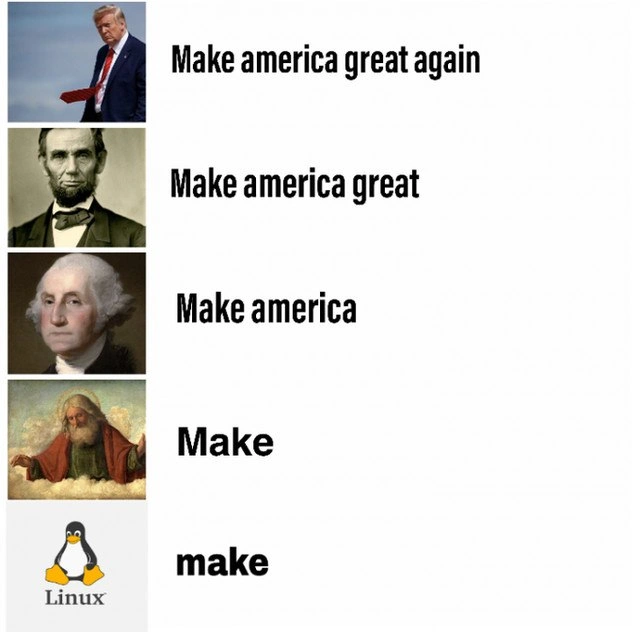
That’s exactly what this meme is doing. It starts with a famous big slogan (“Make America Great Again”) that everyone understands. Then it keeps chopping off words: “Make America Great,” then just “Make America.” By the end, it isn’t talking about America or greatness at all — it suddenly talks about CMake and uses a silly computer command. It’s as if the friend group ended with someone speaking in secret geek code instead of plain English.
The humor comes from taking a simple idea too far. It’s like a show-off move where someone tries to be super smart or efficient, but in a playful way. Even if you don’t know what CMake or -j$(nproc) means, you can laugh because the phrase transformed from something rallying and ordinary into complete gobbledygook. It’s the contrast that’s funny: one moment we’re talking about making things great, and the next we’re in some nerdy world talking about who-knows-what. Essentially, the meme is joking, “You wanted to make something great? How about we really make something… by turning it into a techie command! Ta-da!”
So even without the tech details, you can enjoy the silliness. It’s like someone started with a normal sentence and ended up casting a magic spell from a computer wizard’s book. The last line in a big “galaxy brain” picture is showing that person feeling ultra-smart for coming up with the wild idea. In simple terms: the meme is funny because it shows how a simple phrase can spiral into a crazy, over-complicated plan — all in the name of being “smart.”
Level 2: Make & CMake 101
Let’s break down the technical terms and tools referenced in this meme, as if you’re a newer developer encountering them for the first time:
“Make” (GNU Make): In programming, Make is a classic build tool that automates the process of compiling code. A build tool takes your source code (like
.cor.cppfiles) and compiles and links them into an executable program or library. Make uses a special file called aMakefilewhich contains rules on how to build the project (which files depend on which, how to compile each, etc.). When you run themakecommand in a project directory, it reads the Makefile and executes the necessary compile commands. The meme’s text “MAKE AMERICA GREAT AGAIN” starts as a normal English phrase, but as it gets shorter (“MAKE AMERICA GREAT”, then “MAKE AMERICA”), the word “MAKE” starts hinting at this tool. By the time it just says “CMake ..”, it’s no longer a slogan – it’s pointing to a software tool related to Make.CMake: CMake is a newer, higher-level build system generator. Think of CMake as a tool that writes Makefiles for you (or project files for other build systems like Visual Studio or Xcode). With CMake, you describe your project in a
CMakeLists.txtfile (listing source files, desired libraries, etc.), and then you run thecmakecommand to generate the platform-specific build files. For example, in a typical C++ project, you might create a separate directory for building, navigate into it in the terminal, and runcmake ... Those two dots..tell CMake “the source code and CMakeLists are in the parent directory.” CMake will then produce a Makefile (or Ninja build file, etc.) in your build directory. After that, you usemaketo actually compile. The meme shows the CMake logo (a red, blue, and green triangular prism icon) next to “CMake ..”, which is exactly how a developer would type the command. This indicates the meme’s final “evolved” form isn’t part of the slogan at all, but a literal command-line instruction to configure a build. It’s a playful way to end the slogan with a tech twist, since CMake contains the word “Make” (capital M) in it.Parallel make with -j: Normally, if you just run
make, it will compile files one by one (sequentially). But modern computers have multiple cores, meaning they can do many things at the same time (in parallel). The-joption stands for “jobs” and lets you tellmaketo run multiple compile jobs simultaneously. For example,make -j4would try to keep up to 4 compilation processes going in parallel. If you have a 4-core CPU, this can speed up the build roughly by 4x, because each core can handle a separate file’s compilation. In the meme,make -j$(nproc)is used. Here:nprocis a command you can run in a Unix-like terminal that simply outputs the number of processing units (cores) on your machine. On a laptop with a dual-core (2 cores, 4 with hyperthreading),nprocmight output “4”. On a 8-core machine, it might output “8”. It’s a quick way for scripts to know the hardware’s capability.$(nproc)in the command is how we insert the result of that command into another command. The$()notation means “execute what’s inside and put its output here.” So ifnprocreturns 8,make -j$(nproc)becomesmake -j8.- Thus,
make -j$(nproc)is a convenient way to say “compile using as many parallel jobs as there are CPU cores available.” It’s a form of build automation that adapts to whatever machine you’re on.
Why use all cores? If you’re new to compiling large programs, this might sound fancy. But think of it like cooking a big meal: if you have four burners on a stove (4 cores), you can cook four dishes at once instead of cooking them one by one. Similarly, with code, many source files can be compiled independently. Parallel compilation means the overall build finishes much faster by using all your “burners” (CPU cores) simultaneously. Developers often do this to save time, especially for big projects that could take a long time to build. It’s so common that many project README files or tutorials will explicitly tell beginners: “Run
make -j4(ormake -j$(nproc)on Linux) to speed up the build.”The plus one (
+1): Now, the last part of the meme showsm -j $(expr $(nproc) + 1). Let’s decode that:mis likely an alias or shorthand formake. On Linux/macOS, you can set an alias in your shell so that a short command stands in for a longer one. e.g.,alias m='make'. This means you can typemand it will actually runmake. People who runmakedozens of times a day sometimes do this to save a few keystrokes.$(expr $(nproc) + 1)is a slightly old-fashioned way of doing arithmetic in a shell command.expris a command-line utility that evaluates expressions. Here it’s taking whatever$(nproc)outputs (say 8) and adding 1 to it, yielding 9. In modern Bash, one could write this as$(( $(nproc) + 1 )), but usingexprlooks a bit more “wizardly” (and works in older shells).- So if
nprocwas 8, this whole thing becomesm -j 9, i.e., use 9 parallel jobs on an 8-core machine. - Why one more job than cores? This is an advanced tweak some developers experiment with. The logic is that occasionally one of the compile jobs might be waiting (for disk I/O or some short pause), so having one extra job in the queue can keep all cores busy almost all the time. It’s not always beneficial — if all jobs are truly CPU-heavy, that extra job can just overload the CPU. But some swear by using N+1 jobs for builds as a minor optimization. In truth, it depends on the workload. This meme exaggerates it to be funny: it’s like saying “I even go beyond 100% to compile my code!” It’s more of a show-off move than a practical standard recommendation.
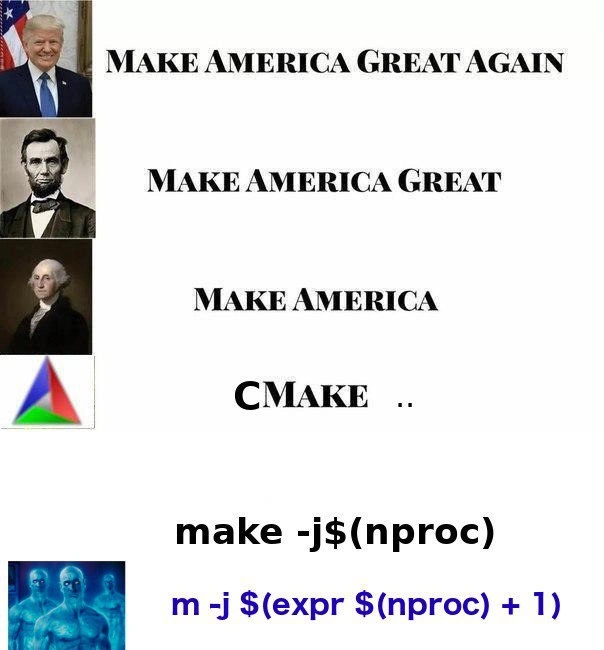
Political slogan parody aspect: Let’s not forget the obvious layer — this is parodying the slogan “Make America Great Again,” which was used in U.S. politics (most famously by Donald Trump). The meme visually goes from Trump (with the full slogan text) to Lincoln (with a shortened slogan), to Washington (even shorter), to finally the CMake logo (no more slogan, just a command). The idea is each step is “more enlightened” (as per the galaxy brain meme format) but also more niche and geeky. By the time we reach “CMake ..”, any connection to the original patriotic meaning is gone; it’s purely about software build tools. This contrast is what makes it funny — it’s absurd to associate George Washington with “Make America” or to see the CMake logo as a political figure with the word CMake written next to it like it’s part of the phrase. It’s a meme mashup of two very different worlds: political catchphrases and programmer command lines.
Why this is funny to devs: If you’re a junior developer or not yet familiar with these terms, you might sense there’s some joke but not fully get it. Essentially, it’s the incongruity that’s humorous. People in tech find it amusing when serious non-tech phrases coincidentally overlap with tech jargon. In this case, “make” is an English verb, but also the name of a ubiquitous build tool. So Make America… gradually transforms into CMake (which looks like someone yelling “See, Make!”). Then the meme doubles down and goes to actual command syntax (
make -j$(nproc)). It’s like if you had a slogan “Build Success” and a coder turned it into typing./build.sh success. It’s unexpected and delightfully nerdy.
For an early-career dev, the key takeaways are:
- Make and CMake are tools you’ll encounter in the context of compiling code (especially C/C++ projects). Make executes build recipes; CMake helps generate those recipes.
- The
-jflag withmakeis a pro-tip to compile faster by using multiple cores. nprocis just a handy command to get number of CPU cores on Linux.- And yes, some developers like to go one step further, using aliases and tricky shell commands to optimize things — partly for actual efficiency and partly as a form of geeky pride.
Ultimately, the meme’s progression is exaggeration for comedic effect. It’s teaching us (in a jokey way) that there’s always a more complex or “optimized” way to run a build, and some folks can’t resist going from a simple idea to an over-the-top solution. As a newcomer, you might not have used these commands yet, but one day when you’re waiting for a long compile, remember this meme – you’ll try make -j$(nproc) and join the ranks of those enlightened just enough by the power of parallel builds!
Level 3: CLI One-Upmanship
This meme brilliantly captures a bit of developer culture: the tendency to show off ever-more clever command-line tricks and optimizations. It starts with a famous political slogan and devolves into a series of build tool commands, each more “advanced” than the last. Here’s why experienced devs smirk at this:
Meme Format (Galaxy Brain Parody): The structure is a riff on the “expanding brain” or galaxy brain meme, where each successive panel represents a more enlightened (yet often more absurd) idea. On the left, the meme has four images: first a modern politician (blurred, but recognizable as a recent US president) with the text “MAKE AMERICA GREAT AGAIN.” Below that, a 19th-century statesman’s portrait (Abraham Lincoln) with “MAKE AMERICA GREAT.” Next, a founding father era figure (George Washington’s painted visage) with just “MAKE AMERICA.” Finally, instead of a person, there’s the colorful triangular CMake logo with the caption “CMake ..” (literally the word CMake with two dots). Each step drops a word from the slogan, until it’s no longer a political phrase at all, but a reference to the CMake build system command
cmake ... The joke is that the word “MAKE” gradually shifts from a verb in a patriotic slogan to the name of a build tool (make), and then mutates into CMake, a specific software tool. This is a classic meme parody of political slogans – taking a serious catchphrase and twisting it into a programmer in-joke.From Slogan to Build Command: Seasoned developers immediately recognize the punchline: “CMake ..” is something you’d type in a terminal, not something you’d chant at a rally. The humor lies in the absurd juxtaposition. We’ve gone from grandiose “MAKE AMERICA GREAT AGAIN” to the extremely niche
cmake ..command that only build engineers and C++ devs care about. It’s poking fun at how an epic four-word slogan might sound to a hardcore programmer: “Hmm, that starts with ‘Make’… did someone say Make? Or CMake?” The leap from Make (the build tool) to CMake is a nod to real tech progression: many C/C++ projects moved from handwritten Makefiles to using CMake for build configuration. CMake uses the word “Make” in its name, so it’s like an evolution: make something great -> just make -> actually, use CMake. The “..” after CMake is a typical usage: it tells CMake to look in the parent directory for the source (common when you do an out-of-source build). Including that detail in the meme is funny to insiders because it’s so specific – it’s not just “CMake” but a proper command snippet, as if the meme itself has entered the command-line realm.make -j$(nproc) – The Power User Move: Below the sequence with CMake, the meme shows in bold monospace text:
make -j$(nproc). This is where an experienced dev will grin. Runningmake -jNis how you compile code using N parallel jobs, dramatically speeding up build times on multi-core machines. And using$(nproc)is the clever part: it’s a shell substitution that inserts the number of CPU cores available. Essentially,make -j$(nproc)means “build using as many threads as I have processor cores.” In a CLI context, that’s a pro trick: it spares you from manually counting your cores or hardcoding a number. For example, on a 4-core machine you’d domake -j4, on an 8-coremake -j8, etc. Writing it as-j$(nproc)automates this. This suggests a level of build automation where the developer wants the build process to be optimally fast everywhere. It’s a humble brag: “Yeah, I always compile on full throttle.” Many of us remember the first time we discovered parallel_make and thought, “Wow, I can compile code 8 times faster by using all my cores!” After that, running plainmake(single-threaded) feels painfully slow. So this part of the meme resonates with any dev who’s waited too long for a compile and then had the “Aha!” moment of using-j. It’s practically a rite of passage in systems programming or working with large C/C++ codebases.Galaxy Brain – One Step Further: The final tier of the meme (overlaid on the glowing blue galaxy brain figure) ups the ante to absurdity:
m -j $(expr $(nproc) + 1). This is comedy gold for a certain kind of programmer. It’s the type of thing you’d see on an inside-joke Stack Overflow post or hear from that one colleague who prides themselves on shaving 2 seconds off a 10-minute build. Breaking it down: it’s usingminstead ofmake(implying the person even aliased the command to be shorter, because typing four letters was too pedestrian). Then it uses a shellexprto add 1 to the number of processors. This suggests: “Not only am I using all my CPU cores, I’m using all of them plus one – transcending logical limits!” It’s an intentionally ridiculous one-up. In real life, whether-j$(nproc+1)actually builds faster than-j$(nproc)is situational and often negligible (or could even hurt performance if overdone). But that’s the joke: it’s a one-upmanship arms race. Developer A says, “I compile with 8 threads,” Dev B says, “Oh yeah? I let the system detect cores and compile with 12 on a 12-core,” and Dev C says, “Pff, I compile with 13 threads on a 12-core just to squeeze out more!” The meme exaggerates this competitive optimization mindset to satire it. It’s basically mocking the galaxy brain mentality of turning a simple idea into an overly complex command-line flex.Cultural Cross-over: Part of what makes this meme extra funny to tech folks is the cultural clash. It starts in the realm of politics (with a specific slogan strongly associated with modern political culture) and veers sharply into nerd territory (CMake commands and shell syntax). That contrast is inherently humorous—like hearing someone end a serious patriotic speech with “dot dot.” It highlights how insular and specific developer humor can be. We’re effectively taking something mainstream and then filtering it through our developer humor lens until only programmers will get it. It’s also a nod to how ubiquitous these build tools are in our work. The word “make” triggers in our brains not the idea of greatness, but the command to compile code! So there’s a double meaning: Make America great vs make (compile) my program. The meme plays on that double meaning brilliantly.
Shared Pain and Pride: Many experienced devs have war stories of long compile times. Large C++ projects, for example, can take ages to build from scratch. Discovering tricks like
make -jor settingMAKEFLAGSin the environment to always use parallel builds feels empowering. At the same time, we’ve all seen the colleague who takes optimization too far – spending hours to automate a 5-second task, or in this case obsessing over the perfectmakeincantation to save a few seconds on a build. This meme gets a laugh because it’s true to life: we recognize the scenario. It’s poking fun at ourselves – how a simple idea (“maybe run some tasks in parallel”) escalates into arcane shell magic that only very online engineers find reasonable.
In summary, from a senior dev perspective, this meme is a perfect storm of BuildTools humor and cultural reference. It jabs at our inclination to boast about even trivial improvements. The slogan parody draws us in with something familiar, and the galaxy_brain_meme format delivers a punchline that says: somewhere, an overzealous engineer is gleefully running an N+1 parallel build and feeling like a genius. And honestly, we can’t help but chuckle because we’ve been that engineer at least once!
Level 4: Hyperthreading the Build
At the most esoteric level, this meme dives into the nitty-gritty of parallel build optimization and OS scheduling. The final command m -j $(expr $(nproc) + 1) is a tongue-in-cheek example of taking compile parallelism to the extreme. Here’s what’s going on under the hood:
Dependency DAG & Parallel Make: Modern build systems like GNU Make represent compilation tasks as a directed acyclic graph (DAG). Each source file or component has dependencies, and
makeensures prerequisites are built first. By using-j(jobs),makecan schedule multiple independent compile tasks simultaneously. Under the hood,makespawns worker processes up to the limit you specify. If you have ten source files with no mutual dependencies, a-j10can compile them in parallel, harnessing multi-core CPUs fully. This leverages the inherent parallelism in compiling separate modules of a program.-j$(nproc)– CPU-Core Utilization: The expression$(nproc)dynamically retrieves the number of processing units (cores/threads) available on a Linux machine. It’s a common shell trick in build scripts to avoid hard-coding a number. For example, on a machine with 8 cores,make -j$(nproc)becomesmake -j8. This often saturates all CPU cores with compile tasks. The idea is to maximize throughput: if you have N cores, running N compilation jobs in parallel ideally keeps all cores busy. This is especially impactful in large C/C++ projects where single-threaded builds (without -j) would only use one core and take much longer by not exploiting the hardware.The Galaxy Brain:
+1Jobs (Oversubscription): So why on earth would someone do$(nproc) + 1jobs? This is the galaxy brain move the meme jokes about. In theory, spawning one more job than the number of cores can sometimes eke out a bit more performance. The rationale is that not all compile tasks utilize 100% CPU all the time – some wait on I/O (reading from disk, writing object files) or are uneven in duration. By scheduling N+1 tasks for N cores, you might ensure that whenever one task hits a brief stall (say waiting for disk), another is ready to use the free CPU cycles. It’s akin to hyper-threading at the process level – oversubscribing CPUs by a small factor to keep pipelines full.However, this is a double-edged sword. OS schedulers will context-switch between these N+1 processes on N cores. If all tasks truly demand full CPU, that extra job can cause more harm than good: threads will contend for CPU time, causing overhead from context switching and cache thrashing. There’s a theoretical limit to parallel speedup, highlighted by Amdahl’s Law: beyond a certain point, adding more parallel tasks yields diminishing returns due to serial portions of the workload. For example, if linking the final binary is a single-threaded step, no amount of additional compiler threads will speed that part up. The serial bottleneck ultimately caps the benefit of
-jflags. So while N+1 jobs might squeeze out a few extra % in ideal cases, it can also overcommit resources and saturate memory or I/O. It’s a cheeky, not universally recommended trick—perfect fodder for a BuildSystems_CICD inside joke.CMake vs Make – Build Orchestration: The transformation from “Make” to “CMake” in the meme hints at the layering of build tools. Make is a lower-level build executor, whereas CMake is a higher-level build configuration generator. When you run
cmake .., the CMake tool is processingCMakeLists.txtfiles (which declare the project’s build rules) and emitting a Makefile (or project files for other build systems) in the current directory (the..usually refers to the source directory). Internally, CMake is doing a lot of work: it checks system dependencies, configures compiler flags, and writes out optimized build scripts. This step is typically single-threaded and relatively quick compared to compilation. But once CMake has generated the Makefiles, the heavy lifting is handed off to GNU Make. That’s when you callmake -j$(nproc)to compile everything in parallel. Advanced developers appreciate that CMake facilitates cross-platform builds, but ultimately it’s Make (or an equivalent like Ninja) doing the parallel compile job. The meme’s progression implies an “evolution” from a generic word “make” to the proper noun CMake, reflecting an “enlightened” tool choice (CMake being seen as a more advanced build automation system than raw Makefiles).CLI Aliases and Obfuscation: Notice how the final command uses
minstead ofmake. There is no standard build tool calledm— this likely indicates an alias or symlink a power-user created to save keystrokes. In Unix-like environments, it’s common for veteran devs to addalias m='make'in their shell configuration, so they can invoke make with a single letter. It’s a form of CLI shorthand that screams “I’m a terminal wizard who does this a lot.” Usingexprfor arithmetic is similarly arcane: modern shells allow$(($(nproc)+1))as a neater way to add one, butexpris the old-school Unix command for evaluating expressions. By writingm -j $(expr $(nproc) + 1), the meme concocts a command that looks even more convoluted and brainy. It’s essentially a flex – showing off the most compact or clever command-line incantation to achieve parallel_make plus one extra job. This kind of command line interface trickery is the hallmark of seasoned developers who spend a lot of time optimizing their shell workflow (sometimes to the point of absurdity).Continuous Integration & Build Automation Context: In practice, using
make -j$(nproc)(or some fixed high-jvalue) is a staple in CI pipelines and local builds to speed up build processes. Many CI systems automatically build with as much parallelism as available to reduce waiting time. The meme exaggerates this competitive mindset — it’s as if developers are engaging in one-upmanship over build speeds: “You use all cores? I use all cores plus one!” In reality, build engineers balance these settings carefully; an over-aggressive parallel build can bog down a build server or even timeout if memory or I/O becomes a bottleneck. But the developer humor here comes from recognizing that impulse to always push a little further, turning a presidential slogan into a nerdy shell command.
At this level, the meme is a celebration of low-level optimization joy: it pokes fun at how far we geeks will go for a faster compile. It invokes knowledge of OS internals (CPU scheduling, concurrency), BuildTools intricacies, and shell scripting magic. If you’ve ever tweaked your MAKEFLAGS or laughed at the idea of “fixing slow builds by just throwing more cores at them,” this galaxy-brain make command is the ludicrous yet hilarious culmination of that mindset.
Description
A multi-panel vertical meme that parodies the 'Make America Great Again' slogan by tracing an evolutionary path from politics to advanced software compilation commands. It starts with a photo of Donald Trump and the text 'MAKE AMERICA GREAT AGAIN'. It then simplifies with Abraham Lincoln and 'MAKE AMERICA GREAT', followed by George Washington and 'MAKE AMERICA'. The meme then pivots to the tech world, showing the CMake logo next to 'CMAKE ..'. It continues to evolve into a common optimization, 'make -j$(nproc)', before reaching its final, god-tier form, depicted by an image of the omnipotent Dr. Manhattan from Watchmen, alongside the command 'm -j $(expr $(nproc) + 1)'. This final command is a developer in-joke, suggesting a build process that attempts to use one more CPU core than is physically available, humorously implying a transcendent level of performance optimization. The joke is aimed at systems programmers familiar with the nuances of `make` and parallel compilation
Comments
7Comment deleted
The `+1` in `make -j$(nproc)+1` isn't for an extra core; it's a hint to the OS scheduler that you're willing to negotiate with dark matter to get your build done faster
alias m='cmake --build . -- -j$(($(nproc)+1))' - because real patriots oversubscribe every core and let Jenkins filibuster the swap space
The guy who does make -j$(expr $(nproc) + 1) is the same one who schedules meetings during lunch to "maximize productivity" and wonders why the build server keeps OOM-ing
The true enlightenment isn't just using 'make -j$(nproc)' to parallelize your build across all cores - it's the audacious move to 'm -j $(expr $(nproc) + 1)' that separates the architects from the mortals. Because why merely saturate your CPU when you can oversubscribe it by one job and watch your laptop's thermal throttling kick in? It's the build system equivalent of 'I know what I'm doing' right before everything catches fire - a rite of passage for anyone who's ever stared at a 45-minute C++ compilation and thought 'I can make this worse.'
The real policy upgrade is “CMake .. && make -j$(expr $(nproc) + 1)”; oversubscribe one job to hide I/O stalls, then watch the linker filibuster in single-threaded committee
Slogans shrink, but devs up the ante to -j(nproc+1) - because nothing says 'great again' like context-switch hell and swap thrashing
Peak optimization is aliasing make to “m” and running -j$(nproc)+1 to beat Amdahl’s law - right up until the single-threaded linker reminds you who’s actually in charge