Skip to content
DevMeme
404 of 7435
The Cheeto Lock: Using Base64 as 'Encryption'
Security Post #471, on Jul 9, 2019 in TG

The Cheeto Lock: Using Base64 as 'Encryption'

Why is this Security meme funny?

Level 1: Locked with a Cheeto

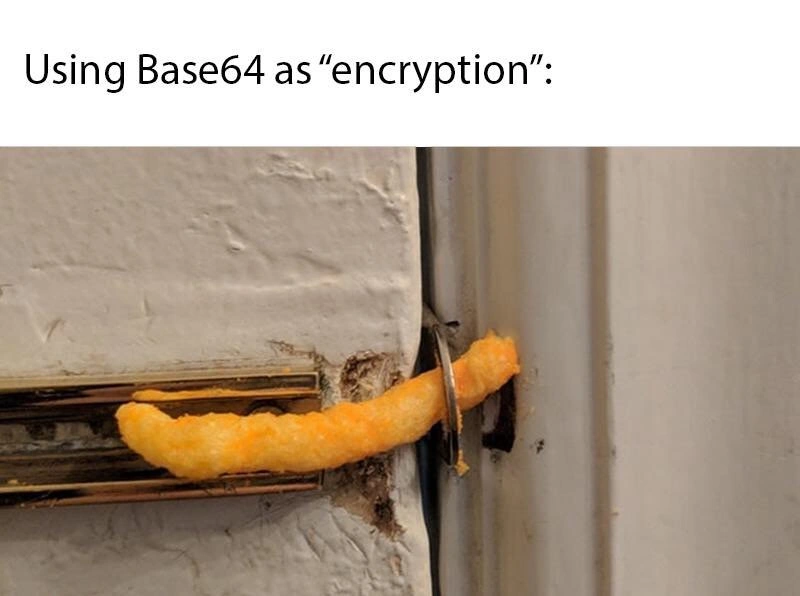
Imagine trying to secure your house by sticking a Cheeto (a crunchy orange cheese puff) into the door's latch instead of using a real lock. It sounds ridiculous, right? Anyone could walk up and yank that snack out — or just push the door until the cheesy puff breaks — and walk right in. Maybe the person who put it there might feel like the door is locked because something is in the way, but in reality it's not doing anything. The picture is funny because it shows how silly that false sense of security is. In the same way, if someone "protects" a secret by just making it look different (without a proper lock or key), it's just like using a Cheeto as a lock. It might look locked at a glance, but it won't stop anyone who really wants to get through.

Level 2: All Crunch, No Crypto

At this level, let's break down what’s happening in simple technical terms. Base64 encoding is a method of converting data (usually bytes) into a set of 64 characters that are safe to print and transmit in text form. It’s commonly used in programming for things like embedding images in HTML/CSS, or safely sending binary data in systems that only handle text. When you Base64-encode something, you take binary data and represent it using letters, numbers, and a couple of symbols (+ and /), plus = as padding. The result looks like a jumbled string, but it's not a secret—it's just a different format. Anyone who knows the trick can decode it back to the original data immediately.

On the other hand, encryption means actually scrambling data in a way that you need a special key (like a password) to unscramble it. This is the kind of thing you want for real security: algorithms like AES or RSA use a key to turn your message into something truly unreadable unless you have the right key to unlock it. If you don't have the key, breaking good encryption is supposed to be practically impossible with current technology.

So why is using Base64 as "encryption" a bad joke? Because Base64 doesn't use any key at all – it’s a reversible encoding, not a lock. It's like translating a message into a different language: sure, it might look unreadable to someone at first, but anyone who knows that language (or can use Google Translate) can convert it right back. By comparison, proper encryption is like locking the message in a safe: only someone with the combination can get it out.

To drive this home, let's look at a quick example in code. We'll "encode" a secret with Base64 and then decode it:

import base64

secret = "OpenSesame"  # This is the secret data we want to protect
encoded = base64.b64encode(secret.encode("utf-8")).decode("utf-8")
print("Base64 Encoded:", encoded)
# Base64 Encoded: T3BlblNlc2FtZQ==

# Now let's 'decrypt' by simply decoding the Base64
decoded = base64.b64decode(encoded.encode("utf-8")).decode("utf-8")
print("Decoded back:", decoded)
# Decoded back: OpenSesame

See what happened? The text OpenSesame got turned into T3BlblNlc2FtZQ== when encoded in Base64. That looks like gibberish at a glance, but the moment we run a decode, we instantly get OpenSesame back. We didn't need any secret password or special permission – the algorithm itself is all that’s needed to reverse it. Anyone can do this. If an attacker or unauthorized person gets a Base64 string, they can just decode it like we did, and boom, they have the original secret.

Now imagine if that secret was your password or private data. Encoding it in Base64 would be almost as bad as leaving it in plain text, because it's so easy to undo. This is why the meme compares Base64 "encryption" to using a cheese puff as a door lock. Security through obscurity – a fancy term for "trying to hide something in plain sight and hoping no one figures it out" – doesn't work here. Base64 might hide the readability of the data (just like a Cheeto might hide the fact that a door has no real lock), but it doesn't add any real protection.

In summary:

  • Base64 = encoding, a way to represent data differently, with no secrecy. It's useful for data formatting, not for security.
  • Encryption = a real lock, using keys and math to actually protect data from anyone who doesn't have the key.
  • Using Base64 like encryption is literally a joke – it's as easy to break as that Cheeto "lock" in the picture. Anyone can reverse it and get the treasure inside.

Level 3: Security Through Snacks

Using Base64 as "encryption":

That caption and the image of a lone orange Cheeto jammed in a doorframe say it all. This meme calls out a classic security flaw that many of us have facepalmed over: treating Base64 encoding as if it were real encryption. It's poking fun at the false sense of security some developers (or their managers) get from "hiding" data with a trivial encoding. In reality, that's just security through obscurity in its most cringe-worthy form. The cheese puff in place of a deadbolt is a perfect analogy: it might look like the door is locked from a distance, but there's no real substance behind it. One good jiggle and the door pops open. Likewise, a Base64-encoded secret might look like random gibberish to a layperson, but any programmer or hacker can decode it in an instant with off-the-shelf tools (or a simple one-liner script).

Seasoned engineers find this hilarious (and a bit horrifying) because we've all seen it in the wild. Weak "encryption" practices like this are unfortunately common:

  • A config file where the database password is merely Base64-encoded, sitting pretty until someone decodes it.
  • An API that transmits "encrypted" data to clients, but the client code just Base64-decodes it before use. Surprise! The secret message was just painted over, not locked away.
  • A legacy system that stores user credentials with a reversible encoding and calls it secure, prompting panicked refactoring when a junior dev figures out the admin password by running base64 --decode.

In corporate environments, this often stems from either ignorance or expediency. Maybe an under-pressure developer thought, "Hey, at least it's not plain text, so that's gotta be safer, right?" – kind of like thinking a Cheeto lock is better than no lock at all. Or a manager wanted to check a compliance box: "We encrypt our data at rest," so the devs just Base64-encoded everything and called it a day. It's a classic case of lax security attitudes: doing the bare minimum and hoping no one notices. Spoiler: people notice. The first time an actual security reviewer or savvy coworker comes along, they'll raise an eyebrow and probably a red flag.

The humor here also lies in how obvious the vulnerability is, once pointed out. The chunk of neon-orange snack in the doorjamb is visually absurd – you don't need to be a locksmith to see that's not going to stop anyone. Similarly, you don't need to be a cryptographer to recognize Base64 strings. They have a pretty distinctive look (only letters, digits, +, /, and maybe = at the end). It's practically screaming "Hey, I'm just Base64, decode me!" to anyone who knows where to look. Using Base64 as your secret-keeper is like hiding a house key under the welcome mat: even amateurs know to check there first.

To drive the point home, here's how the developer's illusion stacks up against reality:

Developer's "Security" Dev's Belief Reality
Base64-encode sensitive data "It looks unreadable, so it's safe." The original text is revealed in seconds.
Stick a Cheeto in the door lock "The door is locked now, all good!" Door opens with zero resistance.

Everyone in software security has some war story about encountering "pseudo-encryption" like this. It's funny in a meme, but scary in production. The meme resonates because it visualizes that internal groan we all have when we stumble on code that does secret = base64.b64encode(data) and calls it a day. You can almost hear the sarcastic commentary in your head: "Great, our bank vault is protected by cardboard and hope. That'll stop the hackers... not."

Ultimately, the joke underscores an important truth in cryptography and software development: encoding is not the same as encryption. Real locks (and real encryption) might take some expertise and effort to implement, but at least they actually protect something. A Cheeto masquerading as a lock only protects one thing: the illusion of security (and even that, not for long).

Level 4: ROT13's Cheesy Cousin

Let's get one thing cryptographically clear: Base64 is not encryption by any stretch of the definition. In the hierarchy of algorithms, it's a simple encoding scheme, about as secret as writing a message backwards. Real encryption algorithms (like AES, RSA, or even an old-school Caesar cipher) rely on a secret key and produce output that is computationally infeasible to reverse without that key. Base64, by contrast, uses a fixed, publicly known transformation with zero secret bits. It's essentially converting data from one representation to another (8-bit bytes into 6-bit sextets) and mapping those sextets to 64 printable characters. This is a reversible, deterministic function – a far cry from any true cipher.

For comparison, even the infamous ROT13 (rotate-by-13 letters) substitution offers a paper-thin semblance of secrecy by shifting letters (anyone can undo it, but at least there's a key of sorts). Base64 is in that same cheesy league of obfuscation (if Base64 qualifies as "encryption," then speaking in Pig Latin must be state-of-the-art cryptography.) It introduces no genuine randomness or lock; it's simply a textbook mapping. In formal terms, encryption should introduce significant entropy and diffusion (Claude Shannon's security fundamentals) into the output. That means a proper cipher thoroughly scrambles the input: even a tiny change in the plaintext yields a huge, unpredictable change in the ciphertext, all controlled by the secret key. Base64 provides none of that. It preserves every bit of original information (zero diffusion) and just repackages it in a different radix. Patterns in the input remain patterns in the output. For instance, a repetitive plaintext like AAAAAAA turns into QUFBQUFB under Base64 – still repetitive and immediately recognizable – whereas a strong cipher like AES would spit out bytes that look like random static, with no discernible pattern at all.

Now consider Kerckhoffs's Principle – the idea that a cryptosystem should be secure even if everything about it (the algorithm, its workings) is public knowledge, except the key. Modern encryption embraces this: algorithms like AES are openly published for all to scrutinize. Their security rests entirely on the secret keys (e.g. a 128-bit AES key has $2^{128}$ possible values, an astronomically large search space). Now put Base64 under Kerckhoffs's microscope: the encoding method is public (heck, standardized in RFC 4648) and... there is no key. It's like claiming a door is secure when the "lock" is just a known puzzle anyone can solve. The moment an attacker suspects your "encrypted" text is just Base64 (and the limited character set [A–Z, a–z, 0–9, +, /] with those telltale = padding signs is a dead giveaway), they don't need to brute-force a thing – they simply run a decode function. Complexity analysis drives the point home: decrypting a well-secured cipher might require trying unimaginably many keys or leveraging complex math, whereas decoding Base64 is an $O(n)$ operation – linear time, basically one direct lookup per character. No exponential-time ordeal, no advanced cryptanalysis – just a quick inverse mapping that any computer (or any user with an online decoder) can do in seconds.

In summary, Base64 offers 0 bits of true security. It's the cryptographic equivalent of a flimsy stage prop. Calling Base64 "encryption" is like calling a Cheeto a deadbolt: it might fool the uninformed at a glance, but anyone actually trying to get past it will burst out laughing and walk right through.

Description

This meme uses a simple, effective visual metaphor to critique a common security misconception. The top of the image has the text 'Using Base64 as “encryption”:'. Below the text is a close-up photograph of a door's slide bolt lock. Instead of a sturdy metal pin, the latch is 'secured' by a single, orange, puffy cheese snack, which is clearly fragile and provides no real security. The joke is a visual pun that equates the false sense of security from using Base64 for encryption with the absurdity of using a cheese puff to lock a door. For experienced developers, this is a relatable jab at the naive practice of mistaking encoding (a reversible data representation) for encryption (a secure, key-based transformation). It highlights a classic beginner mistake and serves as a humorous reminder of what constitutes real security


Comments

7
Anonymous ★ Top Pick I once saw a PR where the secret was Base64 encoded. I told the junior dev that's like trying to secure a house by writing 'Please Do Not Enter' on a piece of paper and taping it to the front door
  1. Anonymous ★ Top Pick

    I once saw a PR where the secret was Base64 encoded. I told the junior dev that's like trying to secure a house by writing 'Please Do Not Enter' on a piece of paper and taping it to the front door

  2. Anonymous

    Architect review: If your “encryption” strategy can be reversed by typing `echo $DATA | base64 -d`, congratulations - you’ve installed the Cheeto dead-bolt

  3. Anonymous

    Just like this Cheeto lock, Base64 'encryption' provides exactly the level of security you'd expect from something that literally has 'decode' as a standard library function in every programming language - it's security theater that wouldn't even fool a script kiddie with a browser console

  4. Anonymous

    Ah yes, Base64 - the cryptographic equivalent of writing your password on a Post-it note, then folding it in half and calling it 'encrypted.' It's the security measure that screams 'I attended a compliance meeting but skipped the OWASP training.' Nothing says 'enterprise-grade protection' quite like an encoding scheme that any browser's developer console can reverse in milliseconds. At least when you ROT13 your secrets twice, you can claim you're using 'military-grade double encryption.'

  5. Anonymous

    Base64 'encryption': secure until the intern runs `echo 'data' | base64 -d` over coffee

  6. Anonymous

    Base64 “encryption” is the Cheeto deadbolt - great for closing a SOC2 ticket, instantly opened by anyone who can type echo $token | base64 -d

  7. Anonymous

    When a review says “credentials are encrypted (Base64),” I update the threat model to “attacker lacks the decode button.”

Use J and K for navigation