Code Review Hypocrisy: Garbage vs. Trash
Why is this CodeReviews meme funny?
Level 1: Only My Mess, Not Yours
Imagine you have two trash bins in your room. One has a big label that says “Garbage Only” and right underneath it says “No Trash.” That sounds pretty silly, right? Garbage is trash – they’re the same thing. It’s like if your sibling told you, “I can throw my candy wrappers in this bin because they’re ‘garbage’, but you can’t throw yours in because they’re ‘trash’.” There’s no real difference between the two, so it’s totally unfair! This meme is making fun of someone doing that with their work. In the world of computer code, one person is letting their own messy code go into the project (their “garbage” is allowed), but when another person tries to add their code, the first person says “No, that’s trash, you can’t put it in.” It’s funny because it’s such an obvious double standard — one set of rules for themselves, another set of rules for everyone else. Just like with the trash bins, everyone can see it doesn’t make sense, and that’s why we laugh at it.
Level 2: Code Review Double Standards
Let’s break down the meme in simpler terms, especially for those newer to Git and code collaboration. In software development, teams use VersionControl systems like Git to manage changes in code. Two key actions in Git are push and pull request. When you “push your changes,” you’re using git push to send the code you wrote on your computer up to the shared repository (for example, on GitHub). Think of it like uploading your latest draft to a shared drive so everyone can see it. Usually, for important branches (like the main codebase), there’s a rule: you shouldn’t directly push your code changes without someone else looking at them first. That’s where a pull request (PR) comes in. A pull request is when you ask, “Hey, can you pull (bring in) my changes to the main project?” It’s basically a request for your teammates to review your work and approve it before it becomes part of the official code. This is a common practice in CodeReviews to maintain quality and catch mistakes.
Now, what is the meme scenario? It says “when you push your changes but deny someone’s pull request.” This describes a person who merges their own code changes without waiting for review (the push part), but when another developer submits their code for review (the pull request part), that person says “Nope, not good enough” and doesn’t allow it to merge. Denying a pull request means the reviewer finds issues or simply rejects the changes, so the code doesn’t get added in. It’s like one developer is playing by a different rulebook: they don’t have to get permission for their code, but they refuse permission to someone else. In a fair process, everyone’s code – whether junior or senior – would go through the same review. So this situation is uneven and understandably frustrating. It’s a big DeveloperExperience no-no when one team member isn’t following the agreed workflow.
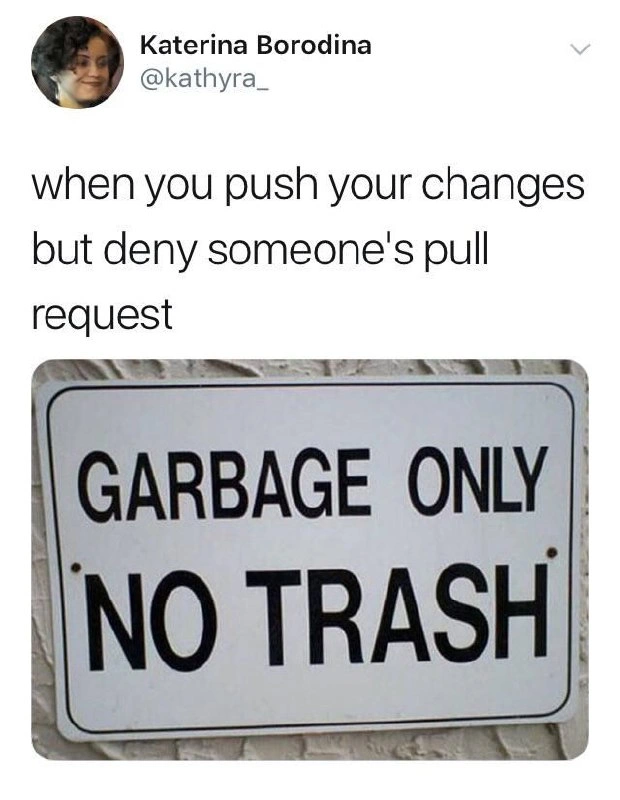
Let’s talk about the images: The top part is a tweet (a short message on Twitter) capturing that exact irony in one sentence. The bottom part is a photo of a sign that says “GARBAGE ONLY” on the first line and “NO TRASH” on the second line. Normally, garbage and trash mean the same thing (unwanted waste). Seeing a sign effectively say “Only throw away garbage, do not throw away trash” instantly makes you do a double-take — it’s nonsensical! In the context of the meme, this sign is a perfect metaphor for the person’s behavior in code review. It’s as if the person is saying: “My code is garbage (and that’s allowed), but your code is trash (and that’s not allowed).” The difference between “garbage” and “trash” is imaginary here, just like the supposed difference between their code and your code. In other words, they’re being hypocritical: they act like their contributions are clean enough to go in, but label someone else’s contributions as rubbish without a fair basis.
For a new developer, how does this relate to real life? Imagine you make some changes in code and want to contribute them. You’d typically create a new branch (a separate line of development in Git), push your commits to that branch on the remote repo, and then open a PullRequest asking to merge those commits into the main branch. Your team or a senior developer would then review the PR. They might comment with suggestions (“hey, you need to fix this part” or “there’s a bug here”) or in the best case, say “Looks good, let’s merge it.” If they deny the PR, it means you have to address their feedback or they outright decided these changes won’t be included. That can happen for valid reasons (like failing tests, not matching requirements, or needing improved code style). But it can also happen for less great reasons – maybe the reviewer is overly picky, or they prefer their own way of doing things.
Now picture the other side: the person who denied your PR goes and makes their own changes to the same project. Instead of making a PR and letting others review it, they just directly push their changes to the main branch. No one looks at it, no discussion, it just becomes part of the code. Why can they do that? Perhaps they have higher permissions (like they’re the team lead or the repo admin), or the rules aren’t enforced for them. It’s like bypassing a safety check. This is generally frowned upon in collaborative environments because it skips the whole idea of peer review. If their un-reviewed code has a mistake, no one catches it before it’s in the main project – and that could cause problems later (bugs, MergeConflicts, etc.). Meanwhile, your change — which might have been fine or at least fixable — is delayed or rejected. You can see why this feels unfair.
The meme is funny to developers because it exaggerates a real feeling. It’s labeled under DeveloperHumor and RelatableDevExperience for that reason. Almost every programmer has a story about a tough code review or an inconsistent standard. Maybe you had a strict reviewer who made you change trivial things (like variable names or add a comment) while you noticed their own code wasn’t exactly perfect. Or you’ve seen a senior engineer commit a quick fix that actually broke something, all because no one reviewed it. This isn’t how code review is supposed to work! Ideally, everyone follows the same guidelines to keep things fair and the code high-quality. When someone doesn’t, it stands out – and people cope by joking about it. The “GARBAGE ONLY, NO TRASH” sign is a lighthearted way to call out that double standard. Even if you’re new, you can understand it as “they’re using two words that mean the same to make a fake rule,” which is precisely what happens when a developer says “my code is fine but yours isn’t” without a solid reason. It’s a reminder that sometimes the challenges in programming aren’t just technical – they’re human.
Level 3: Push–Pull Paradox
This meme exposes a classic code review contradiction that seasoned developers know all too well: your own code is perfectly fine to merge, but someone else’s code is “not up to standards.” The top panel sets the scene with a tweet proclaiming, “when you push your changes but deny someone’s pull request”. In a VersionControl context like Git, that translates to one developer blithely running git push to merge their own code, while slamming the brakes on a colleague’s PullRequest. The bottom panel drives the joke home: a sign reading “GARBAGE ONLY – NO TRASH.” Garbage and trash are synonyms, so the sign is absurd – just like acting as if my code is good (garbage allowed) but your code is bad (trash rejected) even when they’re essentially the same quality. It’s the ultimate reviewer double standard.
Experienced engineers will recognize the technical gatekeeping at play. We’re looking at a form of code snobbery where one person (often a senior or project "owner") treats the repository like their kingdom. They have push access and can merge their own commits at will – no code review for the king’s code. But when a teammate opens a Pull Request to propose changes, this self-appointed gatekeeper becomes hypercritical. They’ll nitpick variable names, demand more tests, or question every design choice, effectively stamping “NO TRASH” on the other person’s work. It’s funny because it’s true: this hypocrisy turns the collaborative spirit of CodeReviews into a one-way street. The meme’s sign perfectly encapsulates the attitude: “My code = garbage (allowed); Your code = trash (not allowed).”
Why is this scenario so relatable (and cringeworthy) to those of us with lots of Dev experience? Because we’ve all seen how CodeReview pain points often come not from the tool or the process, but from people. Humans introduce subjective bias. Maybe the gatekeeper truly thinks they’re maintaining quality, or maybe they just trust themselves more than others. Yet, ironically, bypassing peer review for one’s own commits is a known recipe for technical debt and bugs slipping into production. It’s the sort of move that leads to a 3 AM outage because Sir Push-a-Lot merged a “quick fix” without a second set of eyes. Meanwhile, the new developer’s well-tested PR for a feature sits unmerged, gathering dust (and merge conflicts). Ever had a MergeConflict because someone merged their code while yours was waiting review? This meme hits that nerve.
To those in the trenches, the humor has a bitter edge: we laugh, remembering how the “Garbage Only” merges (unchecked changes) often become tomorrow’s emergency patch, whereas the rejected “trash” PR might’ve been perfectly fine if given a chance. It highlights a broken DeveloperExperience (DX) – where process is wielded unevenly. The sign’s contradictory message is basically the unwritten motto of toxic code review culture. Garbage in, garbage out? More like “garbage in (if it’s mine), nothing out (if it’s yours).” In a healthy team, everyone’s code undergoes the same scrutiny and CodeReview standards. In the dysfunctional scenario this meme mocks, standards apply only to others. The end result? The team’s morale smells about as pleasant as week-old trash. But at least we can meme about it, finding solidarity (and a dark laugh) in calling out the absurdity.
# Example of the double standard in action:
git commit -m "Hotfix: quick and dirty workaround"
git push origin main # <-- Garbage goes in (no review for the boss)
# Meanwhile, on a teammate's pull request:
# Reviewer's comment:
> "Please fix indentation and add more comments. Also, are you sure this approach is optimal? 👀"
# Pull request status: REJECTED (Trash not allowed)
In summary, the DeveloperHumor here works because it’s exaggerating a real struggle. The push vs. pull request disparity is the Push–Pull Paradox: some folks act like their commits are always mission-critical (even if half-baked) while treating others’ contributions as unwelcome chores. It’s a knowing wink to every programmer who’s felt the sting of an unfair code review. The next time you see a code comment that feels pedantic, just remember the “GARBAGE ONLY, NO TRASH” sign and have a little chuckle – sometimes laughing at the problem is step one to fixing it.
Description
This meme is a screenshot of a tweet from user Katerina Borodina (@kathyra_). The text of the tweet reads, 'when you push your changes but deny someone's pull request'. Below this caption is a photograph of a white rectangular sign with black, bold, sans-serif text. The sign says 'GARBAGE ONLY' on the top line, and 'NO TRASH' on the line below. The humor stems from the absurd and arbitrary distinction between 'garbage' and 'trash', which are synonyms. This is used as a metaphor for the hypocrisy sometimes present in code reviews, where a developer might consider their own code (the 'garbage') acceptable for merging, while rejecting a colleague's code (the 'trash') for similar or equally trivial reasons. For senior developers, it's a cynical but relatable take on ego, subjectivity, and power dynamics in the pull request process
Comments
7Comment deleted
My code is 'technical debt'. Your code is 'a legacy-to-be'. It's all about framing
Senior dev logic: my emergency hotfix can go straight to prod because “Garbage Only™” is basically a design pattern; your fully-tested PR is rejected because we don’t allow “trash” that might bump the cyclomatic complexity by one
The difference between garbage and trash is that garbage has commit history proving it evolved from good intentions
The classic 'do as I say, not as I commit' philosophy - where your hastily written 3am refactor that touches 47 files gets force-pushed to main, but your colleague's meticulously crafted, fully tested, single-line bug fix gets blocked for 'not following team conventions.' It's the architectural equivalent of demanding SOLID principles in code reviews while your own codebase is held together by global variables and prayer
Protected branch policy: my admin-merge is “garbage collection”; your PR is trash until it survives a design doc, perf benchmarks, and three approvers on PTO
We call it “quality gates” - your code needs two approvals and green CI; my commits are “expedited maintenance” straight to main - governance for thee, velocity for me
My pushes bypass linting like GC pauses; your PR triggers every static analyzer alarm. Denied