Skip to content
DevMeme
1853 of 7435
When a Client's 'Simple' Request Defies Logic
Stakeholders Clients Post #2061, on Sep 18, 2020 in TG

When a Client's 'Simple' Request Defies Logic

Why is this Stakeholders Clients meme funny?

Level 1: Wrong Tool for the Job

Imagine your friend gives you a cookie cutter that’s a circle and says, "Here, use this to make a perfectly square cookie." 🍪 They think it should be easy, because hey, a cookie cutter is for making shapes, right? But you know that a round cutter can only make round cookies, not squares. You’d probably laugh or get frustrated, because it’s obvious you’ve been handed the wrong tool to do what they want.

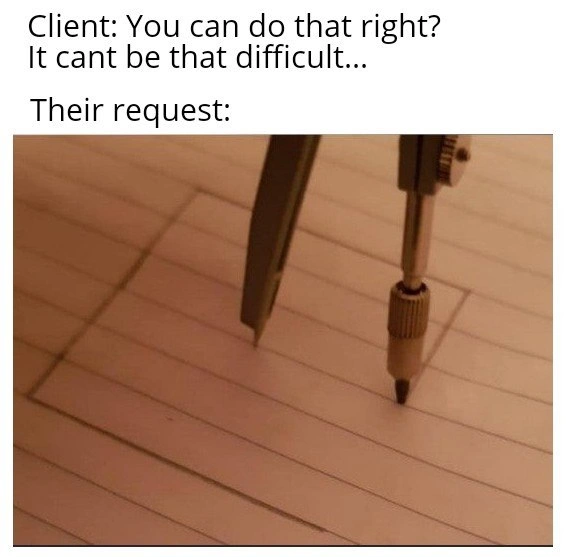
This meme is just like that, but for software. The client in the picture is like the friend with the silly idea. They’re asking the developer to do something in a way that doesn’t make sense – using a compass (which draws circles) to draw a square. It’s funny because the client really believes it "can’t be that difficult," while the poor developer is stuck trying to explain that just because something sounds simple doesn’t mean it is. In simple terms, the client doesn’t understand the tools or the work needed, and the developer feels like they’ve been asked to do the impossible. The humor comes from that mismatch: one person thinks it’s a piece of cake, and the other person knows it’s actually like trying to fit a square peg in a round hole. It's a lighthearted way of saying, "Sometimes people ask for really crazy things without realizing it!"

Level 2: Scope Creep 101

Let’s break down the joke. In the picture, we see a compass – the kind from math class used to draw circles – being used in an attempt to draw a square. A compass is a drafting tool with two legs: one has a sharp point to anchor on paper, and the other holds a pencil to draw an arc. It’s great for circles, but terrible for straight lines. A square has four straight edges and right-angle corners, something you'd normally draw with a ruler or a T-square (a straightedge tool), not a compass. By showing a compass awkwardly placed at the corner of a penciled rectangle, the meme visually shouts, "They’re using the wrong tool for the job!" 🛠️

The top text is written from the perspective of a client or stakeholder. They say: "You can do that right? It can't be that difficult..." just before revealing their request: drawing a square with a compass. This scenario is a perfect illustration of ClientExpectations versus reality. Non-technical stakeholders often underestimate how complex a software task is. They might assume adding a complicated feature is as easy as toggling a setting. When the client says "It can't be that difficult," developers hear a red flag. It usually means the client doesn’t understand what they're asking for or the limitations involved.

This ties into a common project issue known as scope creep. Scope creep is when a project's requirements keep growing ("creeping") beyond the original plan. For example, you start a project thinking you'll draw circles, and halfway through someone says, "Actually, we also need squares, triangles, and maybe a portrait of the CEO, but you can handle that, right?" Each time, they insist it's a small change. Here, the square is an extra requirement that wasn’t planned initially, and using only the compass (existing tools/code) to do it makes it an unrealistic expectation.

Another concept here is ambiguity in requirements. The client might not specify details or might mix up terms. They could be asking for a “square” without providing a ruler – in software terms, that’s like asking for a feature without giving you the proper resources or acknowledging the needed technology. There’s a communication gap: the client’s stakeholder expectations are that any good developer can quickly MacGyver a solution. The developer, especially if they are early in their career, might initially think, "Maybe there’s a trick I’m missing?" But soon they realize the request is genuinely problematic. A junior developer might learn the hard way that just because something sounds simple to a non-dev doesn’t mean it’s actually simple.

In real development, a client’s request akin to "drawing a square with a compass" could be something like: "Can you build this entirely new feature by tomorrow? You can reuse what you have, it’s just a small change." To the client, it’s a square: just another shape. To you, it’s a whole new geometry that your current toolset (your “compass”) isn’t built for. This often leads to a tough conversation where developers have to explain why it’s not as easy as it looks. The meme resonates with anyone who has had to diplomatically tell a client, “I’m sorry, but we’ll need a different approach (or more time/money) to do that,” after the client assumed it was a no-brainer. It’s a relatable lesson in project management and communication: make sure everyone understands what the tools can and cannot do from the start, or you’ll end up trying to perform the impossible.

Level 3: Square Peg, Round Compass

This meme nails the painful comedy of misaligned expectations between developers and stakeholders. The client cheerfully insists, "You can do that, right? It can't be that difficult..." while asking for something as absurd as drawing a perfect square using a compass. Every seasoned engineer immediately recognizes this scenario: a stakeholder or client requests a feature that fundamentally conflicts with the tools or constraints at hand, yet they assume it's a trivial tweak. It's a classic case of RequirementsVsReality – the person making the demand has no idea how hard the implementation really is.

In the image, the compass (a tool designed for drawing circles and arcs) is awkwardly poised to sketch a rectangle. It's the visual equivalent of a client handing you the wrong library or framework and expecting magic. Imagine a non-technical manager saying, "Just reuse the login module to build a payment system. It's basically the same, right?" 😫 The humor (and horror) comes from how relatable this is: developers are often pressured to repurpose something in a way it was never meant to work. StakeholderPressure like this tends to ignore reality – akin to forcing a square peg through a round hole.

From a senior developer's perspective, this is ProjectManagement hell. The request likely wasn’t in the original scope, but now it's thrown in last-minute with a smile, a textbook example of scope creep. You've probably heard the infamous phrase "can't you just…" in meetings – ClientExpectations run wild because to them everything looks easy when they don’t grasp the complexity. They think you can whip up a major feature as casually as drawing a doodle. Meanwhile, you're thinking about architectural changes, edge cases, integration tests, and the all-nighter it would take to even attempt this feature creep. The meme perfectly captures that frustration: the client’s ambiguous specs and confidence contrast with the developer’s internal scream of "Are you kidding me?!".

There’s a dark humor in how common this scenario is. Experienced devs have the scars from agreeing to similar impossible requests under deadline pressure. Maybe you hack together a convoluted workaround (like trying to scratch out straight lines with the compass point 😒), but such quick-and-dirty fixes inevitably lead to technical debt and late-night emergencies. In other words, doing it “because the client insisted” often means paying the price at 3 AM when that shaky solution falls apart in production. The meme is funny because it's true – anyone who’s survived a few projects has been asked to "draw a square with a compass," and it never ends well. It's a sardonic reminder that "it can't be that difficult" usually precedes something that absolutely is that difficult (or flat-out impossible) given the current constraints.

Description

A two-part meme that contrasts a client's casual dismissal of complexity with the absurdity of their request. The top section contains text: 'Client: You can do that right? It cant be that difficult... Their request:'. Below this text is a photograph showing a drawing compass, a tool designed exclusively for drawing circles, being used in an attempt to draw a square on a piece of lined paper. The compass point is on one corner, and the pencil end is on another, implying the user is trying to draw a straight line. This serves as a powerful visual metaphor for when clients or stakeholders request features that are fundamentally illogical, technically infeasible, or require using tools and systems in ways they were never intended. The humor resonates with any developer who has had to explain why a seemingly simple change is actually a monumental task due to underlying architectural constraints
Comments

7
Anonymous ★ Top Pick Client: 'Just make the database relational and non-relational at the same time. It can't be that hard, right?' The request felt like they'd handed me a compass and told me to draw a perfect square
  1. Anonymous ★ Top Pick

    Client: 'Just make the database relational and non-relational at the same time. It can't be that hard, right?' The request felt like they'd handed me a compass and told me to draw a perfect square

  2. Anonymous

    Product: “Just break the monolith into event-sourced microservices, keep global ACID, and ship next sprint - it’s basically a config flag.” Me, drawing a square with a compass: “Right after I finish squaring this circle for you.”

  3. Anonymous

    Just like asking for a microservice architecture that's both completely decoupled AND has zero network latency - some client requests violate the fundamental laws of physics, but they still insist it should be done by Friday

  4. Anonymous

    This perfectly encapsulates the moment when a client asks you to 'just add a simple feature' - and that feature is essentially rebuilding authentication from scratch because they want users to log in with their astrological sign. Sure, we *can* draw a straight line with a compass on lined paper, just like we *can* implement blockchain for your local bakery's loyalty program, but perhaps we should discuss whether the lines that already exist might suffice

  5. Anonymous

    Like demanding CAP theorem compliance from a single-node DB: theoretically elegant, practically impossible

  6. Anonymous

    “Just a small tweak,” they say - then ask for a square with a compass: all three of CAP, guaranteed, by Friday

  7. Anonymous

    Translation: “NoSQL but ACID, multi‑region strong consistency, offline‑first, p99<50ms - should be a quick PR, right?”

Use J and K for navigation