Clients Demanding Email Summary After Two-Hour Spec Clarification Call
Why is this Stakeholders Clients meme funny?
Level 1: Double Duty Déjà Vu
Imagine you spend all afternoon explaining the rules of a new board game to your friend. You answer every single question they have while you’re playing together. Finally, after two hours, you’re done talking and you think, “Great, now they really get it!” But then your friend, feeling a bit like a bossy king, says, “That was great. Now can you write down all those rules on paper for me so I won’t forget them?” It’s a funny — and a little annoying — situation, right? You’d probably think, “Wait, didn’t I just tell you everything? Why do I have to do it all again on paper?” The humor here is that your friend acts very proud and formal about asking for the write-up – like an important royal request – even though you literally just finished explaining it. It’s amusing because it’s so over-the-top: you just did a ton of work explaining, and now you’re being asked to do the same work again, just in a different way. We’ve all known someone who makes us repeat ourselves for no good reason, and it makes us feel like we’re doing the same job twice – that’s exactly why this situation makes people grin and groan at the same time.
Level 2: The Email Aftermath
Let’s break down what’s happening in the meme in more straightforward terms. We have a client (or stakeholder) on a project who needed some things explained in detail. The developer just spent about two hours on a call going through the project spec point by point, answering every question and clearing up all the confusion. (Spec is short for specification – basically the document or list of requirements that says what the software should do.) These kinds of calls are common when parts of the initial written spec are unclear or when the client has lots of questions. By the end of the call, everyone should be on the same page... or so you’d think.
But then the client comes out with, “Please send a detailed email with all your clarifications on the spec.” In plain terms, they want the developer to write down everything that was just explained verbally, and email it to them. This is essentially like writing up meeting minutes or a summary of the conversation. It might sound reasonable at first – having things in writing can be helpful. Maybe the client wants a record of the answers for later, or they need something to forward to a teammate who missed the call. Perhaps they just prefer reading a document over remembering a long conversation. Communication in business often follows the rule “document everything” just to be safe.
However, for the developer who did the explaining, this request can feel pretty frustrating (or even a bit redundant). Imagine you just spent two hours carefully explaining a complicated topic, answering every question as thoroughly as possible. You probably feel a bit drained but relieved that it’s finally clear. Then the person you explained it to basically says, “Thanks, now do it all over again, but in writing this time.” It can make you wonder, “Didn’t we just cover all that? Why do I have to repeat it?” From a developer’s point of view, if the requirements were clarified in the call, ideally the next step would be to update the actual spec document (the main source of project truth, often referred to as a single source of truth) rather than writing a separate long email. Having one central updated doc that everyone refers to is usually better than scattering the info across an email thread and the spec document. Otherwise, there’s a chance something might get lost or become inconsistent between the two places.
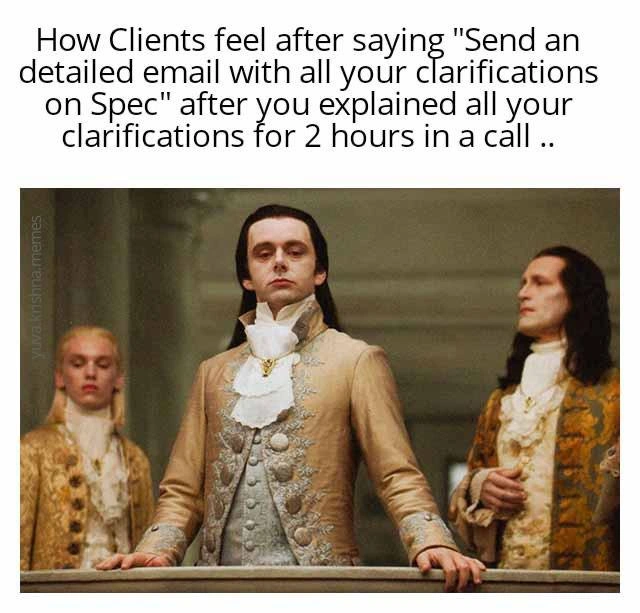
The meme uses a funny image to drive this point home. The picture is a scene from what looks like an old period drama – basically, a show about 18th-century fancy aristocrats. In the image, three men dressed in elaborate, old-fashioned noble outfits are standing on a balcony. They have their chests puffed out and look very pleased with themselves, almost smug. The idea is that these aristocratic characters represent the clients in this scenario. After making the demand for an email recap, the clients feel like aristocracy – as if they’ve just made a wise proclamation from on high. It’s an exaggerated comparison, of course. The clients aren’t really dukes or kings, but to the tired developer it can sure feel like they’re acting a bit high-and-mighty. The image pokes fun at how proud some stakeholders seem when they enforce extra process like this. Their body language screams, “We have spoken, now you shall do the grunt work again.”
For someone early in their career, this situation is a lesson in managing stakeholder expectations and project communication. Clients or managers will often ask for things to be written down, even if you just talked about them. Part of it is understandable: written documentation can prevent miscommunication later on. People might forget what was said, or they might interpret a conversation differently a day or two later. An email is a tangible reference that everyone can check back on. However, the funny (and slightly painful) part is when this becomes overkill – you start feeling like you’re doing double the work. The meme resonates with developers because it highlights that common “Didn’t we already go over this?” moment. It’s a reminder that in the real world of software development, good communication often means repeating yourself in different formats. And yes, sometimes it feels like being a student who, after a long class discussion, is told to write a full report about that same discussion. No wonder the developer community finds humor in it – laughing about it is a way to cope with a pretty universal office scenario.
Level 3: Regal Redundancy
For a seasoned engineer, this meme triggers equal parts amusement and a weary eyeroll. It showcases a classic communication dysfunction in software projects: after a marathon requirements call (two hours spent explaining every detail), the stakeholder grandly insists, “Send a detailed email with all your clarifications on the spec.” It's documentation déjà vu of the highest order. We’ve all been there – you pour your energy into aligning on ambiguous requirements over a long meeting, only to be tasked with rehashing everything in writing for the client's satisfaction. The humor comes from that shared pain of redundant communication: it’s both absurd and frustrating, a perfect example of stakeholder expectations gone awry.
In modern development, face-to-face discussion (even via Zoom) is supposed to clarify specs quickly and replace heavy paperwork. The Agile Manifesto famously values “working software over comprehensive documentation,” emphasizing collaboration over excessive process. Yet here we have a stakeholder clinging to waterfall-era habits: they want an exhaustive spec email on top of the call. Instead of treating the meeting as the update to the official single source of truth (say, the spec document or project wiki), they create a parallel record via email. It's the epitome of requirements vs. reality: in theory, the requirement was explained clearly in conversation, but in reality, the client won’t consider it “real” until it’s in their Outlook inbox. In many corporate cultures, there's an unwritten rule that if it’s not written down, it didn’t happen. So ironically, that entire two-hour conversation doesn't count in their eyes until it's codified in an email – the modern parchment that makes everything official.
The meme’s image nails this dynamic. It shows three 18th-century aristocrats on a balcony, dressed to the nines in ornate coats and lace cravats, chests puffed out in smug satisfaction. This perfectly caricatures the stakeholder’s attitude: channeling their inner aristocrat, regal and self-important, after making that demand. They look like they just issued a royal decree, basking in the sense of control. In the developer’s mind, the client has basically assumed the role of a noble who expects their loyal scribe (the developer) to document the kingdom’s business. The posture screams “I have spoken – now make it so, and in writing!” It's a playful jab at how stakeholders can sometimes act high-and-mighty during meetings, as if requesting a written recap is their divine right.
Beyond the humor, every experienced dev knows this pattern leads to miscommunication and a persistent documentation gap. By summarizing the clarifications in a separate email, you now have two sources of truth: the spoken conversation and the written follow-up. We’re violating the DRY principle (“Don’t Repeat Yourself”) outside of code, duplicating knowledge in multiple places. Fast-forward a week: the project moves on, something inevitably changes or someone remembers a detail differently. Now the email and the actual updated spec (or the dev team’s understanding) fall out of sync. This is how requirements ambiguity sneaks back in. The very thing that the two-hour call was meant to eliminate can return thanks to dueling documentation. It’s tragically ironic: the stakeholder thinks an email recap will reduce confusion (and cover their bases), but by dragging the project further from a single authoritative source, they often increase confusion down the line.
From a cynical perspective, there's a whiff of CYA (“cover-your-behind”) politics here too. The client might want a paper trail to shield themselves later: an email they can pull up to say, “See, we wrote it all down!” if any dispute arises. In their mind, ordering an email summary is good project hygiene – it makes them feel responsible and in control. Meanwhile, the dev team is left sighing, because they know the drill: after burning hours crafting that pristine follow-up email, those very stakeholders may not even read it thoroughly. There’s a running joke in tech: “This meeting could have been an email.” Here we’ve got the worst of both worlds – a meeting and an email. And chances are, at the next status meeting, someone will ask a question that was answered in that very same email. 🤦♂️ In other words: the cycle continues. Meetings spawn emails, emails recap meetings, and developers are stuck playing documentation ping-pong to appease the lords of the requirements. It's a farcical loop that every veteran developer recognizes all too well.
Description
A meme showing characters from the Twilight saga's Volturi scene -- three aristocratic vampire leaders in ornate period costumes standing on a balcony looking down smugly. The top text reads: 'How Clients feel after saying "Send an detailed email with all your clarifications on Spec" after you explained all your clarifications for 2 hours in a call ..' A watermark 'yuva.krishna.memes' is visible on the left side. The meme captures the power dynamic where clients dismiss two hours of verbal explanation by requesting the same information in written form, making the developer re-do all the work while the client feels superior
Comments
8Comment deleted
Client's 'put it in writing' is just a distributed systems problem -- they need eventual consistency between the call's verbal payload and the email's persistence layer, but refuse to acknowledge the sync already happened
That's the client's version of an RFC, except the 'C' stands for 'Clarifications you just gave me that I wasn't listening to'
Sure, I’ll Summarize™ - do you want that in Confluence, Jira comment, Slack thread, or the stone tablet we’ll ship with the next release?
After 15 years in enterprise software, I've learned that clients requesting 'just a quick email summary' of a 2-hour requirements call is their way of establishing plausible deniability for when they inevitably change everything in sprint 3 and claim 'that's not what we discussed.'
After architecting a comprehensive two-hour technical deep-dive covering edge cases, scalability concerns, and implementation trade-offs, the client's request for 'a detailed email with all clarifications' is essentially asking you to compile meeting minutes as if you're their personal technical stenographer - because apparently, their note-taking app was in maintenance mode during your entire presentation. It's the enterprise equivalent of explaining distributed systems consensus algorithms in excruciating detail, only to have someone ask 'can you send me a link about that?' The real kicker? They'll skim your 3000-word specification email in 45 seconds and reply with 'looks good, but can we hop on a quick call to discuss?'
Two hours of clarifications, then “send an email on spec” - because in enterprise architecture, Outlook is the single source of truth and the RTM is just a reply‑all thread
Clients after 2-hour spec calls: smug nobles demanding your email PR, because verbal commits never merge without written sign-off
That two-hour call was UDP; the “please email it” is the TCP ACK they’ll forward to Legal during the postmortem