You Wouldn't Download a Car: 3D Printed Pipe Fitting from McMaster-Carr
Why is this Hardware meme funny?
Level 1: Printing a Toy Car
Imagine a big sign that says, “You wouldn’t download a car.” It’s basically saying you can’t get a real car from the internet. Now imagine how cool it would be if you had a special machine at home that could actually make things. It’s like a printer, but instead of printing pictures on paper, it builds up layers of melted plastic to create real objects. If you found a file online with the design for a small toy car, you could send it to that machine. The machine would follow the instructions and – poof! – a toy car appears, built right in front of you. In this meme, an engineer did something like that with a small pipe fitting – they downloaded the design and “printed” a real piece of it at home. It’s funny because the old warning said nobody would (or could) ever do that, but now people actually can. In other words, technology took something that sounded impossible and made it possible. That surprise twist is what makes us smile.
Level 2: From Bits to Atoms
The top of this meme references an old anti-piracy ad that used the slogan “You wouldn’t download a car.” Back then (in the 2000s), it was a way of saying “stealing movies or music online is as bad as stealing a car.” It became a running joke among techies because the idea of literally downloading a physical car was impossible (and therefore kind of funny). People would quip, “If I could download a car, I definitely would!”
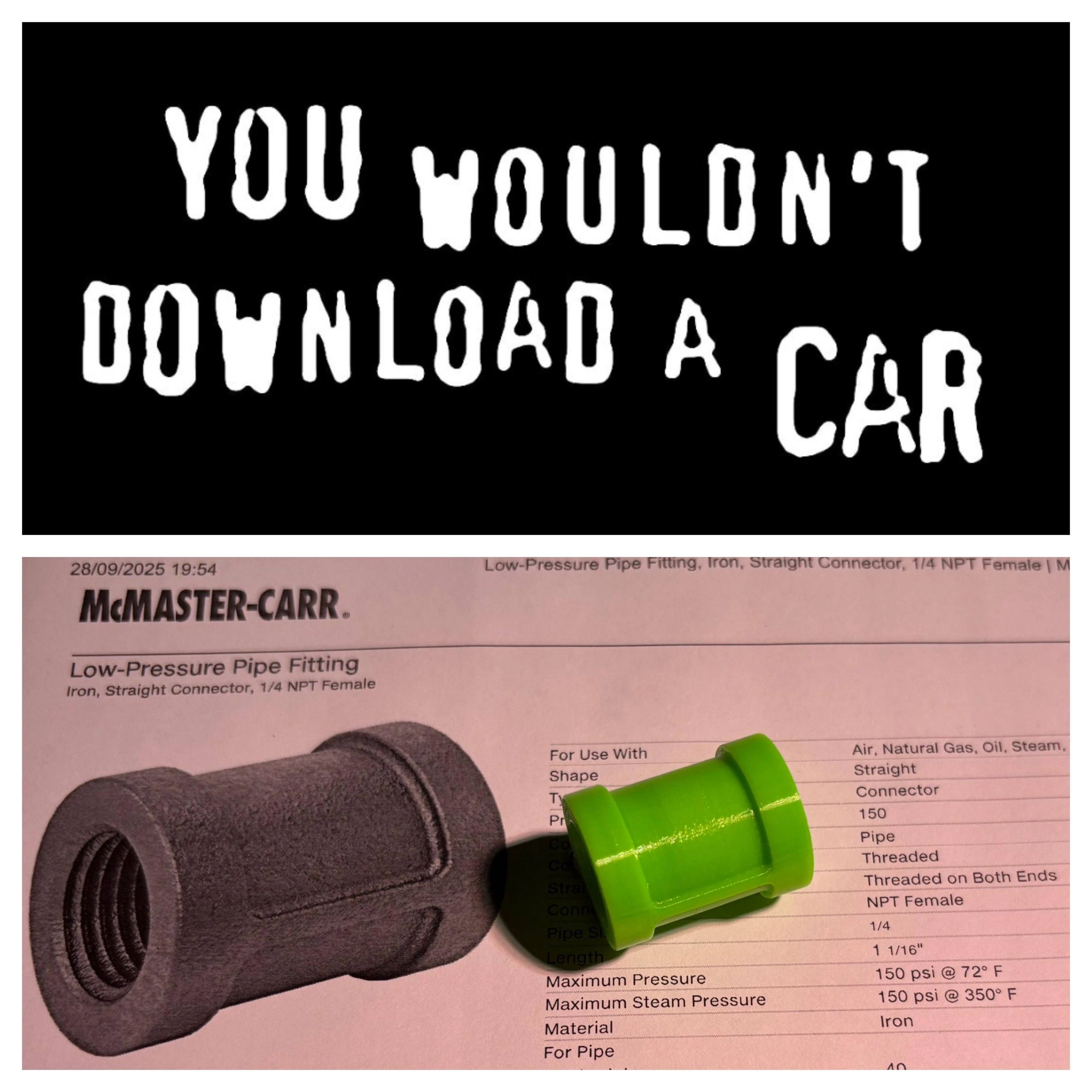
Now, fast-forward to the era of home 3D printers, and that once-silly idea isn’t so far-fetched. In the bottom panel of the meme, we see a printout from McMaster-Carr – which is like a giant hardware catalog that engineers use to buy parts or find technical drawings. McMaster-Carr provides detailed specs and even free 3D models (CAD files) for many of their products. The meme shows one of those parts: a pipe fitting (a connector for pipes) with threads labeled 1/4" NPT female. (That just means it’s a small connector that screws onto a 1/4-inch pipe using a standard thread type called NPT). On the paper, you can see details about what it’s used for (air, gas, oil, steam) and its material (iron).
Sitting on that printout are two physical objects. One is a real iron fitting (dark gray, heavy metal). The other is a bright green plastic copy of that same fitting. How was that copy made? With a 3D printer. Essentially, someone downloaded the digital design of the part and then “printed” it out as a real object. Modern 3D printers – now affordable enough to sit on a desktop – allow you to do exactly that. It’s like having a machine that can create a small part for you right in your home, as long as you have the blueprint.
Here’s how it typically works, step by step:
- Get the 3D model – You either design the object on a computer using CAD (Computer-Aided Design) software or download an existing model file. In this case, the engineer likely downloaded the model of the pipe fitting from McMaster-Carr’s website. The model usually comes in a format like STL (originally short for stereolithography), which is a common file type that represents the 3D shape using lots of tiny triangles.
- Prepare the print – You take that STL model and load it into a program called a slicer. The slicer converts the 3D shape into thin horizontal layers and generates a set of instructions (called G-code) for the printer. It’s basically chopping the object into many flat slices. These layer-by-layer instructions tell the printer where to move and how much material to lay down for each layer.
- Print the object – You send those instructions to the 3D printer. A typical hobbyist printer uses a spool of plastic filament (imagine a long string of plastic) as its “ink.” It heats the plastic and deposits it one layer at a time according to the pattern from the slicer. After building up hundreds or thousands of layers, the plastic cools and solidifies into the shape of the object. In the end, you have a physical part that matches the digital model you started with.
So in the meme, the green piece was created by following this process. The engineer literally downloaded the part’s CAD file and then printed it at home. In a sense, they “downloaded” a physical item – which is exactly what the old slogan said you shouldn’t do! It’s a funny reversal: the warning “you wouldn’t download a car” has turned into “hey, now we actually can download parts of a car (or any object) if we want.”
This reflects a big trend in tech and DIY communities. Maker culture is all about hands-on projects: people build their own gadgets, 3D print parts, tinker with electronics, and so on. They love sharing design files and instructions online so others can make the same things. There’s a popular saying about going "from bits to atoms," meaning turning digital information (bits on a computer) into real physical objects (atoms in the real world). 3D printing is one of the key technologies that makes this possible. Not long ago, it was mostly hype to imagine downloading a product design and just printing it at home instead of buying it in a store. We’re not at the point of printing entire cars or smartphones at home, but for simpler objects like a pipe connector, a replacement knob, or a phone case, it’s absolutely doable today.
The bright green connector in the meme is a perfect example. The green part was made of plastic on a home machine, whereas the real part from McMaster-Carr is made of iron and rated for high pressure (150 psi) and high temperature. Obviously, the plastic version isn’t as strong or heat-resistant – you wouldn’t want to actually use it in a pressurized steam pipe! But it’s great for testing size and fit, or as a temporary placeholder. It demonstrates that with some inexpensive material and a digital file, you can produce a physical copy of an industrial part by yourself.
In plain language, this meme is showing the irony that what we “weren’t supposed to do” before (copy a car or its parts from the internet) is now something anyone can do in their garage. An old cautionary message meant to discourage piracy has been outpaced by technology and turned into a lighthearted joke. For an engineer or a tech hobbyist, it’s both amusing and exciting to see how far we’ve come.
Level 3: Slicing Through Irony
"YOU WOULDN’T DOWNLOAD A CAR"
That infamous line from an early-2000s anti-piracy PSA appears in the meme’s top panel, evoking a time when industries tried to equate copying movies with grand theft auto. It was a rhetorical admonition—meant to guilt-trip would-be pirates by implying of course you wouldn’t steal a whole car, so why download a movie? Tech folks immediately saw the irony: given the chance, we absolutely would download a car. Over the years, “You wouldn’t download a car” became a tongue-in-cheek slogan, a meme of its own, with geeks joking “try me” at the absurd scenario.
The bottom panel delivers on that decades-old punchline. It shows a McMaster-Carr specification sheet for a “Low-Pressure Pipe Fitting, Iron, Straight Connector, 1/4 NPT Female”, dated late September 2025. On that printout sit two objects: on the left, a real dark-gray iron connector; on the right, a neon-green plastic lookalike fresh off a 3D printer. In other words, someone literally downloaded a hardware part’s design and manufactured a copy at home. The once ominous warning is turned into a makerspace flex. The meme practically shouts: Yes, we would download a car – one STL fitting at a time!
This juxtaposition is hilarious to seasoned engineers because it flips a dire warning into DIY triumph. The creator likely went to McMaster-Carr’s online catalog (a favorite haunt of mechanical and hardware engineers) and grabbed the free CAD model for that pipe fitting – McMaster is famous for offering downloadable 3D models of their parts. They then fed that model (probably exported as an STL file, the common 3D printing format) into a trusty 3D printer. A bit of plastic filament and a few thousand layers later, out pops a functional replica of a mass-produced iron part. It’s essentially a maker supply chain hack: instead of waiting days for a $5 fitting to ship, just print a rough-and-ready clone from the digital specs. Thanks to a well-oiled CAD-to-part pipeline (design → slicer → print), turning a downloaded blueprint into a physical thing is now often faster than a trip to the store.
The humor here works on multiple levels of engineering irony. First, it undercuts that old anti-piracy PSA in the nerdiest way possible – by doing exactly what it said we shouldn’t. What was unthinkable in 2004 is a casual weekend project by 2025. Second, there’s the visual gag of the part itself: the official spec sheet boasts things like “Maximum Pressure: 150 psi @ 72 °F” for the iron fitting, while the bright green replica is clearly just plastic. Any engineer knows a 3D-printed polymer part isn’t handling 150 psi of hot steam (unless you fancy turning your print into a melted, neon projectile). The absurdity of using a flimsy stand-in for a heavy-duty iron connector is part of the joke. It’s a wry nod to hardware humor – we know the printed version isn’t a true replacement, but that’s beside the point. The point is we can download the design and make a tangible object that looks the part.
Zooming out, this meme is a cheeky celebration of how far maker culture and digital fabrication tech have come. Back when that PSA aired, the idea of downloading a physical object was science fiction. Now, thanks to affordable 3D printers and freely shared CAD files, “downloadable hardware” is real. Enthusiasts swap STL files in online hubs (imagine a Pirate Bay for parts), printing out everything from replacement knobs to custom drone frames. What used to be an ominous corporate warning has become an industry in-joke: the fastest way to get engineers to do something is to tell them it’s impossible. One part at a time, we’re living the dream of duplicating physical things – not to get rich, but to solve everyday problems in creative ways. The meme captures that evolution perfectly: a once-hyperbolic admonition turned into a proud nerd achievement.
Description
A two-panel meme. The top panel shows the iconic anti-piracy campaign text 'YOU WOULDN'T DOWNLOAD A CAR' in white distressed lettering on a black background. The bottom panel shows a 3D-printed pipe fitting (in green) sitting next to a real iron pipe fitting on top of a McMaster-Carr product page dated 28/09/2025 19:54. The product page describes a 'Low-Pressure Pipe Fitting, Iron, Straight Connector, 1/4 NPT Female' with specs including: for use with air, natural gas, oil, steam; shape straight connector; 150 PSI rating; threaded on both ends; NPT female 1/4; maximum pressure 150 psi at 72F; material iron. Someone literally 'downloaded' (3D printed) a physical part from McMaster-Carr's catalogue, proving that yes, people actually would download physical objects if they could

Comments
17Comment deleted
McMaster-Carr: the only website where 'right-click save as' now means spending $2000 in filament to print a $3 pipe fitting at 60% infill
The best part is that you can often download the STEP file for the part you're replacing directly from McMaster-Carr's website. It's less like pirating a car and more like the dealership handing you the keys and a factory manual
CI/CD now stands for “Commit, Infill, Cure, Deliver” - because procurement just git-cloned the McMaster fitting and pushed it straight to the printer
After 20 years of arguing about software piracy, we've finally reached the point where you literally CAN download a car part from McMaster-Carr's CAD library and 3D print it - though good luck getting the material properties right for 150 psi at 350°F without an SLS printer and a materials science degree
The beautiful irony here is that McMaster-Carr actually *does* let you download a car - or at least every component to build one - complete with STEP files, STLs, and full engineering specs. What the MPAA feared in 2004 has become the backbone of modern engineering: instant access to precise 3D models of physical objects. The anti-piracy campaign warned us we wouldn't download a car, but they never anticipated that engineers would be downloading pipe fittings at 19:54 on a Sunday to meet Monday's deadline, or that entire industries would run on the ability to instantly procure CAD models of standardized components. Turns out, we absolutely *would* download a car - we just call it 'digital twin modeling' and 'rapid prototyping' now, and it's completely legal and essential to modern manufacturing
NPT threads: plumbing's leftpad - essential, tiny, and yanking one halts your whole pipeline
McMaster is apt-get for atoms: pinned 1/[email protected] in BOM.lock, printed the dependency locally, and enabled offline mode for the supply chain
2005: you wouldn’t download a car; 2025: curl STEP from McMaster | slicer | print - perfect for fit checks, catastrophically noncompliant with a 150‑psi SLA (the mechanical version of “works on my machine”)
Material: Iron bruh Comment deleted
There are iron printers Comment deleted
not of industrial grade too? Comment deleted
I guess only industrial, for now Comment deleted
the home FDM/SLA ones with some% metal infused filament/resin make quite poor quality parts when baked, the SLM metal machines are super expensive, and the fine metal powder they use is expensive too, usually really not worth the cost when the part can be done on a lathe or 6-axis Comment deleted
I've seen people take these printed parts and put them in a furnace to be smelted. It's a lot of extra work but the printed parts can make for an easy cast for molds at least Comment deleted
that's what I'm talking about, those parts usually shrink in the furnace and deform in unpredictable ways Comment deleted
To me it makes no sense to melt them this way because melting pure metal instead produces the results people want. Some people will literally make a mold from the printed shape and melt another printed shape into the mold. Why go through all that trouble just to melt the filament that took an expensive machine to make into a shape just to melt it? Comment deleted
God will do the rest 🙏 Comment deleted