Jensen Huang Feeds Meta and OpenAI While Small Devs Get Nothing
Why is this AI ML meme funny?
Level 1: Imaginary Walls and a Clever Cow
Imagine you’re at a playground and two kids each build a little wall out of cardboard, leaving only a small gap like a doorway in each. They put some candy behind the doorways to tempt you. They act like you must walk through their tiny gate to get the candy. You feel a bit confused, standing there like, “Which gate do I go through? Is this the only way to the candy?” But then you realize something funny: the walls are only in front of you and don’t stretch out to the sides at all. In fact, the whole space around those cardboard walls is open. You could literally just walk around the end of either wall and get to the candy (or even find more candy in the open field beyond). In the meme, the developer is like a cow facing these pretend walls from Meta and OpenAI. The cow thinks it’s stuck at a gate, but actually there are no real fences stopping it from going elsewhere. It’s a silly situation that makes us laugh because the cow (just like a person who’s new to a game) imagines a barrier that isn’t truly there. The moral of the joke? Sometimes the only thing trapping us is the idea that we’re trapped – and once we see the whole field, we realize we were free to roam all along.
Level 2: Open vs. Closed AI Paths
In this meme, two big tech companies are represented by literal walls, but the joke is that the walls don’t fully close off anything. Let’s break down the elements in plain terms. On the left, there’s the Meta logo (Meta is the company behind Facebook). On the right, there’s the OpenAI logo (OpenAI is famous for making ChatGPT). These walls symbolize the two companies’ AI platforms or ecosystems. Meta’s approach to AI has been more open: for example, they released a model called LLaMA 2 and allowed developers to download its weights (the trained data that makes the AI work) and run it themselves. “Open weights” means you can get the actual AI model files and work with them directly. OpenAI’s approach has been more closed: they have very advanced models like GPT-4, but you can’t see or download the model itself. Instead, you use it through an API, which is basically a service or interface where you send a request (like your prompt or question) to OpenAI’s servers, and they send back a response. Using an API is like using a tool through a small window – you can access the output, but you don’t get to see the inner machinery. OpenAI keeps that machinery behind their gate, so to speak.
Now, the meme shows a narrow gate between the Meta wall and the OpenAI wall. That gate represents the official, tightly controlled access each company gives you. It’s the notion of “you shall pass here (and only here) to use our AI.” In real life, this could mean things like signing up for a service, agreeing to a license, paying for API calls, or abiding by usage limits. The corridor formed by the two walls is like a funnel — it gives the impression that a developer must choose one of the two big providers and go through their process to get anything done with serious AI. This reflects how newcomers often feel: “Should I use Meta’s AI model or OpenAI’s? Are those my only choices?” The cow in the picture is the developer, shown as if it’s being herded or guided down this path. The cow looks puzzled and hesitant, which is exactly how a developer might feel when confronted with these two options and the surrounding hype.
The key to the joke is the area outside the walls. If you look closely, the walls don’t form a complete enclosure; the back and outer sides are open. This means the cow (the developer) could literally walk around the entire contraption. In technology terms, there are alternative paths outside of what Meta and OpenAI offer. For instance, there are truly open-source AI models created by the community (not by giant corporations) that anyone can use freely. These might not be as instantly powerful as OpenAI’s very latest model, but they can often get the job done, and you can run them without asking permission or paying per use. It’s like having a wide open field to the side, while the big companies have set up a fancy gate in front of you. Walled garden is a term often used in tech to describe a closed platform that doesn’t easily let you mix in outside technologies or leave for a competitor. Here the walls literally depict that idea. Meta’s wall and OpenAI’s wall suggest two walled gardens – one is saying “come use our open model (but it’s our model),” and the other is saying “use our API (but you must stay in our garden).” The AI license walls mentioned in the tags refer to legal or technical restrictions: Meta’s AI model might be free to use but maybe not for everyone (for example, some of their model licenses allow commercial use only if you’re a small company). OpenAI’s usage comes with terms of service and costs. Those are the “walls” that make developers feel confined.
To a newer developer or someone outside this field, it might not be obvious at first that you can just avoid these walls. The meme’s humor comes from that Aha! moment. The small cow thinks it’s stuck at a gate, but in reality the whole pasture around is open. In practical terms, if you ever feel forced to pick between two tech giants’ solutions, it’s worth checking if there’s a third option that’s community-driven or doesn’t lock you in. For example, instead of using OpenAI’s API exclusively, you could try a open-source model from Hugging Face (a platform where many free models are shared). You could even run a smaller AI model on your own computer for free. Bypassing restrictions here simply means taking the open route: walking around the gate instead of through it. That grey-haired person peeping over the wall in the meme likely represents an observer who sees the obvious solution. It might be a hint that experienced folks (with a bit of grey hair) are watching this whole “Meta vs OpenAI” situation and chuckling because they know the developer could just go around. Perhaps it’s even a nod to a third-party like an older expert or another company (for example, the CEO of a hardware company who isn’t directly in the fight) watching the two giants compete. In any case, it emphasizes an outside perspective that “hey, this barrier isn’t as real as it looks.”
In summary, the meme uses simple visuals to comment on a complex trend in AI. Meta_vs_OpenAI is the competition being depicted: one side open(ish), one side closed. The arms_race_meme context means both companies are rushing to outdo each other in AI, sometimes at the expense of developer experience. The poor developer (cow) feels a bit of developer_disillusionment – as if being treated like cattle in a corporate cattle chute. But if that developer takes a step back, they’d see it’s just an illusion of choice. There’s a whole open world beyond those walls, because technology is never completely monopolized as long as the open-source community is around. The meme is essentially an AIHumor cartoon delivering the message: Don’t let big companies fence you in — you’re free to roam! To drive it home with a bit of code analogy, here’s how a developer’s choice might look in practice:
# Using a closed AI model via OpenAI's API (inside the walled garden)
import openai
openai.api_key = "YOUR_API_KEY"
response = openai.Completion.create(
model="gpt-4", # OpenAI’s large model (closed, accessed through API)
prompt="Hello, AI world!"
)
print(response["choices"][0]["text"])
# Using an open-source AI model (walking around the wall into open pasture)
from transformers import pipeline
local_model = pipeline("text-generation", model="meta-llama2-7b-chat-hf") # Meta’s LLaMA-2 7B model weights, open to download
print(local_model("Hello, AI world!")[0]["generated_text"])
Above: The first part shows a developer going through OpenAI’s gate — you must use their openai library, need an API key, and you’re sending a prompt to a model you can’t see inside. The second part shows going around the gate — using an open-source model locally via the Hugging Face Transformers library, where you have the model weights downloaded (llama2-7b-chat in this example) and can get the AI’s answer directly. The difference is stark: one is dependent on a corporation’s service, the other you control yourself. The meme encapsulates this difference with the cow and the open gap beside the gate. It’s a friendly reminder to new developers: those AI license walls often have a door to nowhere – you can step around them when you need to.
Level 3: Illusory Barriers in the AI Arena
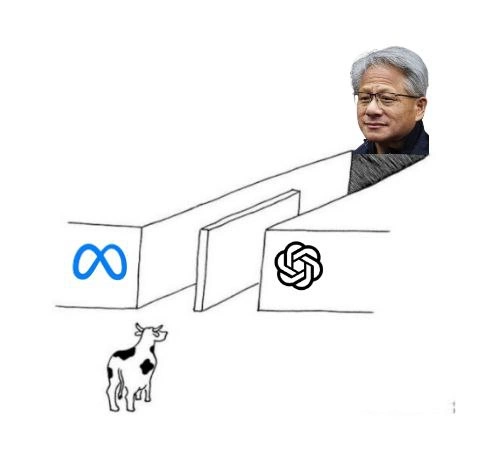
At first glance, this meme paints a walled garden showdown between two tech giants: Meta and OpenAI. Each wall flaunts a corporate logo (Meta’s blue infinity on the left, OpenAI’s knotted emblem on the right), creating a narrow corridor with a tiny gate in the middle. Our confused cartoon cow — labeled as a developer — stands facing this constricted path. The scene screams “pick a side!” as if engineers are being funneled into choosing one AI ecosystem over the other. It’s a clever nod to the AI arms race dominating tech headlines: Meta has been touting “open weights” and open-source models, while OpenAI keeps its crown jewels behind a closed API. The humor is immediately apparent to seasoned developers: the entire outward side of this corridor is open. There’s no real fence beyond the logos — an illusory barrier. In other words, nothing actually prevents the cow (the developer) from walking around the corporate walls entirely. The meme visually satirizes how these ai_license_walls are often more psychological or contractual than technical.
For those in the know, this image hits on a familiar IndustryTrends trope. Meta and OpenAI are duking it out in an AI arms race, each trying to corral developers into their own pasture. Meta’s strategy: release powerful models (like LLaMA 2) with relatively open licenses to foster community adoption. OpenAI’s strategy: provide a highly polished, but closed-off service (ChatGPT, GPT-4/5, etc.) where usage is through a tightly controlled API. These approaches are represented as walls guiding the developer towards a narrow gate — the official way in. It’s a classic CorporateCulture play: create a sense of enclosure, a feeling that “if you want the good stuff, you have to come through our gate.” The cow’s puzzled stance captures that developer disillusionment: “Do I really have to choose one of these gated paths to do AI?” The joke’s punchline is that the AIHypeVsReality gap is exposed – the walls are only as real as we let them be. In reality, developers can simply step to the side into the open field, using community-driven models or alternative tools. The meme is laughing at how often engineers feel herded by hype into false choices.
This resonates strongly with veteran engineers because we’ve seen this movie before. It harkens back to earlier tech wars and IndustryTrends. Remember the browser battles of the 90s, or the mobile app store duopoly? Tech giants love building walled gardens to lock users in, but history shows there’s usually an open gate to freedom if you look for it. The meta_vs_openai standoff is the 2020s equivalent: two big players trying to dominate AI platforms. OpenAI (ironically less “open” than its name) creates a closed ecosystem where they hold all the model weights and you pay for access. Meta (Facebook’s parent company, surprisingly championing openness in AI) releases models to the public, saying “here are the weights, do what you want” – yet even that comes with some license strings attached. The AIHumor here is rich in irony: OpenAI isn’t very open, and the company formerly obsessed with walled social networks (Facebook/Meta) is now preaching open-source values. Engineers who have been through format wars and proprietary lock-in sagas can’t help but smirk. It’s as if we’re watching AOL vs. the open web all over again, but this time with large language models. The grey-haired figure peeking over the wall even adds a dash of TechIndustryHumor: it might represent a wise old tech observer (or a wily third-party, like the hardware vendor selling shovels at this gold rush) peering over to say, “Look at these kids building walls again.”
The deeper message for experienced developers is about AIHypeVsReality and empowerment. The meme encourages a bit of rebellion: you don’t have to be locked into Big Tech’s AI silos. Sure, Meta and OpenAI are in an AI arms race pouring billions into ever larger models, and it’s easy to feel like you must pick a team to survive. But the reality is many tasks can be solved by smaller, open models, or by community-driven projects that exist outside these corporate fortresses. The cow could walk around those walls and find plenty of grass to eat – likewise, a developer can bypass these restrictions by choosing open-source frameworks, decentralized AI networks, or other creative solutions (bypassing_restrictions the big players impose). The developer_disillusionment captured here is real: dealing with usage quotas, API fees, restrictive licenses, or shifting terms of service can be exhausting. This meme vents that frustration with a visual “facepalm”: the only thing trapping the dev is the notion that the trap exists at all. It’s a comical reminder (especially at 3 AM deployments when you’re questioning all your life choices) that sometimes the AIIndustryTrends hype blinds us to the obvious solution sitting right outside the frame. In true darkly comedic fashion one might say, not my first AI rodeo — I know a paper cow fence when I see one. The cow isn’t actually caged, and neither are you.
Description
A meme using the cascading feeding trough template showing Jensen Huang (NVIDIA CEO) at the top of a stepped feeding structure. The Meta infinity logo sits in the upper trough and the OpenAI logo sits in the lower trough, while a small cow stands at the bottom looking up with nothing to eat. The image satirizes how NVIDIA's GPU supply chain prioritizes massive AI companies like Meta and OpenAI, leaving smaller players and independent developers starved for compute resources
Comments
8Comment deleted
NVIDIA's trickle-down GPU-nomics: Meta gets the H100s, OpenAI gets the A100s, and indie devs get to run inference on a Raspberry Pi with a prayer
It's the ultimate 'Choose Your Own Adventure' for AI developers, where every choice ends with you buying a pallet of H100s
It’s the Llama-2 vs GPT-4 license debate: everyone complains about the gate while the spec forgot to close the other end of the corridor
The only thing more impressive than GPT-4's ability to generate plausible-sounding answers is Meta and OpenAI's ability to generate plausible-sounding valuations from VCs who still think 'transformer architecture' is about electrical grid infrastructure
When your entire AI strategy is 'just add more H100s' and you realize Jensen Huang is the only one holding the keys to the GPU kingdom - suddenly that $40K per chip doesn't seem like a negotiation. Meta and OpenAI can build the fanciest LLMs in the world, but at the end of the day, they're all waiting in line for NVIDIA's silicon like it's the hottest nightclub in town, and the bouncer is wearing a leather jacket
Claude's ∞ safety rails or Grok's knotted edge - Jensen's H100s milk both paths dry
Pick LLaMA and GPU costs herd you; pick GPT and legal herds you - either way your architecture ends in a wrapper around somebody else’s rate limits
Architecture review summary: everyone wants OSS Llama until someone asks who’s on-call for CUDA drivers - then we suddenly love POST /v1/chat/completions