Skip to content
DevMeme
733 of 7435
Clean Code Principles vs. Regex Reality
CodeQuality Post #831, on Nov 19, 2019 in TG

Clean Code Principles vs. Regex Reality

Why is this CodeQuality meme funny?

Level 1: When Code is Magic

Imagine you have a friend who says, “Instructions should be so clear that we never need any extra help to follow them.” Now picture that friend opening a recipe book and finding a recipe written in a secret code of strange symbols and letters that don’t make sense at first glance. Suddenly, your friend’s like, “Uh oh, what does this even mean?” It’s a funny scene, right? They were confident everything would be easy to understand, but one look at this mysterious recipe and they’re totally lost.

That’s exactly what’s happening in this meme. The dog character thinks every piece of code should be easy to read, just like a simple recipe. Then a crazy regex (which is like a recipe written in ancient magical runes) barges in, and the poor dog is shocked. It’s as if someone said “I don’t need any hints to solve a puzzle,” and then got handed the world’s most confusing puzzle. We find it funny because the dog’s proud idea of “no explanations needed” gets smashed by something so confusing it looks like magic. It’s a light-hearted reminder that sometimes, even when we think we won’t need help understanding something, we run into a wild riddle that changes our mind. In other words, some code is so weird and complex that it might as well be an ancient spell, and even the biggest know-it-alls would stop and say, “Okay, maybe give me a clue for this one!”

Level 2: Regex: Code or Spell?

Let’s break this down in simpler terms. The meme is contrasting clean code with a regex. First, what do we mean by clean code? Clean code is a coding philosophy (popularized by software experts like Robert C. Martin, a.k.a. “Uncle Bob”) that says code should be written in a clear and understandable way. One famous clean code guideline is “write your code so that it’s self-explanatory, and you won’t need to write a lot of comments.” In other words, if your code is well-structured and named clearly, anyone reading it can tell what it’s doing without extra notes. For example, if we have:

# Clean, self-explanatory code snippet
def calculate_total(price, sales_tax):
    return price + price * sales_tax  # price plus tax

In well-written code like above, even the small comment at the end isn’t really needed because price + price * sales_tax is straightforward when the variables are named clearly. A clean coder might say, “If you just name your function and variables right, the code speaks for itself.” That’s why Gromit (the dog in the meme) is proudly waving with the phrase “Clean Code doesn’t require comment.” He’s basically saying: Good code doesn’t need extra explanation.

Now enter regex, short for Regular Expression. A regex is a special pattern string used to match text. It’s like a mini-language built out of punctuation characters and a few letters that each have special meaning. Developers use regex to find or validate text patterns – for example, checking if a string looks like an email address or splitting a log file by dates. Regex is powerful because it can concisely define very complex criteria. However, it’s notoriously hard to read. It looks confusing because it uses lots of symbols with special meanings (like ^ means “start of line”, \d means “a digit”, ( and ) group parts, | means “or”, and so on). If you’re not already familiar with it, a regex looks alien – almost like a secret code or, as the meme jokes, an “ancient spell.”

For example, imagine we want to verify a date in the format YYYY-MM-DD (year-month-day). We could use a regex pattern:

import re
pattern = re.compile(r"^(\d{4})-(\d{2})-(\d{2})$")
# This uses regex to match a date like "2023-11-19" (YYYY-MM-DD format).

To someone who knows regex, ^(\d{4})-(\d{2})-(\d{2})$ means:

  • ^ = start of the string,
  • (\d{4}) = exactly 4 digits (the year),
  • - = a literal hyphen character,
  • (\d{2}) = exactly 2 digits (the month),
  • - = another hyphen,
  • (\d{2}) = exactly 2 digits (the day),
  • $ = end of the string.

So that pattern matches strings like "2019-11-19". But if you’ve never seen regex before (or even if you have but the pattern is long), it’s not obvious at first glance. It certainly doesn’t read like plain English! A code comment (the bit after the #) is used here to explain in normal words what the regex does. The irony highlighted by the meme is that while clean code principles tell us our code should be understandable without comments, regex often forces us to break that rule. Without the comment, many programmers would be unsure what that pattern is checking, especially if the regex were even more complex.

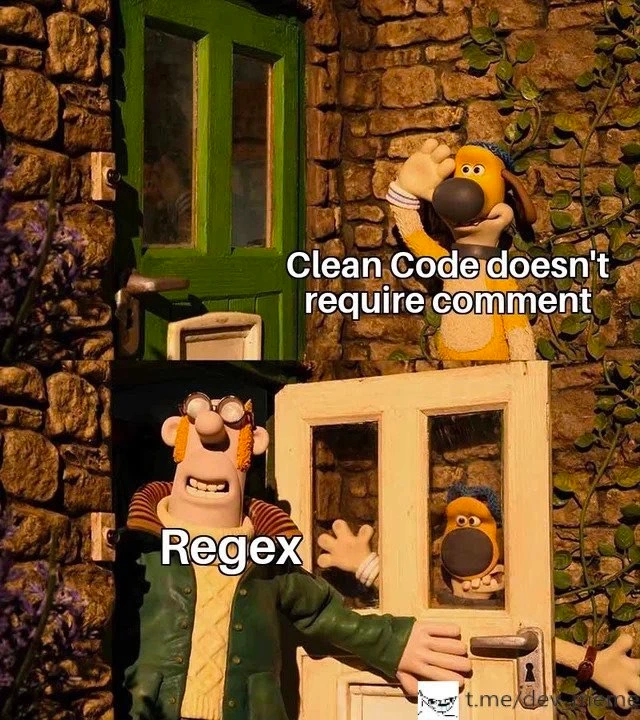
The two panels in the meme illustrate this in a funny way. In the first panel, the idea "no comments needed" is presented as the ideal. In the second panel, labeled "Regex", a character literally bursts through a door—meaning regex arrives forcefully and kind of wrecks the neat situation. It’s saying: “Surprise! Here’s a piece of code that isn’t self-explanatory at all.” If you’ve ever opened up a code file and seen something like:

const emailPattern = /^([A-Za-z0-9_\-\.])+@([A-Za-z0-9_\-\.])+\.([A-Za-z]{2,})$/;
// Whoa! That line above is a regex to validate an email address.

…it feels daunting. Even if you generally understand programming, that single line is packed with symbols (^, $, [A-Za-z], +, etc.) that you have to interpret. It’s dense. It’s normal for a less experienced developer (and sometimes even a seasoned one) to look at such a regex and say, “Uhh, what is this doing exactly?” That comment on the second line (“that line above is a regex to validate an email address”) is exactly what a clean-code purist tries to avoid – they’d prefer the code be clear by itself. But with regex, the code’s intent is not obvious just by reading the pattern unless you are fluent in regex syntax.

So the meme is humorous for developers because it shows a principle meeting its exception. CodeQuality and CodeReadability ideals hit a wall when encountering a wild regex pattern. The caption in the social post, “You right buddy, but this ain't code it's an ancient spell,” is written in a casual tone, almost like a friend chiming in. It means: “Sure, in general you’re correct that good code shouldn’t need comments… however, what we’re looking at here isn’t normal code – it’s basically magical hieroglyphs (so all bets are off)!”

For a junior developer, the takeaway is: Most of the time we strive to write code that others can read easily (use clear names, simple logic, etc.), so that the code itself serves as its own explanation. But regular expressions are a special case. They are extremely useful for certain tasks (like advanced find-and-replace, input validation, parsing text), but they come with a cost: they’re hard for humans to read. It’s like having a super-compact secret language inside your code. As a result, good developers often do one of two things when using a complex regex: either comment it (explaining what the regex is intended to do in plain language, right there in the code), or use regex features that allow comments within the pattern itself (some regex flavors let you break the pattern into multiple lines and annotate parts of it). The meme simply pokes fun at the situation that one moment you’re saying "we don’t need any comments," and the next moment you’re face to face with a piece of code so cryptic that you’re begging for a comment or explanation. In short, even the best practices have exceptions, and a gnarly regex is a classic exception when it comes to code readability.

Level 3: The Regex Ambush

In practice, this meme hits home for every senior developer who’s ever done a code review and encountered a gnarly regex. The top panel shows a confident Gromit (the dog) waving from behind a door with the caption “Clean Code doesn’t require comment.” That’s the classic software craftsmanship mantra: well-written code is self-documenting, so comments should be minimal or only explain why (not what) when absolutely needed. Many experienced engineers, influenced by guides like Clean Code, advocate for clear naming and simple logic instead of peppering code with comments. It’s a noble ideal – in theory, if your code is crystal clear, any additional comment is either redundant or a sign the code itself could be refactored to be clearer.

Then comes the sucker-punch: Wallace (the man) bursting through the door labeled “Regex” in the bottom panel, startling poor Gromit. This represents the sudden intrusion of a massive, unreadable regular expression into our neat, self-explanatory codebase. It’s the comedic ambush of reality: one moment you’re preaching purity in code style, the next you’re staring at a 200-character regex string of perplexing symbols that defies quick understanding. RegularExpressions are notorious for being compact yet incredibly opaque. They often look like line noise – there's an old joke that Perl (a language that heavily uses regex and special symbols) is a “write-only language,” implying you can write it once but never read it again. This meme captures that exact feeling: CleanCodePrinciples meet their match when a regex shows up, because suddenly a comment or an explanation isn’t just helpful – it’s basically required if you ever want a future developer (or even yourself, two weeks later) to comprehend what’s going on.

Seasoned devs are chuckling because they’ve been there: perhaps refactoring legacy code and finding a regex that matches, say, email addresses or some data format, ridiculously packed with groups, quantifiers, and look-arounds. It might solve the problem in one swift line, but CodeReadability goes out the window. During code reviews, it’s common to see an exchange like:

Reviewer: “This regex is doing a lot... can we add a comment explaining what it matches? Better yet, can we split it or use well-named constants for parts of it?”
Author: “But I followed the spec to the letter! It passes all tests.”
Reviewer: “Sure, but six months from now, whoever maintains this will have to summon Cthulhu to decipher it.”

It’s a shared experience in development teams that some constructs (especially regexes) are regex_hell for maintainers. The meme leverages the Wallace & Gromit scene as an analogy: Wallace labeled "Regex" comes crashing through like an unexpected complication, basically saying "Surprise! Your rule about no comments doesn’t apply to me!" Gromit’s principle of “no comments needed” is suddenly under siege.

We find it funny because it’s true: Regex is practically the poster child for code that is not self-documenting. No matter how senior you are, a sufficiently complex regex pattern will make you squint, slow down, and maybe even draw it out on a whiteboard to understand it. It violates the clean code gospel in such an extreme way that it loops back around to being humorous. You can almost hear the collective groan (or cackling laughter) of reviewers encountering if (re.match(/^(?:[A-Za-z]+(?:, ?[A-Za-z]+)*)$/,...)) with zero comments – it’s the “unreadable regex wall” the meme title mentions.

The text overlay "Clean Code doesn't require comment" is a direct reference to a well-known maxim: if code is well-structured, you shouldn’t need an explanatory comment for it. We strive for functions named clearly (e.g. validateEmailAddress()), simple logic, and no mysterious side-effects – all so anyone reading the code knows what it does at a glance. But a regex is like a code mini-language inside your language. Looking at a gnarly regex is like decoding a mini puzzle, even for the experienced. It’s the one place even the most comment-averse dev might grudgingly say, “Yeah... okay, maybe drop a comment here explaining this pattern.”

So the humor comes from that gotcha! moment. Every senior dev idolizing clean, comment-free code has had their moment of reckoning when confronted with a piece of complexity that just can’t be easily self-explained. Regular expressions frequently are that piece of complexity. The meme specifically uses the phrase “unreadable regex wall” – which conjures the image of a solid wall of /\/\/\^\$\(\?\:/ characters blocking your path to understanding. The poor dog (representing clean code ideals) is shown literally behind a wall (the door) and then gets that wall smashed through by Wallace (the avalanche of regex). It's an exaggeration of code readability versus complexity: we say no comments... until a wild regex appears. The bottom caption from the post, “You right buddy, but this ain't code it's an ancient spell,” perfectly encapsulates the senior perspective with a snarky grin: Yes, clean code is great in theory, but have you seen this thing? It reads like an ancient magic spell – good luck not commenting that!

In essence, the senior-level joke is about exceptions to the rule. A wise engineer knows that principles guide us, but reality has edge cases. A regex is the classic edge case where the code’s intent is not obvious from the code itself, unless you’re well-versed in regex lore. It forces a pragmatic compromise: either heavily document it or use alternative approaches (like breaking the regex into smaller pieces or using verbose regex modes that allow comments). The meme gets a nod and a laugh because it dramatises a scenario we’ve all experienced: confidently touting best practices and then swiftly eating our words when confronted with a hairy piece of code where those practices don’t cleanly apply. It’s a light-hearted poke at the CleanCodePrinciples zealotry, reminding us that in software, there’s always a trade-off between ideal readability and compact power – and sometimes that trade-off barges in like an uninvited guest named Regex.

Level 4: Arcane Automata

At the most theoretical level, regular expressions are not just random gibberish – they stem from formal language theory, giving them an almost arcane pedigree in computer science. A Regular Expression (regex) defines a regular language that can be recognized by a finite state machine (think of a little automaton that reads characters one by one). In fact, the * in regex (meaning "repeat indefinitely") is called the Kleene star, named after mathematician Stephen Kleene who first formalized these patterns in the 1950s. Regex syntax is dense because it’s essentially a compact algebra for text patterns. Each symbol or meta-character (like \d for digit or . for any char) encodes a state transition in that automaton. This mathematical elegance makes regex extremely powerful – and notoriously hard to read for humans.

From a Clean Code perspective, regex is a paradox. Clean code principles preach that code should be self-explanatory, using meaningful names and simple structures, almost like well-written prose. But regex is more like a mathematical formula or a magic spell: it trades verbosity for brevity and precision. A single regex line can accomplish what might require dozens of lines of standard code, leveraging the computational theory of automata under the hood. The price of this conciseness, though, is readability – to the uninitiated, /^(?:\w+\.)*\w+@(?:\w+\.)+\w+$/ might as well be written in Elder Futhark runes.

Internally, regex engines often compile these patterns into bytecode or state machines. Backtracking regex engines (used by languages like JavaScript, Python, PCRE) will try different paths through the pattern, almost like exploring a maze, which is why a careless regex can explode in complexity or even performance (catastrophic backtracking is a real nightmare, where a seemingly harmless pattern sends the engine down exponential dead ends). There’s deep computer science behind that humor: writing a complex regex without comments is like presenting a condensed automata theory proof as one line of code. The meme jokingly calls regex an "ancient spell" because, in a sense, it is derived from ancient (in tech terms) theoretical knowledge – but when unleashed in a modern codebase it feels like mystical art. Readable code and regex thus collide at a fundamental level: one prioritizes human-friendly structure, the other leverages mathematical terseness that only the initiated can effortlessly parse. It’s a clash between two worlds – the clean, explicable realm of structured code and the cryptic power of formal language incantations.

Description

A two-panel meme using characters from the Aardman Animations (likely 'Shaun the Sheep' or 'Wallace and Gromit'). In the top panel, a friendly, waving claymation dog character is labeled with the text 'Clean Code doesn't require comment'. This represents the popular software development principle that code should be self-documenting. The bottom panel shows a menacing, toothy-grinned human character, labeled 'Regex', bursting through a door. This hilariously personifies Regular Expressions (Regex) as the chaotic exception to the 'clean code' rule. The joke is that Regex patterns are famously cryptic and unreadable, making them nearly impossible to understand without accompanying comments, thus challenging the absolutism of the 'no comments' ideology. It's a relatable scenario for any developer who has tried to decipher a complex Regex pattern without documentation

Comments

7
Anonymous ★ Top Pick Some say clean code is like a good joke; it needs no explanation. Regex is like a lawyer's joke; you need a lawyer to explain it, and even then, it's not funny
  1. Anonymous ★ Top Pick

    Some say clean code is like a good joke; it needs no explanation. Regex is like a lawyer's joke; you need a lawyer to explain it, and even then, it's not funny

  2. Anonymous

    “Clean code reads like prose - right up until someone commits a 120-char PCRE with two negative look-behinds, an atomic group, and a back-referenced emoji, and suddenly my ‘no comments’ rule turns into a 600-word lore preface.”

  3. Anonymous

    After 20 years in the industry, I've learned that 'self-documenting regex' is like 'simple YAML' - technically possible, but only exists in conference talks and the fevered dreams of architects who haven't touched production code since the jQuery era

  4. Anonymous

    The irony is that even the comment explaining your regex will need a comment. Senior engineers know that 'self-documenting code' is a noble goal until you write `^(?=.*[A-Z])(?=.*[a-z])(?=.*\d)(?=.*[@$!%*?&])[A-Za-z\d@$!%*?&]{8,}$` and realize that sometimes, just sometimes, a three-paragraph essay above your code is not just acceptable - it's a moral imperative. The real clean code move? Extracting that regex into a well-named function like `isValidPassword()` and hiding the eldritch horror where future maintainers won't accidentally glimpse it and question their career choices

  5. Anonymous

    Self‑documenting is great - until a 200‑char PCRE with nested lookbehinds lands; then the MVP docs are x‑flag comments, a test matrix, and a rollback plan

  6. Anonymous

    Clean code doesn’t need comments - until it’s a regex; then re.VERBOSE isn’t style, it’s life support for the backtracking grenade you just armed

  7. Anonymous

    Regex: clean code's kryptonite, where even architects whisper 'godspeed' before a comment

Use J and K for navigation