Valve Announces Half-Life: Alyx VR Game
Why is this GameDev meme funny?
Level 1: Christmas Morning Excitement
Imagine you have a favorite story or toy that you’ve loved for a long, long time, but it seemed like it was over and you’d never get more of it. Then one day, out of the blue, the company that made that favorite thing says, “Surprise! We have a new amazing version of it, and you’ll get to see it in a couple of days!” How would you feel? You’d probably be jumping up and down, right? That’s exactly what happened here, but for video game lovers.
Half-Life is like a really loved storybook for gamers, and for years there were no new chapters. People almost gave up hope for a new one. Then the company, Valve, suddenly announced on Twitter, “Hey everyone, we made a new Half-Life game, and it’s super special – you get to be inside the game using virtual reality!” This news made all the developers and gamers as excited as kids on Christmas morning. Virtual reality means instead of just watching the game on a screen, you wear big goggles and it feels like you stepped into the world of the game — kind of like magic glasses that take you to another place. So it’s not only a new chapter of a favorite game, but you also get to play it in a completely new, more immersive way.
The funny image with the red background and symbols is basically the “announcement poster” for this surprise. One symbol is the company’s name (Valve), the middle one says it’s for VR, and the last one is a special logo (λ) that fans recognize as the symbol of that favorite Half-Life game world. Seeing all that together was like seeing a big wrapped present with your favorite characters on it. Everyone knew something amazing was inside. The phrase “dev hype meter explodes” just means people got unbelievably excited. In plain terms: it’s like the hype (the excited anticipation) went through the roof, as if a meter measuring excitement just burst from how high it went. Developers who make games were grinning ear to ear, because not only do they get their beloved game series back, they also get to see cool new technology in action. It’s a huge “YAY!” moment, full of joy and eager waiting — kind of like counting down the days to a really awesome surprise party that everyone’s been dying to have.
Level 2: Flagship VR 101
Let’s break down why this tweet had developers and gamers so excited. First, Valve is the company behind the Half-Life series and the owner of Steam, the biggest PC game platform. Valve is famous for making ground-breaking games (like Half-Life, Portal, Team Fortress) but also for being very slow or secretive about new releases – especially anything related to Half-Life. In the world of GamingCulture, Half-Life isn’t just any game; it’s a legendary series with huge influence on the FPS (first-person shooter) genre and on game storytelling. The last Half-Life game left fans on a cliffhanger back in 2007, so people have been joking and yearning about a “Half-Life 3” for over a decade. That’s why even a hint of a new Half-Life causes a big stir.
Now, the tweet announces Half-Life: Alyx and calls it a “flagship VR game.” VR stands for Virtual Reality, which means a type of technology that lets you wear a headset and immerse yourself in a 3D virtual world, looking and moving around as if you’re inside the game. A flagship VR game refers to a major, high-quality game designed to show off what VR can do – basically a title meant to lead the way and justify the VR platform. Valve saying this is their flagship VR game means they’ve put a lot of resources and importance on it; they consider it a defining VR experience for their platform. And what platform is that? SteamVR is Valve’s VR software platform (the VR extension of Steam) that supports various VR headsets on PC. Valve even makes their own headset called the Valve Index (a high-end VR device with advanced features like finger tracking and a fast refresh rate). This tweet is essentially Valve combining all these things: their famous Half-Life franchise, their VR technology, and their platform, into one big announcement.
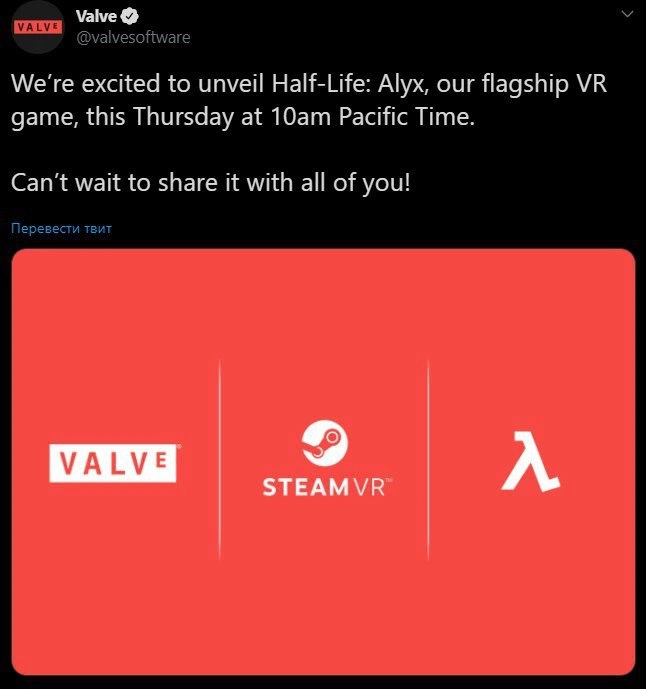
The image in the tweet has three logos on a red background:
- VALVE – the company’s logo, showing it’s an official Valve project.
- STEAMVR™ – the logo/text for SteamVR, indicating this game is built for PC VR through Steam.
- λ (Lambda) – the Greek letter lambda, which has become the symbol for the Half-Life series (in the games, it’s the logo of the Resistance and references the Lambda Complex in the story).
Seeing the Half-Life lambda symbol next to Valve and SteamVR basically confirms: Valve is making a new Half-Life game in VR. For many developers (especially those into gaming), that’s huge news. GameDevelopment folks get excited because Valve’s games often bring innovations – for example, the original Half-Life (1998) set new standards for storytelling in shooters, and Half-Life 2 (2004) introduced advanced physics and modding capabilities. So a new Half-Life title could mean new breakthroughs in how games are made or experienced, this time in VR. It also validates VR as a serious gaming platform – up until then, VR had a lot of smaller indie games or tech demos, but not a lot of full-length AAA games. Valve calling Half-Life: Alyx a flagship suggests it will be a full-length, high production value game, not just a short experiment. That’s why developers who’ve been learning or working with VR (the AR_VR field) are hyped: they might get to see state-of-the-art VR game design and maybe new tools or engines (it’s likely using Valve’s latest Source 2 engine, which is interesting to devs).
Another reason for the excitement is simply GamingIndustry hype and nostalgia. Half-Life has a massive fanbase. Alyx Vance, the character named in the title, is a beloved character from Half-Life 2 – so the game Half-Life: Alyx likely revolves around her story. It’s not the direct Half-Life 3 many imagined, but it’s the first new entry in this universe in years, and it’s official. On social media (Twitter, Reddit, etc.), any official hint from Valve gets blown up because people have spent years analyzing rumors and tiny leaks. Here we have an outright public tweet from @valvesoftware saying “We’re excited to unveil Half-Life: Alyx ... Can’t wait to share it with all of you!” along with a time and date for the reveal. It’s basically Valve saying “Yes, it’s real, come back on Thursday for details.” In modern game industry marketing, this is a common tactic: tease a big announcement a few days ahead to build buzz. And boy, did it work! The phrasing “Can’t wait to share it with all of you” also got folks excited – it sounds very enthusiastic and inclusive, like the developers at Valve are just as eager to show it as we are to see it.
To someone newer in the developer world, it might help to clarify a few terms:
- VirtualReality (VR): You wear a headset that covers your eyes and often wear handheld controllers. The headset shows you stereoscopic 3D visuals and tracks your head movement, so you can look around a virtual environment naturally. The controllers track your hand movements, letting you interact (pick up objects, shoot, push buttons) inside the game. In VR games, you might physically duck, turn around, or reach out – it’s very immersive compared to playing on a flat monitor.
- Valve Index: This is Valve’s own VR headset, released in mid-2019. It’s a premium device known for a wider field of view and finger-tracking controllers (they can detect individual finger movements). When Valve says Half-Life: Alyx is their flagship VR game, implicitly the best experience might be on the Valve Index, because it can utilize those advanced features (for example, letting you actually see Alyx’s hands and fingers in the game picking up items or reloading weapons in a natural way).
- SteamVR platform: This is the software layer on Steam that supports VR. It’s what you run on your PC to use VR headsets and play VR games. It supports many headsets (HTC Vive, Oculus Rift, Valve Index, etc.) through a common API. So, a SteamVR game can usually be played with different VR gear. Valve making a flagship game for SteamVR is them putting content on their own platform to drive more users and validate the ecosystem they’ve built.
- Half-Life and the λ symbol: Half-Life is a famous video game series. The first game followed a scientist named Gordon Freeman who survives an experiment-gone-wrong and fights aliens and soldiers. The second game continued the story in a dystopian future. λ (lambda) is the series’ logo because in science, lambda often denotes decay constant in the half-life formula (a clever nod to the title), and in the game’s story it’s the logo of the research facility and later the resistance against the alien occupiers. Gamers instantly recognize λ on any sign or promo as “Half-Life”. So seeing λ in the promo image causes a surge of excitement for those in the know.
- IndustryTrends_Hype: This refers to how the tech and gaming industry goes through hype cycles – periods when a technology is talked up as the next big thing. VR has been one of those trends. Around 2012-2016, VR got massive hype as futuristic tech. Many devs learned VR hoping it would go mainstream. But adoption has been steady rather than explosive, partly due to cost and lack of must-play games. Now a huge title like Half-Life coming to VR in 2020 (which is what the teaser is pointing to) is seen as a possible turning point. It’s an “industry trend” moment where everyone’s paying attention to see if VR will finally hit the big time or if this is just another spike of interest.
- GamingCulture and memes: As mentioned, there’s a long-running meme “Half-Life 3 confirmed?” because fans would joke that Valve gives tiny hints but never actually releases Half-Life 3. This tweet was on November 19, 2019, and it genuinely confirmed a new Half-Life something, so the meme kind of came true (in a way people didn’t expect – via VR). The culture around Valve is such that the slightest news causes an uproar. Developers are not immune to this either; many developers are fans first. So the “dev hype meter explodes” title essentially means even normally tech-focused folks were just pure fans at that moment, extremely hyped up.
So, in simpler terms: Valve used Twitter to announce that in a couple of days they would reveal Half-Life: Alyx, a big new game made specifically for virtual reality. This matters because it’s combining a legendary game series with new VR technology. Developers who make games, especially those interested in VR, got very excited to see what this would look like and what it means for the future of VR gaming. It’s like a signal that VR might really be taking off, and it’s being led by one of the most respected companies in gaming, using one of the most beloved franchises in gaming. No wonder everyone was losing their minds a bit – it’s a major IndustryTrend and a big dose of nostalgia/hype all at once.
Level 3: Full SteamVR Ahead
The moment Valve tweeted that teaser, the collective developer community went into overdrive. This single image combines three powerhouse symbols: the Valve logo (the legendary PC game studio and Steam platform owner), the SteamVR logo (Valve’s own VirtualReality ecosystem), and the iconic white lambda λ (emblem of the Half-Life franchise). For seasoned devs and gamers, seeing these three side by side on a bright alert-red background is like witnessing a rare alignment of planets. It signifies a GameDevelopment milestone where cutting-edge AR_VR tech meets a storied game series that defined an era. The tweet explicitly calls Half-Life: Alyx their “flagship VR game,” which is bold industry code implying this isn’t a mere demo or side project – it’s a full-scale, high-investment showcase meant to push ValveIndex hardware and VR design to their limits.
From an experienced developer perspective, the humor and excitement here come from finally getting a new Half-Life installment after a 12-year gap – but with a futuristic twist. Valve is famously secretive and has a running gag in the community of “not being able to count to 3” (since Half-Life 3 became almost mythical after Half-Life 2). So any whisper of Half-Life returning tends to send fans into a frenzy of speculation and memes (“Half-Life 3 confirmed!” being the enduring joke). Now Valve drops this bombshell on Twitter of all places – effectively confirming a new Half-Life game (at least in spirit) – and does it in the context of VR. It’s the ultimate crossover event: a beloved franchise meets bleeding-edge tech. Developers who’ve been around know that Valve doesn’t hype things lightly; when they label something a flagship, it’s a signal that they’ve thrown serious engineering muscle behind it. We’re talking about Source 2 engine upgrades, new physics for VR interaction, finely-tuned motion controls, possibly even breakthrough solutions to notorious VR challenges like motion sickness and hand presence. It’s a perfect storm of nostalgia and innovation.
The meme-worthy aspect is also how dramatically the IndustryTrends_Hype dial got cranked to 11. Valve essentially said “tune in Thursday at 10am Pacific” – meaning they announced an upcoming announcement – and the dev hype meter practically exploded. It resonates because hype anticipation is a familiar cycle: much like an Apple keynote for gamers, everyone starts clearing their calendars, sharing guesses in Slack, and tweeting reactions GIFs. A normally jaded senior dev might suddenly act like a giddy intern again. Many of us remember the first time Half-Life wowed us with its physics and story, and the thought of experiencing that level of immersion in VR is mind-blowing. There’s also a touch of irony: Half-Life: Alyx isn’t Half-Life 3 (chronologically it’s more like a side-story or prequel), yet it’s enough to send waves through the GamingIndustry and GamingCulture. Seasoned developers appreciate the subtext too – Valve’s making a strategic play. By tying their flagship franchise to SteamVR, they’re implicitly validating VR’s importance. They want this title to be VR’s “killer app”, the game that finally compels skeptics to don a headset. And indeed, right after the tweet, reports flew around that the high-end Valve Index headset sold out in many regions – a tangible measure of hype converting into action.
For veterans who’ve followed VR’s bumpy road, this moment has deeper meaning. Virtual Reality had big buzz around 2016 (with Oculus Rift, HTC Vive – which Valve partnered on – and talk of the “VR revolution”), but enthusiasm had tempered when killer apps failed to materialize beyond tech demos. Now Valve appears, essentially saying “Here’s a full-length, AAA-quality VR-only Half-Life adventure.” It’s as if a dormant superhero (the Half-Life IP) has been called in to save the day for VR. The humor lies in how over the top the excitement is – even crusty old sysadmins and graphics programmers who normally groan about hype found themselves sharing the Valve tweet with multiple exclamation points. In many game studios, productivity probably dipped that morning as developers pored over the red teaser image, looking for hidden clues (we developers love Easter eggs). The image’s minimalist style – just logos on red – almost begs to be over-analyzed, which in itself is a playful poke at how nerds dissect everything Valve posts. Is the red color a hint? (Half-Life’s HEV suit is orange… close enough to red?) Are the vertical lines in the graphic hinting at the number 3? (There are three logos… Half-Life 3?! – yes, people really joked about that). The lambda logo reference is especially significant: in computing, lambda might mean an anonymous function or indicate half-life’s scientific origins, but in gamer culture that λ instantly shouts “Half-Life is back!”.
All these layers make the meme funny and exhilarating. It’s a relatable scenario of hype in tech/gaming: a revered company finally addressing a long-unfulfilled wish, using the latest tech as the vehicle. And experienced devs know this feeling all too well – equal parts excitement and cautious optimism. We’ve been burned by hype trains before, but this one is Valve and Half-Life, so even the cynical among us are grabbing popcorn. The tweet’s closing line, “Can’t wait to share it with all of you!”, is exactly how the community felt. We also couldn’t wait for them to share it! In fact, the excitement was so high that someone jokingly might have written code like this to measure the hype:
// Pseudo-code of the dev community's reaction to Valve's tweet
if (tweet.content.includes("Half-Life: Alyx") && tweet.content.includes("VR")) {
devHypeMeter.level = Infinity;
console.log("🚀 The hype is off the charts!");
}
In summary, at this senior level we recognize the potent mix of elements: a famed series revival, a leap in technology, and a savvy industry move. It’s humorous because it’s so very predictable that devs would lose their minds over this – and yet we’re totally unashamed about it. Valve pulled a classic “one more thing” move, and the entire dev world bit hard. Full SteamVR ahead, indeed – we’re all aboard this hype train, laughing at ourselves for how quickly we jumped on.
Description
A screenshot of an official tweet from the verified Valve Twitter account (@valvesoftware). The tweet, posted on a dark background, announces the unveiling of a new game. The text reads: 'We’re excited to unveil Half-Life: Alyx, our flagship VR game, this Thursday at 10am Pacific Time. Can’t wait to share it with all of you!'. Below the text is a prominent red banner with three logos separated by vertical lines: the 'VALVE' logo, the 'STEAM VR' logo, and the iconic lambda symbol 'λ' representing the Half-Life series. This image is not a meme but a significant industry announcement. For the tech community, particularly those in game development and virtual reality, this tweet was a major event, signaling Valve's long-awaited return to the Half-Life franchise and a serious push into the VR market with a AAA title

Comments
7Comment deleted
Valve's project timelines are the industry's best example of asynchronous, non-blocking I/O. You send a request for Half-Life 3, and years later, a callback finally executes with a VR prequel
Valve basically put Half-Life 3 in a lambda, yielded for 15 years, and resumed execution in VR - still no return value
Valve finally figured out how to ship Half-Life 3: rename it to avoid the number entirely, require $1000 in hardware nobody owns, and call it a prequel so the timeline doesn't matter
After years of 'Valve can't count to 3' memes, they finally delivered a Half-Life sequel - by cleverly avoiding the number entirely and pivoting to VR. Classic Valve: when your engineering team solves the 'HL3 problem' by redefining the problem space itself. It's not a sequel if you change the platform paradigm
Half‑Life: Alyx is SteamVR’s most expensive end‑to‑end test - Valve still won’t bump the major version to 3 because it’d break both the ABI and the meme
Valve chose λ over 3; when you can’t return 3, just curry the franchise into VR and hit a 90Hz frame‑time SLA instead
Half-Life: Alyx in VR - where the real infinite loop is chasing 90FPS without GPU thermals hitting black mesa meltdown