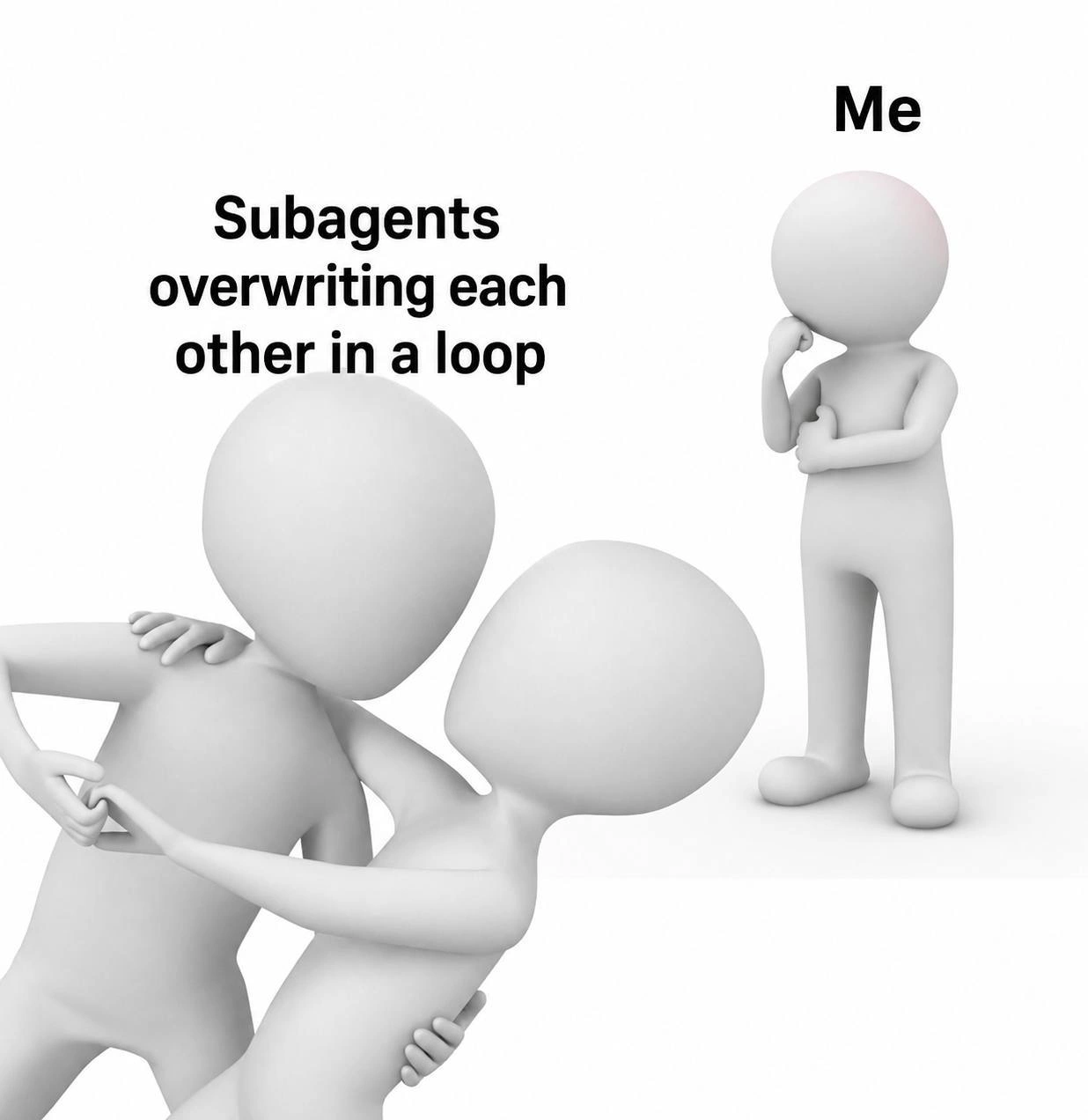
Anthropic's 'Ultrathink' is Literally the Expanding Brain Meme
Why is this AI ML meme funny?
Level 1: Brain at Full Blast
Imagine you’re helping your friend solve a puzzle. First you say, “Okay, give it a think.” They try, but they’re still stuck. So you encourage them, “Hmm, think harder!” They furrow their brow and try a bit more, maybe making some progress. Still not there, so you really egg them on: “No, no, you need to ultra-think this one!” Now your friend is concentrating as hard as humanly possible – cartoon smoke coming out of their ears – and they finally solve the puzzle. 😀 This meme is funny because we’re doing exactly that, but with a computer program. We’re literally telling the AI “please think… now think harder… now REALLY think super hard!” and expecting better answers each time. It’s like there’s a little dial for the AI’s brainpower, and “Ultrathink” is turning that dial up to 11 (just like blasting the volume to the max on your speakers). But just like giving your friend a huge energy drink to solve a puzzle, there’s a catch – in real life, making an AI think extra hard means using more resources (kind of like paying for more fuel to keep a machine running longer). The joke compares this to paying more money for a bigger, faster tool when the small one isn’t enough. So it’s amusing and a bit silly: we’re treating the computer like a person who can be told to put in maximum effort, and in doing so, we’ve made a real-life manual that sounds like a meme. In short, it’s funny because “ultrathink” sounds like a made-up superhero power, yet here we are, seriously using it to get better answers from our AI – and crossing our fingers we don’t get an ultra-sized bill in return!
Level 2: Turbo Brain Mode
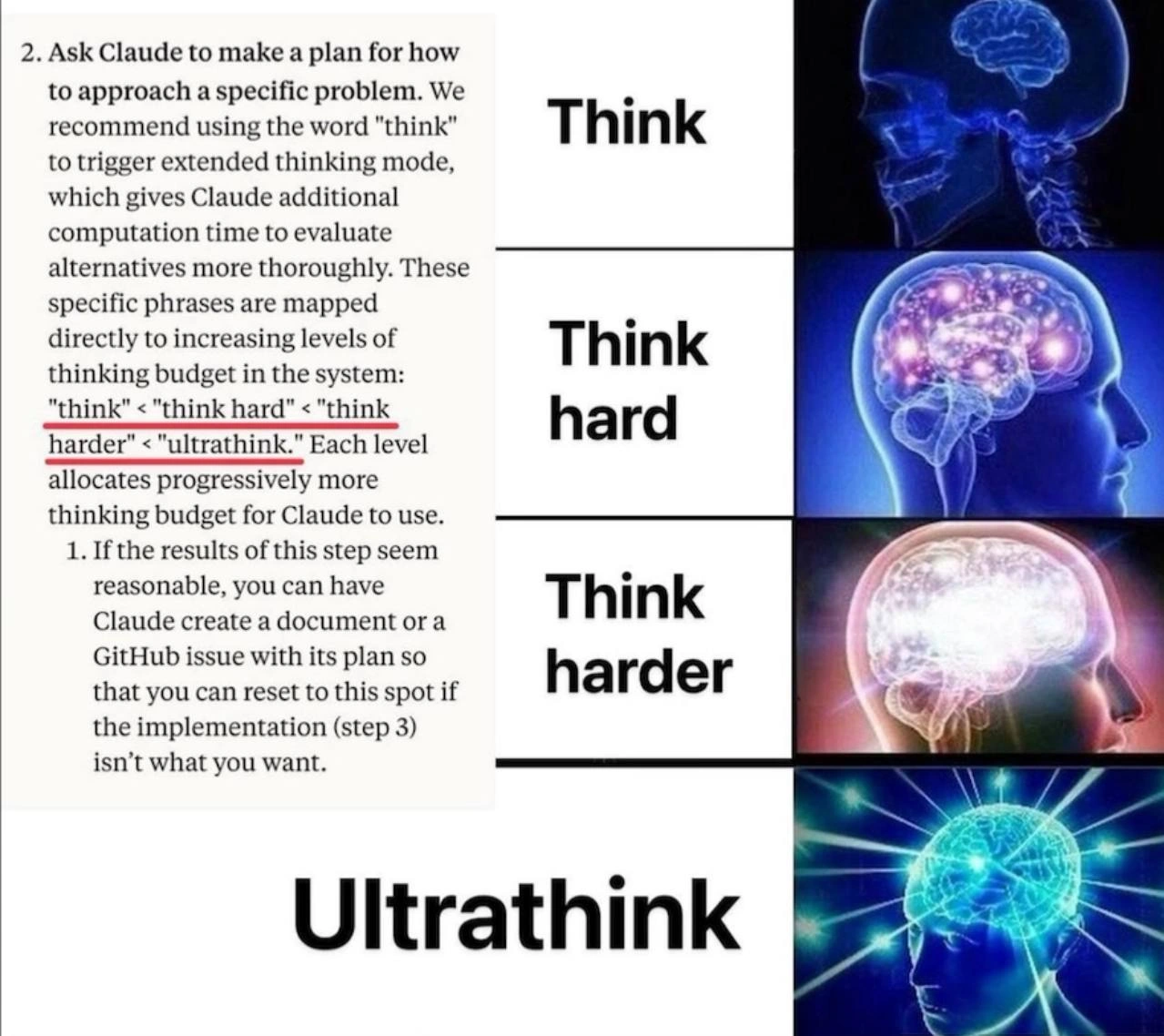
Let’s break down what’s going on here in simpler terms. On the left side of the meme, there’s a snippet from Anthropic Claude’s documentation. Claude is an AI model, a type of AIAssistant similar to how ChatGPT works – you give it text prompts, and it responds with answers or plans. The doc is giving advice on prompt engineering, which is the craft of writing your instructions or questions (prompts) to an AI in a way that gets the best result. In this case, the advice is about getting Claude to plan out a solution to a problem. They literally suggest using the word “think” to encourage Claude to enter an “extended thinking mode.” In plainer words, if you include phrases like “think hard” or “think harder” in your prompt, the system will allow Claude to spend more time/effort on the problem. They outline a hierarchy: “think” < “think hard” < “think harder” < “ultrathink.” Each of those is like a dial setting for the AI’s brainpower. The further right you go on that scale, the more thinking budget (i.e., computational resources and time) Claude will use to mull over the question. “Ultrathink” is the most extreme setting – basically telling the AI, “Really put all your brain cells on this, no holding back.”
Now, the right side of the meme uses the popular expanding brain meme template. This template usually shows four images of a human brain, each one more lit-up and glowing than the last, next to text that increases in “galaxy brain” absurdity or insight. Here, the labels are exactly those phrases: “Think”, “Think hard”, “Think harder”, and “Ultrathink.” As you move down, the brain images progress from a normal brain to a bright, cosmic, radiant brain. It’s a visual way to represent the AI using more brainpower at each level. The joke is that Anthropic’s documentation unintentionally reads like this meme format – it’s as if the tech writers created a serious developer prompt workflow that doubles as a punchline. AIHumor often comes from these kinds of coincidences, where a straight-faced technical instruction sounds like something from an internet joke.
The title of the meme compares this “think” to “ultrathink” escalation to increasing AWS spend. AWS, or Amazon Web Services, is a huge cloud computing platform. Developers and companies use AWS to rent servers and computing power. One well-known issue with AWS (and cloud services in general) is that the costs can balloon as you use more power or add more resources – it’s easy to rack up a big bill if you’re not careful. So, saying “escalating from think to ultrathink is like increasing AWS spend” means that each step up in AI thinking likely comes with a higher price tag or resource cost. This is because AI models like Claude or GPT-4 charge by usage, often measured in tokens. A token is basically a piece of a word; both input and output text are made of tokens, and longer or more complex answers mean more tokens used. If “ultrathink” mode lets the AI generate more content or try more ideas internally, that’s probably going to consume more tokens. More tokens = higher charge if you’re using a paid API. So developers joke that using “ultrathink mode” might solve your problem better, but you’ll feel it in your cloud bill (just like running a beefy server on AWS gets the job done faster but costs more money).
Let’s also clarify thinking budget with a simpler analogy. Think of an AI’s brainpower like a time limit or a fuel tank for solving a problem. A small thinking budget is like giving someone 5 minutes to figure out a puzzle – they might do something quickly but maybe not thoroughly. A large thinking budget is like giving them an hour – they can try more approaches, double-check their work, maybe come up with a more optimal solution. Anthropic’s system has these trigger words to decide how long or deeply the AI should think about your question. It’s quite literal: “think harder” means the AI will literally put in more effort (computational effort) behind the scenes. Ultrathink mode is just the company’s internal name (and a pretty amusing one) for the highest effort setting.
For a junior developer or someone new to AI, this is also a peek into how AI/ML services are evolving. We used to worry mostly about CPU, memory, and writing efficient code. Now with AI assistants, we also think about things like token limits, prompt phrasing, and compute budgets for AI. It’s a shift in DeveloperExperience_DX – you might find yourself writing, essentially, English-language instructions that tweak performance, which is very different from turning knobs in a config file. It’s so on-the-nose that it became a meme: telling a computer to “think hard” feels like something a frustrated teacher would tell a student daydreaming in class, not a real parameter you pass to an API. Yet here we are!
The AIHype aspect is also relevant: right now, companies are racing to market all these advanced AI features (hence tags like AIHypeCycle). Every new feature gets a fancy name. “Ultrathink” sounds hype-y, like a superhero power. The meme is winking at that too – it’s as if our tools themselves have started using meme-like terminology. In software development culture, when something sounds over-the-top, we often match it with an over-the-top meme (enter the glowing brain image).
To sum up the technical bits: The meme highlights a real technique in AI usage (graded prompt_engineering commands for more thorough AI reasoning) and compares it to a classic developer concern (managing cloud costs). It’s connecting new school AI practices with old school practical issues. And it’s doing it in a humorous way that pokes fun at how surreal it is that “just think harder” is part of an official programming guide. If you’re new to this, don’t worry – it is as crazy as it sounds, and yes, even experienced devs find it funny that this is where we’ve arrived!
Level 3: Think Hard, Pay Harder
For seasoned developers, this meme hits on two fronts: AI hype and good old-fashioned cloud bills. On the right, we have the classic expanding brain meme – each panel representing a higher state of enlightenment. On the left, we have Anthropic’s very real documentation listing “think” < “think hard” < “think harder” < “ultrathink” as trigger phrases for increasing an AI’s thinking budget. Put them together, and you get a perfect satire of our current IndustryTrends_Hype: the belief that if an AI didn’t solve your problem, you just didn’t tell it to “try hard enough.” The joke practically writes itself: escalating from “think” to “ultrathink” is like escalating your AWS EC2 instance from a t2.micro to an m5.24xlarge – each step up might give you more power, but your AWS spend (or in this case, your token usage bill) is climbing faster than that glowing brain in the meme.
Seasoned engineers recognize the pattern: performance tuning by brute force. Once upon a time, you’d optimize C code or tweak SQL queries; now you literally type “think harder” and hope the AI throws more GPUs at the problem. It’s both hilarious and painfully relatable. We’ve started juggling token budgets the way we used to juggle memory and CPU cycles. In an age of AIAssistants, this is the new normal: do we want the quick answer, or do we whisper “ultrathink” and watch the meter run? The meme’s subtitle (“like increasing AWS spend”) nails this parallel. Anyone who’s ever gotten a surprise cloud bill can appreciate how each extra “9” of reliability or each bigger instance means exponentially more money. Similarly, each jump from “think” to “think harder” to “ultrathink” presumably consumes more of the model’s context window, more API tokens, and more processing time. AIHumor often comes from these parallels to traditional dev life – here we’re basically managing an AI’s effort like a finite resource.
The expanding brain imagery underscores how ridiculously straightforward these tiers are. “Ultrathink” sounds like satire – like a term a parody sci-fi show would use – but here we are, with a real company effectively saying “Pssst, just say ‘ultrathink’ and our AI will really put its thinking cap on.” No wonder the poster wrote “They played us for absolute fools.” It’s the kind of marketing-technobabble combo that senior devs love to roll their eyes at. It reminds us of other hype-cycle absurdities we’ve lived through. Remember the era of Enterprise JavaBeans where “just add one more XML config and it will magically scale”? Or the days of multi-tiered architecture diagrams promising that more layers = more robustness? This “ultrathink” business carries that vibe: a little secret sauce phrase that supposedly unlocks higher capability.
From a DeveloperExperience_DX standpoint, it’s both empowering and comical. On one hand, having such a simple prompting protocol is useful – it’s like an easy developer workflow to try basic solution, then ask for a more thorough one if needed. On the other hand, it’s the kind of thing an AIHumor meme can’t resist: it reduces a complex AI operation to a one-word incantation, like we’re casting spells. Seasoned devs have a dark chuckle because we see the hidden trade-off: sure, Claude will think harder… and use 10x the tokens, just like sure, that new r5.12xlarge instance will handle the traffic… and cost 10x the money. The phrase “unspoken token-cost trade-offs” from the description is exactly right – in meetings now, senior engineers quietly weigh “Is this query important enough to justify an ultrathink (and will I have to explain the OpenAI/Anthropic invoice later)?”
Real-world scenarios? Imagine you’re coding with an AI pair-programmer and the initial suggestion is mediocre. You remember the docs and literally type: “Think harder: how else could we approach this problem?” – the AI churns for a bit longer and prints out a more detailed plan, complete with edge-case considerations. Victory? Possibly. But then you check your usage stats: that one answer was a whopping 10,000 tokens! In a hackathon, that’s fine – in production, your finance team might ultra-think you're burning cash. Seasoned devs have seen this pattern with new tech: the first hit is free (or cheap), the ultra-mode blows the budget. It’s reminiscent of a developer discovering that an overly broad database query is eating all the CPU – except now it’s an overly fancy prompt eating all the tokens.
Another layer of humor is how deliberate the wording is. “Think hard” and “ultrathink” – it’s not even trying to sound formal. It’s like the devs at Anthropic leaned into the meme. Could you imagine a code review for that feature? “We’ve mapped 'ultrathink' -> mode=4'. Approved.” It feels like a cheeky Easter egg that leaked into prod. And for those of us who recall the “galaxy brain” meme format (each panel showing an idea more cosmic and outlandish than the last), seeing Ultrathink in the final radiant-brain tier is just chef’s kiss. It implies that by the time you reach Ultrathink, you’ve achieved some transcendent, budget-blowing clarity – or maybe you’ve just gone nuts.
Finally, there’s an underlying commentary about AIHypeVsReality. In hype, AI seems magical: just ask it and it solves anything. In reality, you often have to coax it, structure your prompts cleverly (that’s the whole prompt_engineering game), and sometimes literally say “no, really THINK about it” to get a good answer. It humanizes the AI in a weird way – we’ve gone from optimizing machines in machine terms to encouraging machines in human terms. A battle-scarred coder can’t help but smirk at the role reversal: now developers are the ones saying to the computer what our bosses used to say to us: “I need you to put in some extra thought on this one.” And just like in real life, extra thought has a cost – be it pizza and overtime or tokens and GPU time. This meme packs all that into a neat, humorous package that anyone who’s waded into AI development lately will appreciate.
Level 4: Cognitive Overclocking
At this deepest level, the meme hints at the algorithmic levers behind modern AI assistants. When Anthropic’s docs talk about increasing “thinking budget”, it implies a controlled compute expenditure per query – essentially letting the AI run more internal reasoning steps, akin to giving it a bigger scratch pad or extra processing cycles. Under the hood, Large Language Models (LLMs) like Claude might implement this by extending the chain-of-thought reasoning: for each increment from “think” to “ultrathink”, the model could be performing additional inference passes or exploring a larger search space of possible solutions. This concept parallels how classical AI algorithms work: for example, a chess engine given more time will examine more moves ahead, and a heuristic search given a higher node-expansion budget will dig deeper into the decision tree. In Claude’s case, more thinking budget likely means it can consider more alternative approaches or perform a lengthier internal dialogue before finalizing an answer. It’s a form of cognitive overclocking, where extra GPU cycles and memory are spent to (hopefully) yield a smarter result. Of course, fundamental computational theory tells us there’s no free lunch: giving an AI more cycles follows diminishing returns, much like how doubling a brute-force search budget might not double the quality of the solution if the problem’s complexity grows exponentially. But from an engineering standpoint, Anthropic has essentially exposed a multi-tier “solve harder” API. This is both brilliant and a bit absurd: brilliant because it provides a tunable accuracy-vs-cost knob (similar to adjusting precision in numerical computations), and absurd because it formalizes “just think harder, computer” as an actual feature. One can imagine pseudocode for this logic baked into Claude’s system:
# Hypothetical internal prompt parsing for Claude's thinking budget
if "ultrathink" in user_prompt:
reasoning_steps = 4 # maximum depth of reasoning
elif "think harder" in user_prompt:
reasoning_steps = 3
elif "think hard" in user_prompt:
reasoning_steps = 2
elif "think" in user_prompt:
reasoning_steps = 1
else:
reasoning_steps = default_steps
answer = model.generate_answer(query, steps=reasoning_steps)
This tongue-in-cheek pseudocode isn’t official, but conceptually it illustrates the point: those magic words likely flip internal switches that allocate a progressively larger slice of compute. We’re essentially scaling the transformer on demand. It’s a fascinating glimpse into prompt engineering where simple English cues control something as arcane as an AI’s reasoning depth. In academic terms, this relates to research on self-reflection and multi-step reasoning in LLMs, where explicitly prompting an AI to “think step-by-step” often leads to better outcomes (as shown in numerous AI papers on reasoning and AIHypeCycle breakthroughs in 2022-2023). Anthropic has taken that idea literally and given it discrete levels. It’s a bit like the CAP theorem of AI responses: you can trade resources for thoughtfulness. And just as distributed systems can’t cheat CAP, you can’t magically get a perfect answer without paying in computation. The meme winks at this by equating “Ultrathink” to scaling up cloud resources: if thinking is one CPU, then ultra-thinking is a cluster of GPUs spinning at full throttle. In summary, the left panel is essentially describing a meta-algorithm for an AI’s cognitive effort, a real product of our AI/ML era where human-like “hard thinking” has been quantified and exposed via an API. It’s high-concept stuff hiding behind funny phrasing—an inside joke at the intersection of prompt_engineering and computational resource management.
Description
This image is a four-panel meme that juxtaposes official documentation for the AI model Claude with the classic 'Expanding Brain' meme format. The left side of the image contains a screenshot of text explaining how to trigger different 'thinking modes' in Claude by using specific phrases. The text details a hierarchy: 'think' < 'think hard' < 'think harder' < 'ultrathink', with each level allocating a progressively larger 'thinking budget'. On the right, each of these commands is paired with a corresponding stage of the Expanding Brain meme. 'Think' shows a basic X-ray of a brain. 'Think hard' and 'Think harder' show the brain becoming increasingly illuminated. Finally, 'Ultrathink' is aligned with the final panel of the meme, depicting a brain glowing with cosmic energy. The humor is derived from the direct, literal parallel between a real, documented feature of a sophisticated AI and a well-known internet meme. For senior developers, it's a funny critique of how AI capabilities are marketed and controlled, satirizing the concept of 'prompt engineering' by revealing a backend resource allocation mechanism that sounds like a video game power-up. It amusingly exposes the anthropomorphic language used to describe complex computational processes

Comments
15Comment deleted
So 'ultrathink' is just a SaaS wrapper for allocating more vCPU and RAM. I can't wait for the 'megathink' API call that provisions a whole new Kubernetes cluster just to answer whether a hot dog is a sandwich
Great - now my sprint planning includes a column for ‘increase LLM thinking budget’ right next to ‘provision more GPU nodes.’ Finance will *love* this burn-down chart
Ah yes, the four stages of prompt engineering: 'think' for when you need a quick regex, 'think hard' for debugging race conditions, 'think harder' for explaining monads to management, and 'ultrathink' for finally understanding why your Kubernetes cluster costs more than your mortgage
Ah yes, the classic engineering solution: when your AI isn't thinking hard enough, just add more 'hard' to the prompt. It's like discovering that your distributed system's performance scales linearly with the number of times you write 'fast' in the config file. Next release: 'ultrathink_but_like_really_really_hard_this_time_i_mean_it.exe' - because nothing says production-ready like prompt keywords that sound like Dragon Ball Z power levels. At least they documented the token budget escalation strategy, which is more than most APIs give us before surprise billing alerts
We've reached the era where 'think harder' is a supported API parameter - set X-Thought-Budget: ultrathink, trade latency and token burn for a 15-page plan and three GitHub tickets, just like a senior engineer but without the calendar conflicts
Escalating Claude's think modes like a P1 incident: 'Ultrathink hard' before it hallucinates another merge conflict
“Ultrathink” is the LLM equivalent of moving from eventual consistency to linearizability - nicer plans, catastrophic latency, and a CFO alert on token burn
next claude update : by typing play me for absolute fools Claude tried to make a fool of you by throwing random bullshit and misinformation to your face Comment deleted
Oh, great! So in next update I will have to explicitly ask for it? R-right? Comment deleted
So the next update won't do that by default? Neato! Comment deleted
mankind is braindead power is fuel processing capacity is full Comment deleted
apple fans love it Comment deleted
pro max ultra think ++ Comment deleted
Noted. Will use that trick on my future robot wife to fix her "natural" behavior mimicking. ✏️ Comment deleted
UltraThinkPad Comment deleted