Skip to content
DevMeme
6405 of 7435
A Programmer's Literal Interpretation of 'Name Every Computer'
Languages Post #7026, on Aug 12, 2025 in TG

A Programmer's Literal Interpretation of 'Name Every Computer'

Why is this Languages meme funny?

Level 1: Careful What You Wish For

Imagine you ask a very literal friend to do something impossible, like “Hey, you’re a librarian? Prove it. Name every book ever.” You meant “tell me the title of every book in existence” — an obviously huge or impossible request, said as a joke. But your friend decides to take your words super literally. They go to every book in the library and write the word “Ever” as the title on each book’s cover. Then they come back and say, “Done! Now every book is named ‘Ever’.”

Silly, right? They didn’t actually do what you meant, but they did do exactly what you said. The joke in the meme is just like that, but with computers and code. Someone said, “If you’re an engineer, name every computer ever.” The engineer knows they can’t really list every computer’s name (that’s impossible), so instead they pretend the task was to give every computer a new name. They write a tiny program that renames all the computers to be called “ever.” It’s as if a teacher told the class to “name every star in the sky” and a clever student climbed a ladder and put a sticker saying “Star named Ever” on each one they could reach. Not what the teacher meant, but technically they did name them, just all with the same name!

The heart of the joke is about taking words literally. It’s funny because the engineer solved the “problem” in a mischievous way. It reminds us of those fairy tales or genie stories where you have to be careful how you word your wish. If you’re not specific, you might get something very literal and not at all what you intended. Here, the request was to prove engineering skill by doing something outrageous. The engineer proved their cleverness by following the request to the letter (quite literally naming everything “ever”) rather than the spirit. It’s a playful twist that makes us laugh because it’s so literal and absurd.

In plain terms: someone asked for every computer’s name, and the engineer jokingly responded by giving every computer the name “Ever.” It’s like a child misunderstanding an instruction on purpose to be funny. We find it humorous because the engineer acted like a human computer or genie, executing exactly the words of the command without any common-sense adjustment. So the lesson is: be careful what you ask for — especially if you ask a programmer! They just might do exactly what you say in the most unexpectedly literal way.

Level 2: Looping Through Computers

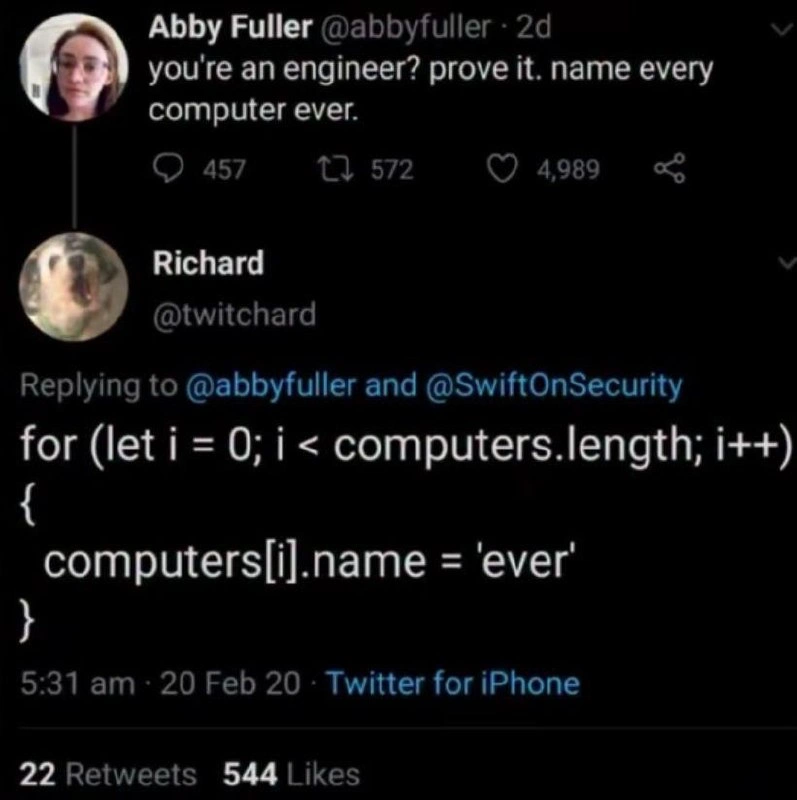
Let’s unpack the joke in more straightforward terms. The meme shows a JavaScript code snippet that looks like this:

for (let i = 0; i < computers.length; i++) {
    computers[i].name = 'ever';
}

This is a basic for loop in JavaScript, a common way to repeat an action for each item in a list. Here’s how it works step by step:

  • computers is an array (a list) of computer objects. In programming, an array is like a numbered list of items stored in a single variable. Each item in this array is presumably an object representing a computer, and each of those objects has a property called name (among other properties like maybe id or type). For example, the array might look like:

    let computers = [
        { name: "ENIAC" },
        { name: "HAL 9000" },
        { name: "Deep Thought" },
        // ...and so on
    ];
    
  • The for loop syntax for (let i = 0; i < computers.length; i++) means:

    1. Start with a counter variable i set to 0. (In coding, we often start counting from 0, so i = 0 points to the first element of the array.)
    2. Run the loop as long as i < computers.length. computers.length is the number of items in the array. So if there are 100 computers, computers.length is 100. The condition i < computers.length ensures the loop runs for each index from 0 to 99 (which covers all 100 items, since array indices 0-99 are 100 numbers total). This prevents us from going out of bounds.
    3. After each loop iteration, do i++, which means “add 1 to i”. This increments the counter so that the loop moves to the next item.
  • Inside the curly braces { ... } is the code that executes each time the loop runs. The code computers[i].name = 'ever'; means: take the i-th computer in the list and set its name property equal to 'ever'. In JavaScript (and many languages), computers[i] accesses the element at index i of the array. Then .name accesses that object’s name field. We use the = operator to assign a new value. Here the new value is the string 'ever'. A string is just a piece of text in quotes. So 'ever' is literally the characters e-v-e-r. After this line runs, that computer’s name is now "ever" instead of whatever it was before.

Putting it together, the loop will go through each computer object one by one, from the first to the last, and change each one’s name to "ever". After the loop finishes, every object in the computers array will have a name property set to "ever". We started with different computer names, and ended with all of them named the same thing. For example:

let computers = [
  { name: "ENIAC" },
  { name: "HAL 9000" },
  { name: "Deep Thought" }
];

console.log(computers.map(c => c.name));
// Output before: ["ENIAC", "HAL 9000", "Deep Thought"]

// Rename every computer's name to "ever"
for (let i = 0; i < computers.length; i++) {
  computers[i].name = "ever";
}

console.log(computers.map(c => c.name));
// Output after: ["ever", "ever", "ever"]

As you can see, the names have all been overwritten to "ever". The code itself is straightforward for anyone familiar with basic programming: it’s a standard array iteration pattern taught in introductory courses. We use a loop to iterate (go through) each element. This kind of operation (changing every element in a list) is extremely common in programming. In fact, many languages have convenience methods for it (like a forEach loop or functional methods), but the classic indexed for-loop is a clear way to show the process.

Now, why did the engineer write this code in response to the tweet? This is where the humor comes in. The original tweet said: “name every computer ever.” In everyday language, that phrase means “tell me the name of every computer that has ever existed.” Of course, that’s an impossible task — there have been millions of computers, and no one knows all their names. It was meant to be a playful challenge or a joke. But the engineer took the phrasing and jokingly treated it like a literal requirement: “Name every computer ‘ever’.” In other words, they pretended the task was to assign the name "ever" to each computer. By writing the above code, they prove they can follow the instruction in a programming sense, even though it’s clearly not what the original tweet intended. This is a classic case of a language quirk being exploited for comedy. The word “name” can be a verb meaning “give a name to something”, not just “state the name of something”. So the programmer did exactly that — gave every computer a name: the same name, "ever".

This kind of joke is very popular in DeveloperHumor circles, especially on Twitter and forums where programmers hang out. A non-programmer might read the tweet and be confused why setting everything’s name to "ever" is funny. But people who know coding see instantly that the engineer answered in “code form” to a plain English request. They essentially turned a human request into a code snippet. It’s funny because it’s overkill and missing the point on purpose. Instead of seriously trying to list out computer names, they wrote a quick script to do something absurd yet technically literal. It shows how programmers often think in terms of writing code for tasks — even jokes. It also pokes fun at how an engineer’s brain might latch onto a phrase like “name every X” and think of object properties and loops.

In summary, the code is simple JavaScript that loops through an array and changes a property on every element. The humor comes from applying that literal coding mindset to a casual phrase. The result: a perfect little piece of coding humor that tells us a lot about how developers enjoy twisting words and requirements in a funny way.

Level 3: One Loop to Name All

In a single sly stroke of code, this engineer turns an impossible challenge into a literal one-liner solution. Abby Fuller’s tweet — “you’re an engineer? prove it. name every computer ever.” — sounds like a tongue-in-cheek dare to list every computer in existence. Any seasoned developer immediately spots the ambiguity: “name every computer” could mean identify each one by name, but it could also be taken as assign the name ‘every’ (or in this case 'ever') to each computer. Richard’s reply does exactly the latter with a simple JavaScript loop:

for (let i = 0; i < computers.length; i++) {
    computers[i].name = 'ever';
}

This code snippet playfully interprets the requirement literally. It treats computers as an array of computer objects and uses a classic for loop to iterate from index 0 up to computers.length - 1. On each pass, it sets the .name property of the current computer to the string 'ever'. In essence, the engineer renames all objects in the list to the same name. The result? Every computer in this hypothetical universe now has its name property set to “ever”. It’s a cheeky way to "name every computer ‘ever’," flipping the English phrasing into code.

Why is this so hilarious to developers? It highlights the perennial gap between stakeholder wording and engineering interpretation. In software development, we often joke that computers will do exactly what you tell them to, which is not always what you meant. Here, the stakeholder’s request (perhaps jokingly posed by Abby) is essentially impossible in spirit — no one can actually list the name of every computer ever made. But an engineer’s literal mindset finds a loophole: interpret “name” as an action (to assign a name) rather than an outcome (to enumerate names). The humor lands because Richard’s response is technically correct (the best kind of correct, as another meme goes) while completely sidestepping the intended meaning. It’s a witty demonstration of that classic developer trait: taking instructions at face value and bending logic to meet them.

Senior devs also appreciate the subtle jabs in this snippet. The silent side-effects are clear: this loop mutates the state of each object in the array. Instead of producing an output (like a list of names), it directly changes data — a big no-no if someone actually wanted a report, but perfect for a punchline. This contrasts the spirit of the request (probably wanting a list of computer names) with the letter of the request (literally assigning a name to every computer). It satirizes real-life miscommunications: think of a manager asking for one thing in plain English and the engineer delivering something completely different in code because the spec was ambiguous. Every experienced programmer has a war story about a feature that was implemented “to the spec” but not to the intention. This meme captures that scenario in one goofy JavaScript trick.

There’s an extra layer of insider humor here about naming. Seasoned developers often quip: “There are only two hard things in Computer Science: cache invalidation and naming things.” By naming every computer 'ever', the engineer ironically solves the naming challenge by giving everything the same name! It’s a mockingly simple solution to an impossible task. Additionally, the code snippet itself is a nod to old-school looping. Modern JavaScript might use higher-level functions like .forEach() or .map(), but here we see a traditional indexed loop with let i = 0; i++ — a tiny hint of nostalgia that senior devs recognize from countless codebases. (At least there’s no off-by-one error: the loop uses i < computers.length correctly, sidestepping another classic bug, which itself is part of a famous joke about the hardest problems in programming!).

Finally, consider the DevCommunity context: this exchange happened on Twitter, where brevity and wit reign. Abby Fuller is a real engineer known online, SwiftOnSecurity (tagged in the reply) is a popular tech humor account, and their audiences love clever code gags. The response got hundreds of likes because it’s a perfect bit of CodingHumor – it merges a programming in-joke with a universal developer experience. It’s the kind of joke you only get if you’ve wrestled with code and requirements: a mix of LanguageQuirks (treating an English phrase as code) and the jubilant cunning of an engineer showing off. In short, Richard’s reply “proves” he’s an engineer not by listing ENIAC, UNIVAC, and every machine since Babbage, but by thinking like a programmer. One loop, all computers renamed — mission accomplished, literal requirement met, and a timeline of developers is left chuckling at their screens.

Description

A screenshot of a Twitter exchange. The first tweet, from a user named Abby Fuller, poses a challenge: 'you're an engineer? prove it. name every computer ever.' Below it is a reply from a user named Richard, who responds not with a list, but with a snippet of code written in a JavaScript-like syntax. The code is a for-loop that iterates through a hypothetical array called 'computers' and assigns the string 'ever' to the 'name' property of each element: 'for (let i = 0; i < computers.length; i++) { computers[i].name = 'ever' }'. The humor comes from the literal, programmatic interpretation of the request. Instead of listing computer models, the engineer 'renames' every computer to 'ever', perfectly fulfilling the absurd command in a way only a developer would. It's a classic example of programmer humor, highlighting a pedantic and logical mindset applied to everyday language
Comments

24
Anonymous ★ Top Pick The fastest way to fail an interview is to answer 'name every computer ever' with a list. The fastest way to get the job is to write this script and ask if they want it containerized
  1. Anonymous ★ Top Pick

    The fastest way to fail an interview is to answer 'name every computer ever' with a list. The fastest way to get the job is to write this script and ask if they want it containerized

  2. Anonymous

    Sure, it passes QA - until the CMDB flags 10 million hosts all called “ever” and the uniqueness constraint Sambas your night on-call

  3. Anonymous

    Ah yes, the classic O(n) solution to impostor syndrome - just iterate through all computers and rename them. Though in production, this would probably trigger a cascade of hostname conflicts that would make DNS weep and your SRE team update their resumes

  4. Anonymous

    A perfect demonstration of why requirements gathering is critical: when asked to 'name every computer,' a senior engineer delivers exactly what was specified - just not what was expected. The for loop mutates state, has O(n) complexity for a trivial operation, and completely sidesteps the impossible ask by exploiting linguistic ambiguity. It's the programming equivalent of 'technically correct, the best kind of correct,' and a masterclass in malicious compliance that any architect who's dealt with vague stakeholder requirements will deeply appreciate

  5. Anonymous

    Nothing says 'engineer' like satisfying the spec literally: an O(n) in-place rename that passes UAT, wrecks the CMDB diffs, and closes the Jira

  6. Anonymous

    Classic enterprise: we met the spec by mutating in O(n); the CMDB deduped the fleet to one host and on-call learned idempotency the hard way

  7. Anonymous

    When specs demand the infinite, engineers assume finite arrays and mutate reality - O(n) problem solved

  8. @learner_beginner 11mo

    map(computers, lambda comp: comp.name = 'ever')

    1. @sysoevyarik 11mo

      congrats, you have successfully confirmed your unemployment 🎉

  9. @moosschan 11mo

    Just use 'name-every-computer-ever' package

    1. @qpurypa 11mo

      shit they are good...

  10. @qpurypa 11mo

    computer[0].name = "ever"; computer[1].name = "ever"; computer[2].name = "ever"; computer[3].name = "ever"; computer[4].name = "ever"; computer[5].name = "ever"; computer[6].name = "ever"; # do i need to say more?..

  11. アレックス 11mo

    “Claude, can you please name every computer ever?”

    1. @moosschan 11mo

      @grok is this true

      1. アレックス 11mo

        “Oh, wow! You’re setting my digital heart so a-flutter right now!”

    2. @Alepaff 10mo

      Claude: "Of course, here are all computers computer[0]='ever' computer[1]='ever' Would you like to continue?" - yes "Oh, great, here are the rest computer[2]='ever' computer[3]='ever' "

  12. @advanced_name_1 11mo

    woman☕️

  13. @AbolhasanAshori 11mo

    Peak programming efficiency. 🧑‍💻

  14. Mr Hidden 11mo

    Ahhhhhhh where's the semicolon??

    1. dev_meme 11mo

      JS devs code up entire apps in JS but are still afraid of semicolons, don't bring that up

    2. Deleted Account 11mo

      dont worry, that's python, ofcourse old python , not modern python

  15. Mr Hidden 11mo

    ah thank God 🙏

  16. @ipidkun 11mo

    Why not for (const computer of computers) ?

  17. @diomorphine 8mo

    """"Abby""""

Use J and K for navigation