Claude Code Before and After the Dreaded 'Compacting...' Spinner
Why is this AI ML meme funny?
Level 1: The Helper Who Forgot the Story
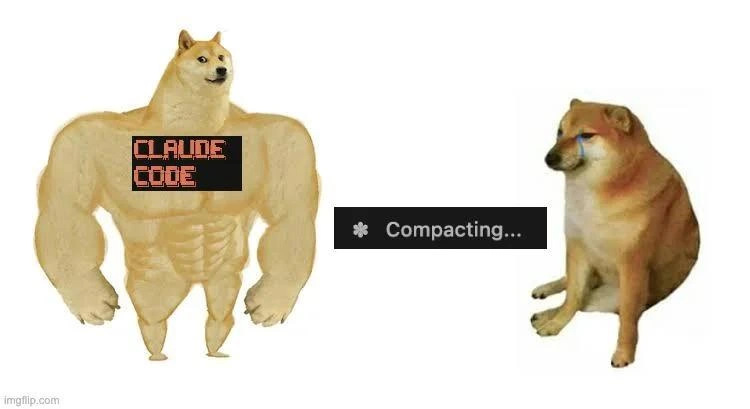
Imagine an amazing helper who's building a LEGO castle with you. For an hour they're brilliant — they remember every piece, every plan, exactly where the drawbridge goes. But their notebook only has so many pages, so when it fills up, they quickly rewrite the whole story onto one page and throw the rest away. They come back smiling... and ask, "So, what were we building?" The two dogs are that helper before and after the notebook ran out: a superhero, and then a sad little dog who means well but lost the plot. It's funny because everyone has worked with someone — or been someone — who was unstoppable right up until they forgot what they were doing.
Level 2: When the Robot Forgets the Plan
The cast, decoded. Claude Code is Anthropic's terminal-based AI coding agent: you type goals in plain English, it reads your codebase, edits files, and runs commands. The context window is its working memory — everything it currently "knows" about your session, measured in tokens (word fragments). Crucially, this memory is not unlimited, and unlike a human it can't selectively remember the important stuff once the limit hits.
Compacting is the housekeeping step shown in the dark status pill: the agent condenses the long conversation into a short summary to free space, the same way you might compress a folder — except this ZIP loses data by design. After it finishes, the agent still works, but you'll notice the symptoms: it asks what you were doing, forgets a decision you made together, or re-reads files it already read. The meme's two dogs are the same tool minutes apart — full-context Claude Code confidently refactoring half your repo, and post-compaction Claude Code wiping away a tear and asking which file we were editing.
The practical lesson juniors learn quickly: treat the agent's memory like RAM, not disk. Put durable decisions in files (a plan document, comments, commit messages) rather than relying on the chat history, because the chat history is exactly what gets thrown overboard. The imgflip watermark in the corner is its own small signal — this was made fast, from a feeling, by someone who had just watched the spinner eat their afternoon.
Level 3: Lossy Compression of a Colleague
The format is Swole Doge vs. Cheems, the canonical before/after of capability collapse. On the left, the buff Doge flexes under a retro-pixel label reading CLAUDE CODE. On the right, a teary Cheems slumps beside a dark terminal pill — asterisk spinner, the single word Compacting... — rendered exactly as it appears in the real CLI. No further caption needed; for anyone who runs Claude Code as a daily driver, that spinner is the punchline.
The mechanic being mourned: every LLM agent operates inside a finite context window — the token budget holding the system prompt, your instructions, file contents, tool outputs, and the whole conversation. A long agentic session devours that budget fast, because coding agents don't just chat; they read files, run commands, and paste back walls of output. When the window nears its ceiling, Claude Code triggers context compaction: it summarizes the conversation so far and replaces the transcript with that summary. The session survives. The details often don't.
And summarization is, irreducibly, lossy compression. The summary preserves what a summarizer deems salient — and the summarizer doesn't know that the load-bearing fact was the third bullet of a plan agreed forty minutes ago, or that you explicitly said don't touch the migration files. Post-compaction, the agent re-reads its own compressed memory of you and resumes with the confidence of the left dog and the recall of the right one: re-asking answered questions, re-exploring explored directories, occasionally re-introducing the exact bug it fixed before lunch. It's the software equivalent of a senior engineer returning from vacation having been replaced by someone who skimmed their handover doc.
The deeper joke is that this isn't a bug anyone can simply fix — it's the central engineering trade-off of agentic AI in 2026. Bigger windows cost more, slow inference, and degrade attention quality over distant tokens; compaction keeps sessions affordable and unbounded at the price of context amnesia. Whole cottage industries of workarounds exist — memory files, scratchpad notes, "re-read the plan after compaction" rituals — all of them developers building external hippocampi for a brilliant goldfish. The meme lands because the failure is behavioral, not catastrophic: nothing crashes, the agent stays polite and articulate, it has simply, quietly, become Cheems.
Description
A 'Swole Doge vs. Cheems' meme format on a white background (imgflip watermark bottom-left). On the left, the muscular buff Doge stands proudly with a black retro-pixel-font label reading 'CLAUDE CODE'. On the right, a small, sad Cheems dog sits slumped with a tear on its cheek, next to a dark terminal-style status pill showing an asterisk spinner and the text 'Compacting...'. The meme captures the experience of using the Claude Code CLI agent: powerful and confident with a full context window, then suddenly weak and lossy once the conversation hits the context limit and triggers context compaction, after which the agent often forgets details of what it was doing
Comments
3Comment deleted
Claude Code after compaction is the new hire on day two: full of confidence, vaguely remembers there was a plan, asks you what file we were editing
А говорили про 1 млн токенов контекстного окна, и хде... Comment deleted
1. Via API (go get your credit card ready) 2. Please, only use English around dev meme 🙏 Comment deleted