Skip to content
DevMeme
7048 of 7435
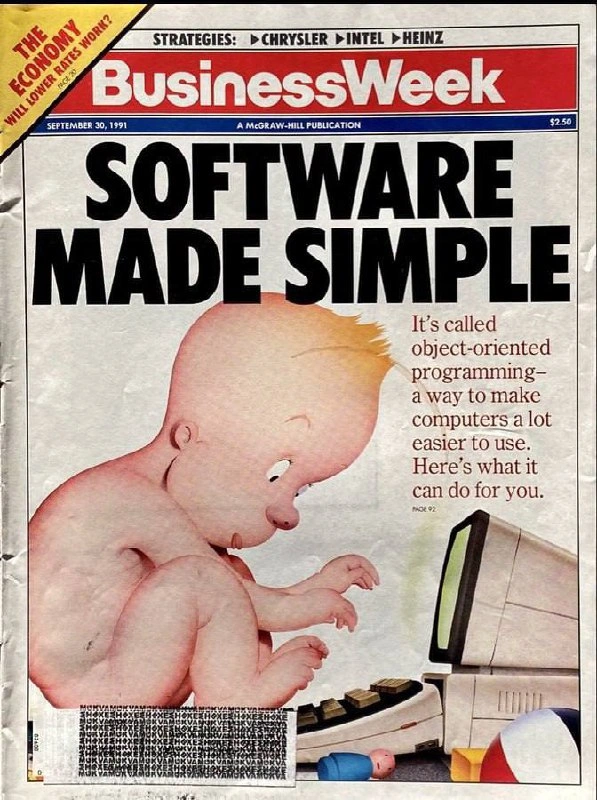
BusinessWeek 1991: Object-Oriented Programming Will Make Software Simple
TechHistory Post #7729, on Feb 19, 2026 in TG

BusinessWeek 1991: Object-Oriented Programming Will Make Software Simple

Why is this TechHistory meme funny?

Level 1: The Magic Toy Box

A famous magazine once put a baby at a computer on its cover and announced, basically: "Great news! There's a new way to build things that's so easy, even this baby can do it!" Grown-ups spent the next thirty years discovering that building things stayed hard — the new way just made different parts hard. It's like promising that a new kind of LEGO will make castles build themselves, and then finding out you now need a thick instruction manual just to open the box. People share this old cover and laugh because every few years someone makes the exact same promise with a new magic word in it — and the castle still doesn't build itself.

Level 2: Objects, Promises, and Page 92

Object-oriented programming is the idea of organizing code into objects — bundles of data plus the functions that operate on that data. A User object holds a name and knows how to authenticate itself; a Button knows how to draw and click. The 1991 promise rested on three pillars you'll meet in any CS course: encapsulation (hide internals behind a clean surface), inheritance (new classes reuse and extend old ones), and polymorphism (code works with any object that speaks the right interface). In theory this yields LEGO-brick software; in practice, as every junior discovers in their first legacy codebase, inheritance trees grow tangled, abstractions leak, and "reusable" components get reused exactly once.

A hype cycle is the recurring pattern where a technology is announced as revolutionary, peaks on magazine covers, crashes into disillusionment, then settles into ordinary usefulness. This cover is a museum-grade specimen from the peak — note that the breathless framing ("a way to make computers a lot easier to use") even blurs writing software with using computers, a conflation only possible before the author has tried either. The CRT monitor and beige keyboard date it as firmly as carbon; the lesson doesn't age at all: when a headline says any paradigm makes software simple, the correct response is to ask which kind of complexity it removes — and where the rest of it went.

Level 3: No Silver Bullet, But a Lovely Cover

The artifact is a creased, yellowed BusinessWeek cover dated September 30, 1991 ($2.50, "A McGraw-Hill Publication"), shouting in block capitals:

SOFTWARE MADE SIMPLE

Beneath it, a cherubic illustrated baby happily paws at a beige CRT-era desktop, beach ball nearby, while the red deck copy promises:

It's called object-oriented programming — a way to make computers a lot easier to use. Here's what it can do for you.

Thirty-five years of hindsight is what turns this from journalism into comedy. The cover captures the exact moment OOP crossed from research idea (Simula's classes, Smalltalk's message passing, Alan Kay's biological vision of computing) into business-press deliverable. The pitch to executives was seductive: software built from reusable "objects," snapped together like parts on an assembly line — so intuitive a literal infant could participate. What the industry actually received over the following decades was C++ multiple-inheritance diamonds, Java's AbstractSingletonProxyFactoryBean school of enterprise architecture, UML modeling committees, and design-pattern catalogs needed just to instantiate things politely. The baby grew up and now maintains a 14-level inheritance hierarchy where the behavior it needs is overridden in level 9 and silently re-overridden in level 12.

The deeper resonance — and the reason this cover keeps recirculating — is that Fred Brooks had already written the rebuttal four years earlier. "No Silver Bullet" (1987) argued that software's essential complexity lives in the problem domain, and no notation or paradigm can abstract it away; tools only shave the accidental complexity. The tech press has run this exact cover ever since with the noun swapped: CASE tools, 4GLs, visual programming, UML round-tripping, low-code, and — in the year this meme recirculated — AI coding agents, the current candidate for "so simple a baby could ship to production." The Telegram poster's sardonic caption ("You gotta be fired very soon, dear, better learn something besides playing with your computer") inverts the cover's optimism into the modern anxiety: the baby was supposed to be empowered by simplicity; instead each simplicity wave gets re-read as a threat to the people who mastered the previous one. Neither reading has ever fully come true — complexity is conserved; it just moves to a different layer and acquires a new conference.

None of which means OOP failed. Encapsulation, interfaces, and polymorphism quietly won and now sit, unremarked, inside nearly everything — including the languages that market themselves as OOP's rejection. That's the standard life cycle of a silver bullet: overpromised, ridiculed, then absorbed as plumbing.

Description

A worn, creased cover of BusinessWeek magazine dated September 30, 1991 ($2.50, 'A McGraw-Hill Publication'). The giant black headline reads 'SOFTWARE MADE SIMPLE' above an illustration of a baby happily typing on a beige desktop computer with a CRT monitor, with a beach ball and toy nearby. Red side text explains: 'It's called object-oriented programming - a way to make computers a lot easier to use. Here's what it can do for you.' A yellow corner banner reads 'THE ECONOMY: WILL LOWER RATES WORK?' and the top strip lists 'STRATEGIES: Chrysler, Intel, Heinz'. Shared today as ironic tech-history: the breathless 1990s promise that OOP would make software so simple a baby could do it, viewed from decades of AbstractFactoryBean inheritance hierarchies later - and rhyming with every subsequent 'X makes software easy' hype cycle
Comments

5
Anonymous ★ Top Pick 1991: OOP will make software simple. 2026: the baby grew up, and so did the AbstractSingletonProxyFactoryBean it has to maintain
  1. Anonymous ★ Top Pick

    1991: OOP will make software simple. 2026: the baby grew up, and so did the AbstractSingletonProxyFactoryBean it has to maintain

  2. @egorvoron 4mo

    son named Horus Heresy

  3. @chupasaurus 4mo

    The only thing that comes to mind when putting OOP and 1991 together is C++😂

    1. @SamsonovAnton 4mo

      c++ && !linux btw

  4. @WhatTheTea 4mo

    > Will lower rates work? 🫩

Use J and K for navigation