Never Touch the Terminals: The Memetically Infectious IEEE1394 Manual
Why is this Hardware meme funny?
Level 1: The Sign That Just Says No
Imagine a sign on a playground slide that says: "Never touch the ladder. Please don't. Cause of falling. This may be the cause." And then a second sign: "It is not possible for two kids to slide at once. It is not possible." You can tell a grown-up wrote it who knew something important but was too tired, or too rushed, to explain it — so it just pleads. It's funny the way a wobbly translation is funny: all the seriousness of a real warning, none of the words in the right order, and somehow the broken version is more memorable than a correct one could ever be. That's why the person sharing it says it "infected" them: once you read "It is not possible. It is not possible," you will say it forever.
Level 2: The Terminals You Must Never Touch
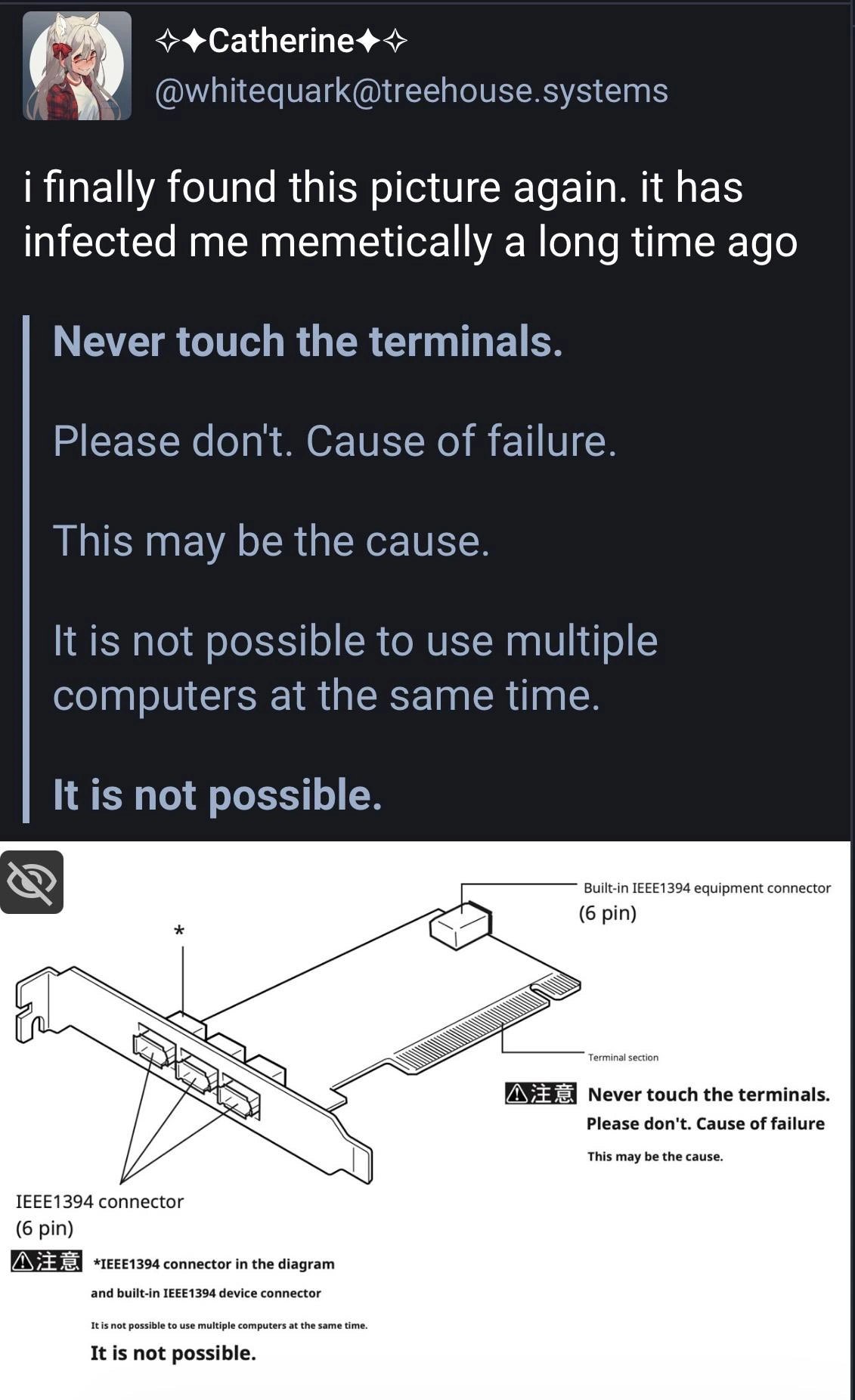
Glossary for the diagram. IEEE1394, marketed as FireWire (Apple) or i.LINK (Sony), was a high-speed serial connection from the late '90s/2000s used for camcorders, external drives, and audio interfaces — largely extinct since USB and Thunderbolt absorbed its niche. The 6-pin connector is its classic plug. The drawing shows a PCI card, the kind you slotted into a desktop motherboard to add ports, and the "terminal section" means the exposed gold edge contacts — touch those with a static-charged finger and you can genuinely kill the card, which is the legitimate engineering fear hiding under "Never touch the terminals. Please don't."
The second warning — "It is not possible to use multiple computers at the same time" — is the manual's way of saying the card connects one host computer to devices; you can't wire two PCs together through it and expect shared control. Reasonable constraint, unforgettable phrasing.
The early-career lesson lurking here: documentation is part of the product. Every developer eventually meets an error message, README, or vendor manual that technically contains the answer but emotionally resembles a hostage note. When you write your own docs — API references, runbooks, commit messages — this page is the cautionary tale: state what fails, why, and what to do instead, or your warning becomes a meme that outlives your product by twenty years. FireWire is gone; "It is not possible" is immortal.
Level 3: Cause of Failure. This May Be the Cause.
The post comes from Catherine (@[email protected]) — a name hardware and compiler people will recognize from the reverse-engineering and open-tooling corners of the fediverse — confessing that a scanned manual page "has infected me memetically a long time ago." The artifact in question: a line-art diagram of a PCI expansion card bristling with IEEE1394 (6 pin) connectors, annotated with two of the most quietly devastating warnings in documentation history:
Never touch the terminals. Please don't. Cause of failure. This may be the cause.
It is not possible to use multiple computers at the same time. It is not possible.
This is a recognizable genre: the Japanese hardware manual passed through a translation pipeline that preserved the register of Japanese technical caution but none of its grammatical connective tissue. The 注意 (chūi, "caution") icons sit beside prose that reads like rejected Beckett. The original Japanese almost certainly said something rigorous — touching the edge contacts risks ESD damage; IEEE1394's peer-to-peer bus does not support two host controllers managing the same device tree — but the translation collapsed cause, effect, and plea into freestanding declarative koans. "Please don't" as a standalone engineering justification. "This may be the cause" — of what? Of failure. Which failure? The one you will cause. The text achieves a perfect circle of blame with zero referents.
The technical irony is what elevates it for the FireWire faithful. IEEE1394 was the sophisticated bus of its era — isochronous transfers for video, peer-to-peer DMA, daisy-chaining 63 devices, the standard Apple bet on against USB. Its DMA capability was so direct that FireWire ports famously became a physical-access attack vector (read arbitrary RAM over a camcorder port). A protocol that powerful, documented in prose this helpless, is the whole tragicomedy of the hardware industry in one page: the gap between the rigor of the silicon and the budget allocated to explaining it. Localization was, and remains, the last line item anyone funds — which is why a connector spec ratified by an IEEE working group reached consumers as "It is not possible."
And the meme does infect. "It is not possible. It is not possible" has the structure of liturgy — assertion, then assertion again, harder. Once read, it becomes the phrase your brain supplies for every unsupported configuration forever after.
Description
A fediverse (Mastodon-style) post by '✦✧Catherine✦✧' (@[email protected]), with an anime-style avatar, saying: 'i finally found this picture again. it has infected me memetically a long time ago', followed by a blockquote: 'Never touch the terminals. Please don't. Cause of failure. This may be the cause. It is not possible to use multiple computers at the same time. It is not possible.' Attached is a line-art hardware manual diagram of a PCI expansion card labeled with 'IEEE1394 connector (6 pin)', 'Built-in IEEE1394 equipment connector (6 pin)', and 'Terminal section', plus Japanese 注意 (caution) warning symbols and the awkwardly translated warnings: 'Never touch the terminals. Please don't. Cause of failure. This may be the cause.' and 'It is not possible to use multiple computers at the same time. It is not possible.' The humor comes from the deadpan, pleading, Engrish-flavored translation in a FireWire card manual reading like absurdist poetry to hardware nerds
Comments
11Comment deleted
Twenty years of documentation tooling later, this FireWire manual still has the clearest error message in the industry: 'It is not possible.' No stack trace, no blame - just acceptance
Why isn't it possible? Why not, you stupid bastard? Comment deleted
What's this, a nothing card? Comment deleted
it is possible Comment deleted
How are we supposed to touch the PCI conductors when the card is inserted into the slot? 🤔 Comment deleted
don't even if it isn't Comment deleted
But I feel the urge! How is it possible to resist and avoid touching something that supposedly should not be touched? Comment deleted
stop feeling Comment deleted
This is how documentation to Rust unsafe keyword should be written Please don't. Cause of failure Comment deleted
yes Comment deleted
0.1G is still unused, gotta do better🥰 Comment deleted