The Senior Engineer's 3-Minute Bug Fix
Why is this Debugging Troubleshooting meme funny?
Level 1: When Mom Finds It
Imagine you spent all day searching for your favorite toy in your room and you just cannot find it. You’re looking and looking, getting more upset because it’s been hours. Then your mom walks in, takes one quick look, and immediately spots the toy sitting right there on the shelf. It’s been in plain sight, but somehow you missed it the whole time! You feel relieved she found it, but also a bit silly for not seeing it. That’s exactly what’s happening in this meme, but with computer code. The young developer was like you searching for the toy (frustrated and tired), and the boss is like the mom who finds the “hidden” thing in an instant. It’s funny in a friendly way – sometimes we just need another person’s eyes to see what we couldn’t see ourselves.
Level 2: Fresh Eyes Advantage
Let’s break down what’s happening in simpler terms. In software, a bug is not a creepy insect but a mistake in the code that causes things to go wrong. Debugging is the process of finding and fixing that mistake. Sounds straightforward, but in practice it can feel like searching for a needle in a haystack (or in a massive codebase). The meme shows a developer who spent all day (literally 12 hours) trying to fix a stubborn bug and getting nowhere. That’s an exhausting experience we call debugging fatigue – when you’ve been at it so long that your brain is frazzled. In the tweet’s words, “I spent all day trying to fix a bug and lost.” We can feel the frustration and defeat in that statement.
Then comes the twist: the developer asks their boss for help and boom, the boss finds the problem in about three minutes. This highlights the fresh_eyes_advantage. When you’ve stared at the same code for too long, you start missing obvious things – your brain filters them out or you assume everything you wrote is correct (even if it isn’t). A new person looking at the code isn’t tied to those assumptions. The boss likely just opened the file and immediately noticed, say, a variable that was never updated, or a simple typo causing the whole failure. It feels almost magical when someone else spots in minutes what you couldn’t see in hours. In reality, it’s because the boss (a senior developer) has a lot of experience debugging similar issues. They might recognize the pattern of the error. For example, maybe the program was giving a weird zero result, and the boss remembers “Ah, last time that happened, it was because we forgot to add something to the total.” Sure enough, that’s exactly it. Experience gives a sort of sixth sense for these things.
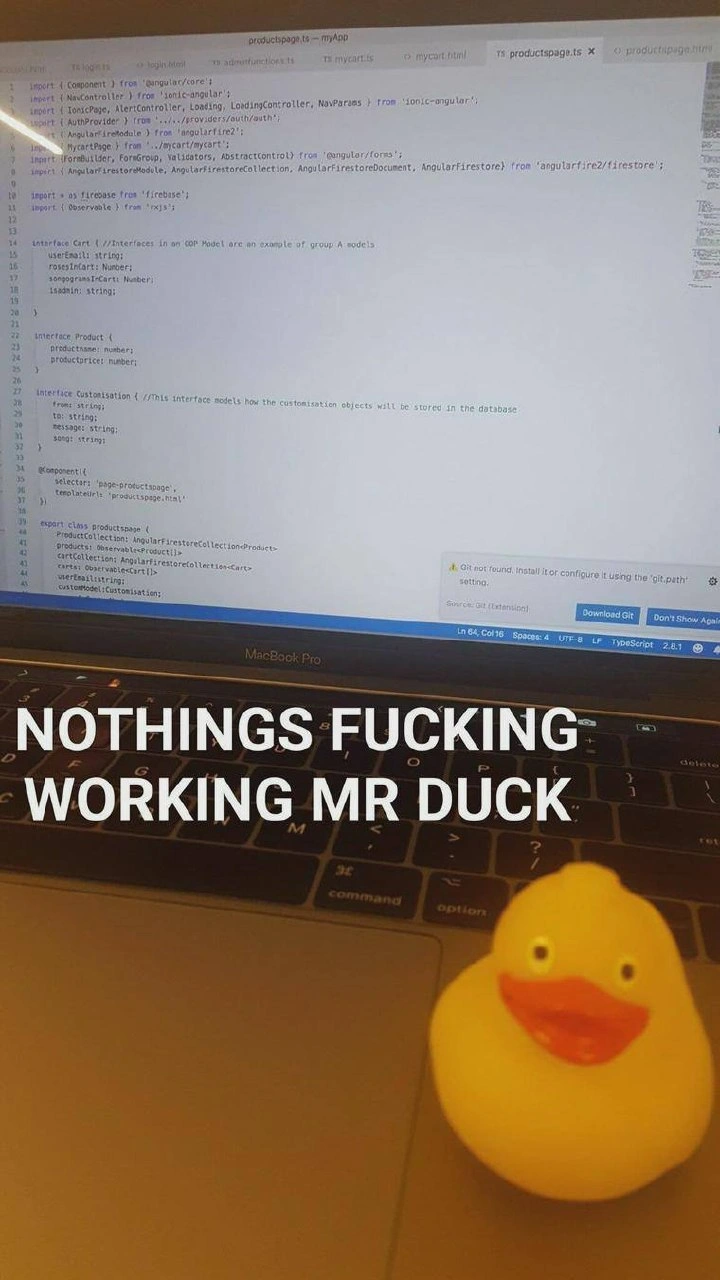
Another concept at play is the rubber duck effect. This comes from a technique called rubber duck debugging where you literally explain your problem to a rubber duck (or any inanimate object) on your desk. The act of explaining forces you to slow down and examine your logic, often revealing the bug. In our case, the boss is basically a human rubber duck with debugging superpowers. By formulating the question to ask for help, the developer has to describe the problem clearly, which might already uncover clues. And if not, the boss listens and then systematically checks each part. Perhaps the developer says, “I know the calculation function is correct, it must be something else,” and the boss’s fresh perspective is to not take that for granted. Lo and behold, the calculation function has a flaw after all! It’s a classic scenario of fresh eyes catching something the original author overlooked.
To illustrate, imagine a simple piece of code with a hidden bug that’s easy to overlook when you’re tired:
# A simple code snippet with a hidden bug:
def calculate_total(prices):
total = 0
for price in prices:
total + price # 🐞 bug: this line does nothing! It's missing an assignment to update 'total'
return total
# After hours of debugging, the developer is stumped...
# Boss takes one look and spots the missing '+=' operator in seconds.
In the code above, our poor developer might have been wondering all day, “Why is total always 0?!” They check complex parts of the system, completely missing that one line in the loop where they wrote total + price instead of total += price. It’s a tiny oversight that a fresh observer (like the boss) catches right away: the code never actually adds the price to the total. This is a trivial example, but it paints the picture. A lot of bugs boil down to small mistakes or wrong assumptions that hide in plain sight.
The time_spent_vs_time_solved contrast here is huge: 12 hours versus 3 minutes. This teaches a valuable lesson for any junior developer (and honestly, for everyone): sometimes taking a step back or getting a second opinion can save you a ton of time. It’s not that the boss is some super-genius who never struggles; it’s that they’ve probably seen something similar before. They also weren’t mentally worn out from fighting the issue all day, so they could approach it calmly and logically. For a new developer, this meme is a reassurance that asking for help is okay. It doesn’t mean you’re bad at your job; even the boss likely had the same situation early in their career. It’s a relatable developer experience: feeling stuck and then amazed when someone else finds the answer immediately. The main take-away is that debugging can be really hard and frustrating when you’re in the thick of it, but a fresh perspective can work wonders. Next time you’re utterly stuck on a bug, remember the fresh eyes advantage – even stepping away for a coffee break or explaining the problem out loud (yes, even to a rubber duck on your desk) might be enough to shake loose the solution.
Level 3: Senior Debugging Sorcery
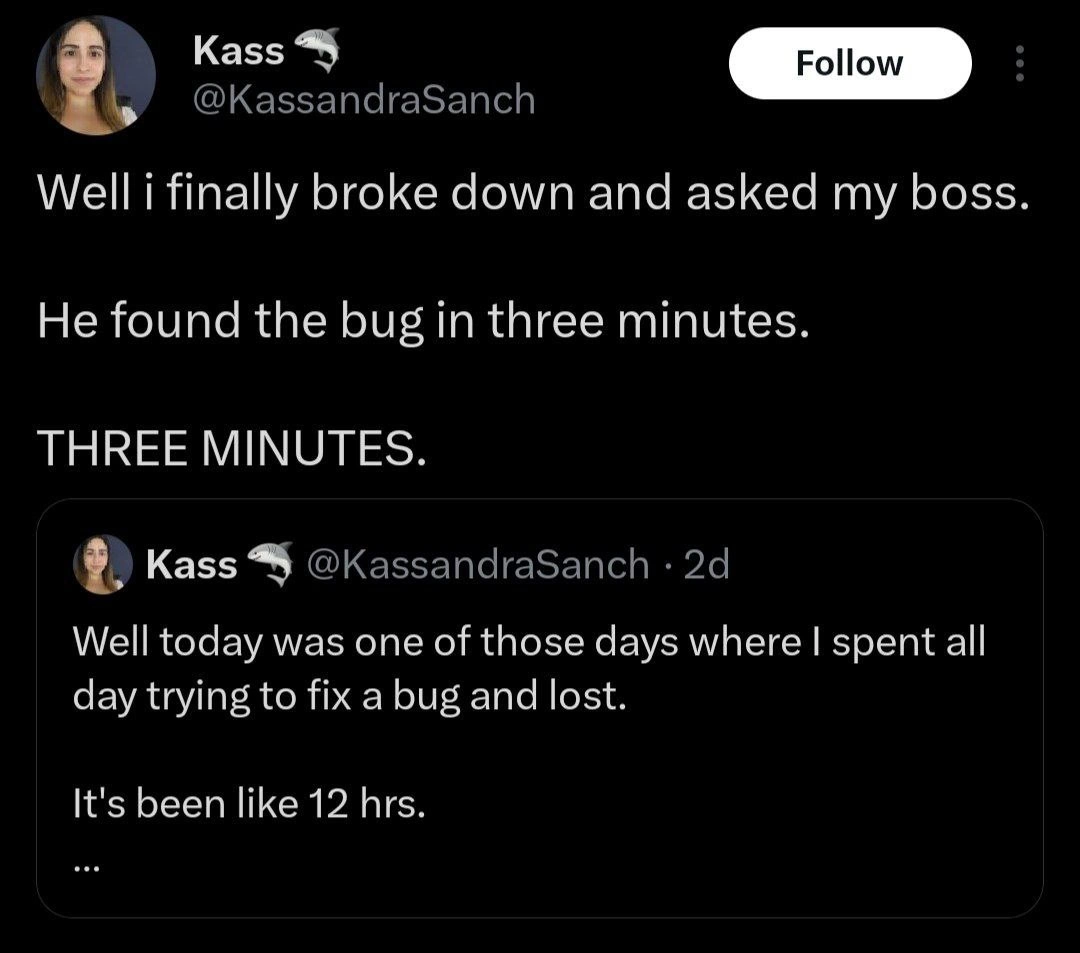
The meme captures that classic debugging nightmare: a developer spends twelve hours chasing an elusive bug, finally caves and asks the boss for help, and the boss tracks it down in mere minutes. This scenario is painfully relatable in the software world. Why is it funny? Because it’s true – any seasoned developer can recall a day lost in frustration (the ultimate DebuggingFrustration), only for a fresh pair of eyes to pinpoint the issue almost instantly. The tweet’s author exasperatedly writes, “He found the bug in three minutes. THREE MINUTES.” That all-caps emphasis nails the mix of astonishment and agony. We laugh because we’ve all been that developer, utterly DebuggingFatigued and convinced the code is haunted, when along comes someone else who spots the obvious mistake we blinded ourselves to.
From a senior engineer’s perspective, this isn’t magic but hard-earned intuition. The boss likely has a mental catalogue of common pitfalls and a senior eye for bugs – a kind of pattern recognition superpower. After years of bug-hunting, certain telltale signs just pop out. Maybe the app was crashing on launch and the boss immediately asks, “Did you check the configuration file for a typo?” Sure enough – one misplaced character and that’s the culprit. Or perhaps the junior dev was tunneling into complex logic, while the boss glances at a log message and recognizes the signature of a known off-by-one error. This almost mystical ability can feel like debugging sorcery to less experienced devs. In reality, it’s the Fresh Eyes Advantage coupled with experience: the boss isn’t burdened by the same assumptions and exhaustion, so they can methodically eliminate possibilities without bias. It’s the rubber-duck effect with a brain – explaining the problem or bringing in another person forces you out of your headspace and often reveals what was there all along.
Crucially, the humor also comes from the humbling reality behind the joke. It highlights the gap in DeveloperExperience_DX between a stuck developer and a mentor who’s seen this movie before. There’s an unspoken truth: spending more time on a bug doesn’t always mean you’ll find it – in fact, time_spent_vs_time_solved can be wildly disproportional. After 12 hours of staring at the screen, you develop cognitive blind spots (you literally stop seeing certain code paths or assume “it can’t be that line”). A fresh brain walks in and checks those very blind spots first. It’s a gentle reminder of the value of teamwork and that asking for help isn’t defeat – it’s often the quickest path to a solution. Yet every developer knows the pride vs. pragmatism struggle: you don’t want to bother the senior dev or admit you’re stuck, until eventually you do, and they solve it in a flash, leaving you equal parts grateful and facepalming. The DeveloperHumor here is half laughing at the absurdity and half nervous-laughter because we’ve been there. It’s the kind of relatable embarrassment that unites devs across teams and years. In those THREE MINUTES, the boss not only fixed the bug but delivered a memorable lesson: sometimes you need a second set of eyes (or a rubber duck) to light up that dark, nettlesome corner of your code. The meme nails this JuniorVsSenior dynamic perfectly – it’s funny because it’s true, and maybe a little therapeutic to know it happens to everyone in the craft.
Description
A screenshot of a Twitter thread from a user named Kass (@KassandraSanch). The original tweet, posted 2 days prior, expresses frustration: 'Well today was one of those days where I spent all day trying to fix a bug and lost. It's been like 12 hrs. ...'. The follow-up tweet above it provides a resolution: 'Well i finally broke down and asked my boss. He found the bug in three minutes. THREE MINUTES.'. The meme captures a universally relatable developer experience: the agony of being stuck on a problem for an extended period, only for a more experienced colleague to solve it almost instantly. This scenario highlights the value of experience, the importance of asking for help, and the humbling nature of software development. It resonates with developers who have felt both the pain of being stuck and the amazement at how quickly a senior can cut through the noise

Comments
7Comment deleted
A senior dev's '3-minute fix' is just the amortization of 10,000 hours of previous suffering. You're not paying for the three minutes; you're paying for the pattern-matching engine built on a decade of cryptic bugs
Fresh senior eyes are basically `diff -u` against your cognitive cache - they skip the 12-hour execution trace and jump straight to the missing semicolon
The difference between debugging for 12 hours and your boss finding it in 3 minutes is that they've already made that exact mistake in production twice
The classic 'rubber duck debugging' paradox: spend 12 hours talking to yourself, or 3 minutes talking to someone who's seen this exact race condition in production at 3 AM. The real bug was the friends we didn't ask along the way - turns out that senior architect's pattern recognition from debugging similar issues across three different codebases and two database migrations is worth more than your entire git blame history
The observer effect strikes again: bugs persist in superposition until a colleague collapses the waveform to a missing null check
Your boss didn’t debug in three minutes - he hit a cache of decade-old incident patterns, turning your O(n) log search into an O(1) lookup
I brute‑forced for 12 hours; my boss did an O(1) lookup in the “seen‑this‑before” cache and returned the offending line