Skip to content
DevMeme
3294 of 7435
Cicero's Unplanned Legacy: From Roman Statesman to Placeholder Text
WebDev Post #3618, on Aug 30, 2021 in TG

Cicero's Unplanned Legacy: From Roman Statesman to Placeholder Text

Why is this WebDev meme funny?

Level 1: Candy Over Cures

Imagine a doctor who a long time ago cured a lot of sick people and did really important work. But today, all the kids in town know him as “the nice man who gives out lollipops after a check-up.” The doctor is jokingly happier about being famous for handing out candy than for saving lives. Silly, right? In reality, curing people is much more important than giving candy. But from the kids’ point of view, candy is the coolest thing ever!

This meme is like that. A very famous man from ancient times (Cicero) did great, serious things (like leading and speaking in Rome), but people making websites today mostly remember him for something small and funny: some gibberish words he wrote that we now use to fill in empty space on webpages. The picture joke shows him saying “no” to being remembered as a great leader, and “yes” to being the lorem ipsum text guy. It’s funny because it’s so absurd – of course a real hero wouldn’t prefer being known for something trivial like dummy text or candy. But pretending he would makes us laugh, because it flips things upside down. It reminds us that what’s important can seem different depending on who you ask. To web designers, that goofy filler text is super useful (and a little legendary), so the meme imagines Cicero being proud of that in a playful way.

Level 2: Dummy Text 101

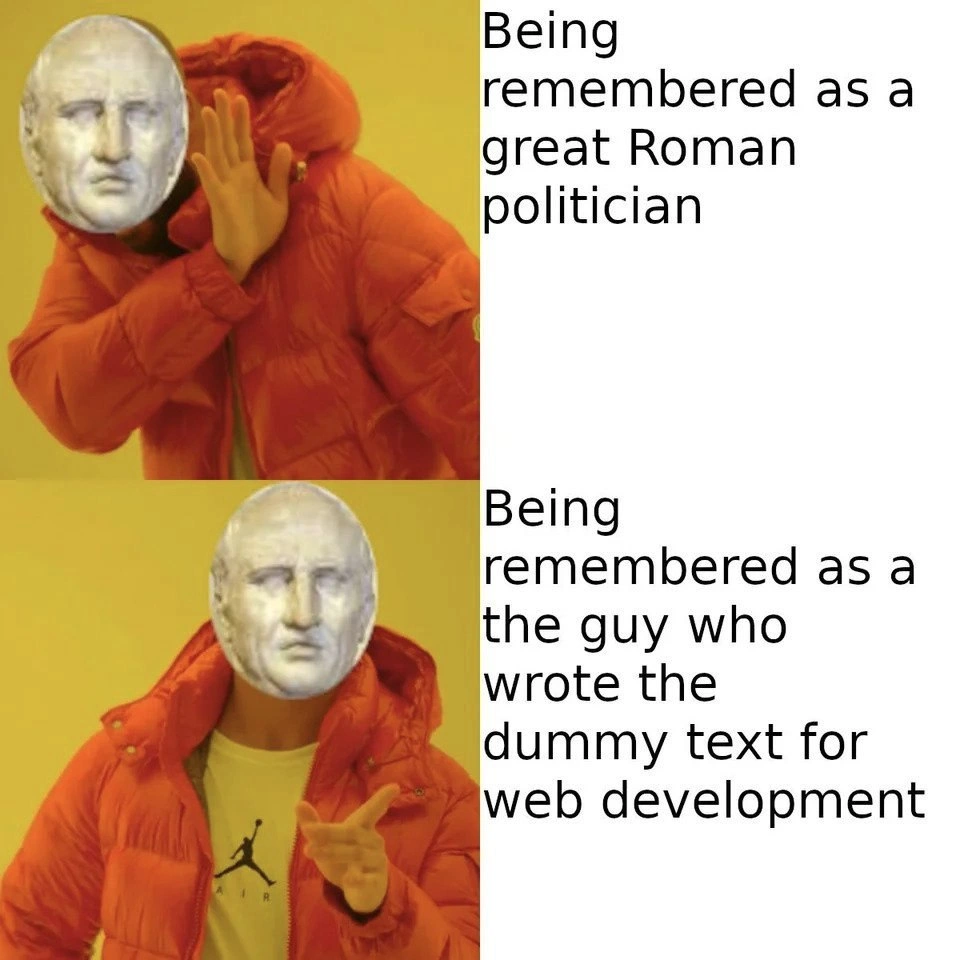
Let’s break down this meme and its references in simpler terms. The meme uses the popular Drake Hotline Bling format – an image of the musician Drake making a disgusted face in the top picture and a happy face in the bottom picture – to show a preference between two captions. In this version, the creator pasted an image of an ancient Roman bust (a sculpture head of Cicero) over Drake’s face. This is a visual clue that the “character” in the meme is Marcus Tullius Cicero, a real person from Roman history. Cicero was a famous Roman politician and speaker who lived over 2,000 years ago, known for his great speeches and writings. The meme’s text contrasts two ways Cicero could be remembered:

  • Option 1 (Top panel): “Being remembered as a great Roman politician.” – That’s what Cicero actually was in history (a great politician/orator). In the top image, “Drake-Cicero” is making the “no thanks” gesture, meaning he’s supposedly NOT interested in that.
  • Option 2 (Bottom panel): “Being remembered as the guy who wrote the dummy text for web development.” – This refers to Cicero’s writing being used as lorem_ipsum text (the filler text web developers use). In the bottom image, “Drake-Cicero” is pointing cheerfully like “Yes, that’s the one!”

The joke is that Cicero should want to be famous for his real achievements (governing Rome, inspiring people with speeches), but here he’s depicted as preferring to be famous for something very silly and modern: being the author of the “Lorem Ipsum” dummy text that web developers use when building websites. “Lorem Ipsum” is a snippet of Latin text that starts with those words lorem ipsum. It’s basically placeholder text – a block of writing that doesn’t actually mean much of anything – used in web pages, designs, or documents as stand-in content. Developers and designers use placeholder text to see what a page or app would look like with text on it, without needing real content. It’s like filling a template with gibberish just to check the layout. You might have seen web templates or WordPress themes where the text is just “Lorem ipsum dolor sit amet…” repeated over and over – that’s dummy text.

Why Latin? The idea is that Lorem Ipsum looks like natural text with normal word lengths and letter frequency, but since most people don’t understand Latin, they won’t get distracted by reading it. They’ll focus on the design instead. It’s been a tradition in printing and design for a long time. In fact, the placeholder_text “Lorem ipsum” actually comes from real Latin that Cicero wrote a long time ago (from a piece of writing about philosophy). Long after Cicero died, printers in the 1500s started using a scrambled portion of his work as filler text. This practice stuck around. Fast forward to today’s WebDevelopment and we’re still copying and pasting Cicero’s Latin words as dummy content! Most developers have done this at least once when making a website layout. It’s a little piece of TechHistory living on in everyday coding.

So, the meme is funny to people in coding and web design because it’s so true: we often remember or care about Cicero not from history class, but from that nonsense text we see in our code editors. It’s a bit of FrontendHumor that assumes you know both who Cicero is (or was) and what Lorem Ipsum is. It’s “relatable humor” for anyone who has ever built a webpage and needed some filler text. Imagine you’re a new front-end developer learning to make your first website. Your instructor might say, “Just use Lorem Ipsum text in the paragraphs for now.” You’d Google “Lorem ipsum” and find this long paragraph of weird words to paste in. Every front-end dev quickly recognizes that jumble of Latin. It practically screams “this is placeholder text.” There are even online dummy_text generators and text editor plugins that will output a chunk of Lorem Ipsum for you automatically. It’s become a running in-joke among developers – we see those same Latin words so often that they’re like an old buddy in our code.

To illustrate, here’s how a developer might use Lorem Ipsum in a simple webpage:

<!DOCTYPE html>
<html>
<head>
  <meta charset="UTF-8" />
  <title>Mockup Page</title>
</head>
<body>
  <h1>My Website Title</h1>
  <p>
    Lorem ipsum dolor sit amet, consectetur adipiscing elit, sed do eiusmod tempor incididunt ut labore et dolore magna aliqua.
  </p>
  <!-- Using Cicero's Lorem Ipsum as placeholder content -->
</body>
</html>

In the HTML code above, the <p> paragraph contains that Lorem Ipsum text as placeholder content. This is exactly what designers/developers do when the real text isn’t ready yet – they fill it with Cicero’s dummy text just to see how the page will look with some words in place.

Now, think about Cicero. He lived in ancient Rome, gave powerful speeches in the Senate, and wrote important books. But web developers (who spend their days in code editors and browsers) mostly come across his words in this jumbled Latin form while designing pages. So the meme imagines Cicero jokingly saying: “Yes, forget my career in Roman politics; I’d rather be known for providing lorem ipsum for web development!” Of course, in reality Cicero didn’t intend to write dummy text for websites – there were no websites in 45 BC! That’s what makes it historical_reference_humor. It’s the funny idea that a serious historical figure would value modern tech notoriety (being a meme and design-tool legend) over genuine historical fame. For a junior developer or someone newer to coding, the takeaway is:

  • Cicero = famous old Roman guy who unknowingly wrote the text that designers use as filler.
  • Lorem Ipsum = filler text used in coding and design, taken from Cicero’s writing.
  • Drake meme format = a way to show someone’s preference by using Drake’s “No/Yes” reactions (here used with Cicero’s face for a comedic twist).

The meme is a lighthearted nod to the fact that in web development, we sometimes reference all sorts of things (even ancient Latin!) in our work without even thinking about it. And it humorously suggests even Cicero would be proud of his odd connection to modern WebDevelopmentHistory.

Level 3: From Senate to Sample Text

This meme is a tongue-in-cheek collision of ancient Rome and web development culture. It’s a prime example of developer humor that blends TechHistory with everyday FrontendHumor. The format is the familiar Drake meme template: Drake (in an orange jacket on a yellow background) usually rejects something in the top frame and approves something in the bottom frame. Here, however, Drake’s face is replaced by a marble bust of Marcus Tullius Cicero – the famed Roman orator and Roman politician – creating a clever cicero_reference gag. In the top panel, Cicero-Drake is rejecting the caption “Being remembered as a great Roman politician.” In the bottom panel, he’s enthusiastically approving “Being remembered as the guy who wrote the dummy text for web development.” (Side note: the meme text has a tiny typo “as a the guy,” perhaps a fitting slip since no one actually reads Lorem Ipsum closely.) The humor comes from the absurd contrast: a towering historical figure appears to prefer internet placeholder_text fame over real political accomplishments.

For modern front-end developers, this joke is instantly relatable. Why? Because Lorem Ipsum dummy text is everywhere in WebDev. Practically every web designer or front-end dev has filled a layout with “Lorem ipsum dolor sit amet…” at some point. It’s the go-to placeholder text when the real content isn’t ready. In coding communities, Cicero is jokingly more famous as the “Lorem Ipsum guy” than as a hero of the Roman Republic. The meme exaggerates this idea for comic effect: Cicero (one of history’s greatest communicators) giving a smug thumbs-up to the notion of being the dummy_text author for web pages, while shrugging off his actual legacy as a statesman. This flips our expectations – ordinarily, being a renowned politician and philosopher is a far greater accomplishment than writing filler text. But in the context of DeveloperHumor, the everyday Frontend experience values that filler text so much that it eclipses the grand legacy. It’s poking fun at our industry’s priorities: we lionize tools and snippets that make our developer lives easier (even if they’re 2,000-year-old Latin gibberish) just as much as, or more than, loftier achievements outside tech. It’s the kind of historical_reference_humor that makes those in the know smirk and say, “It’s funny because it’s true – in web development, even Cicero’s legacy gets boiled down to Lorem Ipsum.”

There’s also a rich historical irony under the hood. The block of pseudo-Latin known as Lorem ipsum isn’t just random text – it actually derives from Cicero’s writing! The placeholder paragraph that begins “Lorem ipsum dolor sit amet…” is a scrambled excerpt from Cicero’s 1st-century BC work De Finibus Bonorum et Malorum (“On the Ends of Good and Evil”). Through a quirk of history, a typesetter in the 1500s took Cicero’s Latin prose and jumbled it to create a generic sample text. Using Latin filler text for printing layouts was a common practice in the printing era (often called “greeking” the text – using a foreign or nonsense text to simulate real content). It helped printers and later graphic designers focus on layout and typography without the distraction of meaningful words. The Latin looked real enough to resemble typical body text with a natural distribution of letters, but readers wouldn’t get sucked into actually reading it. Over the centuries, Lorem Ipsum became the de facto standard dummy text in design. It’s a quirky piece of WebDevelopmentHistory: a chunk of Cicero’s 2,000-year-old Latin survived by evolving into filler text for mockups. Talk about an unexpected legacy! Cicero’s words about ethics and pain were repurposed to painlessly test page layouts. O tempora, o mores! – “Oh, the times, oh, the customs!” – one can imagine Cicero exclaiming at the idea that his serious prose turned into designer dummy text.

Fast forward to the digital age, and Lorem Ipsum is now ubiquitous in web design and front-end development. Need to design a magazine layout or a website before the articles are written? Just drop in Lorem Ipsum paragraphs. Every front-end developer recognizes it; it’s practically the “Hello, World!” of web design. Many frameworks and editors even have Lorem Ipsum generator functions (for example, VS Code has lorem ipsum snippets, and design tools like Figma or Photoshop can auto-fill placeholder text). This makes the meme especially RelatableHumor for anyone in WebDevelopment – we’ve all seen those filler Latin blocks so often that we’re sometimes more familiar with “dolor sit amet, consectetur adipiscing elit…” than with Cicero’s role in Roman history. The meme cheekily implies that Cicero’s most widely experienced “contribution” in modern times is not his philosophical ideas or political deeds, but this nonsensical Latin blurb that appears in millions of webpages and templates. In other words, his TechHistory claim-to-fame is being an involuntary lorem ipsum content creator!

To highlight the contrast, here’s Cicero’s legacy in two worlds:

Cicero’s Real Legacy (History) Cicero’s Meme Legacy (WebDev)
Renowned Roman orator, statesman, and philosopher of the 1st century BC. Unwitting author of the ubiquitous “Lorem Ipsum” placeholder text.
Wrote influential works and speeches studied for millennia in politics and rhetoric. His Latin prose is used as filler text in countless website templates and app UIs.
Remembered for shaping language, law, and philosophy in Western history. Remembered on the internet for filling mockup blog posts and design dashboards with dummy content.

In essence, the meme humorously asks: What if Cicero himself cared about what today’s coders care about? It’s as if he’s saying, “Who needs the Roman Senate? My real glory is having my words in every Frontend developer’s toolbox!” The absurdity of a venerable historical figure craving credit for something as trivial as dummy text is what makes it funny. It’s a sly nod to how perspectives change over time: a serious contribution in one era becomes a running gag in another. Cicero’s name might appear in history books for his eloquence, but in a coder’s world, he’s a legend for accidentally providing the lorem ipsum text we all copy-paste. The meme capitalizes on that inside joke. It’s both CodingHumor and a mini history lesson – a reminder that even a fragment of classical literature has managed to infiltrate modern coding and design in the quirkiest way. And truth be told, if Cicero could see how widespread his dummy text has become, he might just smile and think, “At least they’re still reading something I wrote, even if they don’t know it.”

Description

This meme uses the popular two-panel 'Drake' format to comment on historical irony in the tech world. In both panels, the head of the rapper Drake is replaced with a Roman bust of Cicero. The top panel shows Cicero with a look of disdain, rejecting the text beside it: 'Being remembered as a great Roman politician.' The bottom panel shows Cicero with a look of approval, pointing towards the text: 'Being remembered as a the guy who wrote the dummy text for web development.' The joke centers on Marcus Tullius Cicero, whose 1st-century BC Latin text, 'De finibus bonorum et malorum,' is the source of the famous 'Lorem Ipsum' placeholder text used universally in web development, design, and publishing. The humor lies in the profound irony that a celebrated orator and politician's most enduring legacy in the modern digital age is a scrambled version of his philosophical work, used as meaningless filler. For developers and designers, it's a nod to one of the most ubiquitous yet rarely questioned artifacts of their trade

Comments

16
Anonymous ★ Top Pick Cicero spent his life debating the highest good, only to have his work become the default seed data for a million half-finished staging environments. It's the ultimate null-terminated string to a great career
  1. Anonymous ★ Top Pick

    Cicero spent his life debating the highest good, only to have his work become the default seed data for a million half-finished staging environments. It's the ultimate null-terminated string to a great career

  2. Anonymous

    Cicero spent decades saving the Republic, but the only artifact that survived CI/CD is lorem-ipsum.txt - proof that in software, seed data outlives empires

  3. Anonymous

    After 20 years in tech, I've realized Cicero has more commits to production websites than most developers - his Lorem Ipsum has shipped in more MVPs than actual features ever have

  4. Anonymous

    Cicero spent decades mastering rhetoric and philosophy to influence the Roman Republic, only to achieve immortality in tech by having his prose butchered into 'Lorem ipsum dolor sit amet' - proving that in software, your greatest legacy might be the thing you never intended. Every frontend developer has shipped his words to production more times than they've read the actual De Finibus, making him arguably the most deployed author in history, albeit completely out of context and semantically meaningless

  5. Anonymous

    We built a headless CMS, i18n, and an approval workflow - then shipped to prod with Cicero-as-a-Service because “we’ll swap the lorem next sprint.”

  6. Anonymous

    Cicero: the most deployed copywriter in web history - Lorem Ipsum v1.0, backward-compatible with every redesign and more reliable than our CMS

  7. Anonymous

    Cicero's prose: the ancient monolith codebase devs paste into every prototype, accruing zero deps but infinite tech debt

  8. Deleted Account 4y

    Is there anyone who can explain?

    1. @saidov 4y

      Loren Ipsum excerpt is taken from his papers

      1. Deleted Account 4y

        Thanks.

  9. @GTRst 4y

    Cicero

  10. Deleted Account 4y

    I don't even know his name

    1. @kitbot256 4y

      And this is not something to be proud of. I am not urging you to read all his works cover to covers, but this is definitely one name to know.

      1. @RiedleroD 4y

        wasn't he called cicero or somthing like that?

        1. @kitbot256 4y

          https://en.wikipedia.org/wiki/Cicero

          1. @RiedleroD 4y

            I knew it

Use J and K for navigation