Skip to content
DevMeme
3295 of 7435
The Art of Reclassification: It's Not a Bug, It's a Feature
Bugs Post #3619, on Aug 30, 2021 in TG

The Art of Reclassification: It's Not a Bug, It's a Feature

Why is this Bugs meme funny?

Level 1: I Meant to Do That

Imagine you ask your friend for a peanut butter and jelly sandwich. They give you a sandwich with just peanut butter — no jelly at all. You point out that they forgot the jelly, so the sandwich isn’t right. But your friend smiles and says, “No, I didn’t forget. I’m just saving the jelly for next time as a special extra!” They’re pretending they meant to make it that way. It’s like they’re trying to say the sandwich isn’t wrong or broken, it’s just not finished yet. This is funny because instead of admitting they made a mistake, they cleverly call the missing jelly a planned “feature” of the sandwich. It’s that same cheeky feeling when someone insists, “It’s not broken — I intended it to be like that!”

Level 2: Bug or Feature?

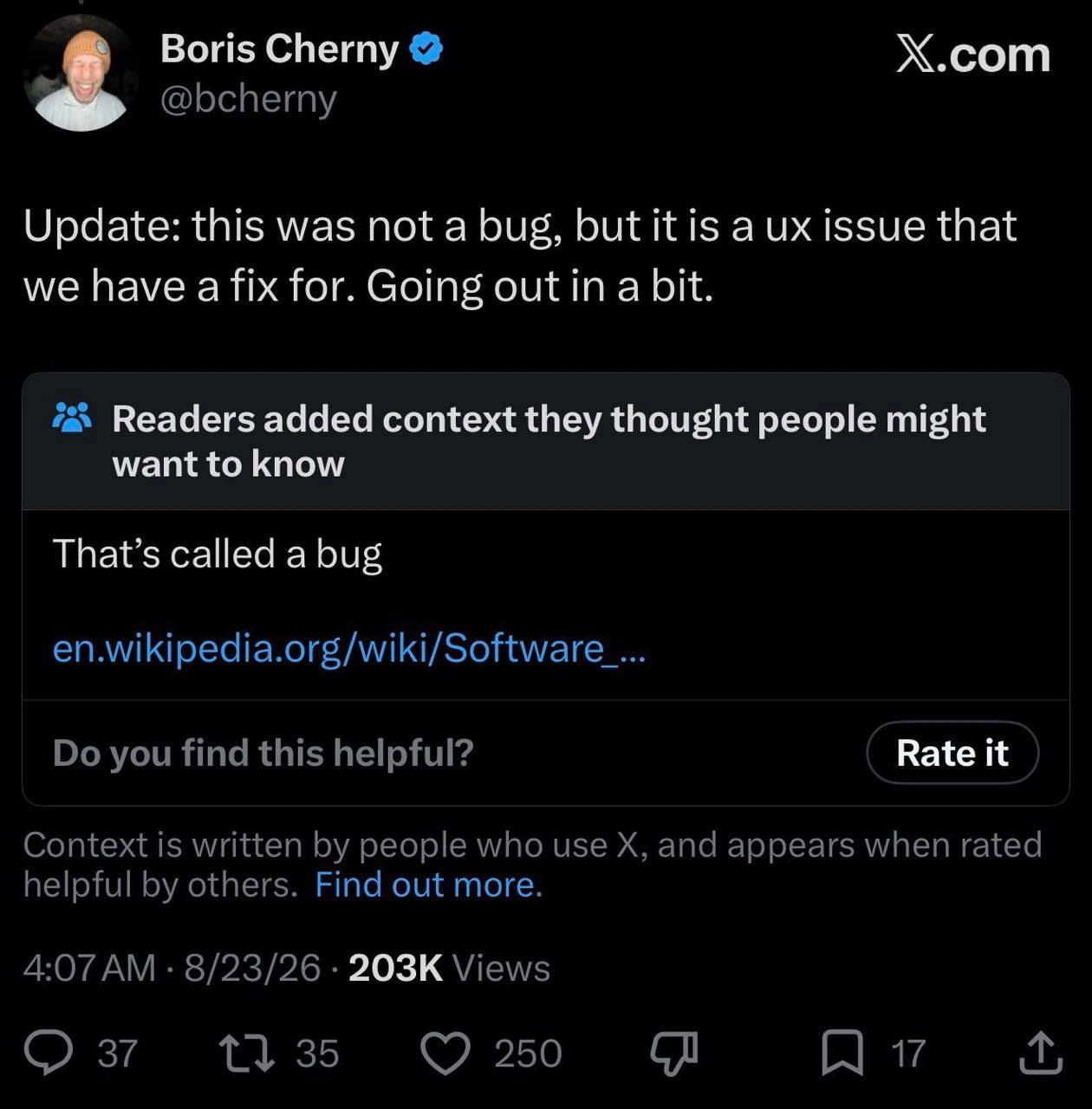
In this meme, we see a GitHub issue timeline screenshot. GitHub is a popular platform where developers collaborate on code and track issues (like bugs, tasks, or feature requests). Each issue can have labels — little colored tags that categorize the type of issue. For example, a bug label (often shown in red) means something in the software isn’t working correctly. There are also labels like enhancement or feature request (usually green) which mean the issue is about adding something new rather than fixing something broken.

The screenshot shows that someone removed the bug label from an issue. Right below that, a comment says: “It wasn’t a bug. It was a missing feature.” This means the person is claiming the issue isn’t an error in the code, but rather a request for new functionality. In other words, they’re saying nothing is actually broken; the software just didn’t have that capability yet.

Whether something is labeled a bug or a feature often depends on expectations. Ask yourself: was the program supposed to do this thing in the first place? If yes and it’s not doing it, then it’s a bug (the software isn’t doing what it was meant to do). If no (the program was never intended to do that until someone asked), then it’s a missing feature (the software isn’t faulty, it just lacks a new capability). To make it clearer, here’s a simple comparison:

Bug (Defect) 🐛 Missing Feature (Enhancement) 🌟
Something is broken or not working as intended. Something is not there (absent), but someone wishes it existed.
Implies a mistake: the code isn’t doing what it should. Implies an omission: the feature wasn’t built into the code yet.
Needs a fix to correct the current behavior. Could be planned as a new addition in a future update.
Example: A login button is supposed to log you in, but clicking it does nothing. (That's a bug – it’s not doing what it should.) Example: The app has no “Forgot Password” option at all, and users want one. (That's a missing feature – the app isn’t broken, it just never had that feature.)

In our GitHub issue, it was initially marked as a bug, meaning the team thought something was wrong that needed fixing. By removing the bug label and calling it a missing feature, the teammate is basically reclassifying the problem from an error to an enhancement request. It’s a somewhat cheeky way to avoid blame: they’re implying the app isn’t broken, it just doesn’t have this feature yet.

Developers often joke with the phrase “It’s not a bug, it’s a feature” when playing off a mistake as if it were intentional. Here, the meme shows that idea literally in action. The teammate quietly changed the label and said it’s a missing feature – as if to say “See? No mistake here, just a new feature to add!” The humor comes from how changing just a label and a few words can completely change how an issue is perceived. It turns “Oops, the software failed to do something” into “Hey, wouldn’t it be nice if the software did this someday?” For someone new to development, it’s a funny example of how teams might spin a problem in a positive way.

Level 3: Label Alchemy

Seasoned developers will smirk at this scenario because it’s a textbook case of issue-tracking semantics used for blame evasion. In the screenshot, a teammate performs some label alchemy: transmuting a dreaded bug label into a harmless missing feature label with a quick GitHub edit. It’s basically the old “not a bug, it’s a feature” excuse, repackaged for the GitHub era. Every experienced dev has witnessed this kind of sleight-of-hand in the wild, which is why the meme lands as classic developer humor.

GitHub doesn’t lie: the issue timeline openly logs that someone “removed the bug label.” That’s like trying to sweep dirt under the rug while leaving a big lump — everyone can see the attempted cover-up. The teammate then doubles down with a comment: “It wasn’t a bug. It was a missing feature.” To anyone who’s been through bug triage, that line practically screams “let’s not call this my fault.” It’s a subtle missing feature excuse that really means: “We didn’t mess up – the product just hasn’t gotten around to this idea yet.” Quietly reclassifying the problem shifts the story: an apparent defect suddenly becomes an unimplemented enhancement.

From a Project Management angle, this kind of label management has tactical perks. A bug label implies something is broken (developer error) and might trigger urgent fixes and awkward conversations. But re-label it as a feature request, and it transforms into a future improvement – a nice-to-have rather than a mistake. Teams sometimes play this BugVsFeature game to keep bug counts low and morale high. Fewer “bugs” on the tracker makes the release look stabler on paper. It’s essentially moving the goalposts: if an issue threatens to derail your perfect sprint, just redefine the problem and poof – no more showstopper.

As absurd as this semantic judo might sound to outsiders, it’s exactly the sort of issue triage humor developers bond over. We’ve all sat through meetings where an obvious flaw gets reframed as “working as intended” or tagged a “future enhancement” to dodge accountability. In terms of team communication, just a few words can shift responsibility. One moment, it’s a bug the dev introduced (oops); the next, it’s framed as a missing feature (hey, no mistake — we just didn’t build that yet). This meme nails that shared experience: sometimes it’s easier to change the label on a problem than to change the code. And if you do it quietly enough, maybe—just maybe—no one will notice the difference (spoiler: they always notice).

Description

This image is a screenshot of an issue tracking system, likely GitHub or a similar platform, showing a classic developer joke in action. The first line indicates a user, whose avatar is an alien emoji, has 'removed the bug label'. Immediately following this action, the same user comments, 'It wasn't a bug. It was a missing feature.' The name of the user is redacted with a blue scribble. The humor lies in the subtle but significant re-framing of a software problem. This is a universally recognized trope in the software industry where a developer, product manager, or company reclassifies an unintended, often negative, behavior (a bug) as a desired, albeit unimplemented, functionality (a feature). For senior developers, this is a cynical nod to the politics of software development: reclassifying a bug can de-escalate its urgency, shift blame, manage client expectations, or avoid admitting a mistake. It's a humorous commentary on scope creep, requirement ambiguity, and the corporate doublespeak that often surrounds development processes
Comments

13
Anonymous ★ Top Pick We have a special workflow for these. When a QA engineer files a bug, and a developer re-labels it as a feature, our CI/CD pipeline automatically moves the ticket to the marketing backlog
  1. Anonymous ★ Top Pick

    We have a special workflow for these. When a QA engineer files a bug, and a developer re-labels it as a feature, our CI/CD pipeline automatically moves the ticket to the marketing backlog

  2. Anonymous

    Nothing juices sprint velocity like re-labeling a sev-1 prod bug as a “Phase-2 enhancement” - it’s basically technical debt laundering

  3. Anonymous

    After 20 years in tech, I've learned that 'missing feature' is just what we call bugs when the PM is watching, and 'technical debt' is what we call them when asking for refactoring time

  4. Anonymous

    Ah yes, the ancient art of issue reclassification - where 'bug' becomes 'missing feature' faster than you can say 'works as designed.' It's not a memory leak, it's aggressive caching. It's not crashing, it's an unplanned rapid disassembly. Senior engineers know this dance well: the PM calls it critical, the architect calls it technical debt, and the developer who wrote it three years ago is conveniently on vacation. The real skill isn't fixing the code - it's mastering the taxonomy of blame avoidance in your issue tracker

  5. Anonymous

    In metric-driven development, the fastest fix for a Sev-1 is a label change - instant OKR green with a zero-line diff

  6. Anonymous

    Refactoring the ticket label: zero code changes, but velocity metrics just tripled

  7. Anonymous

    Our most scalable fix this quarter was renaming “bug” to “missing feature” - defect rate plummeted, the roadmap ballooned, and the only thing we truly repaired was the KPI dashboard

  8. @tarasssssssssssssss 4y

    Lol 🤣

  9. Ievgen 4y

    If the feature is on roadmap but not delivered yet, then this approach is ok

  10. @SamsonovAnton 4y

    Nope: "It does not work". Yeah: "It is missing operational status".

  11. @sylfn 4y

    But we don't

    1. @RiedleroD 4y

      how tf are you always online omg

      1. @sylfn 4y

        i'm not

Use J and K for navigation