Chromium browsers lose adblockers: kids blissfully unaware in classroom meme
Why is this WebDev meme funny?
Level 1: If They Only Knew
Imagine a classroom full of kids who love watching their favorite cartoons. These kids have a special remote that can skip all the commercials, so they get to enjoy their shows without any ad breaks. It’s great – no interruptions for snack ads or toy commercials, just the cartoon from start to finish. Now, picture a man outside the classroom window putting up a big sign that says: “Soon, all new TVs will remove the skip-commercial button.” The company that makes the TVs claims this will make the TV perform better, but what it really means is the kids won’t be able to skip ads anymore.
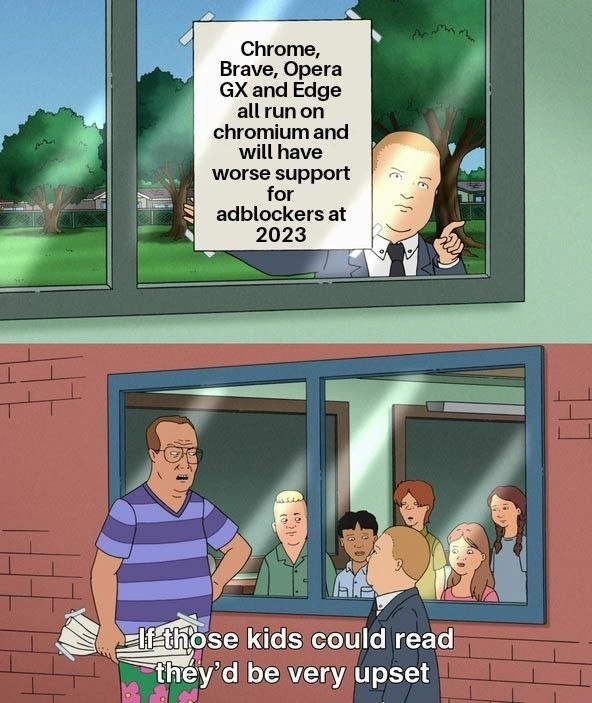
Inside the classroom, the kids are happily unaware of this sign and what it says. They’re busy with their cartoons, not paying attention to the window. The teacher sees the sign and knows the children have no idea what’s coming. He jokes, “If those kids could read, they’d be very upset.” In simple terms, the teacher is saying: “These kids don’t know that a change is about to happen that they won’t like. If they understood it, they’d be really angry, but since they don’t, they aren’t worried.”
This is funny because we (the viewers) know something important that the kids do not. The kids' favorite feature (watching cartoons with no ads) is going to be taken away, and they have no clue. The humor (and a bit of sadness) comes from that dramatic irony: we can see the trouble on the horizon, but the kids remain blissfully ignorant. By the time they figure it out – like when their next new TV doesn’t have a skip-ad button and they’re forced to sit through commercials – they’re going to be upset. The meme is using this simple scenario as an analogy for a real tech change: most users don’t read technical announcements, so they happily go on with their day, unaware that something they enjoy (browsing without ads) might soon change. If they only knew, they’d be worried – but for now, what you don’t know can’t upset you, just like those kids in the classroom.
Level 2: One Engine, Many Browsers
Let’s break down the humor and context of this meme in simpler terms. The sign outside the window in the first panel lists a bunch of web browsers: Chrome, Brave, Opera GX, and Edge. They might seem like different choices – and they do have different logos and features – but under the hood they actually have a lot in common. In fact, all of those browsers are built on the same base: the Chromium engine. Chromium is an open-source browser core made largely by Google (it’s what Google Chrome itself runs on). Think of Chromium as a browser’s engine or foundation. So even though Brave, Edge, and Opera have their own branding and some unique tweaks, they are mostly Chromium on the inside. This means when Chromium changes something deep in how browsers work, all those browsers that rely on it will change too, whether they like it or not. It’s as if several different car brands all use the same engine – if that engine design changes to run on a different fuel, all those cars have to use the new fuel. In the browser world, this heavy reliance on one engine is sometimes jokingly called a monoculture (one culture for all), and it’s exactly what’s in play here.
Now, the message on the sign is saying that in 2023 these Chromium-based browsers will have worse support for adblockers. An adblocker is a type of browser add-on (extension) that people install to prevent advertisements from showing up on websites. For example, if you’re tired of seeing YouTube ads or pop-ups on news sites, you might install an adblocker extension like Adblock Plus or uBlock Origin. What it does is identify content that looks like ads (based on known patterns or lists) and stop the browser from downloading or displaying that content. This makes your browsing experience cleaner and faster and has become pretty popular — many web users, especially more tech-savvy ones, consider an adblocker almost a must-have tool.
So, when the sign says those browsers “will have worse support for adblockers,” it means something is changing in the browser technology that will make these adblocker extensions less effective or even break some of their functionality. That “something” is a change in the browser’s extension system known as Manifest V3. Think of Manifest V3 as a new rulebook for how browser extensions have to behave and what they are allowed to do. Google (who maintains Chromium and Chrome) decided to update this rulebook, and it has big consequences for adblockers.
In the current (older) system, which we can call Manifest V2, adblocker extensions had a lot of freedom in how they blocked ads. They could basically listen to every network request your browser was about to make – like each time your browser tries to fetch an image, or a script, or a video from the internet – and then the extension could say “Hey, this URL is on my ad list, I’m going to block it.” This was done through something called the webRequest API. In simple terms, the adblocker acted like a security guard checking every request and throwing away the ones on the “ads and trackers” blacklist. It happened in real-time, for each request, which let the adblocker be very precise and even apply some smart logic (for example, “block this request only if it came from this type of element on the page”).
Under Manifest V3, this process changes. Instead of an adblocker actively intercepting each request one by one, the browser asks the adblocker to hand over a pre-written list of rules ahead of time. This is via a new API known as declarativeNetRequest. “Declarative” means the extension declares its intentions up front. So an adblocker now provides a big list of filters to Chrome/Chromium saying essentially “Here are all the patterns of URLs or page elements that I want you to block.” The browser will then enforce those rules internally, but the extension’s own code isn’t consulted on each request anymore. There’s also a strict limit to how many rules an extension can have in that list (for example, say 150,000 rules maximum). At first glance, this still achieves the basic goal – the browser can block known ad URLs by matching them against the list. But the catch is that this system is less flexible. If an adblocker wants to do something more sophisticated than just matching a URL from a list (maybe some conditional logic, or generate a new rule on the fly in response to something), it can’t easily do that under the new rules. Also, some comprehensive adblocking setups use multiple large lists (ads, trackers, malware domains, annoyances, etc.) that in total can exceed the rule limit. Under Manifest V3, extensions might have to trim down which lists or how many entries they use to fit within the allowed size. In short, adblockers under Manifest V3 can’t block quite as much, or as smartly, as they could before.
Google’s stated reason for making this change is to improve browser security and performance. By not letting each extension examine every request, the browser might run faster (since it’s doing the blocking in a more optimized way internally rather than via potentially slow extension code) and be safer (since a malicious extension can’t eavesdrop on all your traffic or modify it arbitrarily). There’s truth in that — there have been bad extensions abusing the old system, and Chrome will likely run a bit more efficiently with fewer hooks into its network internals. However, many people can’t help but notice an unhappy side effect: this change also means more ads might slip through your defenses. For users, that’s obviously not great. And for a company like Google, which makes a lot of money from online advertising, a future where adblockers are weakened could arguably be beneficial. It’s a bit of a conflict of interest: “We’re doing this to protect you... and if it just so happens to also protect our ad revenue, that’s purely coincidental!” 🙃 This discrepancy is why the tech community has been skeptical and why the meme frames the whole situation as something users would be upset about if they understood it.
So, practically, “worse support for adblockers” means when 2023’s changes fully hit, you might start seeing ads that previously would have been blocked, or your adblocker might not be able to use certain advanced features to hide elements on the page. The extension developers are having to rewrite their extensions to fit the new Manifest V3 rules. Some features will have to be dropped or redesigned. This is a big Developer Experience (DX) headache for those developers, and it potentially affects the user experience for millions of people who enjoy an ad-free web.
Now let’s look at the second panel of the meme – the classroom scene. The children inside represent the everyday users or less tech-savvy folks, and they are blissfully unaware of everything we just explained. They’re not reading browser tech blogs or following extension developer discussions. They don’t know what “Manifest V3” is, and they might not even realize Chrome/Brave/Edge share the same engine; they just use whatever browser and adblocker they like and assume it’ll keep working. The man outside with the sign is like someone trying to broadcast this important information (the proverbial “town crier” for browser changes), but it’s literally not reaching the audience – the kids can’t or won’t read it. The teacher making the quip, “If those kids could read, they’d be very upset,” is basically saying: “These users have no idea that something they care about (blocking ads) is under threat. If they understood, they’d be angry, but since they don’t, life goes on as normal… for now.” It’s a funny illustration of the knowledge gap.
For a junior developer or anyone new to this area: this meme is highlighting a real tension in web development and browser policy. It touches on browser compatibility and dominance: because so many browsers rely on Chromium, one change there creates a widespread ripple effect. It also touches on web standards in a sense – Google’s changes to extension APIs are becoming a sort of standard that others may begrudgingly follow. Firefox is the exception here; it uses a different technology base (not Chromium), and Firefox’s team has explicitly said they’ll try to maintain strong adblocker support. But Chrome-based browsers together have an overwhelming share of users, so if they all enforce these new rules, the web (especially the ad-supported part of it) changes noticeably. A lot of developers joke that Chrome is the new Internet Explorer (a reference to how Internet Explorer once dominated and dictated web practices), and this meme plays into that: a single company’s decision is setting the experience for nearly everyone.
In summary, this meme humorously warns that Google’s Manifest V3 update will make ad-blocking less effective in all the popular Chromium-based web browsers, and most users have absolutely no clue it’s coming. It’s like an inside joke among developers and tech-aware folks: “They don’t know their ad-free honeymoon is almost over.” If those users could read (i.e., if they understood the technical announcement on that metaphorical sign), they’d be upset to learn they might start seeing more ads online. The meme gets a laugh by portraying this serious issue as a scene from a cartoon – using the innocence of kids to represent oblivious users – which makes the truth a bit easier to swallow (or at least chuckle at). It’s a blend of web development reality and dark humor about how changes in tech often go unnoticed by the people who will feel them the most.
Level 3: Declarative War on Ads
The top panel of this meme is essentially broadcasting a bombshell of browser news: every major browser built on Chromium is about to cripple ad-blocking extensions. The suited man holding the sign lists Chrome, Brave, Opera GX, and Edge – different browser brands that all share the same engine under the hood (Google’s open-source Chromium). In other words, a single architectural decision by Google (Chromium’s maintainer) cascades down to all of them. Here, that decision is Google’s move to Manifest V3, a new extension platform spec that severely limits what ad-blockers can do. It’s a classic case of a browser engine monoculture flexing its power. The meme humorously highlights how everyday users are blissfully unaware of this looming change: the kids in the classroom have no clue what’s written on that sign. If they did, they'd be furious that their beloved ad-blocker is about to get nerfed. The teacher’s deadpan line, “If those kids could read they'd be very upset,” drives home the punchline – only those who understand the tech notice the trouble ahead.
Seasoned developers immediately recognize the reference to Google’s Manifest V3 and its infamous adblocker API restrictions. In plain terms, Manifest V3 deprecates the old chrome.webRequest API that extensions like uBlock Origin used to intercept and cancel network requests (i.e., block ads) on the fly. It replaces that power with a neutered, rule-based system called declarativeNetRequest. The result? The most effective method ad-blocking extensions had for zapping ads is being taken away or heavily constrained. Officially, Google’s rationale is “security and performance” – by not letting arbitrary extension code run on every request, Chrome can be faster and more secure. But conveniently, this also aligns with Google's financial interests, since Google’s parent company makes a huge portion of its money from online ads. Developers and power users can’t help noticing that this security upgrade also happens to make blocking ads much harder. It’s like a restaurant claiming a new “no outside food” policy is for cleanliness, when really it means you have to buy their food. 👀
For context, here are the key changes Manifest V3 brings that upset ad-blocker developers:
- No more on-the-fly blocking: Extensions can no longer use the
chrome.webRequest.onBeforeRequestlistener in blocking mode to dynamically halt network calls. In Manifest V2, an adblocker could examine each outgoing request (say, tohttps://adserver.tracking.com/...) and cancel it before it fetched an ad. V3 removes that capability. - Declarative filtering only: Instead, extensions must predefine filtering rules via the
chrome.declarativeNetRequestAPI. The browser enforces these rules itself internally. This means the extension says “block anything from these domains or matching these patterns” ahead of time, but it can’t execute custom logic at runtime. - Rule limits and simplicity: The new API imposes a hard limit on how many rules you can have (initially around 30k, later increased after community backlash, but still a limit). Advanced blockers that used to juggle huge filter lists (combining multiple subscriptions for ads, trackers, annoyances, etc.) or do dynamic scripting to counter sneaky ads now have to cut back. Complex or dynamic filtering logic (for example, heuristics that block elements based on behavior) isn’t feasible with static rules.
- No persistent background scripts: Manifest V3 also revamped extension background pages, replacing long-running scripts with ephemeral service workers. This means an adblocker can’t keep a continuously running background process to, say, compute complex blocking logic or maintain a real-time blacklist beyond the declarative rules. It has to fit work into event-driven bursts.
- The security narrative: Google claims these changes enhance browser security and performance by limiting what extensions can do. In fairness, there were malicious extensions abusing the old webRequest power to spy on users, and intercepting every request did add overhead. Under V3’s model, there’s less risk of a rogue extension stealing your data via network hooks, and Chrome can load pages a bit faster without dozens of extensions executing code on each request. But the trade-off is significant: user choice and extension capabilities are reduced. It’s not lost on the developer community that an ad company is behind a change that incidentally makes ads harder to block across the web. 🙄
These technical shifts might sound dry, but they have massive implications. An entire category of extensions – adblockers, privacy filters, anti-tracking tools – is getting handicapped. And because of Chrome’s central role, it’s not just Google’s browser affected. We used to talk about Browser Wars (back when Firefox and Internet Explorer duked it out), but nowadays one engine dominates. It’s more like one empire (Chrome/Chromium and its look-alikes) ruling the web, with only a tiny rebel alliance (Firefox, Safari) as holdouts. When Chromium sneezes, Brave, Edge, Opera all catch the cold. In this case an upstream policy change by Google kneecaps robust ad-blocking across the board in those browsers. The meme’s sign explicitly naming Chrome, Brave, Opera GX, and Edge highlights this one-size-fits-all outcome. Even browsers that brand themselves as unique or privacy-focused aren’t immune if they rely on Chromium under the hood.
Consider Brave – this browser’s whole selling point is aggressive privacy and built-in ad & tracker blocking. Yet Brave depends on Chromium. When Google pushes Manifest V3, Brave’s team has to do extra engineering gymnastics to keep Brave’s shields effective. In fact, Brave forked the adblock component into their engine directly to mitigate the damage, essentially working around the very platform they’re built on. It’s a real-life example of how a browser engine monoculture forces smaller players to either comply or spend effort to rebel. Opera GX (targeted at gamers) and Microsoft Edge are also on that sign. Realistically, those browsers aren’t going to fight Google on this; they’ll inherit the change without much fuss. Microsoft’s Edge switched to Chromium precisely to avoid the cost of maintaining its own engine, so it’s unlikely to defy Google’s extension policies. Opera, once known for innovation, long ago adopted Chromium as well – their users will face the same ad flood when Manifest V3 kicks in.
You might notice one big name missing from the sign: Firefox. Firefox uses a completely different engine (Gecko) and isn’t tied to Chromium’s decisions. Mozilla (Firefox’s developer) has indicated they’ll support the Manifest V3 format for cross-browser extension compatibility, but they plan to preserve the older blocking capabilities for adblockers in Firefox as long as it makes sense. In other words, Firefox might remain a safe haven for powerful ad-blocking extensions while Chrome and its clones get tamer versions. However, Firefox’s market share is small, and most non-technical users aren’t going to jump ship until they feel pain. So the meme rightly focuses on the Chromium herd that dominates user share. It’s implicitly pointing out the danger of a browser engine monoculture: one policy change in Chromium sets the fate for a huge chunk of web users and developers.
Now circle back to the meme’s classroom. The bottom panel caption, “If those kids could read they’d be very upset,” lands as a punchline because it perfectly captures the situation’s irony. The “kids” represent the vast majority of users (or even less-informed developers) who don’t follow tech news or browser policy updates. They’re blissfully enjoying their ad-free web experience, unaware that the rules of the game are changing. The suited man outside with the sign is like a tech whistleblower or a browser engineer trying to warn everyone about the coming change (in a very literal sign-posted way). The teacher figure who delivers the line knows the truth but also knows the kids haven’t caught on. It’s darkly comedic: by the time these users realize something’s wrong – e.g. when their favorite adblocker suddenly stops blocking all ads – it’ll be too late, and they’ll be very upset indeed. As a seasoned dev, you chuckle because you’ve seen this story before: a big platform change quietly rolls out, the general public ignores it until it hits home, and then there’s a loud outcry after the fact. The meme gets a knowing laugh (and maybe a sigh) from developers because it’s a slice of truth about how the web ecosystem works. It’s funny and frustrating at the same time: the people most affected by such architectural decisions often have no idea what’s coming. In summary, this meme hits home by satirizing Google’s Manifest V3 rollout and the obliviousness of everyday users — a perfect “inside joke” for anyone in web development dealing with browsers, extensions, and the fallout of big tech decisions.
Description
Two - panel cartoon. Panel 1 (top): a man stands outside a classroom window holding a taped-up white sign that reads, “Chrome, Brave, Opera GX and Edge all run on chromium and will have worse support for adblockers at 2023.” Trees and a playground are visible behind him. Panel 2 (bottom): inside the classroom, an adult in a purple-striped shirt holding a stack of papers talks to a group of children while a suited boy looks up at him; subtitle text says, “If those kids could read they’d be very upset.” The meme riffs on Google’s Manifest V3 change that limits web-request APIs, reducing the effectiveness of ad-blocking extensions across all Chromium-based browsers. It satirizes how everyday users (the kids) are oblivious to architectural decisions that frustrate extension developers and impact the wider web ecosystem
Comments
6Comment deleted
Manifest V3: “Yes, you may still block ads - just compress every dynamic webRequest into a 30 k static rule set and pray your bloom filter fits in the sandbox.”
We spent 20 years fighting IE's monopoly just to hand 90% market share to Google, who then deprecated the one API that made the web tolerable without their ads
The real irony is that Chromium's Manifest V3 migration - ostensibly for 'performance and security' - effectively kneecapped the very extensions that protected users from Google's ad-tracking empire. It's the browser equivalent of a landlord removing fire escapes to 'improve building aesthetics' while running a matchstick factory downstairs. Senior engineers saw this coming the moment Google announced declarativeNetRequest would replace webRequest APIs - because nothing says 'user empowerment' like limiting extension capabilities to a pre-approved allowlist of 30,000 rules. Meanwhile, Firefox quietly became the unexpected hero by maintaining proper extension APIs, proving once again that monocultures are bad for ecosystems, whether we're talking about agriculture or browser engines
Manifest V3: ad blocking went from a programmable firewall (webRequest) to a quota‑bound ACL - proof that four “independent” Chromium browsers share one upstream PM
Chromium's silent coup: cross-browser testing reduced to 'Does it work in Chrome?', with Firefox as the quirky outlier senior devs still swear by
Manifest V3 is the only “security” change that turns a programmable firewall (webRequest) into a capped ruleset (declarativeNetRequest) and somehow benchmarks higher on ad revenue