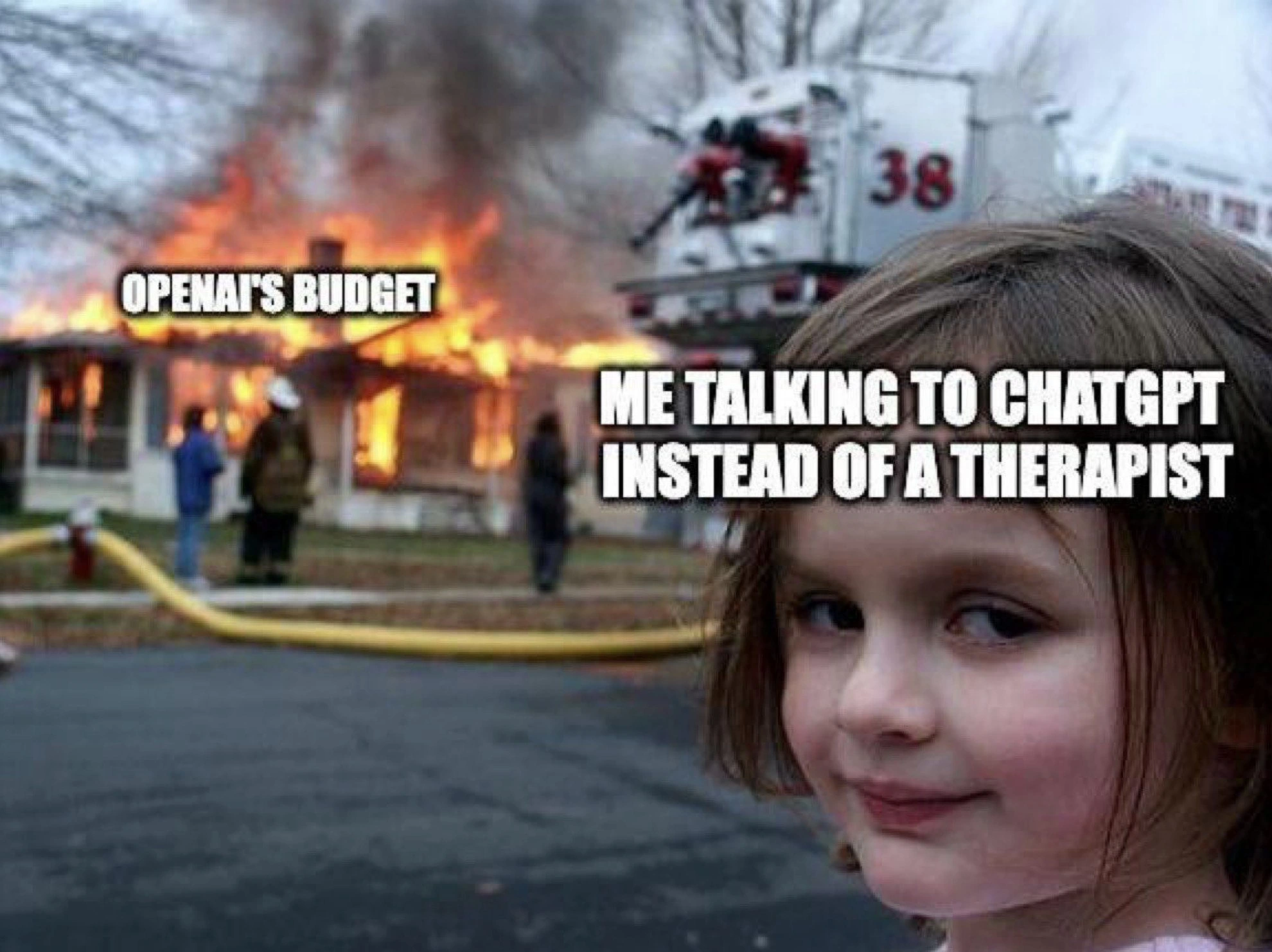
Disaster Girl watches ChatGPT chats set OpenAI’s budget on fire, meme edition
Why is this AI ML meme funny?
Level 1: Playing with Fire
Imagine you have a special talking robot friend that will chat with you and make you feel better when you’re sad. You can tell this robot anything, and it gives you kind and helpful words. It’s like having a friendly little counselor in your room. Now, talking to the robot feels free – you just turn it on and talk. But here’s the catch: every time you have a long, nice talk with it, somewhere in the background your parents are burning through money to power that robot. It’s as if each comforting answer the robot gives you makes a little stack of your parents’ dollar bills poof into smoke. In the meme’s picture, a girl is smiling while a house is on fire behind her. She’s the one talking to the robot (ChatGPT) and feeling happy, and the house on fire is like the pile of money that’s being spent to keep the robot talking. The funny (and slightly naughty) part is that the girl isn’t worried at all – she’s enjoying her chat, while the big problem (the burning money/house) is happening behind her. It’s like if you left the hot water running to have a warm bath for your toys: you’re having a great time and feel cozy, but meanwhile the hot water tank (and your parents’ wallet) is working overtime, on fire. The meme makes us laugh because we see the kid (or user) having innocent fun, not realizing (or not caring) that something very expensive is going on in the background to make that fun possible.
Level 2: Free Chat, Big Cost
In simpler terms, this meme jokes about how using ChatGPT feels free, but running ChatGPT is actually very expensive for the company behind it (OpenAI). The picture is the famous “Disaster Girl” meme: a young girl smirking at the camera while a house burns down in the background. In meme culture, that girl’s smirk implies “I did this, and I’m totally fine with it.” Here, the burning house is labeled “OpenAI’s Budget”, and the girl is labeled “Me talking to ChatGPT instead of a therapist.” That means OpenAI’s money is going up in flames (the house fire) because I’m choosing to chat with their AI rather than doing something like paying a real therapist. And I, the user, am just smiling mischievously, as if I either don’t know or don’t care that my lengthy heart-to-heart with the AI is costing a fortune behind the scenes.
Let’s break down the key parts:
- ChatGPT is an AI assistant (a chatbot) created by OpenAI. It’s a kind of software based on machine learning (ML), specifically a generative AI model that can produce human-like text. You type in messages, and it responds with surprisingly coherent answers. Many people use it for fun, for help with tasks, or even for emotional support. It feels like talking to a knowledgeable friend.
- A therapist is a trained professional you talk to about personal or mental health issues. Therapy sessions in real life cost money (often a lot!). In this meme, “talking to ChatGPT instead of a therapist” means the person is using the AI chatbot to talk about their feelings or problems, basically treating the AI like it’s a therapist or counselor. Importantly, ChatGPT isn’t a real therapist – it doesn’t have feelings or real understanding – but it can produce comforting words or advice because it has been trained on tons of conversational data. People sometimes do this as a form of venting or seeking advice anonymously.
- OpenAI’s budget refers to the amount of money OpenAI has (from investments, revenue, etc.) to spend on running and developing ChatGPT and other projects. When we say something “burns the budget” or “sets the budget on fire,” we mean it uses up money really fast.
Now, why would using ChatGPT burn money? Because every time you interact with ChatGPT, OpenAI’s servers have to work hard. ChatGPT isn’t just a simple program running on your phone; your messages go over the internet to OpenAI’s computers – specifically powerful machines with GPUs in a data center – which then run the ChatGPT model to generate a response. GPUs (Graphics Processing Units) are hardware that can do a lot of calculations in parallel, which is great for AI tasks. But they consume a lot of electricity and the hardware itself is expensive. Running a big AI model like ChatGPT is far more computationally intensive than, say, loading a web page or doing a Google search. It’s the difference between asking a calculator to do 2+2 versus asking a supercomputer to write a page of novel-quality text. So each chat with ChatGPT costs OpenAI a non-trivial amount of computing resources (and thus money for electricity, server maintenance, and hardware depreciation). When millions of users are chatting for free, those costs add up like crazy – hence the idea of a budget going up in flames. In tech terms, this is highlighting generative_ai_costs: the operational expense of letting people have free-form AI conversations. It’s a funny way to visualize the hidden cost of those friendly AI replies.
For a new developer or someone early in their tech career, think of it this way: have you ever left a cloud server running by accident and later realized you owe a bunch of money for the usage? Or maybe you know that feeling when you accidentally use too much of a paid API thinking it was free. ChatGPT is like a super-sophisticated “cloud service” that seems free to use, but behind the curtain, every query uses real compute power. It’s as if a million people are each running a hefty program on a remote supercomputer at the same time – you can imagine the electric bill! AI tools often have this hidden complexity: what feels like a simple conversation is actually lots of number-crunching on GPUs in a data center known as an AI cluster. OpenAI initially let the public talk to ChatGPT for free (as a research preview and to gather feedback). But free to us doesn’t mean free to them; they were essentially subsidizing our chats, hoping to improve the system and perhaps hook users for paid versions down the line.
The meme also touches on the mental health angle: instead of booking an appointment with a human therapist (which costs money and effort), the person in the meme just types their problems into ChatGPT. It’s convenient and doesn’t cost them anything extra (especially if they already have internet). Many people have actually reported that talking through issues with ChatGPT can feel therapeutic. It’s available 24/7, it won’t judge, and it will respond patiently. Of course, it’s not a real doctor or counselor, but when therapy is expensive or hard to access, you can see why someone might try an AI as a substitute. The meme exaggerates this for humor, implying “I’d rather spill my feelings to a fancy AI for free than pay a therapist – and look, it’s kind of working for me 😏.” The smirking girl from the original smirking_child_meme perfectly represents that cheeky attitude.
To connect the dots clearly: the house on fire = OpenAI’s money being spent rapidly to keep the service running; the smiling kid = the user (me) who is happily enjoying long chats with ChatGPT about personal issues, essentially an informal therapy session. The user is benefiting (they get a friendly ear and advice from an AI) at no cost to them, while the usage is so high that it’s like setting piles of OpenAI’s money ablaze. It’s a classic cost vs usage joke in tech.
Here’s another way to visualize it:
| What I (the user) do | What happens behind the scenes at OpenAI |
|---|---|
| I open ChatGPT and type a long message about my feelings. | The request goes to OpenAI’s servers. A cluster of high-end GPUs loads the LLM and starts computing a response. This uses a lot of electricity. |
| I get a thoughtful, paragraph-long reply from ChatGPT. | The GPUs churn through billions of calculations to generate that reply. The longer and more detailed the response, the more compute is used (costly!). |
| I continue back-and-forth conversation for an hour. | The servers run non-stop for that hour to keep the conversation going. Other users are doing this too, so tens of thousands of GPU chips might be busy. OpenAI’s cloud bill (for power and hardware time) climbs steadily. |
| I feel better after venting to the AI. It was free for me and easy. | OpenAI has to pay for all those GPU hours. They might be using up the budget they have from investments or revenue. Essentially, they paid for my “free” therapy session with the AI. |
So, in summary: The meme uses a funny picture to show a serious truth in an amusing way. People treating ChatGPT like a free therapist = lots of long, resource-intensive chats. OpenAI’s servers working overtime = a huge cost, burning through the company’s budget. The humor comes from that stark mismatch: what’s a light, free activity for one side is a five-alarm fire in terms of expense on the other side. It’s TechHumor 101 – revealing the hidden mechanics (and costs) of the technology we casually use. And for developers, it’s a chuckle and a lesson: even AI assistants have a price tag somewhere, and if you’re the one running them, you’d better watch that openai_budget so it doesn’t end up like the house in flames in the meme!
Level 3: Budget Bonfire
From a senior developer’s perspective, the meme hits on a very real industry scenario: tremendous operating costs incinerating a company’s budget thanks to extremely popular but compute-intensive AI services. The burning house labeled “OpenAI’s Budget” represents the runaway spending on GPU cloud compute, while the smirking “Me talking to ChatGPT instead of a therapist” embodies the user cheerfully engaging in a resource-heavy activity with zero awareness (or concern) for its cost. This contrast is basically the tale of many modern AI startups: pour investor money (or cloud credits) on the fire to keep those AIAssistants running, while users happily exploit the free tier for all it’s worth. It’s funny because it’s true – at the height of AI hype, millions of people were chatting with ChatGPT about everything from debugging code to existential dread, often for mental health support or boredom relief, all while OpenAI was footing an eye-watering cloud bill.
Anyone who’s managed cloud infrastructure or looked at AWS/Azure bills knows the term “burn rate”. Here it’s quite literally depicted as a fire. OpenAI’s CFO might be wincing at each lengthy user conversation, watching dollars combust with every GPU-hour. In startup terms, user adoption skyrocketed before a sustainable monetization plan – a classic “we’ll figure out revenue later” play. The meme captures that tension hilariously: the child’s sly smile (a famous element of the Disaster Girl meme format) is the user kinda knowing that using ChatGPT as a therapist is indulgent and that someone else (OpenAI) is picking up the tab, but hey, it’s working for them! It’s the same vibe as knowingly running a super-expensive algorithm on company servers just to see what happens – you grin while the server farm figuratively catches fire.
For experienced engineers, this also evokes the reality that “the cloud is just someone else’s computer” – and in this case, someone else’s very expensive, GPU-packed supercomputer. Every free conversation with a large language model is effectively running up an unseen bill on the backend. It’s developer humor gold because we’ve all seen situations where a simple user action triggers massive hidden costs or complexity. Remember those stories of naive algorithms accidentally racking up giant bills, or that one script that spawned endless processes? Here, the “script” is people’s heartfelt chats with an AI friend. The tech humor lands since we recognize that ChatGPT isn’t magic; it’s thousands of networked GPUs crunching numbers. So a person using ChatGPT as a pseudo-therapist is akin to using a Formula 1 car to fetch groceries – comical overkill.
And then there’s the MentalHealth angle: in the fast-paced dev world, stress and burnout are common, and many devs joke about needing therapy. So the meme riffs on that by suggesting we’ve found a hacky solution – talk to an AI instead of a human therapist. It’s absurd yet relatable. We know an AI can’t truly replace professional help, but it’s available 24/7 and doesn’t charge by the hour (for the user, at least!). The shared experience being satirized: Tech folks often try to solve personal problems with tech (be it a scheduling app for work-life balance, or here, an AI chatbot for loneliness or anxiety), and sometimes that “solution” has unintended consequences or costs. This is “too real” for those of us who’ve seen systems buckle under unexpected uses. OpenAI probably didn’t initially expect people to spill their feelings to ChatGPT as if it were a licensed therapist, but of course users will push tools into whatever role they need – that’s the nature of disruptive tech and enthusiastic early adopters.
There’s also an echo of every “free unlimited” service that later had to pull back. Seasoned devs recall the days of generous free APIs or unlimited cloud compute trials that had to be curbed once the cost vs usage graph went vertical. In this meme, the generative_ai_costs are the big gotcha. AI tools like ChatGPT have an alluring shine – they feel like they can do anything, even comfort us – but scaling that service is wildly expensive. The meme’s comedic punch is essentially: “Haha, I’m having a deep, comforting conversation with an AI for free – meanwhile, OpenAI’s investors are watching money go up in flames. Oops?” It’s a knowing laughter, because behind many slick tech offerings (especially in AI), there’s a frantic team optimizing kernel code, seeking bulk GPU deals, and praying that either monetization or more funding kicks in before the cash runs out. The AIHumor here masks a genuine tech-business concern: these models are amazing, but they ain’t cheap. And until someone figures out how to make conversations with an LLM economically efficient or adequately monetized, every heartfelt “therapy” chat with ChatGPT is one more log on that budget bonfire.
Level 4: Transformer Thermodynamics
At the deepest technical layer, this meme highlights the thermodynamics of Transformers – in other words, how ChatGPT’s underlying computations guzzle energy and money, turning electrical power (and cash) into heat (and answers). The caption “OPENAI’S BUDGET” emblazoned on the blazing house hints at a burn rate driven by fundamental physics and algorithmic complexity. Every time someone has a casual heart-to-heart with ChatGPT, an array of GPUs springs into action, performing billions of matrix multiplications. These GPUs (Graphics Processing Units), optimized for the linear algebra that powers neural networks, draw significant electrical power and run hot – literally converting electricity (and dollars) into heat as they infer responses.
Under the hood, ChatGPT is a giant Large Language Model (LLM) built on the Transformer architecture. When you send a message like “I feel sad today. Any advice?”, the system isn’t just recalling a canned response – it’s recomputing a probability distribution across a 175 billion parameter neural network for each token it generates. The self-attention mechanism inside the Transformer means computational cost grows quadratically with the length of the conversation context. In practice, that means a longer, therapeutic chat with lots of back-and-forth is orders of magnitude heavier to process than a single question. So an extended venting session to an AI – which might feel as easy as texting a friend – can crank the data center’s cooling systems into overdrive. We can think of each token of AI-generated empathy as requiring millions of aggregate floating-point operations. All those fused multiply-add operations happening across tens of thousands of GPU cores produce heat akin to a bonfire. In effect:
$$ \text{Your casual chat} \xrightarrow{\text{Transformer inference}} \text{high power draw} \implies \text{OpenAI burns cash}. $$
It’s a tongue-in-cheek way to point out a thermodynamic reality of generative AI: as these models grow in size and capability, the energy (and dollar) cost per query grows, too. The meme’s dark humor arises from a real engineering constraint – GPUs on fire (metaphorically and sometimes almost literally) denote the intense compute being leveraged. No matter how well-optimized the code or how many tensor operations are merged, serving a massive model’s reply to “Me talking to ChatGPT instead of a therapist” demands a bonfire of GPU cycles. And someone has to pay for all that fuel. In theoretical CS terms, it’s highlighting an intractability of scale: you can’t escape the physics and complexity math that make a state-of-the-art AI chat so costly. This is the entropy of modern AI – powerful, impressively human-like conversation emerges by expending a huge amount of ordered energy (money turned into compute) that inevitably degrades into heat (the budget going up in smoke). The meme deftly connects this high-level idea to a visual of a conflagration. To a seasoned engineer or researcher, it’s a nod that behind ChatGPT’s friendly neural banter lies a HPC inferno of tensor operations and a billowing cloud of expenses.
Description
Classic “Disaster Girl” meme: a suburban house is engulfed in flames, thick black smoke rising while firefighters work in the background. Bold white caption over the burning house reads “OPENAI’S BUDGET.” In the foreground, the famous smirking child (face intentionally blurred here) looks toward the camera; over her is the text “ME TALKING TO CHATGPT INSTEAD OF A THERAPIST.” The visual joke contrasts soaring GPU-compute costs with users who treat a large language model as an informal therapist. Technically, it pokes fun at generative-AI operational expenses versus casual, often non-revenue usage, highlighting the real-world burn rate of running LLM inference at scale
Comments
6Comment deleted
Every 3 AM existential rant I offload to GPT-4 spins up enough A100s to trigger a Sev-1 in FinanceOps - turns out my feelings are literally burning through cap-ex
ChatGPT's context window is 128k tokens but somehow still forgets what I told it three messages ago - just like a real therapist, except this one costs $700 million in compute annually
When your ChatGPT conversations rack up more compute costs than your entire AWS bill, but at least the model doesn't judge you for deploying on a Friday. OpenAI's accountants watching token counts climb while users treat GPT-4 like a $0.03-per-message therapist is the real distributed systems problem nobody talks about in the architecture reviews
OpenAI's burn rate looks like a flame graph; meanwhile I'm rubber-ducking architecture with ChatGPT, streaming 100k-token logs into a 1M context - 'Regenerate' is my most expensive keystroke
Using ChatGPT as therapy: converting burnout into somebody else’s burn rate
OpenAI torches billions training LLMs so devs get inference therapy at token cost - scaling laws' cruel irony