Skip to content
DevMeme
4688 of 7435
When your parody HTML5 GPU meets a real ARM JavaScript instruction
Hardware Post #5138, on Apr 20, 2023 in TG

When your parody HTML5 GPU meets a real ARM JavaScript instruction

Why is this Hardware meme funny?

Level 1: From Joke to Reality

Imagine you joked that your school backpack was getting so heavy, you’d need a crane to lift it onto the bus. Everyone would laugh because it sounds ridiculous to use a crane for a backpack. But then one day, the school actually brings in a small mechanical lift to help kids hoist their overloaded bags. Suddenly that wild joke isn’t so wild anymore! That’s what’s happening in this meme. People mocked the silly idea of a special gadget to make websites run faster — it sounded like overkill. But then part of it came true in real life: computer engineers really did add a little feature inside processors to help speed up JavaScript in web pages. It’s funny and surprising because an idea that sounded crazy at first turned out to have a bit of truth to it.

Level 2: Accelerating the Browser

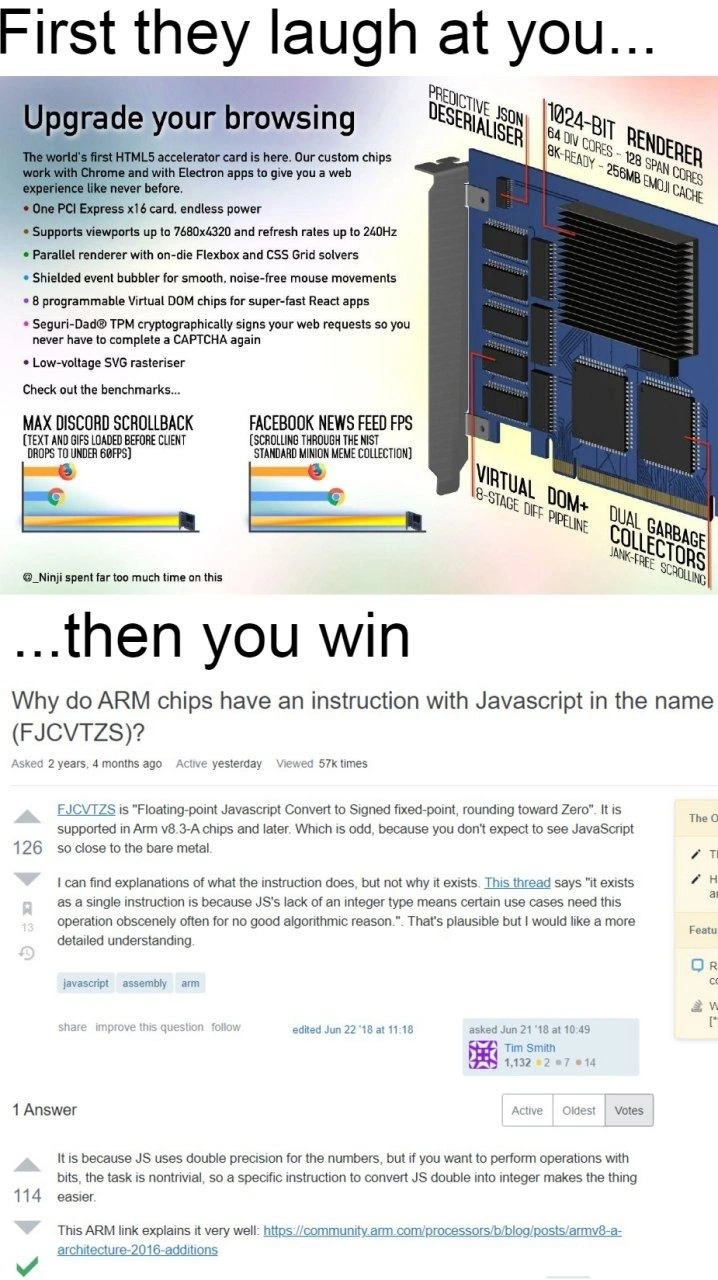
Let’s break down what’s going on in this meme in simpler terms. The image is a combination of a joke advertisement and a real-life Q&A snippet:

  • HTML5 accelerator card (PCIe x16): The top part pretends there’s a new add-in card (plugs into a PC’s PCI Express slot, like a graphics card) specifically to speed up web browsing. “HTML5” here refers to modern web technology (HTML/CSS/JS). The joke is that web apps have become so heavy, we’d need dedicated hardware to make Chrome or Electron-based apps run faster.
  • 8K @ 240Hz support: It claims to support extremely high display output – up to 7680×4320 resolution at 240 Hz. That’s an insanely high setting (8K is a huge ultra-HD resolution, and 240 Hz means a very high refresh rate). This exaggeration mocks how web content is being treated like high-end video or gaming graphics that demand top-tier specs.
  • 1024-bit renderer (64 DIV cores, 128 SPAN cores): Real GPUs might have a 256-bit or 384-bit memory interface; “1024-bit” is overkill. The mention of DIV and SPAN cores is a pun: <div> and <span> are basic HTML elements for layout/text. It’s as if the card has specialized mini-processors just to draw ordinary webpage elements. In reality, we don’t have separate cores for each HTML tag – this is pure silliness to highlight how rendering a heavy web page can feel as complex as rendering a 3D scene.
  • On-chip Flexbox & CSS Grid solvers: Calculating layout with modern CSS (using Flexbox or CSS Grid rules) can be CPU-intensive for complex pages. The ad jokes that the card has dedicated hardware to compute these layout arrangements instantly (“on-die” means built into the chip itself). It’s like having a special calculator inside the card just for figuring out where page elements should go.
  • Shielded event bubbler: In web development, event bubbling is how events (like clicks or mouse movements) propagate from one element up through its parent elements. A “shielded” event bubbler suggests the card handles user input events in isolation to keep them ultra-smooth and noise-free. In simple terms, your mouse movements and clicks would feel super responsive because the hardware is taking care of dispatching events without letting other stuff slow it down.
  • 8 Virtual DOM chips (React acceleration): The Virtual DOM is a technique used by frameworks like React where the UI is first computed in memory (a “virtual” copy of the webpage) and then differences are applied to the real page, which is more efficient than updating everything blindly. The card boasts 8 special chips to handle these calculations, meaning it could update complex user interfaces much faster. This pokes fun at how much work modern web frameworks can do under the hood — so much that we’re joking about offloading it to dedicated hardware.
  • Dual Garbage Collectors (no jank): JavaScript has a garbage collector that automatically frees up memory when it’s no longer needed, but when it runs, it can pause the application momentarily and cause “jank” (stutters or freezes). The meme proposes having two garbage collector systems working in tandem, so one can clean up memory while the other keeps the app running, resulting in jank-free scrolling. Of course, in reality you can’t just add a second garbage collector and expect double performance, but it humorously imagines a hardware cure for those annoying GC pause spikes.
  • 256 MB emoji cache: Emojis — those little smiley and icon graphics 😀 — might seem trivial, but in chat apps they’re everywhere, and loading lots of emoji images or animations (think stickers and GIFs) can actually use notable memory and processing. A cache is a chunk of fast memory for storing frequently used data so it can be accessed quickly. Claiming a whopping 256 MB just for emojis is a humorous exaggeration, implying that modern chat apps (Discord, Slack, etc.) fling around so many emojis and GIFs that we’d allocate an absurd amount of memory to keep them all handy for rendering.
  • TPM to bypass CAPTCHAs: A TPM (Trusted Platform Module) is a secure chip in many computers that stores encryption keys and can attest to a device’s identity. The ad cheekily names this feature “Seguri-Dad©” and says the card will cryptographically sign your web requests, so you never have to do a CAPTCHA again. In practice, that means the hardware would prove to websites that you’re a trusted human user, skipping those “click all images with a traffic light” tests. It’s a tongue-in-cheek solution to a universally hated little inconvenience — using a high-tech hammer to smash a tiny problem.
  • Low-voltage SVG rasteriser: SVG is a format for vector graphics (images defined by shapes and lines, not pixels). Rasterizing means converting those vector images into the pixels you actually see on screen. The card advertises a low-power SVG rasteriser, implying it can draw vector images very efficiently (without draining much battery or CPU). This jokes that even drawing an icon or logo on a webpage could be moved into specialized hardware for speed.
  • Discord scrollback & Facebook feed FPS: At the bottom of the fake ad, there are “benchmark” graphs like you’d see in a graphics card review. One called “MAX DISCORD SCROLLBACK” measures how far you can scroll up a busy Discord chat (with lots of text and GIFs loaded) before the client drops below 60 FPS (frames per second). The other, “FACEBOOK NEWS FEED FPS,” measures the frame rate while scrolling through a Facebook feed full of memes (the example mentions a Minion meme collection). Normally, nobody talks about FPS for scrolling a webpage – FPS is a gaming metric – so this is absurd on purpose. It highlights how even everyday activities like reading chat or browsing social media can feel like they push performance limits, as if you need a gaming-grade GPU to scroll without lag.
  • ARM’s JavaScript-named instruction (FJCVTZS): Finally, the bottom panel of the meme points to real life. It shows a question from Stack Overflow where a developer noticed an actual CPU instruction on some ARM processors (the kind of CPUs in many phones, tablets, and even laptops) that has “JavaScript” in its name: FJCVTZS. This stands for “Floating-point JavaScript Convert to Signed,” and it’s part of the ARM v8.3-A chip design. Essentially, it’s a built-in machine operation to convert a JavaScript number (which is a 64-bit floating-point value) into a normal integer, following JavaScript’s usual rule of chopping off the decimal part (rounding toward zero). Why would chip designers add something so specific? Because JavaScript doesn’t have a separate integer type, its engines often need to do this conversion in software, and doing that millions of times can slow things down. It became common enough that ARM decided to handle it in hardware with a single swift instruction. It’s pretty startling (and funny) to see “JavaScript” mentioned inside a CPU’s instruction set — it’s like the hardware is tipping its hat to the web. The meme juxtaposes the crazy fake hardware with this real example to say: see, the web has gotten important enough that even CPUs are adapting to it! Sometimes the line between parody and reality in tech is thinner than you’d expect.

Level 3: Meme to Machine Code

The meme’s caption “First they laugh at you… then you win.” riffs on a well-known saying about bold ideas: initially everyone mocks the concept, but eventually it triumphs. Here the idea is the absurd notion of hardware specially built to speed up websites. The top half presents a parody HTML5 accelerator card ad under the line “First they laugh at you...”. It’s essentially a fake GPU for your browser, and the listed features are hilariously exaggerated. For example, it touts a 1024-bit renderer with 64 DIV cores and 128 SPAN cores (imagine a graphics card bragging about how many <div> tags it can paint, as if web page elements were pixels in a video game!). It also promises a predictive JSON deserializer to gulp down data before your app even needs it, and 8 Virtual DOM chips to turbo-boost React’s UI updates. The spec sheet reads like the fever dream of a front-end performance engineer. It throws in on-die Flexbox and CSS Grid solvers to calculate complex page layouts in hardware, a shielded event bubbler for ultra-smooth mouse interactions, and dual garbage collectors so your scrolling never stutters from a surprise memory cleanup. There’s even a 256 MB emoji cache (apparently even smiley faces need serious memory nowadays). As a final touch, it includes a TPM-based trick to bypass CAPTCHAs (so your PC can prove “I’m not a robot” to websites automatically). In short, every notorious bottleneck in modern web apps – from layout jank to endless emoji – gets a tongue-in-cheek hardware fix in this fantasy card. It’s a classic case of web bloat irony: instead of slimming down the software, we jokingly propose beefing up the hardware to absurd levels.

Then comes the “…then you win” part: the bottom half reveals a real-world twist that validates the parody, at least in spirit. It shows a genuine Stack Overflow question asking, “Why do ARM chips have an instruction with JavaScript in the name (FJCVTZS)?” — and the fact it has over a hundred upvotes means lots of developers were astonished by this. The answer explains that FJCVTZS is an actual ARM CPU instruction: “Floating-point JavaScript Convert to Signed”. In plain terms, ARM processors added a built-in operation to convert a floating-point number into an integer the same way JavaScript would do it. That’s not a normal thing to find in hardware! But the reason is pragmatic: JavaScript uses 64-bit floating numbers for everything, so when a web page or Node.js script needs an integer (say for array indices or bitwise math), the engine has to convert those floats to ints over and over. Enough web code was doing this that ARM’s engineers said, “you know what, let’s handle it in one swift step at the silicon level.” It’s like they secretly slipped a little “make JS faster” magic into the chip. Seeing “JavaScript” acknowledged at the CPU instruction level is what really makes developers smirk. It’s as if the wild idea from the parody card got partially realized — not a full HTML5 graphics card, but the processors themselves bending to accommodate our high-level webby inefficiencies.

To a seasoned developer, this juxtaposition is both hilarious and thought-provoking. We’ve all joked about how bloated web apps have become — how a simple chat app can hog as much CPU and memory as a 3D game. Those parody benchmarks (measuring Discord scrollback FPS and Facebook feed FPS like they’re Doom or Crysis) hit a nerve because we’ve literally seen our computers struggle to scroll through meme-heavy pages smoothly. The meme takes that “what have we come to?” feeling and exaggerates it perfectly. And then reality chimes in with FJCVTZS, essentially saying, “Yep, we’re actually tweaking hardware for this stuff now.” It’s the ultimate tech punchline: the line between satire and reality is so blurred that a joke about a hardware fix for frontend problems finds an example in the real world. In other words, the web’s sprawling complexity got the last laugh — right down to the silicon.

Level 4: Bare-Metal JavaScript

Down at the level of transistors and opcodes, it’s unusual to find a high-level language mentioned by name. Yet ARM’s architecture version v8.3-A introduced a curious assembly instruction: FJCVTZS. This mouthful stands for Floating-point JavaScript Convert to Signed fixed-point, rounding toward Zero – essentially an opcode custom-tailored for how JavaScript handles numbers. Why would a hardware designer care about JavaScript? Because JavaScript uses 64-bit double-precision floats for all its numbers, lacking a distinct integer type. To do certain operations – like bitwise math or array indexing – the JavaScript engine frequently converts those floats into 32-bit integers. It’s a surprisingly tricky step at the silicon level: you have to drop the fractional part (round towards zero, so 3.9 becomes 3 and -3.9 becomes -3) and handle edge cases (huge values, NaN, etc.) correctly and fast.

Normally, converting a floating-point number to an integer might take multiple instructions or micro-ops to get exactly the behavior JavaScript expects. But with FJCVTZS, ARM essentially baked a one-instruction solution so close to the bare metal for this very specific task. It’s a single, dedicated circuit path that takes a floating-point register and outputs an integer according to JavaScript’s rules. In ARM64 assembly it might look like:

; ARMv8.3-A assembly example:
FJCVTZS  w0, d0  ; Convert double in d0 to 32-bit int in w0 (JavaScript-style truncation)

Here the CPU directly truncates a float (in register d0) into a signed 32-bit integer (w0). This operation is tailored for JavaScript’s needs – essentially accelerating something that a JS JIT compiler would otherwise have to do the hard way. It’s a rare case of an instruction set architecture (ISA) acknowledging a specific high-level language by name. This is hardware quietly bending to the realities of modern software: web browsers and Node.js run billions of such conversions, so why not handle it in one fell swoop at 3GHz?

From a computer science perspective, it’s a fascinating intersection of layers. We expect software to adapt to hardware, not vice-versa. Yet here, the popularity and performance demands of JavaScript pushed into the microarchitecture. It’s reminiscent of adding specialized opcodes for encryption or vector math – except instead of AES or 3D graphics, it’s things like JSON parsing and web page scripts driving silicon features. In academic terms, it’s an instance of vertical integration: the runtime semantics of a dynamic language influencing the design of a CPU. The absurdity isn’t lost on engineers: “JavaScript on the metal” sounds like a punchline, but it’s real. And that reality sets the stage for this meme’s payoff: the once far-fetched notion of hardware for front-end code isn’t so far-fetched after all.

Description

Meme collage with top text "First they laugh at you..." above a spoof ad for an "HTML5 accelerator card." The faux PCI-e board diagram brags about a "Predictive JSON Deserialiser," "1024-bit Renderer, 64 DIV cores, 128 SPAN cores, 8 K-ready, 256 MB emoji cache," "8 programmable Virtual DOM chips," "Dual Garbage Collectors," and benchmarks like "MAX DISCORD SCROLLBACK" and "FACEBOOK NEWS FEED FPS." Feature list includes viewport support to 7680×4320@240 Hz, on-die Flexbox/CSS-Grid solvers, a shielded event bubbler, SVG rasteriser, and a TPM that bypasses CAPTCHAs. Bottom half reads "…then you win" and shows a real Stack Overflow question: "Why do ARM chips have an instruction with Javascript in the name (FJCVTZS)?" with 126 upvotes, explaining "FJCVTZS" stands for "Floating-point Javascript Convert to Signed fixed-point, rounding toward Zero" in Arm v8.3-A. Humor arises from the absurd hardware acceleration claims for front-end tech juxtaposed with an actual CPU opcode referencing JavaScript, highlighting the clash between web bloat and low-level silicon


Comments

9
Anonymous ★ Top Pick Last quarter I joked about shipping an “HTML5 PCIe card” with 8 Virtual-DOM pipelines and a 256 MB emoji cache - today Arm ships FJCVTZS and the VP wants a querySelectorAll opcode on the next mask spin; turns out satire has a shorter cycle time than silicon
  1. Anonymous ★ Top Pick

    Last quarter I joked about shipping an “HTML5 PCIe card” with 8 Virtual-DOM pipelines and a 256 MB emoji cache - today Arm ships FJCVTZS and the VP wants a querySelectorAll opcode on the next mask spin; turns out satire has a shorter cycle time than silicon

  2. Anonymous

    We spent 20 years arguing JavaScript wasn't a real programming language, and now it's literally etched into silicon because we couldn't agree on integer types

  3. Anonymous

    The beautiful irony here: we mock the idea of hardware-accelerated DOM manipulation and React rendering, yet ARM engineers actually embedded JavaScript semantics into silicon because JS's lack of integer types created enough performance pain at the instruction level to warrant dedicated opcodes. Sometimes the parody writes itself when the metal has to compensate for the abstractions we've built seven layers above it

  4. Anonymous

    They mock JS perf until V8 JITs your Grid-refactored WebGPU fever dream into native-beating glory

  5. Anonymous

    When the ISA ships a JavaScript rounding‑toward‑zero opcode, the HTML accelerator spec stops being satire and starts looking like a Q4 roadmap

  6. Anonymous

    We mocked the PCIe HTML accelerator with dual garbage collectors - then ARM shipped FJCVTZS, and it turned out the web didn’t just eat the world; it annexed the ISA

  7. @Agent1378 3y

    Make your hardware suit your software!

  8. @tedspikes 3y

    Actual link for the interested: https://community.arm.com/arm-community-blogs/b/architectures-and-processors-blog/posts/armv8-a-architecture-2016-additions

  9. @hlvlad 3y

    Link for SO as well: https://stackoverflow.com/questions/50966676/why-do-arm-chips-have-an-instruction-with-javascript-in-the-name-fjcvtzs

Use J and K for navigation