The Developer's Duality: Imposter Syndrome vs. Reckless Overconfidence
Why is this MentalHealth meme funny?
Level 1: Emotional Rollercoaster
Imagine you’re learning to ride a bike without training wheels. At one moment, you’re pedaling smoothly and you feel unstoppable – like a bike-riding champion. You’re yelling, “Look, I can do it! I’m the best!” But then suddenly, you hit a bump and wobble, maybe even take a tumble. Now you feel the complete opposite: “This is terrible, I’ll never be able to do it. I shouldn’t even be on a bike.” That wild swing between “I’m on top of the world!” and “I’m no good at this at all…” is exactly the feeling this meme is joking about, but in the life of a software developer.
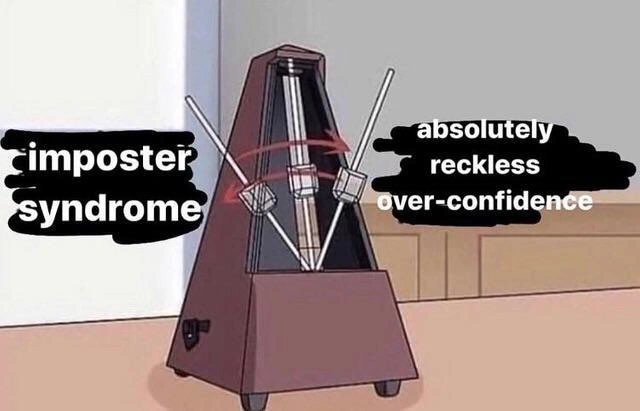
In the picture, the developer’s feelings are like a big swinging arrow. On one side, they feel like a total fraud who can’t do anything right (that’s the “imposter syndrome” side – basically feeling, “I’m not good enough, I don’t belong here.”). On the other side, they feel over-the-top confident to the point of being a little careless (that’s the “reckless over-confidence” side, like feeling “I’m so good at this, nothing can go wrong!”). The red arrow going back and forth shows how the person’s mood flips between those two extremes. It’s funny in the same way watching a little kid boast and then get scared a moment later is funny – we recognize the overreaction. The core idea is simple: sometimes we feel really great about what we’re doing, and sometimes we feel really awful about it, and it can change quickly like a playground seesaw going up and down. This meme makes us laugh because it’s a big exaggeration of a feeling many of us understand: the emotional rollercoaster of trying to do something challenging, where you’re a champion one minute and full of doubt the next.
Level 2: Self-Doubt vs Bravado
In simpler terms, this meme is showing a developer’s mood swinging between two extreme feelings: imposter syndrome on one side, and reckless over-confidence on the other. The picture uses a brown metronome – a device that ticks back and forth to help musicians keep a steady beat – as a clever metaphor. Instead of a gentle tick-tock, though, this metronome’s arm is drawn with motion blur, meaning it’s flipping rapidly between the two labels. On the left we see the text “imposter syndrome” in bold white letters on a black background, and on the right, “absolutely reckless over-confidence.” The red double-headed arrow along the swing path emphasizes that the arrow (and the developer’s mindset) goes both ways, back and forth. In short, the developer’s confidence level is oscillating like a pendulum: first all the way to feeling like a fraud, then all the way to feeling like a tech superstar, then back again. The humor comes from recognizing that absurd back-and-forth in ourselves.
Let’s break down those two big terms, since they’re key to understanding the joke:
Imposter syndrome is a psychology term commonly used in the tech world. It describes when a capable person constantly feels like an imposter or “fraud” – as if they don’t really know what they’re doing and any moment now everyone will find out. A developer with imposter syndrome might look at their colleagues and think, “They’re all so smart and know all these frameworks… I’m just faking it, I got lucky to get this job.” Even if they’ve written good code or have relevant skills, they internally doubt themselves. This feeling is surprisingly common among programmers (and in many high-pressure, knowledge-intensive fields). In fact, talking about ImposterSyndrome has become a part of DeveloperPsychology and even MentalHealthInTech discussions, because so many people in tech secretly feel this way at times.
Reckless over-confidence is basically the polar opposite feeling. It’s when a developer becomes too confident to the point of being a bit careless (reckless). They might think, “My code is amazing, I’m absolutely sure this will work perfectly,” and they charge ahead without double-checking or without a reality check. This is the mindset behind things like deploying code on Friday evening with zero tests or skipping important steps because you just know it will be fine. In everyday terms, it’s like feeling invincible – as if you can do no wrong. A little confidence is good, but over-confidence can blind you to potential problems. That’s why the meme calls it “absolutely reckless over-confidence” – it implies this level of confidence is so extreme that it becomes dangerous, like a daredevil who doesn’t wear a helmet. In a coding context, that could mean introducing bugs or breaking things because you were so sure of yourself that you didn’t prepare for failure.
Now, imagine you are a software developer. This meme is basically saying that inside your head, your self-assessment can swing like a pendulum between those two states. For example, think about the last time you were debugging or building something new. Early on, you might have hit a problem and thought, “I have no clue what I’m doing – maybe I’m not cut out for this.” That’s the imposter syndrome side talking. But then suppose you eventually solve the problem or get a feature working. You run the program and it works, all the tests pass, users are happy – you feel a rush of triumph. In that moment you might think, “Wow, I’m really good at this! I’m on fire!” That’s brushing up against the over-confidence side. The meme suggests that for some of us, this emotional swing happens a lot, almost like a continuous back-and-forth rhythm. One minute you’re down in self-doubt, the next you’re high on achievement, then something humbling happens and you’re back to doubt. It’s a psychological rollercoaster many developers (especially those new to the field or working under pressure) will recognize instantly.
The visual of the metronome is especially apt for developers. A metronome keeps time in music by swinging evenly, tick-tock, tick-tock. Replace the ticks with moods and you get self-doubt, confidence, self-doubt, confidence – as regular as a beat. The red arrow drawn on the image emphasizes the full range of the swing: it doesn’t linger in the middle. In reality, of course, people have many shades of confidence in between, but the meme plays up the two extremes for comedic effect. By seeing those exact phrases “imposter syndrome” and “absolutely reckless over-confidence” boldly written, any coder who has felt insecure about their skills will smirk and think: yep, been there! And any coder who’s ever gotten a bit too cocky after a success will also think: yep… been there too. The DeveloperHumor hits home because it’s making fun of ourselves in a very honest way.
This oscillation often happens in high-pressure or fast-paced DeveloperExperience settings. For instance, a junior developer (or even a senior on a new project) might feel imposter syndrome when comparing themselves to more experienced teammates or encountering a new technology they don’t understand. They might hesitate to commit code or apologize too much for their pull requests, thinking their work isn’t good enough. Now, fast forward to when that same developer completes a challenging task successfully – say they fix a nasty bug that was causing a big issue. They get congratulated by the team, maybe even a shout-out at the team meeting. Suddenly, that doubt flips to a surge of confidence: “Hey, I nailed it! I’m actually pretty good at this.” They might ride that high and tackle the next task with a bit of swagger. Perhaps they become overconfident and decide to refactor a bunch of code in one go because they’re feeling bold. And inevitably, if they hit a snag or the refactor doesn’t go as planned, the confidence crashes back down to “Oh no, I messed up – do I even know what I’m doing?”. The meme captures exactly that kind of scenario with its swinging arrow.
It’s worth noting that this is self-deprecating humor – developers poking fun at their own emotional volatility. By labeling the extremes so bluntly, the meme creates a safe space to laugh at something that is actually a serious personal struggle for many. Mental health in the tech industry is a big topic, and feeling like an imposter is one of the most common issues reported. Memes like this resonate because they say, “It’s not just you; we all feel this way sometimes.” Seeing the words “imposter syndrome” on a silly graphic is almost a form of acknowledgement. It tells developers that it’s normal to have these swings, even if it’s uncomfortable. And seeing “reckless over-confidence” on the other side reminds us that, yes, we also swing too far the other way at times and maybe push a bit too hard thinking we can do no wrong. The developer_experience of alternating between debugging despair and deployment euphoria is practically a rite of passage. In fact, being able to laugh at it is a sign that you’ve been through it enough to know it’s part of the job.
In summary, this meme is highlighting the contrast between two internal states a developer might go through in a day (or an hour). By using the visual of a metronome, it cleverly shows how quickly and regularly a programmer’s sense of confidence can flip from one extreme to the other. It’s funny because it’s true, and it’s also a bit comforting – it tells anyone who has felt inadequate or overconfident in their coding journey that these feelings are more common than you’d think. The pendulum swing of confidence oscillation is something we can all relate to, whether we’re new to coding or have been doing it for years. And by recognizing the pattern, maybe we can smile and remind ourselves to find a bit more balance (slow that metronome down!) the next time our mood starts to swing.
Level 3: The Confidence Oscillator
This meme nails a familiar pattern in developer psychology: the rapid oscillation between crippling self-doubt and reckless over-confidence. In the image, a mechanical metronome swings wildly, with one side labeled “imposter syndrome” and the other “absolutely reckless over-confidence.” That red double-headed arrow along the arc? It’s showing how a developer’s mindset can flip back and forth at whiplash speed. The humor lands because it caricatures a truth every experienced engineer knows: some days (or hours, or minutes) we feel like we have no idea what we’re doing, and moments later we’re convinced we’re unstoppable coding wizards. It’s an absurd pendulum motion of ego that should be contradictory, yet somehow both extremes coexist in our working life.
On a typical project, a developer might start the morning staring at a bug thinking, “How on earth have I not figured this out? I must be the worst programmer here.” By the afternoon, after finally squashing that bug, they’re riding high: “I’m a genius! I bet I could rewrite this whole module from scratch in a day.” This swing from imposter syndrome (feeling like a fraud who’s in over their head) to chest-puffing over-confidence (believing you’ve totally mastered the problem) can happen so fast it’s comical. The meme exaggerates it with the metronome_meme visual — traditionally a device that keeps steady tempo — now frantically ticking between emotional extremes. It’s essentially a confidence_oscillation device, oscillating not in Hertz but in hubris and self-doubt. The reason developers laugh (perhaps a bit nervously) at this is because it rings true: we privately recognize this psychological state toggle in ourselves.
From a senior engineer’s perspective, the meme also hints at a deeper truth about the learning curve in technology. It loosely invokes the Dunning-Kruger effect without naming it: those who know little often feel overly confident (because they’re unaware of what they don’t know), whereas those who know more become acutely aware of the vast gaps in their knowledge, which can fuel feelings of inadequacy. A junior developer might write a few lines of code and think “I’m basically a rockstar developer now” – classic naive bravado. But as they gain experience and encounter the immense complexity of real-world systems, they may swing to the opposite extreme: “Everyone else understands this codebase/framework/tool except me; I must be an imposter.” Even seasoned developers aren’t immune – in fact, the more you learn, the more you realize how much there still is to learn. MentalHealthInTech discussions often highlight that imposter syndrome disproportionately affects high achievers in fast-moving fields like software, where it’s easy to feel “I should know all of this by now”.
The reckless side of the pendulum – that absolutely over-confident state – is something seniors have also seen (and probably done) many times. It’s the mindset that precedes those infamous “YOLO” moments in tech. For example, deploying a major change on a Friday evening with barely any testing because “What could possibly go wrong? I got this!” is a textbook case of bravado that veteran developers instantly recognize (and fear). We joke that the easiest way to summon a catastrophic production outage is to utter something like “I’m sure it’s fine, just ship it” – that’s when Murphy’s Law strikes. Conversely, the imposter syndrome side can be just as paralyzing: a developer might hold off on pushing a well-written feature because they worry it’s not good enough, or hesitate to speak up in a design meeting for fear of sounding ignorant. Both extremes have real consequences in DeveloperExperience_DX and software teams: over-confidence can introduce nasty bugs or system downtime, while excessive self-doubt can slow down development and hinder collaboration. The ideal, of course, is somewhere in between – confidence with caution – but the meme humorously ignores the healthy middle ground. There’s no depiction of a calm, balanced developer on that metronome, because comedy lives in the extremes.
Another angle to this meme is how it captures the emotional rollercoaster of problem-solving. In software development, one minute you’re a hero and the next you’re Googling basic errors in panic. The quick metronome swing in the image is basically yesterday’s victory turning into today’s confusion. It’s a commentary on how volatile our self-assessment can be when facing ever-changing challenges. Write a complex algorithm successfully and you feel on top of the world; hit a wall with an unknown bug and suddenly you’re questioning your career choices. The red arrow looping between “I’m a fraud” and “I’m untouchable” is ridiculously exaggerated, yet it encapsulates that familiar developer_self_assessment loop. We’ve all had code review feedback or a production incident smack our ego down an hour after we were celebrating a win.
Importantly, seasoned devs also recognize the culture and environment that foster this pendulum effect. Tech is an industry that often idolizes “rockstar developers” and encourages a bit of swagger, yet simultaneously the complexity of the work ensures humility is never far away. You might confidently give a talk about a new library one week, then feel like a clueless newbie using a different technology the next. The meme’s popularity is a form of self-deprecating humor—the community collectively laughing at our own oscillating self-esteem. It’s almost a coping mechanism: by joking about it, we acknowledge that hey, it’s not just me. Even that quiet guru engineer in the corner probably has days they feel lost. In fact, many tech leaders openly discuss their bouts of imposter syndrome to normalize it. This shared understanding creates a sense of camaraderie; the meme is funny, but it’s also a gentle nod that you’re not alone in this peculiarly turbulent mindset.
To illustrate how quickly this swing can happen, consider a snippet of a developer’s internal monologue throughout a single workday:
// 9:00 AM - grappling with a tough bug:
console.log("I have no idea what I'm doing. How did I even get this job?");
// 4:00 PM - after fixing the bug and deploying to production:
console.log("Hold my coffee, I'm merging this directly to main. I'm basically a coding god.");
In the morning, our imposter syndrome voice is telling us we’re incompetent. By late afternoon, after one success, the over-confident voice has us doing potentially reckless things (like bypassing code review or merging to the main branch without tests, a.k.a. “cowboy coding”). This little code sketch is tongue-in-cheek, but it’s not far from reality on some days! Experienced developers will chuckle (and maybe cringe) because they’ve lived that exact oscillation: feeling like an imposter at stand-up meeting, then a few hours later acting like they have root access to the universe. The swing can be that dramatic and that fast.
Ultimately, the meme strikes a chord because it exaggerates a real psychological pendulum that many in tech secretly ride. It highlights the absurdity of how we can harbor simultaneously such opposite self-assessments. The truth is software development is hard – there’s always a new error or a brilliant colleague to make you feel humbled, and likewise always some achievement to make you feel proud. We oscillate between “I’m a fool” and “I’m a genius” because programming is a constant learning process with frequent mini-failures and successes. As a community, we’ve turned this into a joke we all get. By laughing at the confidence oscillation, we also remind ourselves to step off that dizzying metronome once in a while and realize: no, we’re not frauds, and no, we’re not infallible either – we’re just developers. And that healthy perspective, somewhere between imposter syndrome and arrogance, is where we ideally try to land (when the metronome finally slows down).
Description
A popular meme format showing a wooden metronome actively swinging its arm back and forth. On the left side of the metronome's swing, a label with crudely written black text says 'imposter syndrome'. On the right side, another label reads 'absolutely reckless over-confidence'. The image visually represents the rapid and extreme psychological oscillation that many software developers experience. It captures the feeling of swinging between intense self-doubt and feeling like an unqualified fraud, to moments of extreme, almost irrational self-belief after solving a complex problem or successfully shipping a feature. This duality is a core part of the developer experience, reflecting the constant challenges and rewarding breakthroughs inherent in the field

Comments
7Comment deleted
The senior dev experience is knowing that the 'absolutely reckless over-confidence' phase is just the setup for the next, more complex bug that will inevitably trigger the 'imposter syndrome' phase
My internal Raft election keeps oscillating between “I’m an unqualified follower” and “I’m the new leader, force-pushing to main” - never stays in candidate state long enough to acquire sanity
The only metronome that speeds up during code reviews and completely stops when the CEO asks "how long will this take?"
Every senior engineer knows this metronome intimately: Monday morning after successfully architecting a distributed system that handles millions of requests - 'I'm a god among mortals.' Monday afternoon when a junior points out your O(n²) algorithm could've been O(n) - 'I've been faking it for 15 years and today they'll finally discover I don't belong here.' The pendulum swings fastest right before production deployments and immediately after someone asks 'why did you choose this approach?' in a design review
Dev CAP theorem: Competence, Availability, Proficiency - pick two, but never escape the split-brain swing
Confidence-driven development: right swing - let's replace the monolith with event‑sourced microservices by Friday; left swing - I'll open a draft PR to rename foo
Senior confidence is a badly tuned PID: it oscillates between impostor syndrome and “let’s rewrite prod in Rust,” and only converges after the postmortem