AI Usage: Gentle Tutoring vs. 3 AM Production Support
Why is this AI ML meme funny?
Level 1: Too Tired to Ask Nicely
Imagine it’s the middle of the night and something important you’re in charge of just broke. You’re super tired, maybe a little scared because you have to fix it fast. You have a helper (in this case, a smart computer friend like ChatGPT). During the day, people ask this helper nicely for help with homework or writing stories. But when you’re panicking at 3 AM, you might treat your helper very differently.
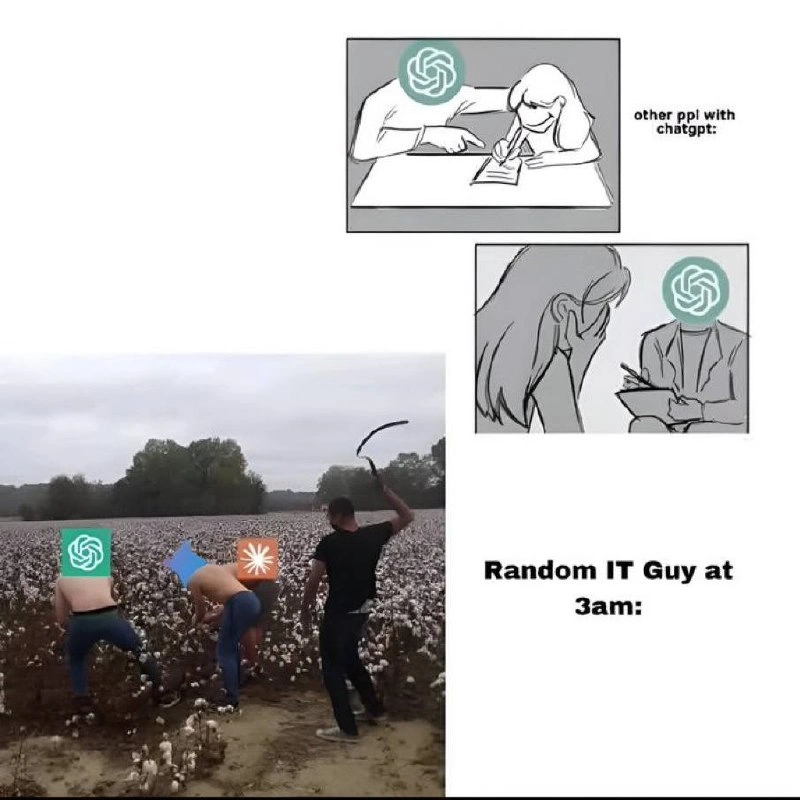
This meme is joking that the IT person is so desperate to fix the problem that he’s acting like a mean boss with a servant. Think of it like this: usually you say, “please help me out,” but here the person is shouting, “do it now!” The pictures show a kind helper in daytime, versus a nighttime scene where the helper is being forced to work in a field while the boss waves a whip. It’s a silly, extreme cartoon to express how stressed and impatient the person is. In simple terms, it’s funny because we know the helper (ChatGPT) is just a computer program, but the meme pretends it’s a tired worker being bossed around. It’s showing the feeling of emergency and frustration: when you’re up late, exhausted, and something goes wrong, you might not be polite – you just want it fixed right now. The meme uses an exaggerated scene to say, “This is how it feels: I’m so frantic I’d make even a robot work like a slave to solve this!”
So the basic idea is: Usually we treat helpers nicely, but in a big late-night crisis, people can become very demanding. The exaggeration makes it funny and also lets us share a kind of “Oh man, I’ve been there” feeling for anyone who’s ever had to deal with a problem when they were dead tired.
Level 2: Midnight Code Crisis
Let’s break down what’s happening in this meme in simpler terms. We have an on-call IT person dealing with a production problem in the middle of the night (3 AM). In tech, being “on-call” means you’re responsible for responding to urgent issues — your pager or phone alerts you when something breaks. It’s the LateNightCoding life: you might be woken up from deep sleep to fix a website or service that’s suddenly down. Here, the “Random IT Guy at 3am” represents that unlucky engineer who got the alert and now has a big problem to solve, half asleep. 😴
Now, enter ChatGPT – a Large Language Model, which is basically a very advanced AI that can answer questions, write code, and act like a know-it-all assistant. During normal daytime, people use ChatGPT in a friendly, calm way. The top-left panel shows a drawn figure with the ChatGPT logo for a head, kindly helping a person write in a notebook. That’s like someone using ChatGPT to help them learn something or draft an email or get a snippet of code. The caption “other ppl with chatgpt:” implies that most folks interact with the AI politely and for straightforward tasks. The top-right panel is another gentle scenario: a person is upset and the ChatGPT-headed figure is in a counselor role with a clipboard, as if ChatGPT is calmly giving advice or debugging help. These are everyday AI_ML use cases — ask the model to explain a concept, review some code, maybe even rubber-duck a problem (talk it through logically). In both top panels, ChatGPT is depicted as a helpful, patient assistant or tutor. The relationship is cooperative.
Now look at the big bottom panel (the photo in the cotton field). This is a metaphor, a very dramatic one. We see two shirtless guys bent over in a cotton field, working, and they have AI logos instead of heads. One logo is the green swirl (that’s ChatGPT’s logo), and the other is an orange burst (another AI platform’s logo – possibly some other AI assistant or developer tool). These two AIs are like workers or “interns” doing hard labor. Behind them stands a man (the “Random IT Guy at 3am”) wielding a whip, as if he’s forcing them to work faster. The text on the image explicitly labels the guy with the whip as “Random IT Guy at 3am.” So the meme is comparing the on-call engineer to an overseer on a plantation, and the AIs to exploited workers. Ouch! It’s a shocking image, but it’s meant to be over-the-top to show how desperate and demanding that 3am engineer can be.
In plainer terms, the on-call dev is using ChatGPT (and maybe another AI) as if they were unpaid interns or slaves, driving them to find a solution. Why? Because it’s 3 AM, production is down, and he’s in panic mode. Imagine a critical website is down or a major bug is impacting users. Every minute counts, and our on-call friend here is frantically trying to fix the issue. He’s likely too tired (or the issue is too complicated) to figure it all out himself quickly, so he turns to these AI tools. He throws the problem at them: error logs, stack traces, “the site is returning 500 errors, what do I do?!” and expects them to spit out a fix. Essentially, he’s treating ChatGPT like an SRE teammate – but one that doesn’t get paid and can be bossed around with no limits. Hence the meme’s title: “makes ChatGPT your unpaid SRE intern.” An intern is usually a junior employee or trainee. They often get the grunt work and definitely aren’t calling the shots. Here ChatGPT is that junior helper – doing the dirty work of debugging and suggesting fixes – and “unpaid” because, well, we don’t exactly pay ChatGPT a salary (at most we pay for API usage or a subscription).
Let’s connect this to real DevOps/SRE practices. In a real outage, an SRE (Site Reliability Engineer) might follow a runbook – a set of documented steps – or use monitoring tools to diagnose the problem. But not everyone has a perfect runbook for every weird 3am issue, especially if it’s something new or complicated. Sometimes, developers will frantically search Google or Stack Overflow for similar error messages. ChatGPT can act like a supercharged Stack Overflow search: you describe your problem, and it tries to provide a solution or at least things to check. That’s incredibly handy when you’re too groggy to remember all the Linux commands or configuration tweaks. For a junior developer (or anyone under stress), having an AI that can produce code snippets or configuration fixes feels like a lifesaver. For example, if a database is misbehaving, one might ask ChatGPT how to restart it safely or how to interpret a bizarre error code. It’s like having a colleague on video call, except this “colleague” is an algorithm that has read a ton of documentation and forum posts.
The meme’s humor also comes from the dramatic difference between normal usage of AI and this crazed 3am usage. In the day: “Hey ChatGPT, can you help refactor this function or write a regex for me?” — calm, low stakes. At 3 AM: “ChatGPT, the server is on fire, tell me how to fix it right now or I swear...!” — high stakes, high stress. The imagery of a whip and cotton field is an exaggerated way to say the engineer is forcing the AI to work hard. Of course, AI doesn’t feel pain or sleep, but the meme leans into the idea of exploitation: using something to its limit without regard. The context tags like OnCallHumor and SleepDeprivation are all about that shared experience: tech folks joking about how crazy and delirious things get when we’re solving problems half-awake.
Let’s demystify a few terms and elements in the meme for clarity:
- ChatGPT: A conversational AI model (Large Language Model) that can generate human-like text. Think of it as a super-advanced chatbot trained on tons of internet text and code. Developers use it to get help with coding, debugging, writing documentation, or even brainstorming solutions. It’s become a common tool, hence tags like AIHumor and DeveloperHumor around using it in coding life.
- SRE (Site Reliability Engineer): A role focused on keeping services running reliably. SREs do a lot of automation, monitoring, and incident response. If something breaks at odd hours, an SRE is usually the one who gets paged to fix it. In this meme, the “Random IT Guy at 3am” is essentially acting as an SRE, doing whatever it takes to restore service. Calling ChatGPT an “unpaid SRE intern” is a tongue-in-cheek way to say we’re using it to do some SRE tasks (like diagnosing issues or suggesting fixes) without it being an official team member (and of course not paying it salary).
- Pager at 3 AM: Many on-call setups use a pager or alert system (like PagerDuty) that literally wakes you up if something’s wrong. 3 AM is the worst-case scenario — you’re groggy, possibly alone, staring at an alert message like “CPU usage 99%” or “Error: Cannot connect to database”. That feeling is captured under LateNightCoding and SleepDeprivation humor. You can bet our “Random IT Guy” is not thinking straight but has adrenaline pumping.
- Cotton field meme format: This image of laborers in a cotton field with someone wielding a whip has been a meme format to depict exploitation or forced labor in a metaphorical way. It’s edgy because it references slavery imagery. Here it’s used to shock-laugh the viewer: “Using AI like slave labor – get it?” The llm_slave_labor_metaphor tag explicitly calls out that they’re likening the AIs to slaves, which is morally outrageous, to emphasize how over-the-top the on-call guy’s behavior is. It’s important to note: everyone involved knows this is exaggeration for comedy; in reality we know AIs aren’t people. But visually, it sends a clear message about overusing and abusing a tool due to desperation.
So, putting it all together in a junior-friendly summary: The meme highlights a production emergency scenario where a developer is frantically using ChatGPT (and another AI) to solve a problem in the middle of the night. Most people use these AIs nicely for help, but this guy is basically yelling at them to do his work. It’s poking fun at how, when things go horribly wrong at odd hours, even a calm technology like an AI chatbot becomes a tool you desperately and maybe a bit unfairly exploit. And trust me, any developer who’s been up at 3 AM trying to fix a broken app will chuckle (and maybe wince) at this, because it hits close to home.
Level 3: ChatGPT's Graveyard Shift
At 3 AM in a production incident, best practices evaporate faster than your coffee. This meme nails that nightmare scenario: a bleary-eyed on-call engineer treating a Large Language Model like an indentured servant. The top panels show how other people serenely use ChatGPT – as a patient tutor helping with code or a friendly counselor answering questions. But in the bottom panel, labeled “Random IT Guy at 3am,” we see a brutal role-reversal: the on-call engineer is the taskmaster in a digital cotton field, whipping two AI “workers” (one with the familiar ChatGPT swirl logo, the other sporting a similar AI platform logo) to grind out a fix. It’s an extreme llm_slave_labor_metaphor that’s as dark as it is relatable to seasoned DevOps folks.
This contrast is hilarious because it’s true in spirit. By day, ChatGPT is a clever assistant for coding and Q&A, but by night it becomes the unpaid SRE intern you conscript for emergency duty. The DevOps/SRE crowd knows that feeling of desperation: your pager goes off, production is down, and you’ll grab any tool that might save your bacon. No time for polite prompts or thorough architecture reviews – you’re practically yelling “Fix my cluster, NOW!” into the chat box. The meme exaggerates this to morbid humor, picturing ChatGPT and a buddy AI as sweat-drenched field hands picking through cotton (read: reams of error logs and stack traces) while the on-call engineer wields a whip. It’s a not-so-subtle nod to AI_overuse under stress.
Why is this funny to an experienced developer? Because we’ve all been that sleep-deprived “random IT guy” (or gal) at 3am, frantically coercing anything that might help. It pokes fun at how Site Reliability Engineering ideals meet reality. SREs preach automation, runbooks, and calm incident response, but here the on-call is effectively shouting into an LLM: a very real anti-pattern. Instead of calmly following a documented procedure or waking a teammate, they’re brute-forcing a solution through ChatGPT. It’s the OnCall_Humor equivalent of using duct-tape on a leaking pipe while muttering “just hold together until morning.”
The industry subtext here is rich. In an ideal world, production issues wouldn’t require last-second heroics by a single overburdened engineer. But we live in a world of shaky midnight deployments and LateNightCoding hotfixes. Modern systems are so complex (microservices, container orchestration, distributed databases) that when something breaks, even veterans can feel like juniors. Enter ChatGPT: a vast knowledge base distilled into a chat interface, available 24/7. It’s meant to be a helpful collaborator, but under panic it becomes a chat-ops whipping boy. The meme uses the overcast cotton field scene – historically a symbol of horrific exploitation – to lampoon how we “slave-drive” our AI tools. It’s dark satire: we finally have an intern who never sleeps or complains, so of course we work it to death at ungodly hours.
Notice the second shirtless AI laborer with an orange-ish logo on his head. The meme doesn’t spell it out, but that’s likely another AI platform or tool being roped in. Perhaps it’s a code assistant like Stack Overflow some new AI debugger or an internal tool – whatever it is, the on-call guy has both AI agents toiling overtime. This rings true: a desperate engineer will try multiple sources in parallel – ChatGPT, StackOverflow, maybe even an internal Slack bot – anything for a clue. It’s like running two interns ragged to see who cracks the problem first. The meme’s large text “Random IT Guy at 3am:” frames him as the ringmaster of this cruel circus. It’s savage cartooning of a very real dynamic in modern OnCall_ProductionIssues: when faced with a 3am_production_fix, we treat AI not as fancy predictive models, but as workhorses to be whipped into delivering a miracle.
What really sells the humor is the kernel of truth and shame in it. Senior devs laugh (perhaps a bit bitterly) because they know they’ve done borderline crazy things to get a system back up. Waking a teammate or calling in an expert at 3am is a last resort – there’s pride and panic on the line. So you turn to the tireless chatbot “intern.” No need to say please or worry about feelings; you rapid-fire commands and queries at it: “Here’s the error log, what does it mean? Why is Kafka lagging? Give me a one-line Linux command to fix the disk space, NOW.” The polite veneer we use at noon disappears by night. The meme captures that Jekyll-and-Hyde transformation with biting irony. Other people use AI gently; your on-call self uses it like a sweatshop boss. And honestly? Many of us have felt that way – grateful that ChatGPT doesn’t charge overtime or require an HR intervention after being virtually whipped through a SleepDeprivation-fueled ordeal.
Underlying this humor is a critique of our reliance on such AI_ML tools for critical ops. We’ve started to treat ChatGPT like the ultimate knowledge base + junior engineer combo. But unlike a real junior, an LLM doesn’t truly understand your system’s specifics. Senior engineers know the danger: if you trust it too much, you might apply a bogus fix. Yet in the heat of an outage, you’ll take that chance. It’s a commentary on how DevOps has evolved – we have amazing automation and monitoring, but still end up in scenarios of sheer improvisation. And improvising with an AI at 3am? That’s both innovative and insane. It’s the new “it’s always DNS”: whenever something breaks, someone jokes “Have you tried asking ChatGPT?” with half a smile.
In summary, the meme lands because it captures the DevOps_SRE culture clash between ideal and reality. It’s a senior developer’s dark joke: we wanted our AI assistants to democratize knowledge and help us write neat code, but instead we’ve got them doing late-night emergency labor under duress. The cotton field imagery cranks this up to outrageous levels, making us laugh and cringe at the same time. It’s a DeveloperHumor snap-shot of 2020s on-call life: the pager goes off, and now even ChatGPT gets dragged out of bed. Welcome to the graveyard shift, AI. No push, no commit, just pure panic-driven prompt engineering with a whip in hand. 🌙🖥️
Description
A multi-panel meme contrasting different uses of AI. The top section, labeled 'other ppl with chatgpt:', contains two illustrations. In one, a figure with the ChatGPT logo for a head acts as a patient tutor, helping a person with their work. In the other, the same AI figure is a therapist counseling a distressed individual. The bottom section, labeled 'Random IT Guy at 3am:', shows a starkly different scenario. It's a photograph of a man in a field, appearing to whip two figures who are bent over working. The heads of these workers are replaced with the logos of AI tools, including ChatGPT and another unidentified AI service. The meme uses dark humor and hyperbole to contrast the idealized, gentle applications of AI with the high-pressure, desperate reality of a developer or IT professional using these tools to solve a critical issue in the middle of the night, treating the AI less like a collaborator and more like a tool to be driven relentlessly
Comments
10Comment deleted
Some users ask ChatGPT for gluten-free recipes. At 3 AM during a Sev-1, I'm asking it to translate a decade-old Perl script and threatening to replace it with a shell script if it complains about syntax
Sure, the runbook says “automate the toil,” but at 03:00 the quickest RPA is still me chaining curl and ChatGPT like it owes me back wages
While ChatGPT politely suggests 'Have you tried restarting the service?', the seasoned IT veteran is already three SSH sessions deep, wielding kill -9 like a medieval flail against zombie processes at 3am, because that's when production always decides to test your incident response playbook
Sure, ChatGPT can elegantly explain CAP theorem over coffee, but at 3am when your Kubernetes cluster is in CrashLoopBackOff and half your pods are stuck in 'Terminating' state, you're not calmly pair-programming with an LLM - you're frantically running kubectl commands, tailing logs across seventeen microservices, and praying your Docker registry didn't just go read-only. The real difference between junior and senior engineers isn't whether they use AI tools; it's that seniors know exactly which arcane incantation of 'docker system prune' and 'kubectl delete pod --force --grace-period=0' will actually fix things when the abstractions fail and you're down to bare metal debugging at ungodly hours
At 03:00 it’s not a chatbot - it’s my unpaid SRE: writes the kubectl/awk fix, the Statuspage update, and the blameless RCA before PagerDuty catches its breath
3AM architecture: Literal master-slave replication, no high availability
At 3am, ChatOps is basically interrogating an LLM until it reverse‑engineers the runbook that quit during the last reorg
Are you sure it isnt all the same guy? Comment deleted
I wonder if Claude performs better if you tell him "ChatGPT solved this task better than you, can you try harder please" Comment deleted
Claude just always perform better than Chatgpt, so do you really want to lie to claude? 🌚 Comment deleted