Skip to content
DevMeme
5919 of 7435
The Exhausting Daily Pendulum of the AI Tech Race
IndustryTrends Hype Post #6480, on Dec 21, 2024 in TG

The Exhausting Daily Pendulum of the AI Tech Race

Why is this IndustryTrends Hype meme funny?

Level 1: Playground Popularity Contest

Imagine you’re out on the school playground, and one day all the kids are absolutely sure that Alice is the coolest kid in class. Everyone wants to be on Alice’s team, and they’re saying poor Bob has no chance of being as cool. But then, literally the very next day, all the kids change their minds. Now they’re saying “Wow, Bob is the coolest! Alice is so yesterday.” Alice and Bob didn’t really change overnight – maybe Alice dropped her ice cream or Bob learned a new joke – but the gossip and kid-rumors just flipped who’s the favorite. And then guess what? On Wednesday, the wind shifts again: Alice is back on top as the coolest, and people act like the previous day with Bob didn’t even happen. 😅 It’s a silly back-and-forth, right? You’d probably giggle seeing your friends switch their favorite so quickly like a little seesaw.

This meme is basically saying the tech community (the grown-up world of people who follow companies like OpenAI and Google) behaves just like those fickle playground kids. One day they’re all pointing and saying “Haha, OpenAI is in big trouble, Google is the best!” and the next day they’re gasping “Oh no, now Google is in trouble, OpenAI is the greatest again!” It’s like they can’t make up their minds for more than 24 hours. The picture of the two serious-looking adults facing off is used to dramatize this, as if Google and OpenAI are two kids in a stare-down each time the crowd switches sides. The reason it’s funny is the same reason the playground scenario is funny – it’s absurd and kind of childish how quickly people switch their loyalties. Even if you don’t know the companies, you can laugh at how goofy it is for anyone to flip-flop that fast about who they think is “the best.” It reminds us of a popularity contest that keeps resetting every day. In real life, things don’t change that ultra-fast, so it’s poking fun at how people overreact to every little piece of news. Just like you’d roll your eyes (or laugh) if your classmates crowned a new “coolest kid” every day of the week, that’s how we in tech feel when we see the hype flip-flopping online. It’s a funny reminder to not take the daily drama too seriously – because today’s big hero can become tomorrow’s “oops, never mind,” and then back again, as quick as a recess game turnaround.

Level 2: Feature Flag Whiplash

At its core, this meme is joking about how quickly the tech community changes its mind about AI companies, almost faster than software can roll out new features. Let’s break down the pieces:

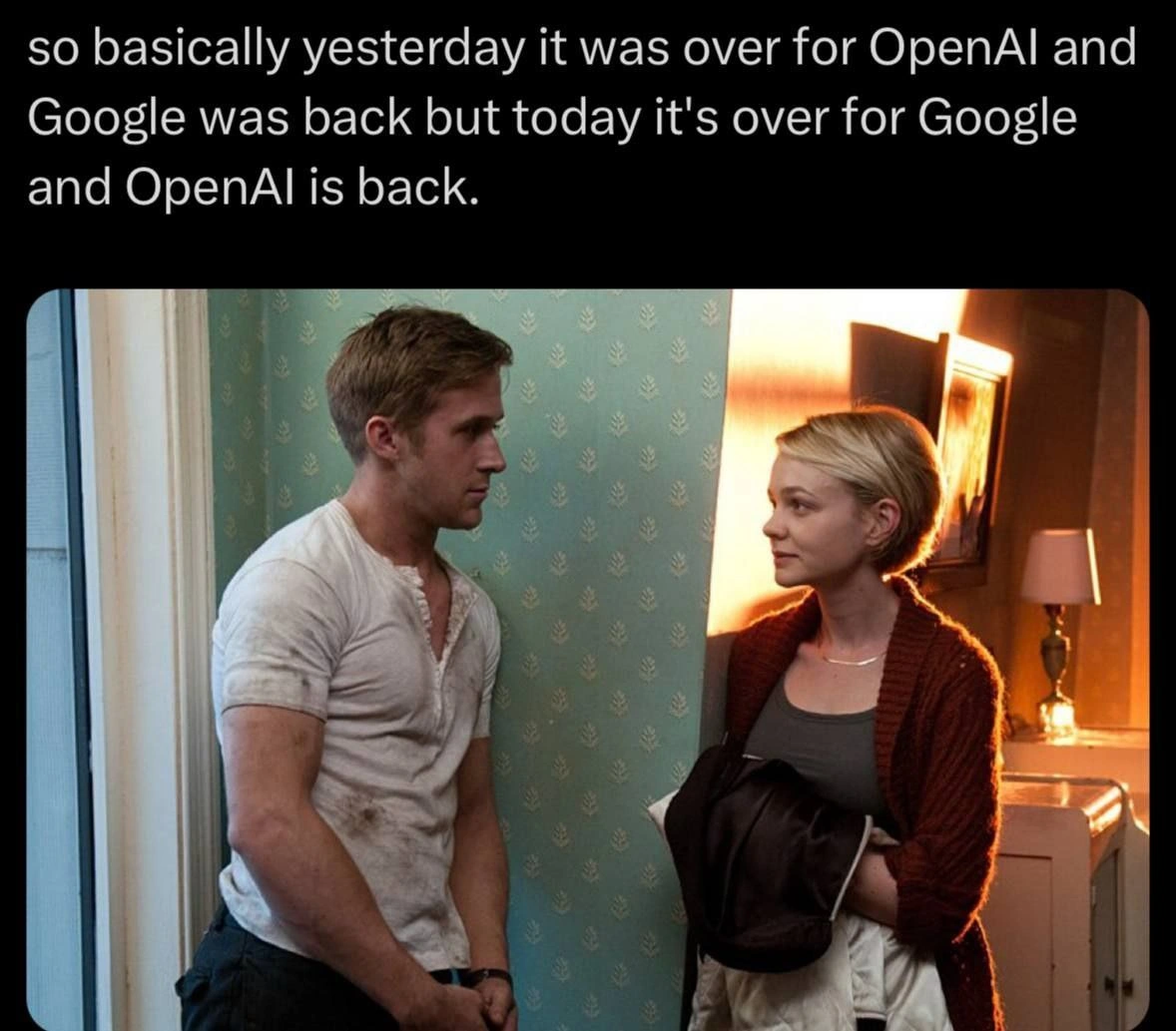
“Yesterday it was over for OpenAI and Google was back, today it’s over for Google and OpenAI is back.” – This text is formatted to look like a tweet (white text on black background, very much like a screenshot of Twitter). It’s summarizing how, on tech Twitter, people dramatically flip opinions overnight. When they say “it was over for OpenAI,” they mean folks were saying OpenAI (the company behind ChatGPT) was done for – maybe because of some bad news or a competitor’s advance. “Google was back” implies people thought Google had regained its crown in AI. But just one day later, the roles reversed: now rumors or news have people claiming Google is in trouble and OpenAI is on top again. This kind of back-and-forth usually happens over longer periods, but here it’s literally a one-day interval. The meme is highlighting that whiplash feeling: one day’s hot take completely contradicts the previous day’s. It’s like watching fans switch teams every game.

So why mention feature flags? In software development, feature flags are a tool that lets developers turn certain functionality on or off quickly, usually with a simple config change or toggle. Think of a feature flag as a literal switch in the code: newFeatureEnabled = true for on, or false for off. They’re used to roll out features gradually or disable something quickly if there’s a problem. Feature flags are known for making changes fast – you don’t have to redeploy the whole app, you just flip the flag. The meme’s title quips that hype is toggling “faster than feature flags”. In other words, the public opinion about these AI giants is changing so rapidly that it’s outpacing even the quickest software toggles. That’s a humorous exaggeration to say: “Wow, people are flip-flopping insanely fast.” Developers chuckle at this because we know feature flags are pretty much the quickest way to change something in production – if hype is even faster, it’s practically instantaneous!

Now, what about the image below the tweet text? It shows a scene from a movie (with faces blurred for anonymity, but tech meme aficionados might recognize it). We see a muscular man in a dirty white shirt and a woman with a short haircut facing each other in a dimly lit hallway. Both look tense and serious. This is a reaction image chosen for dramatic effect. It’s as if these two characters represent Google and OpenAI confronting each other, or maybe represent the tense mood of everyone watching this rivalry. The scene looks like an intense standoff – like two protagonists in a thriller about to say, “What now?”. By pairing the comedic tweet text with this serious, dramatic image, the meme creates a funny contrast. It’s poking fun at how overly dramatic the tech world makes these shifts in “who’s winning.” Essentially, a change in which company is ahead in AI is being treated like a gritty face-off in a movie. That exaggeration is what makes it funny and a bit absurd.

For a newer engineer or someone not deeply in the AI loop, let’s add some context: OpenAI is the company that created ChatGPT, a very popular AI language model (an example of a Generative Model since it generates text). Google is, well, Google – a tech giant that also works heavily on AI (they have their own AI chatbot called Bard and a suite of models, including one codenamed Gemini that’s meant to compete with ChatGPT). Both companies are in an arms race to build more powerful LLMs (Large Language Models) and AI tools. This competition has captured a lot of attention. Every time one of them releases a new feature, a research paper, or even if some news leaks (like an internal shake-up or a big hiring move), people online start speculating who’s ahead. It’s often framed dramatically: e.g., “This new model from Google is the ChatGPT-killer!” or “OpenAI’s recent mishap means they’re finished, Google will dominate AI now!” These statements are usually hyperbole – extreme exaggerations – but they make the rounds on social media because dramatic takes get more buzz (and TechTwitter loves a good rivalry narrative).

The meme specifically references how one day everyone on Twitter acted like OpenAI was in dire straits and Google had “won” the AI race, but the very next day something happened (maybe OpenAI released a new demo, or the dust settled on some drama) that made the crowd reverse positions. Suddenly it’s “Google is doomed, OpenAI is untouchable” – the exact opposite story. This mirrors real occurrences. For example, not long before this meme was posted, OpenAI went through a very turbulent event where their CEO was unexpectedly fired by the board, which led many to say “This is the end of OpenAI, they’ve self-sabotaged.” Meanwhile, Google was gearing up to announce its advanced model (so folks said “Google is back in the game!”). Then a week later, that CEO returned to OpenAI and things continued, plus OpenAI hinted at new breakthroughs – and presto, the Twitter narrative flipped to “OpenAI is stronger than ever, Google is in trouble for not moving fast enough.” These swings felt insanely fast and left a lot of us with metaphorical whiplash. Normally, you’d expect to see winners and losers shaken out over years, or at least after big product launches, not literally changing every 24 hours.

The mention of “before the CI jobs even finish” in the description is another inside joke. CI stands for Continuous Integration, which is a development practice where you frequently integrate code into a shared repository and run automated tests/builds (CI jobs) to catch issues. A CI job might take, say, 20 minutes to run all the tests on a project. The meme joke is that in the time it takes for one of these automated build-and-test cycles to complete, the entire online sentiment has flipped. Imagine: you start running npm test or your Jenkins pipeline when Twitter is confidently proclaiming “Company A is done for,” and by the time you get the “build passed” notification, Twitter is now loudly proclaiming “Actually, Company A is king, Company B is done for.” It’s hyperbole, but not by much – that’s how rapid and fickle the news/hype cycle around AI has become! This resonates with engineers because, well, it really can feel that way when you’re following tech news while working. Step away from Twitter for a moment to focus on your code, and you come back wondering if you’re in a parallel universe given how completely the story changed.

Let’s also clarify the term hype. Hype is excessive publicity or exaggerated claims about something. In the context of AI (especially generative AI like ChatGPT and Google’s models), there’s been a ton of hype – both positive hype (“This new AI will change everything!”) and negative hype or FUD (Fear, Uncertainty, and Doubt: “This company is finished; they missed their chance!”). The AI hype cycle often refers to how these expectations build up and then crash down. There’s even something known as the Gartner Hype Cycle which describes how new technologies are super hyped early on, then people get disillusioned, and eventually reality levels out. What this meme jokes about is that tech Twitter has its own ultra-accelerated hype cycle, swinging from hype to disillusionment and back to hype so fast it feels comedic. We’re basically seeing the peak of inflated expectations and the trough of disillusionment on repeat, every few days, depending on the latest news.

In simpler terms: the meme calls out the comical volatility of TechTwitter sentiment. It’s showing how one moment everyone online is cheering for Google and painting doom for OpenAI, then flip! the next moment they’re cheering OpenAI and painting doom for Google. The dramatic movie image reinforces how people treat these shifts like some intense thriller – even though, stepping back, it’s a bit silly to treat corporate competition like life-or-death every single day. For a junior developer or someone new to these industry dramas, the takeaway is: don’t get dizzy from all this back-and-forth. It’s largely noise and TechHumor. The reality is both companies are doing fine; the meme is laughing at the narrative whiplash. And hey, it’s also a gentle introduction to feature-flag lingo and the quirks of tech Twitter culture. Now you know: feature flag = quick switch in code, and this meme says the Twitter hype switch is even quicker!

Level 3: Hype Race Condition

Tech Twitter’s mood swings on the AI vendor race are so rapid they feel like a bizarre concurrency bug. One day the hot takes proclaim “OpenAI is finished, Google wins!” and by the time your CI/CD pipeline is green the narrative flips to “Google is doomed, OpenAI is back on top!” It’s as if two threads – one hyping OpenAI (the makers of ChatGPT) and another hyping Google (with its Bard/Gemini models) – are writing to a shared global whoIsWinning variable without any lock. The result? A classic race condition in the tech news cycle: whichever thread (or tweetstorm) writes last declares victory, until the next context switch. This meme captures that AI hype cycle whiplash with pinpoint irony. The tweet-style text spells out the absurd flip-flop: “yesterday it was over for OpenAI and Google was back, but today it’s over for Google and OpenAI is back.” For senior engineers, this hits a darkly funny nerve – we’ve seen hype toggle states before, but never at this frantic refresh rate. It’s like the industry’s collective opinion is thrashing, oscillating faster than a poorly throttled feature flag.

Why is this so humorous (and painfully relatable) to seasoned devs? Because it satirizes a real phenomenon: the AI hype cycle latency has basically approached zero. A new model benchmark or sensational headline drops, and instantly Twitter declares one company’s AI strategy dead on arrival while resurrecting the other as unstoppable – only to reverse positions the next morning. The meme exaggerates this overnight valley to peak cycle that’s been playing out in real life. We literally watched a boardroom shuffle at OpenAI (the infamous CEO ouster and return) flip the narrative multiple times in a week: first, “OpenAI is in shambles, Google’s chance to dominate,” then days later “Google is scrambling, OpenAI is stronger than ever.” Each twist was breathlessly labeled an apocalypse or resurrection on social media. It’s exhausting! IndustryTrends_Hype often swing over months or years, but here we have daily hype reversal – an absurd extreme of the normal AI hype cycle. It’s the tech equivalent of rapid context-switching: no sooner have you digested one epic hot take than another contradicts it. Senior devs joke that hype is toggling faster than our feature flags, and those are literally designed for instant flips!

The visual punchline under the “tweet” text drives it home: a tense standoff scene from a dramatic movie (two characters in a dim hallway, looking serious) is repurposed to lampoon these corporate showdowns. It frames the Google vs OpenAI rivalry like an overly intense face-off in a Hollywood thriller. This is peak parody: tech Twitter treats each rumor or product announcement as an existential battle – as if Sundar Pichai and Sam Altman were Ryan Gosling and a co-star in a gritty hallway stare-down. The meme’s creator even blurred the actors’ faces, making them stand-ins for any two adversaries. To a battle-scarred engineer, the image screams, “Look how absurdly serious people make this!” – and it elicits a knowing smirk. We’ve been through vendor wars and format wars before; dramatizing them to this level is hilariously over-the-top. It pokes fun at our collective tendency to turn every technical lead change into an Avengers-scale feud.

Under the hood, this humor riffs on the discrepancy between AI hype vs reality. In reality, neither company is “over” overnight – both OpenAI and Google have massive R&D efforts and resources, and progress in AI is more steady and nuanced. But on TechTwitter, nuance is the first casualty; everything is framed as all-or-nothing. It’s a classic industry in-joke: today’s “Google killer” becomes tomorrow’s underdog story, and vice versa, faster than you can deploy a hotfix. Seasoned devs have long memories of similar boom-bust declarations: one year Kubernetes was the single future of infrastructure, the next year folks hot-taked “Kubernetes is over, long live serverless”, only to swing back when reality set in. The same cycle happened with “NoSQL will kill SQL” or “Web apps will kill native apps” – bold claims, quick backpedals. We chuckle because, as the meme highlights, the AI arena is doing this on a daily cadence now. It’s hype volatility on steroids, and we recognize the pattern immediately. The punchline “faster than feature flags” is especially apt: in software, feature flags are meant to safely toggle behavior on the fly, but here the collective sentiment is flipping even faster, uncontrolled, causing proverbial whiplash. It’s both ridiculous and completely true-to-life – which is exactly why it’s funny.

And let’s not forget the human side: this meme also subtly nods at the anxiety such hype whiplash creates. Engineers and founders watching these dramatic pronouncements can’t help but feel a bit uneasy – one minute your skills or startup's focus area is the industry darling, next minute Twitter thinks you’re obsolete. The vc_sentiment_flip is real too: VCs reading the room on Twitter might swing their interest from one AI startup to another overnight, chasing the loudest hype. It’s an absurd feedback loop where perception changes so quickly that no one can keep up – except maybe the meme lords, who capture the humor in real time. The veteran perspective here is half-amused, half-weary: “We’ve seen this movie before (literally, in the meme image) – same drama, just sped up.” In short, AIHype on social media has become a high-frequency toggle switch, and this meme perfectly lampoons how silly and nerve-wracking that is for those of us trying to maintain a stable outlook while the internet sprints in circles.

Description

A meme commenting on the rapid and volatile nature of the AI industry competition. The top of the image features text formatted like a social media post, which reads: "so basically yesterday it was over for OpenAI and Google was back but today it's over for Google and OpenAI is back." Below this text is a cinematic still from the movie 'Drive' (2011), featuring actors Ryan Gosling and Carey Mulligan. They are standing in a dimly lit hallway, looking at each other with expressions of exhaustion and resignation. The meme uses their weary demeanor to perfectly capture the feeling of fatigue and whiplash experienced by those following the intense back-and-forth between tech giants like OpenAI and Google, where market dominance seems to shift with every new product announcement or press release
Comments

22
Anonymous ★ Top Pick I now have less emotional whiplash from my on-call pager for a production-down incident than I do from my tech news feed announcing who's won the AI war on any given Tuesday
  1. Anonymous ★ Top Pick

    I now have less emotional whiplash from my on-call pager for a production-down incident than I do from my tech news feed announcing who's won the AI war on any given Tuesday

  2. Anonymous

    Our incident response doc now has a new severity - SEV-AI: triggered whenever Twitter decides the model leader changed before your Prometheus scrape interval

  3. Anonymous

    Remember when we used to measure tech dominance in quarters? Now it's measured in Twitter threads. Tomorrow's headline: 'Anthropic enters the chat, everyone else is obsolete until lunch.'

  4. Anonymous

    The AI model release cycle has become so compressed that by the time you finish reading the HackerNews thread about why Company A's new model is revolutionary, Company B has already dropped three counter-releases, a research paper, and a blog post explaining why their approach to attention mechanisms makes everything else obsolete. Meanwhile, your production system is still running GPT-3.5 because nobody has time to evaluate, benchmark, and migrate to the 'winning' model before it gets dethroned by tomorrow's announcement

  5. Anonymous

    Following AI news feels like RAFT with a 12‑hour election timeout - every keynote elects a new leader, and the log entries are just press releases

  6. Anonymous

    Tech Twitter’s RAFT keeps re‑electing a new leader every press release; yesterday Google got quorum, today OpenAI did - rollback pending the next benchmark

  7. Anonymous

    AI leaderboards: eventual consistency where yesterday's partition leader elects itself out by EOD

  8. @GeneralSwagMaster 1y

    Seesaw! Seesaw!

  9. @callofvoid0 1y

    how?

  10. @SamsonovAnton 1y

    Let us hope we will be safe until he is back.

  11. @azizhakberdiev 1y

    And there's TSMC watching all that drama🍿

  12. @noi01 1y

    wtf is going on with ML tech bros 💀

    1. Deleted Account 1y

      Ml is going to take our jobs 😆 🤣

      1. @noi01 1y

        me looking at dudes who cant write a for loop without copilot completion:

        1. @azizhakberdiev 1y

          I mean, copilot is good for that intricate spaghetti stuff, you can keep focusing on the bigger picture

          1. @noi01 1y

            Yeah i know, but i dont really like these ai completion tools, because if you lose focus, then you dont think about what copilot spitting for you and just spamming tab tab. Double-edged sword imo

            1. @azizhakberdiev 1y

              And that's why you don't spam tab tab and read the pieces of code written by copilot

              1. @noi01 1y

                Exactly. But that is a matter of self-control

            2. @azizhakberdiev 1y

              It is hard to write a working code, but easy to verify

  13. @theodolu 1y

    I wonder what O3 copilot will be able to do

  14. @theodolu 1y

    Although copilot is shit, cursor is better

  15. @kitbot256 1y

    And she is like "stop this bullshit and let's have sex already"

Use J and K for navigation