The Unintended Side Effect of AI: 'As of my last knowledge update' Invades Academia
Why is this AI ML meme funny?
Level 1: Forgot to Erase the Notes
Imagine you’re doing a homework project and you ask a really smart computer friend for help. The computer friend (let’s call it ChatGPT) gives you a nice answer, but it also adds a little note saying, “By the way, I only know things up to last year, so this might be outdated.” Now, you take everything it said, including that little note, and put it straight into your essay without changing it. When your teacher reads your essay, they see a sentence that basically says, “As of my last knowledge update in 2022, I don’t know anything newer…” Immediately, your teacher realizes you copied that from somewhere – because why would you, the student, talk about your “last knowledge update”? You inadvertently left in the helper’s note! It’s a bit like copying your friend’s homework and forgetting to remove your friend’s name at the top. Oops!
This meme is making fun of a similar situation, but in the world of grown-ups writing research papers. Some people asked an AI for help writing their papers, and they accidentally left in the AI’s own funny way of talking. It’s as obvious as leaving pencil marks or sticky-note comments in a final report. Everyone can tell that part of the text wasn’t written by the human author – it was the computer helper talking about itself. It’s funny in a facepalm way: the authors basically shouted, “Hey, an AI wrote this part!” without meaning to. And it’s a little worrying too, because it shows they didn’t carefully check their work. Just like a teacher wants you to understand and refine what you turn in, researchers are supposed to double-check and polish their papers. If they don’t, you get these silly mistakes. So the big simple idea here: if a computer or friend helps you with your work, always make sure to clean it up and put it in your own words – otherwise everyone will know you copied, and that can be pretty embarrassing!
Level 2: AI Disclaimers in Plain Sight
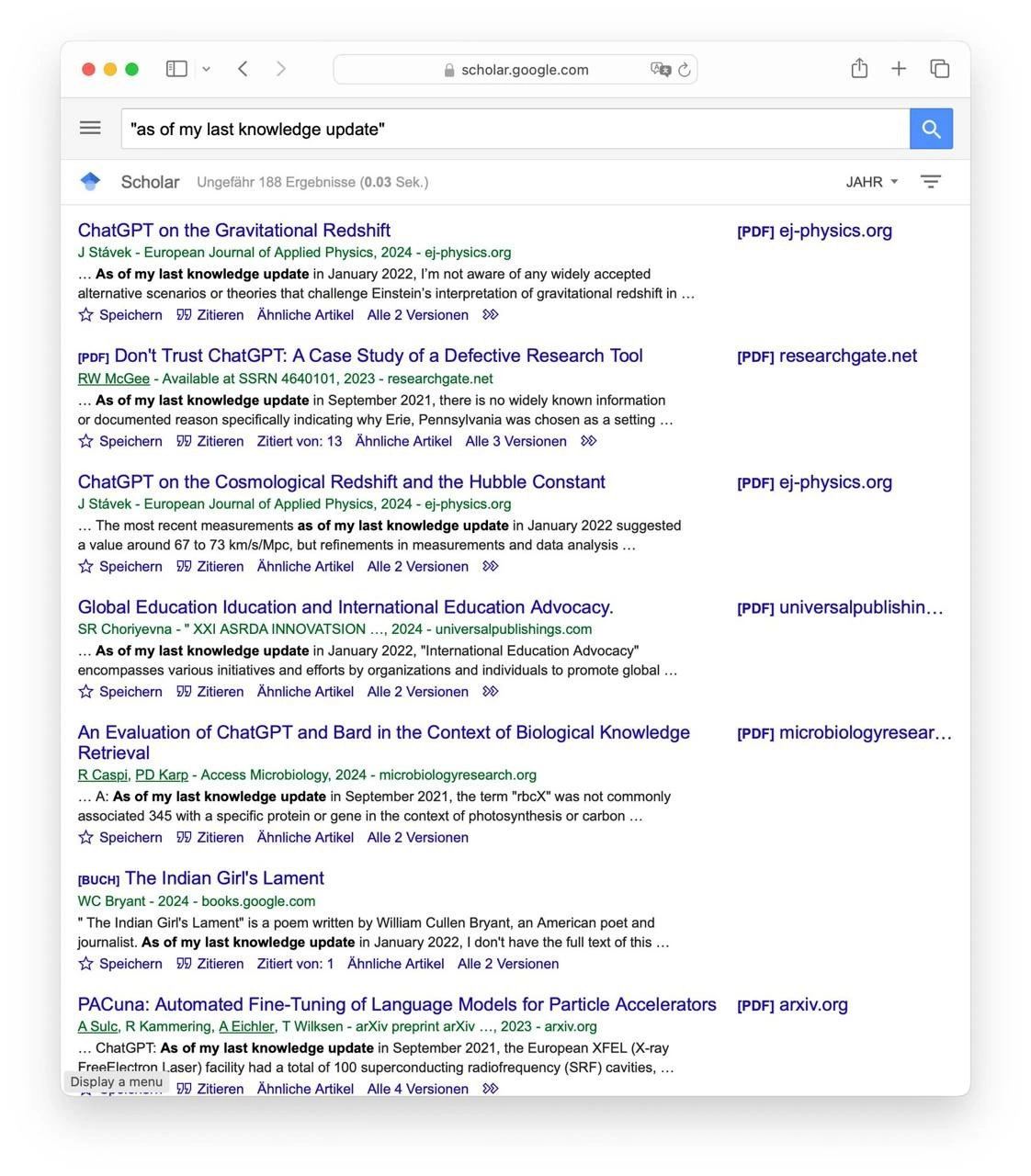
What’s happening here is a mashup of academia and modern AI tools gone awry. Google Scholar – which is like Google’s search engine for academic papers and scholarly articles – is showing a bunch of results where every snippet contains the odd phrase “As of my last knowledge update”. Now, normally you’d never see an academic paper phrase things that way. That wording is a dead giveaway of ChatGPT or a similar AI assistant. ChatGPT is a famous AI model that can generate text, answer questions, and help with writing. But because it doesn’t have information beyond a certain date (its knowledge cutoff – basically the last date its training data was updated), it often begins its answers with a disclaimer like “As of my last knowledge update in September 2021, ...” to let you know it might not have info after that date.
So why is that AI-specific sentence showing up in research papers? The meme suggests that some authors have been using ChatGPT (or other generative AI tools) to help write their papers, and they copy-pasted the AI’s output without fully editing it. In other words, an AI might have helped draft a section of the paper, and the author accidentally left in the AI’s own self-referential comment. It’s like asking an AI, “Explain gravitational redshift,” getting an answer, and then dropping that answer straight into the paper verbatim. The result is that the paper reads as if the AI itself is talking in the first person about what it knows as of 2021 or 2022 – which is very weird for a published 2023/2024 article!
To put it simply, the authors left the AI-generated boilerplate in their final text. Boilerplate means standardized, routine text that gets reused. Here, “As of my last knowledge update…” is boilerplate that ChatGPT uses over and over. It’s not something a human researcher would usually say in a paper; a human would just cite a source or say “As of 2024, no evidence of X has been found.” The presence of this exact AI catchphrase in many different papers is like finding the same watermarked stamp on multiple documents – it tells everyone exactly where that text came from. It’s embarrassingly transparent.
For a junior developer or a student, think of it this way: have you ever seen someone copy a chunk of text from Wikipedia or a website into their report and forget to remove something obvious like “[citation needed]” or a hyperlink? That’s what’s happening here, but with AI. People used ChatGPT to get a quick answer or nicely worded explanation and then forgot (or didn’t bother) to take out the AI’s little disclaimer note about its knowledge being potentially outdated. It shows a lack of thorough proof-reading and understanding. Just as a programmer might be frowned upon for copy-paste programming (grabbing code from the internet without understanding it), a researcher is going to get in trouble for copying AI-written text without proper editing or citation.
This has some serious implications that even a newcomer can grasp. Plagiarism isn’t just copying another student’s homework; it can also mean copying text from an AI without attribution. Using generative AI for help isn’t necessarily banned in all contexts – in fact, it can be a helpful tool – but it needs to be used responsibly. Responsible use means you double-check the AI’s facts, you update any outdated info, and you definitely remove or rewrite the parts that don’t make sense in context (like an AI talking about its own knowledge cutoff!). If an AI gives you a draft paragraph, you should treat it like a rough note from a friend, not a final polished gem. Academic rigor demands verifying every claim and making sure the style and voice are consistent. A random “as of my last update” line in the middle of a paper is a huge red flag that this text wasn’t organically written by the human author.
The meme is also touching on AI ethics concerns in a lighthearted way. There’s a big discussion happening about whether it’s okay to use AI to generate parts of papers or code. Ethically, if you use AI, you should probably disclose it (some journals and conferences now have rules about this). And you absolutely should confirm that the AI’s content is correct – because AI can hallucinate (make stuff up) or be outdated. These search results even include a paper literally titled “Don’t Trust ChatGPT: A Case Study of a Defective Research Tool,” which ironically contains the very phrase that proves the point – someone not fully trusting it, yet directly quoting it. For newcomers, the lesson is clear: generative AI is powerful, but it’s not magic. You can’t blindly trust it, and you certainly shouldn’t paste its raw answers into professional work without careful review. Otherwise, you end up with obvious, even laughable mistakes that anyone can discover with a simple search. This meme’s scenario is funny, but it’s also a bit of a warning: always review AI-assisted content as critically as you would any source from the internet.
Level 3: Ghostwritten by GPT
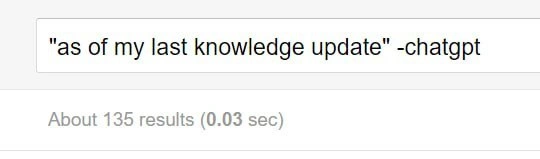
On the surface, this meme exposes an uncanny trend: Google Scholar search results are full of the exact phrase "as of my last knowledge update". To a seasoned developer or researcher, that phrase instantly screams ChatGPT boilerplate. It's the trademark disclaimer ChatGPT (a popular Large Language Model by OpenAI) uses to qualify its answers, referencing its training cutoff date. Seeing it quoted verbatim across ~188 scholarly results (in mere 0.03 seconds!) is both hilarious and horrifying. It means that sections of academic papers have been lifted straight from AI-generated content – disclaimers and all – without proper editing. Essentially, ChatGPT’s stock phrase has made an unwitting cameo in formal literature, a clear fingerprint of an AI ghostwriter at work.
The humor lands because it’s a scenario seasoned tech folks and academics feared: the rise of AI-augmented research turning into copy-paste programming for prose. We have known for years the perils of developers blindly copying Stack Overflow code; now we’re seeing the academic equivalent with ChatGPT. Imagine a proud author presenting a physics paper, but the text reads like a ChatGPT session log:
ChatGPT (in a published paper): “As of my last knowledge update in January 2022, I'm not aware of any widely accepted alternative scenarios or theories that challenge Einstein's interpretation of gravitational redshift in ...”
– excerpt from an actual article snippet, complete with the AI’s dated disclaimer
For those with industry experience, this is a facepalm moment. It’s clear evidence that the author likely asked ChatGPT for an explanation and copy-pasted the answer wholesale. The phrase “As of my last knowledge update” is the AI’s voice, not a human researcher’s. It reads like the AI itself is narrating the paper! In a proper scholarly context, an author wouldn’t normally emphasize the date of their “knowledge update” – they’d just cite current research. This boilerplate stands out like a neon sign, revealing that parts of the paper were essentially ghostwritten by GPT.
Digging deeper, it raises serious questions about AI ethics and academic integrity. In the rush of the IndustryTrends_Hype around generative AI, some scholars apparently treated ChatGPT as an authoritative assistant, forgetting its limitations. Large Language Models are trained on vast datasets but have a knowledge cutoff (ChatGPT’s being around 2021 or 2022 in these cases). That’s why the AI often prepends answers with that very disclaimer – it knows it might be outdated. However, by blindly including that text, the authors not only advertise their reliance on an AI, they also potentially freeze their knowledge in the past. It’s academic humor of the dark variety: citing an AI’s ignorance as if it were your own. If Einstein could see this, he might chuckle at an AI ironically being cited about gravitational redshift, but journal editors and reviewers are certainly not laughing.
From a senior perspective, this situation is the perfect storm of new tech meets old-school rigor. The experienced among us recognize the pattern: a new tool (here, ChatGPT) promises to automate away the grind (like writing background sections or summarizing concepts). Overzealous or undertrained individuals jump on it to save time, and bam! we get an avalanche of AI-written text slipping into places it doesn’t fully belong. The AI/ML hype convinced many that tools like ChatGPT could do no wrong – or at least, that a quick copy-paste was harmless. But those of us with battle scars from past hype cycles (remember when Wikipedia or earlier AI writing tools caused similar stirs?) see the underlying issue: lack of human oversight. This meme’s Scholar page is basically a “hall of shame,” listing paper after paper where authors didn’t scrub out ChatGPT’s telltale prose. It’s a case study in why AI-generated content must be reviewed with a critical eye.
There’s also a bit of poetic justice here. One of the visible results is titled “Don’t Trust ChatGPT: A Case Study of a Defective Research Tool.” In that entry, even the critique of ChatGPT included the chatbot’s own catchphrase! It’s deliciously ironic – as if the authors were proving their point by accidentally demonstrating the very flaw they warn about. Other papers like “ChatGPT on the Gravitational Redshift” or “ChatGPT on the Cosmological Redshift and the Hubble Constant” look like researchers querying ChatGPT about physics topics and publishing the dialogues. In such cases, the AI boilerplate might be quoted intentionally as part of analysis. But the sheer volume of 188 results suggests many instances are not intentional commentary but genuine unedited AI verbiage. It’s the equivalent of catching students turning in essays with “Lorem ipsum” filler still present, except here it’s an AI’s self-referential caveat.
The senior take-away is clear: this is an object lesson in responsible use of generative tools. We’re witnessing the messy intersection of AI convenience and academic rigor. Good research practice means checking facts, updating knowledge, and certainly not copy-pasting answers that literally announce they might be obsolete. The meme brilliantly spotlights how AI ethics concerns aren’t just theoretical – they’re happening now. There are concerns about plagiarism (can you plagiarize an AI? Regardless, it’s not your original text), about accuracy (the AI’s knowledge was only current to 2021 – what if there were new discoveries after that?), and about transparency (readers deserve to know what’s the author’s analysis versus an AI-generated passage).
In essence, the humor is how blatant the oversight is. It’s too real: busy or unscrupulous authors leaned on ChatGPT, and in their haste, left its watermark for all to see. The result? Google Scholar has become a gallery of AI-written blurbs accidentally immortalized in academic archives. We chuckle, but also cringe, knowing this points to a larger trend of sloppy adoption of AI tech. Every seasoned dev or researcher reading this meme is likely thinking, “We’d better develop a linting tool for academic writing that flags ‘As of my last knowledge update’ before this goes any further!” It’s a cautionary tale: if you let an AI do your homework, at least remember to erase the AI’s signature.
Description
A screenshot of a Google Scholar search results page. The search query in the search bar is '"as of my last knowledge update"'. The results below show multiple academic papers and publications with titles like 'ChatGPT on the Gravitational Redshift' and '[PDF] Don't Trust ChatGPT: A Case Study...'. Snippets of text from these papers are visible, and several of them contain the exact phrase 'As of my last knowledge update in January 2022...' or a similar date. The interface is a standard light-mode Google Scholar layout. The meme highlights the humorous and slightly concerning trend of the phrase 'As of my last knowledge update,' a characteristic disclaimer from large language models like ChatGPT, appearing in formal academic papers. This suggests that researchers may be incorporating AI-generated text into their work without proper editing, leading to these artifacts being published. For experienced developers and academics, it's a commentary on the rapid integration of AI into research workflows, the potential for plagiarism or uncritical use of AI tools, and the subtle ways AI is changing professional writing norms
Comments
7Comment deleted
That moment you realize 'As of my last knowledge update' is the new 'Lorem Ipsum' for academic papers
Google Scholar finding 188 papers with “as of my last knowledge update” confirms academia’s CI/CD is basically `curl OpenAI | latexmk` - and peer review is just the smoke test for pagination
The peer review process now includes checking if your citations are more recent than September 2021, because apparently that's when half your co-authors stopped updating their knowledge
When your AI assistant's signature phrase becomes so ubiquitous that it shows up in 188 peer-reviewed papers, you've achieved the academic equivalent of leaving 'TODO: fix this later' in production code - except this time, the code reviewers are journal editors who apparently didn't run the linter. It's the scholarly version of finding 'Lorem ipsum' in a Fortune 500 company's annual report, but with more citations and a higher h-index. As of my last knowledge update, we called this 'research'; now we call it 'prompt engineering with extra steps and a DOI.'
New peer-review heuristic: grep -R 'as of my last knowledge update' - it's basically the MD5 of LLM prose, with the training cutoff doubling as the reproducibility section
When your literature review shows dozens of papers quoting “as of my last knowledge update,” you didn’t find consensus - you found the token window; add RAG or your bibliography is pinned to January 2022
Google Scholar proves LLMs trained us better than we trained them - now even arXiv echoes their canned disclaimers