Skip to content
DevMeme
5487 of 7435
Searching for AI's Footprint and Finding It Everywhere
AI ML Post #6015, on May 21, 2024 in TG

Searching for AI's Footprint and Finding It Everywhere

Why is this AI ML meme funny?

Level 1: Only the AI Says It

Imagine you have a friend who always uses a really unique phrase that no one else does. Let’s say every time your friend gives you an answer, they start with, “Based on the last time I checked my brain…” It sounds formal and a bit odd, right? Now, if you went to a big library or searched the whole internet for that exact phrase, you’d hardly find it anywhere – because it’s pretty much your friend’s own thing. This meme is kind of like that, but with an AI as the friend. ChatGPT, a super-smart computer program that talks, often says “As of my last knowledge update…” when it doesn’t know about new events. It’s like the AI’s personal catchphrase. The funny part? When someone searched the internet for that exact line (making sure to ignore pages that just mention ChatGPT), they found almost no results – hardly anyone else ever says those words! It’s basically a one-of-a-kind phrase.

To make it even funnier for tech folks, the meme jokingly compares this to a tiny tool or service in a company that almost nobody uses. Even that forgotten little tool might get talked about more on the internet than this fancy AI phrase. In simple terms, the joke is highlighting how special and unusual the AI’s catchphrase is: it’s something the AI made up that humans don’t really say. So it’s like discovering that your robot friend has its own secret language quirk that the rest of the world hasn’t picked up on yet.

Level 2: A Rare Google Find

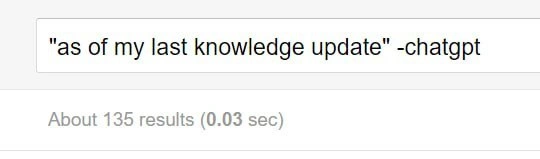
Let’s break down what’s happening in this meme in simpler terms. We have a screenshot of a Google search page. In the search bar, someone has typed the query:

"as of my last knowledge update" -chatgpt

This means they searched for the exact phrase “as of my last knowledge update” (the quotes tell Google to look for that exact sequence of words), while the -chatgpt part tells Google to exclude any results containing the word “ChatGPT.” Why do that? Because the phrase in question is strongly associated with ChatGPT – it’s something the AI often says. By removing “chatgpt” from results, the person is trying to find pages where that phrase appears without just being a quote of ChatGPT. In other words, they want to see how often real people (or at least public webpages) use this phrase naturally.

Now, look at the result count: “About 135 results (0.03 sec)”. That number is tiny! Google has billions of pages indexed, and yet only ~135 of them have this exact sentence somewhere. That’s an indicator of how uncommon or obscure the phrase is on the open internet. For context, even very niche technical terms or misspellings can sometimes get a few thousand hits. Seeing a phrase with only a hundred-something results is almost like finding a needle in a haystack – it’s really rare.

Why is it so rare? Because “As of my last knowledge update” is basically a ChatGPT catchphrase. When people ask ChatGPT about something current (like events after 2021, since its training data cuts off there), the AI often starts its answer with that apologetic line, explaining that it doesn’t have information beyond its last update. Humans, on the other hand, don’t usually talk like that. We might say, “last I heard” or “as far as I know, as of [date]…”. The very formal, somewhat stiff phrasing “as of my last knowledge update” is a giveaway that an AI is speaking. It’s like how a character in a story might have a unique way of speaking – this is ChatGPT’s signature line in those situations.

So the meme is highlighting: “Hey, look, this line that ChatGPT says all the time is virtually absent from Google’s index once you remove references to ChatGPT itself.” In plainer terms, the AI invented a phrase that people don’t really use. That’s pretty funny in the context of AI and humans: it shows how AI can introduce new language or patterns that aren’t yet part of normal human writing. It’s also a bit of a playful jab at ChatGPT – like saying, “Your favorite phrase, dear chatbot, is actually pretty original… nobody else says that!”

Now, the title of the meme says this phrase has a lower Google “DF” than your least-used microservice. Here, “DF” stands for Document Frequency, which is essentially the number of documents (web pages, in Google’s case) that contain a given term or phrase. You can think of it as “Google hits.” So, they’re claiming that ChatGPT’s catchphrase has fewer Google hits than the name of your most obscure microservice.

What’s a microservice? In software development, instead of one big application, people often split functionality into many small services (each doing one thing). For example, an e-commerce site might have separate microservices for user accounts, for the shopping cart, for inventory, etc. Some of these services are heavily used (like the payments service) and some might be very rarely used (maybe a service that handles a once-a-year data cleanup, or an A/B test feature that almost no one triggers). Developers jokingly refer to those seldom-used ones as the “least-used microservice.” Often these have weird specific names and could be almost secret in terms of public knowledge. Yet, if that microservice’s name or API endpoint is mentioned in some public doc, tech talk, or code repository, Google might still find a handful of results for it – possibly more than 135 if it ever got referenced on GitHub or a tech blog.

So the meme humorously says: This AI phrase is so unused on the web that even your least popular microservice has a higher profile! It’s a playful exaggeration meant to emphasize just how rare the phrase is outside of ChatGPT-land. It ties together two tech worlds: AI jargon and developer inside jokes. On one hand, we’ve got an AI-specific phrase (something from the world of AI/ML and chatbots), and on the other, a microservice reference (from the world of software architecture). By comparing them, the meme appeals to folks who straddle both – basically many modern developers who are into AI trends and also build or maintain microservice-based systems. If you’re newer to this, just imagine: you create a little mini-app that almost nobody ever uses; still, that mini-app’s name might pop up on Google more often than this fancy AI phrase. That contrast is the punchline.

In summary, the meme is pointing out how uncommon a certain AI-generated phrase is in normal writing, using Google search as the measuring stick. And it delivers that point with a dash of developer humor, comparing it to an ultra-niche microservice. It’s a lighthearted way to say, “This thing ChatGPT says all the time is basically alien to the rest of the world.” For anyone who’s seen the AI say it, it’s a funny realization. And if you haven’t, well, now you know one of the peculiar habits of our AI friend!

For the experienced developer or engineer, the humor here lands on multiple fronts. First, there’s the recognizably robotic phrase “As of my last knowledge update”, which has become a classic ChatGPT disclaimer. If you’ve used ChatGPT (especially earlier versions), you’ve probably seen it humbly admit that its knowledge is current only up to a certain cutoff date. It’s the AI equivalent of saying, “last I checked (which was a while ago)”. This phrase has practically become the catchphrase of LLMs, in the same way a cartoon character might have a signature line. The meme highlights that signature by putting it in a Google search bar. The twist? The search query excludes “chatgpt” from results (using the -chatgpt operator) to filter out the obvious sources. The outcome: only ~135 results. That number is hilariously low! To a senior dev, seeing such a tiny result count on Google for a full sentence (and one we hear the AI say so often) triggers a knowing chuckle. It means almost no one in the real world writes or talks like this. It’s a sly commentary on how AI’s language can differ from natural human parlance.

Now, why drag a microservice into this joke? Well, in the developer world, microservices are those small, single-purpose services that larger applications are split into. In a big company, it’s common to have some microservices that are so niche or low-traffic that they’re practically forgotten; maybe they handle an obscure feature or run once in a blue moon. The phrase “your least-used microservice” evokes that one service in your architecture that gets, say, one request per week – the one even seasoned team members forget exists. The meme hyperbolically suggests that even that little-used piece of code likely has a bigger footprint on Google than this uber-common-in-AI phrase. It’s exaggeration for effect, of course. If you named your microservice something unique (like OmegaTransactionValidator), even a single GitHub repo or a documentation page mentioning it could give Google a hit or two. The idea is that no matter how obscure you think something in your dev world is, this AI phrase is even more obscure in the wild.

This resonates as an “AI hype vs reality” punchline. Internally in the AI/tech community, “as of my last knowledge update” is an instantly recognizable joke – we’ve all seen the AI say it, and we parody it in tweets and chats. It feels ubiquitous in our little bubble. But step outside that bubble (to the broader internet), and you realize it’s essentially a ghost phrase. The hype is that ChatGPT has these definitive ways of responding that everyone in tech talks about; the reality is those responses haven’t made it into the documented knowledge of humanity (yet). It’s an insider laugh: AI humor poking fun at AI itself.

There’s also a subtle commentary on how quickly new language can form in the era of LLMs. Historically, new slang or jargon spreads through human usage, gradually making its way into written form and then into search indexes and dictionaries. Here, an AI single-handedly minted a phrase that millions have seen, but nobody was proactively writing down. Search engines (and SEO content creators) usually chase trends – when a phrase starts trending, blogs, Q&As, and documentation start including it, boosting its search presence. But ChatGPT’s output isn’t indexed by Google (those are private chat logs, not public pages), and it happened so fast that the SEO pipeline didn’t have a chance to catch up. No one is optimizing for the keyword “as of my last knowledge update” because, frankly, it’s not a human-driven keyword at all! Senior engineers who’ve watched tech trends come and go will note the irony: normally, when something is popular or important, you see it everywhere online. Here we have something extremely popular in conversations (with an AI) that’s virtually absent in print. It’s a bit of a reality check – just because a million people heard it from an AI doesn’t mean it’s made a dent in the collective written record.

And of course, let’s not ignore the cheeky self-deprecation about that “least-used microservice.” There’s an undercurrent of classic developer humor: we all have parts of our system that do almost nothing, yet they’re deployed, monitored, and part of the grand architectural diagram. Comparing an AI’s catchphrase to that forgotten component is a fun way to juxtapose tech hype with tech bloat. The senior perspective might even detect a whiff of “things moving faster than documentation.” Back in the day, we worried about code outpacing docs; now AI-generated language is outpacing search indexes. So this meme manages to tease both AI trends and software architecture quirks in one go. It’s the kind of layered joke that makes an experienced engineer smirk and maybe share it with the comment, “It’s funny ’cause it’s true.”

Level 4: Zero-Shot Catchphrase

At the deepest level, this meme spotlights a quirky intersection of information retrieval and language model behavior. The phrase "as of my last knowledge update" is essentially a neologism generated by an AI – a combination of words that’s syntactically correct, yet almost nonexistent in the vast corpus of the internet. In classical search engine terms, its document frequency (DF) on Google is astoundingly low (only ~135 pages contain it!). By excluding “-chatgpt” in the query, the search is specifically filtering out references to ChatGPT itself, showing how few organic documents ever used this exact phrasing. From an IR (Information Retrieval) perspective, a term appearing in only 135 documents out of billions is extremely rare. In fact, such rarity sends its inverse document frequency (IDF) through the roof, meaning any document with that phrase would normally be considered highly specific or important to that query. This is the textbook “long tail” of language: most content lives in common phrases, but here we have a token (or rather a multi-word token sequence) so far out on the tail that it’s basically an OOV (Out-Of-Vocabulary) phenomenon for typical search indexes.

What’s fascinating is how this phrase came to be. Large Language Models like ChatGPT are trained on massive text corpora and learn to predict likely word sequences. Yet, they can produce novel combinations and emergent phrases by recombining known words in new ways – much like a human might coin a new idiom. This appears to be a zero-shot generalization: the AI has learned the concept of a “knowledge cutoff” (it knows it was trained up to a certain date), and it invents a polite, formal way to state that. It’s likely no single training document explicitly said "as of my last knowledge update"; instead, the model synthesized it from pieces of language it statistically internalized (e.g., it knows the pattern “as of my last X” and it knows “knowledge update” from context of data refreshes). The result is a catch-phrase that’s perfectly understandable, yet unprecedented in the open web. We’re basically witnessing an AI-generated idiom.

From an academic standpoint, this highlights a tiny crack in the assumption that language models just “stitch together seen text”. They do, but the stitching can yield unique combos that haven’t been explicitly seen. The token rarity here is a good example: each individual word (“as”, “of”, “my”, “last”, “knowledge”, “update”) is common, but the specific 6-word sequence is virtually absent from any training corpus or search index. It’s a new collocation born from the model’s internal knowledge graph. If we think in terms of TF–IDF (term frequency–inverse document frequency), the term frequency of this phrase in ChatGPT’s outputs is ironically high (the AI says it a lot), but the term frequency in human-written text is near zero. In formula form, if $N$ is the total number of indexed pages and $\text{DF}$ is 135, the IDF weight:

$$ \text{IDF} = \log\frac{N}{135} $$

is astronomically large, approaching a theoretical extreme. In simpler terms, the phrase is so unique that it’s like a shining beacon against a dark void in Google’s database. The meme jokingly compares this uniqueness to your “least-used microservice” – implying that even an obscure piece of internal software likely has more Google hits or references than this AI-coined phrase. It’s a tongue-in-cheek nod to how generative AI can outpace SEO and documentation: an LLM (Large Language Model) spouts a phrase so new that even Google’s vast index barely knows about it. For seasoned engineers who know both search engines and machine learning, this is an amusing testament to the rapid, somewhat chaotic way AI-driven language is evolving beyond the trails blazed by human authors.

Description

A close-up screenshot of a search engine query. The search bar contains the text '"as of my last knowledge update" -chatgpt' in a plain monospaced font. Below the search bar, the results summary reads 'About 135 results (0.03 sec)'. The visual is minimal, focusing entirely on the search query and its outcome. The technical humor is derived from the search itself. The user is specifically trying to find instances of the classic AI disclaimer phrase 'as of my last knowledge update' while excluding results that mention 'chatgpt'. The fact that 135 results are still found implies that this AI-generated artifact is proliferating across the web from sources other than just ChatGPT, or is being used in contexts where ChatGPT is not explicitly mentioned. For senior engineers, it's a dryly witty observation on the subtle but pervasive spread of LLM-generated content online, becoming a sort of digital watermark for AI influence
Comments

7
Anonymous ★ Top Pick The phrase 'as of my last knowledge update' is becoming the 'Sent from my iPhone' of the AI world
  1. Anonymous ★ Top Pick

    The phrase 'as of my last knowledge update' is becoming the 'Sent from my iPhone' of the AI world

  2. Anonymous

    Only 135 hits - apparently the phrase has a lower document-frequency than our deprecated SOAP endpoint, yet every vector search still autocomplete-spams it

  3. Anonymous

    We've trained our models on human text so well that humans are now training themselves on model text. The real AGI was the linguistic contamination we made along the way

  4. Anonymous

    Searching for 'as of my last knowledge update' while excluding ChatGPT is like running `grep -r 'TODO' --exclude-dir=.git` on a legacy codebase - you know exactly what you'll find, you're just hoping it's not *everywhere*. Spoiler: 135 results in 0.03 seconds suggests we've reached peak LLM saturation, and the internet now has more AI-generated disclaimers than actual knowledge updates

  5. Anonymous

    New pre-commit hook: reject any diff that adds “as of my last knowledge update” - if your docs have a knowledge cutoff, you’ve accidentally implemented eventual consistency in the handbook

  6. Anonymous

    When your ADR starts with “as of my last knowledge update,” you’ve pinned truth to a model version - please add source_of_truth: human to the schema

  7. Anonymous

    Google's search index outpaces ChatGPT's parameters - the ultimate plot twist in AI dependency

Use J and K for navigation