A Gamer's Take on AI Development Release Cycles
Why is this AI ML meme funny?
Level 1: Apples vs Oranges
Imagine two kids: one loves a game that gets new costumes and levels every few months, and the other is waiting for a big new invention to come out. The meme is basically someone saying, “Hey, the game adds new fun outfits all the time, so the inventors should make a new super-smart robot just as often!” 🙃 It’s a silly comparison. Changing a game’s look or adding a level is like quickly putting a new outfit on a doll – it can happen often and it’s not too hard. But making the next ChatGPT (a super smart AI) is like inventing a new robot or discovering a new science idea – it’s really hard and takes a lot of time. We wouldn’t expect scientists to create a groundbreaking new invention every three months just because a game can put out an update in that time. So the joke is funny because the person is mixing up something easy and frequent (game updates) with something very hard and rare (huge AI breakthroughs), which is as odd as comparing apples to oranges. We laugh because it’s obviously not a fair comparison – it’s just plain goofy to think those two things would happen on the same schedule!
Level 2: Game Updates vs AI Upgrades
This meme jokingly compares the speed of updates in a video game to the speed of progress in advanced AI models. Let’s break down the pieces: Fortnite is a hugely popular online video game, and a battle pass in Fortnite is a seasonal package of new content. Typically, about every 3 months Fortnite gets a major update (a new “season”). In that update, players see new character outfits (called skins), new in-game items or maybe map changes, and fresh challenges. It’s part of the game’s way to keep things exciting. These are often purely cosmetic or incremental changes – they don’t reinvent the game from scratch; they add on to what’s already there. The developers behind Fortnite have a well-oiled pipeline: artists design new costumes and weapons, developers tweak some game code or add a feature, and they release it on a regular schedule. It’s a lot of work, but it’s a predictable, assembly-line kind of work in many ways.
Now, ChatGPT (and the GPT series it’s based on) is something entirely different. ChatGPT is an Artificial Intelligence model developed by OpenAI that can engage in human-like conversation and answer questions. The versions here refer to major leaps in the model’s ability – for example, GPT-3 was one version, and GPT-4 is the next big version. Each jump (from 3 to 4, and someday to 5) is a major research accomplishment. Think of it like going from one generation of technology to the next (like going from early smartphones to modern smartphones) – it’s not something you do in a few months. GPT-3 came out around 2020; GPT-4 came out in 2023. These things take years to develop and perfect. So the “joke” is pointing out someone saying: “Hey, Fortnite updates every 3 months with new goodies, so why hasn’t OpenAI released ChatGPT-5 yet? They must be slow! If they were as hardworking as Fortnite’s team, we’d already have ChatGPT-8 by now.”
For a newcomer or junior developer, here’s why that comparison is off-base (and thus funny to those who get it). Updating a game with new skins or levels is a content update – it’s like adding new chapters to a book that’s already written. But releasing a new AI model like ChatGPT-5 is more like writing a whole new book in a brand new genre! It involves solving new problems, collecting a ton of new data, training on extremely powerful computers, and making sure the AI is safe and accurate. In software terms, Fortnite’s updates are like scheduled feature releases, while a new ChatGPT version is closer to a groundbreaking product launch. The release cycles are different: Fortnite follows a tight, regular cycle (because the type of work — adding game content — can be done in parallel and planned out ahead of time). OpenAI’s cycle for new models is irregular and driven by research progress — they can’t just set a date and guarantee “GPT-5” will be ready by then, much like you can’t guarantee a scientific discovery on a schedule.
The meme underscores a bit of AI hype culture too. In the tech community, especially with all the buzz around AI now, some people have unrealistic AI_model_release_expectations. They see frequent version numbers in apps or games and assume AI will be the same, expecting an almost comic-book rapid progression (ChatGPT 5, 6, 7… like issues of a monthly comic). It’s important to know that developing an AI model isn’t just “adding more code”. Often it means waiting for new ideas, running experiments that might fail, and then training a model which itself can take months on supercomputers. There’s also an element of safety and responsibility – companies like OpenAI have to be careful and test these powerful AIs because a flawed AI could give bad or harmful answers. So they can’t rush it out the door just to meet a quarterly deadline.
In simpler terms, the meme humorously points out an unrealistic deadline comparison. It’s as if someone unfamiliar with the complexity is saying, “Hey, my favorite game adds fun new stuff every few weeks, why can’t this world-class AI lab pump out new AIs just as quickly?” Those who know a bit about both domains immediately see the mismatch. Game development (especially adding content to an existing game) and AI development (creating a new model) are very, very different in terms of difficulty and timeline. This is a classic case of comparing content updates vs. model upgrades. Developers often cringe (or laugh) when hearing such comparisons, because it reminds them of times when a boss or client didn’t understand why a certain feature took longer than an unrelated simpler task.
To put it plainly: Fortnite’s devs can indeed release a flashy new battle pass every 3 months because that’s more about quantity of content — they’re extremely skilled at what they do, but they’re building on a platform that’s already there. OpenAI’s team, working on something like ChatGPT-5, is tackling quality and innovation — trying to push the boundaries of what AI can do, which is not a repeatable assembly process. So the meme sets up a goofy comparison to poke fun at the idea that you can measure AI progress with the same ruler as game update speed. It’s funny because anyone who understands the basics of these fields knows it’s a huge misunderstanding – and sometimes, pointing out a huge misunderstanding in a deadpan way (“we’d be on ChatGPT-8 by now!”) is exactly what makes a joke land in tech circles.
Level 3: Skin-Deep vs Deep Learning
To a seasoned developer, this meme highlights a hilarious apples-to-oranges comparison between a game content update and an AI research milestone. The meme is presented as a fake social-media post where someone quips:
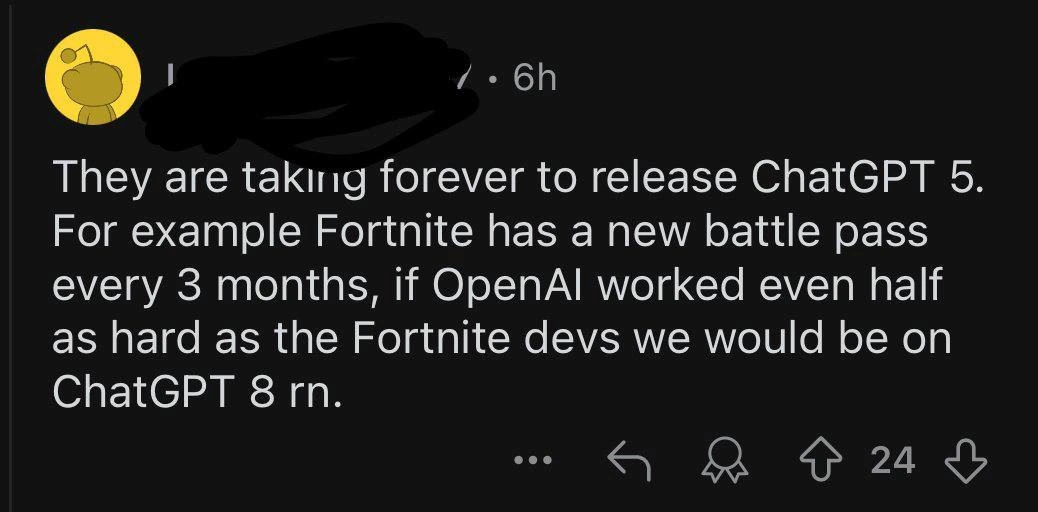
“They are taking forever to release ChatGPT 5. For example, Fortnite has a new battle pass every 3 months. If OpenAI worked even half as hard as the Fortnite devs, we would be on ChatGPT 8 rn.”
This tongue-in-cheek complaint is funny because it measures the progress of advanced AI models by the yardstick of Fortnite’s battle-pass cadence – a completely misaligned metric. Fortnite, a popular online game, keeps players engaged with cosmetic updates and new gameplay content roughly every quarter. New skins, flashy cosmetics, map changes, and gimmicks roll out on a predictable schedule. It’s a high-frequency release cycle, but critically, these are incremental, surface-level changes to a running game. The core engine and game mechanics remain intact; developers are mainly adding art assets, tweaking values, and enabling new challenges. In software terms, Fortnite’s seasonal updates are like minor version bumps or feature packs delivered on a reliable timetable (because the scope is controlled and the content is often planned well in advance).
Now contrast that with OpenAI’s ChatGPT line of models (GPT-3, GPT-3.5, GPT-4, etc.). These aren’t just “content drops”; each major version is a massive leap in capability – an entirely new model trained from scratch or with fundamentally improved architecture. It’s akin to a full version upgrade or even a new product launch, not a patch. So the tweet’s suggestion that OpenAI should be cranking out ChatGPT-5, 6, 7, 8 on a quarterly rhythm like Fortnite seasons is a classic example of industry irony and unrealistic expectations. It’s poking fun at the hype-driven mindset that treats AI breakthroughs as if they were DLCs (downloadable content).
Anyone who’s been in software development (or even just followed big tech projects) will recognize the unrealistic deadlines humor here. We’ve all heard some variant of: “Why can’t your team deliver X faster? Company Y pushes updates all the time!” In the corporate world this is known to invoke Brooks’ Law from the Mythical Man-Month: adding more people (or demanding more speed) to a complex project often makes it slower. In this case, the “If OpenAI worked harder...” line satirically implies the only reason we’re not at ChatGPT-8 is a lack of effort – whereas in reality, it’s the sheer complexity holding things back. It’s like saying, “If NASA just tried a bit harder, we’d have colonies on Jupiter by now.” Seasoned engineers chuckle at that kind of naive pressure, having fought similar battles explaining to non-tech stakeholders why “just do it faster” can fall flat against technical reality.
Another angle that makes this meme resonate is the current AI hype cycle. ChatGPT’s success put AI in the spotlight, and suddenly every non-expert had hot takes on how fast it should improve. The meme exaggerates a real sentiment some have: “Look how quickly my games/apps update, why not AI?” It underlines the misconception that software = software = software – as if all development follows the same timeline. But game development and AI model research are very different beasts. Game dev (especially live-service games like Fortnite) certainly involves intense work – artists, designers, and developers crunch to pump out content – but it’s work with a predictable path. They know the next season’s theme, they have a content roadmap, and crucially, they’re working on top of an established platform (the Unreal Engine, in Fortnite’s case). In AI, there is no guaranteed roadmap to “invent the next breakthrough”. You might set targets, but you can’t say “we’ll increase the model’s IQ by 20% by next quarter” with high confidence. It’s more research-driven and often you’re exploring unknowns (will a larger model even perform that much better? Will a new training method fail spectacularly? Nobody knows until it’s tried).
To illustrate the contrast, consider some key differences between a Fortnite battle-pass update and a ChatGPT new version release:
| Fortnite Battle Pass (Game Update) | ChatGPT Next Version (AI Upgrade) |
|---|---|
| Scope: Adds cosmetic content (new skins, emotes), maybe a gameplay tweak. The core game remains the same. | Scope: Develops a new model with improved understanding, possibly new architecture. It’s a fundamental tech upgrade. |
| Cadence: Fixed schedule – e.g. one new season every ~3 months. Deadlines are set and content is scoped to fit the timeline. | Cadence: When ready – historically years apart (GPT-3 in 2020, GPT-4 in 2023). Release happens only after significant progress and testing. |
| Effort Type: Content production – uses existing game engine. Multiple teams (artists, level designers) can create pieces in parallel. It’s more about creativity and volume. | Effort Type: Research & engineering – requires experimenting with new algorithms, training on massive datasets. LLM training isn’t easily parallelizable beyond big GPU clusters due to coordination overhead. |
| Predictability: High – devs can plan themes and assets in advance. Adding a new skin is well-understood work. | Predictability: Low – training a new model can fail or underperform. You might need to tweak hyperparameters or gather more data, which adds unpredictable delays. |
| Risk of Failure: Low – a buggy update might upset players, but can be patched quickly. Mostly cosmetic risk (“this skin is boring” or balance issues). | Risk of Failure: High – a flawed AI model might produce harmful outputs, leak private training data, or just not be reliably better. It requires extensive AI safety checks. |
| If Rushed: Worst case, players see glitches or the content isn’t as fun; the game’s reputation might dip until a patch. | If Rushed: Worst case, the AI could generate toxic or dangerous responses at scale, causing real fallout. Once deployed, a problematic AI is much harder to “hotfix” in the wild (and could cause mistrust or harm). |
Seeing these differences, it’s clear why the meme’s comparison is facetious. It’s funny in the way an inside joke is: people in tech know that “content updates” ≠ “tech breakthroughs”. The meme exaggerates an ignorant viewpoint for comedic effect. It highlights the gamedev_vs_ai_dev contrast – shipping cosmetic content vs. shipping a new AI model – to the point of absurdity. Experienced folks find it ironic because we’ve felt the pain of being rushed by unrealistic comparisons. It’s a gentle reminder that not all development cycles are created equal. So when someone says, “Why isn’t ChatGPT-5 out yet? Fortnite manages to update faster!”, the only sane response is a chuckle. They’re treating a deep learning advancement (truly deep, fundamental work) as if it were a skin-deep feature drop. And that, precisely, is why this meme lands its punchline: it’s so wrong that it circles back to being riotously funny for those in the know.
Level 4: Quadratic vs Quarterly
At the cutting edge of AI/ML, releasing a new model like ChatGPT-5 isn’t a mere increment—it’s a massive R&D leap constrained by computational and theoretical limits. On a fundamental level, expecting AI model release pace to match a game’s cosmetic updates is like comparing a polynomial growth curve to a fixed calendar schedule. Creating a state-of-the-art Large Language Model (LLM) is a herculean task that often scales up in complexity super-linearly (if not exponentially) with each generation. For instance, GPT-3 had about 175 billion parameters; GPT-4’s exact size is secret but widely presumed to be significantly larger or more complex. Simply scaling such models isn’t trivial: doubling a model’s size (and the data it’s trained on) can easily quadruple the training compute required. In other words, the resource demands tend to balloon much faster than the model’s version number would suggest.
This is a classic case of the velocity fallacy in tech. Even with unlimited enthusiasm (and budget), there are physical and mathematical bottlenecks. Training a new GPT model means marshaling thousands of GPUs in parallel for weeks or months, carefully orchestrating distributed training without errors. There’s a limit to how much you can speed that up – you can’t just throw twice the GPUs to magically get it done in half the time, due to bandwidth, coordination, and diminishing returns. The process involves meticulous data curation, algorithm tuning, and often waiting on research breakthroughs (you might hit a wall where just adding parameters yields minimal gains, and you need a new architecture or training trick). OpenAI and similar labs also must contend with the Chinchilla scaling laws (from DeepMind’s research), which suggest an optimal balance of model size and data. If they overshoot model size without enough data, they waste compute; if they use more data, they need even bigger models to fully capitalize on it. This interplay means you can’t just crank versions out on a whim – there’s a lot of math and experimentation to find a meaningful improvement for a “GPT-5”.
Then there’s the AI safety and alignment overhead. Each new generation of a powerful model must be extensively tested and fine-tuned to ensure it doesn’t produce dangerous or false outputs. Unlike game content where the worst glitch might be a funny visual bug, an unrefined LLM could cause real harm (e.g. misinformation, offensive content) at scale. OpenAI employs techniques like Reinforcement Learning from Human Feedback (RLHF) to align models – this involves training additional reward models and running many trial interactions with humans in the loop. That process itself can take months of careful iteration and validation. It’s a far cry from simply pushing code to production; it’s more akin to a long scientific experiment, with peer review and safety checks, before hitting “release”.
All these factors contribute to why new foundation models don’t drop frequently. The timeline isn’t governed by a marketing calendar but by when the research actually yields a robust result. It’s closer to waiting for a new semiconductor node technology or a new vaccine formula than waiting for a software patch. No amount of “working harder” can instantly overcome the computational complexity, theoretical uncertainty, and safety requirements involved. In short, at the deepest technical level, measuring AI progress by Fortnite’s content cadence is categorically absurd – one is bounded by physics and learning curves, the other by a content schedule. It’s the difference between scaling up a supercomputer and scaling up a content pipeline. You simply can’t schedule a breakthrough the way you schedule a battle-pass drop.
Description
A screenshot of a comment from a platform that appears to be Reddit, given the Snoo avatar. The user expresses impatience about the release of ChatGPT 5, making a direct and flawed comparison to the gaming industry. The comment reads: 'They are taking forever to release ChatGPT 5. For example Fortnite has a new battle pass every 3 months, if OpenAI worked even half as hard as the Fortnite devs we would be on ChatGPT 8 rn.' The technical humor, which resonates deeply with experienced engineers, comes from the commenter's profound misunderstanding of the difference in scope and complexity between the two tasks. Creating a 'battle pass' for a game like Fortnite involves producing new digital assets, designing gameplay challenges, and updating configuration files on a well-established, stable platform - it is content production. In stark contrast, developing a next-generation foundational AI model like ChatGPT 5 is a monumental research and engineering challenge involving petabytes of data, novel model architecture, and training runs that cost hundreds of millions of dollars over many months. The comment hilariously exposes a complete lack of awareness of the scale, cost, and experimental nature of cutting-edge AI development, treating it as if it were a predictable, content-driven software update
Comments
29Comment deleted
Project manager: 'The stakeholders are wondering why we can't ship the new distributed database with the same velocity as the marketing team ships new landing pages.' This comment is the final boss of that conversation
Sure, just fine-tune 1.7 trillion parameters, run safety red-team, negotiate GPU supply, and ship a new model quarterly - what could possibly go wrong besides the AWS bill eclipsing Epic’s V-Buck revenue?
Ah yes, because training a 175-billion parameter model on the entire internet is exactly like reskinning a llama into a disco llama. Next they'll wonder why CERN doesn't release a new particle every quarter like Apple releases iPhones
Ah yes, because training a frontier LLM on exabytes of data with thousands of H100s is clearly equivalent to shipping cosmetic skins and map rotations. If only OpenAI would just 'git push --force' to production like Epic does, we'd have AGI by Tuesday. Bonus points for the implicit assumption that ChatGPT versions should follow semantic versioning at Fortnite's cadence - clearly someone's never dealt with the joys of model collapse, alignment tax, or the minor detail that each GPT generation requires architectural breakthroughs, not just content updates
Shipping GPT isn’t a battle pass - you can’t nerf hallucinations 20% and call it season 8; alignment evals, data governance, and $20M of compute don’t fit in patch notes
Battle passes ship cosmetics; frontier LLMs ship new failure modes, SOC2 paperwork, and a power substation - so no, you can’t hotfix two trillion tokens every quarter
Fortnite devs ship battle passes quarterly via CI/CD bliss; OpenAI's still waiting for that one H100 cluster to finish backprop on the alignment dataset
what in the skibidi Comment deleted
like a fehom tax Comment deleted
fr fr no cap Comment deleted
don't even try rizz me Comment deleted
professional gooner from Ohio Comment deleted
He fucked around and found out 💀 Comment deleted
skibidi grimace shake fanum rizz only in ohio Comment deleted
who's letting this guy cooked 🔥 Comment deleted
Let's poison datasets and make GPT 5 think only about Skibidi Toilets. Comment deleted
fr fr, call fortnite devs here, let em teach openai mfs some cooking Comment deleted
kids these days consider new skins an update... Comment deleted
Back in my day, updates were in engines, CS 1.6 to Source to GO Comment deleted
Game developers were able to write an engine from scratch to begin with. Kids now call Unity and C# a game development Comment deleted
Well this is just plain envy We have created the tools to make life easier and now we complain about younger ones having an easier time Comment deleted
but but- back in my day, the way to and from school was uphill both ways! Comment deleted
Yeah yeah, and now kids on e-scooters have an easy time going both ways Comment deleted
well now it's downhill both ways. obviously Comment deleted
during hard times strong devs appear Strong devs create tools to make life easier during easy times weak devs appear weak devs create troubles Troubles lead to hard times Comment deleted
that's a disproven hypothesis Comment deleted
Hello, is this your first encounter with millennials/boomers? Comment deleted
You know, I’m something of a millennial/boomer myself Comment deleted
Ok grandpa xD Comment deleted