Skip to content
DevMeme
4635 of 7435
When flawless grammar becomes the new phishing red flag after ChatGPT
AI ML Post #5084, on Dec 14, 2022 in TG

When flawless grammar becomes the new phishing red flag after ChatGPT

Why is this AI ML meme funny?

Level 1: Wolf in Sheep’s Clothing

Imagine you used to spot a trick letter because it was full of obvious mistakes – kind of like noticing a wolf because it was wearing a poorly fitting sheep costume. Now, with a tool like ChatGPT, the trickster can dress up perfectly. It’s as if the wolf found a perfect sheep disguise and even learned to talk just like a sheep. The result? The letter looks completely normal – no spelling errors, no weird wording – so it seems safe and friendly. But it might still be the wolf (a scam) in disguise! In simple terms, something that looks too perfect for an unexpected email could be a reason to be careful. The meme is funny because it shows how the one easy clue we relied on (“bad writing meant a bad guy”) isn’t so simple anymore. Now even a letter that reads perfectly could be from a bad guy, thanks to the smart machine helping them. It’s a bit like hearing an evil villain speak in a polite, flawless voice – you have to pay extra attention to what they’re asking for, not just how nice it sounds. The lesson? Even if an email’s words are shiny and correct, we should stay alert – sometimes things that look good on the outside can hide danger.

Level 2: Flawless Fakes

Let’s break down the joke in simpler terms. ChatGPT is an AI program – specifically a chatbot powered by a Large Language Model – that can write text which sounds incredibly human. Give it a prompt, and it will produce a well-written response, whether that’s an essay, an email, or a joke. Because it was trained on vast amounts of text from the internet, it learned proper grammar and tone. Meanwhile, phishing emails are those fraudulent messages you get from attackers pretending to be someone trustworthy (like your bank, your boss, or a popular website). The goal of phishing is to trick you into clicking a bad link, giving away your login credentials, or even sending money. In the past, a lot of phishing attempts were pretty crude. You might have seen spam with sentences like “Dear Sir, I am Prince of Bank unitd state, send account deatails pLz”. The bad grammar and spelling were immediate giveaways that “Hmm, this doesn’t look like a professional email. It’s probably a scam.”

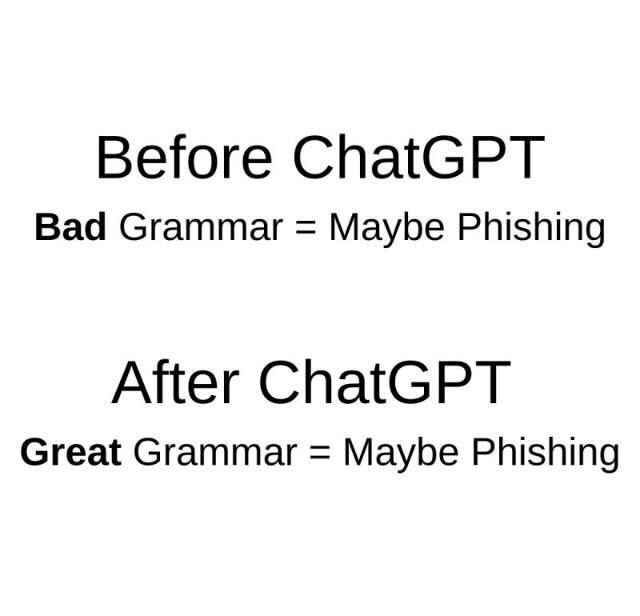
The meme highlights a big change: now that AI-generated content is easily available, scammers can use tools like ChatGPT to write their phishing emails with perfect grammar and style. Imagine a hacker who isn’t great at English – before, their phishing email might have been full of mistakes that made you suspicious. Now they can ask ChatGPT to rewrite it. The result? A flawlessly written fake email that looks just like a legitimate message from a coworker or company. So the old advice “watch for bad English” doesn’t always work anymore. The meme’s first line says “Before ChatGPT – Bad Grammar = Maybe Phishing”. That’s the old rule: if an email was written poorly, you’d raise an eyebrow and think it might be a phishing attempt. The second line says “After ChatGPT – Great Grammar = Maybe Phishing.” This is the funny twist: now even if an email is written extremely well, you might suspect it, because it could be written by an AI-powered scammer.

In short, the phishing threat landscape evolved. Security teams and all of us users have to adapt. Instead of relying on spelling or grammar mistakes to spot a scam, we need to look at other clues. For example, check the sender’s email address closely (is it the real company domain or a look-alike?), inspect links before clicking (do they actually go to the official site?), and be wary of any email – no matter how perfectly worded – that asks for sensitive information or urgent money transfers. The meme uses humor to deliver this lesson in security awareness: don’t be fooled by just good writing. A dangerous email might look as polished as an official notice. It’s a reminder that as technology like AI improves, we have to update our human instincts and training. The old grammar heuristic was a handy tip, but now we must recognize grammatically correct phishing as a real possibility. In other words, a scam email might look grammatically perfect and professionally formatted, and that alone isn’t a clean bill of health. The content and context matter more than ever. The meme got popular with developers and IT folks because it captures this very modern problem in a quick, witty way – we laugh, then we nod, realizing “yep, that’s our new reality.”

Level 3: Phishing, Perfected

To seasoned security engineers, this meme hits home: one of the oldest security awareness tips just got turned upside down. We all remember the classic “Nigerian prince” scam emails riddled with bad grammar and spelling mistakes. Those laughably clumsy messages became a running joke in tech — if you saw “Urgent recuest pls send bank detals” from some unknown sender, you could bet it was a phish. In the Before ChatGPT era, sloppy English was a reliable red flag for phishing. Many of us in IT have told less tech-savvy colleagues, “Watch out for weird grammar or phrasing in emails. Real companies proofread their communications; scammers often don’t.” It was a simple, practical heuristic in the field of email security.

After ChatGPT, that comfort is gone. Suddenly, even great grammar in an unexpected email can make the hairs on the back of your neck stand up. The meme perfectly captures this irony: now when an email is too perfectly written, we joke that it might be “crafted by ChatGPT” and thus a possible scam. The very signal that used to reassure us (“This email reads professionally, so it’s probably legit”) has become a potential cause for concern (“This email is polished to perfection — maybe too perfect…”). It’s the ultimate threat landscape shift: large language models leveled up the criminals’ copywriting game. AI-generated content can make a fake bank notice or HR email read indistinguishably from a genuine one. Social engineers can phish in grammatically correct English, complete with corporate tone and zero typos, blowing up a key differentiator between scam and real communications.

Real-world security operations are already adapting to this LLM-enabled attack vector. For example, instead of relying on just gut feeling about writing quality, professionals emphasize technical safeguards: check the sender’s address carefully, verify DKIM/SPF (email authentication records), scan for malicious links, and confirm requests through secondary channels. But those measures don’t make for a catchy meme — the meme zeroes in on our emotional loss of that one easy rule-of-thumb. It’s funny because it’s true: security folks half-jokingly now see an email that’s squeaky clean in language and quip, “Hmm, who had GPT write this email?” We’ve even heard of internal phishing training emails deliberately written too perfectly to see if employees get suspicious! The social engineering cat-and-mouse game has evolved. Attackers with access to ChatGPT (or similar AI) can produce scam emails that read like they were vetted by a professional editor. No more obvious “I is Prince from foreign country” misfires to tip people off.

The meme’s text itself, with “Bad Grammar = Maybe Phishing” flipping to “Great Grammar = Maybe Phishing,” is both humorous and a bit dark for those in the know. It satirizes how we paranoid techies now joke that nothing can be trusted — if it’s written badly, it’s a scam; if it’s written too well, it might also be a scam! The only safe emails, it seems, are in that narrow uncanny valley of just average writing. 😉 This exaggeration underscores a real point: phishing defenses must get smarter. We’re focusing more on context and content legitimacy (Does this CEO request make sense? Is this invoice expected?) rather than surface-level polish. In short, ChatGPT has forced us to up our game. It’s a reminder that in cybersecurity, attackers will exploit any tool at their disposal — even an AI that writes better English than we do. The meme lands as both a chuckle and a challenge to veterans: time to rethink our email security heuristics, because the game just changed.

# Before ChatGPT: flag emails with obviously bad writing
if email.has_bad_grammar():
    email.flag_as_phishing()

# After ChatGPT: now even flawless language can be fishy
if email.has_perfect_grammar():
    email.flag_as_phishing()

(The code above jokingly illustrates our inverted paranoia: the heuristic literally flipped once AI could polish any scam.)

Level 4: Generative vs Discriminative

At the cutting edge of AI/ML and Security, this meme hints at an arms race between generative models and discriminative filters. ChatGPT is a Large Language Model (LLM) based on the transformer architecture, capable of producing text that is statistically indistinguishable from human writing in grammar and style. In contrast, traditional spam/phishing detectors are discriminative classifiers – they analyze incoming messages for telltale signs of fraud. For years, one low-tech but effective signal was poor grammar or odd phrasing, often characteristic of scam emails written by non-native speakers or hastily composed. This worked because human-written business emails usually maintain a baseline of professionalism, while many social engineering attempts slipped up linguistically.

Enter ChatGPT. Trained on billions of sentences of well-formed English, it can generate flawless prose on demand. Suddenly, attackers have a tool to eliminate the obvious errors that filters and users keyed on. What we’re seeing is akin to an adversarial ML scenario: the generator (ChatGPT-wielding scammer) produces text to fool the discriminator (our spam filters and human heuristics). It’s reminiscent of a neural GAN (Generative Adversarial Network) where one network learns to produce ever more realistic outputs to trick the other. Here, however, the stakes are real emails and real victims. Grammar-based heuristics become far less reliable when the attacker can outsource copy-editing to an AI with near-perfect linguistic prowess. The meme’s “Before ChatGPT / After ChatGPT” format succinctly captures this shift in the threat model.

There’s a theoretical twist on the Turing Test happening: historically, a blatantly bad email failing basic English was a dead giveaway of automation or malicious intent. Now an email passing the Turing test (i.e., reading like it was written by a fluent human) might raise suspicion that it’s too perfect. In other words, perfection itself starts to feel machine-made. Researchers are already exploring solutions like AI-generated text watermarking and advanced stylometric analysis to distinguish LLM output. These methods embed subtle statistical signatures in AI text or detect unnatural patterns in word choice and punctuation distribution. However, it’s a cat-and-mouse game; attackers can fine-tune models or use open-source LLMs to avoid known watermarks, and even instruct the AI to inject minor human-like errors intentionally. The fundamental challenge remains: language fluency is no longer a reliable differentiator between a legitimate sender and a scammer. Our defensive algorithms and mental models must evolve beyond the simplistic grammar metric, delving into context, intent, and verifiable credentials. The meme humorously exposes this deep paradigm shift – a grammar-perfect phishing email is an oxymoron that has become reality thanks to state-of-the-art AI, forcing security to confront the new normal of impeccably phrased threats.

Description

White background meme with two black-text segments, centered and separated by space. First segment reads: "Before ChatGPT" on one line, then "Bad Grammar = Maybe Phishing" with the word "Bad" bolded. Second segment reads: "After ChatGPT" followed by "Great Grammar = Maybe Phishing" with the word "Great" bolded. The joke flips the classic security heuristic - poor English implies scams - highlighting that large language models now let attackers craft perfectly written emails, forcing engineers and security teams to rethink phishing detection signals. Visually simple but technically relevant to AI-generated content, social-engineering defense, and evolving threat models in the post-LLM era

Comments

6
Anonymous ★ Top Pick SOC’s new rule: any email with perfect grammar, an Oxford comma, and clearly scoped requirements is quarantined - real stakeholders never write that well
  1. Anonymous ★ Top Pick

    SOC’s new rule: any email with perfect grammar, an Oxford comma, and clearly scoped requirements is quarantined - real stakeholders never write that well

  2. Anonymous

    We spent 20 years training users to spot phishing by grammar mistakes, then handed attackers a tool that writes better emails than our product managers

  3. Anonymous

    The real zero-day exploit wasn't in the code - it was convincing everyone that typos were our last line of defense. Now that ChatGPT has democratized perfect grammar for threat actors, we've gone from 'Nigerian prince needs help' to 'Distinguished colleague, I hope this message finds you well' faster than you can say 'prompt injection.' Turns out the Turing test for phishing emails is now just checking if they're *too* polite

  4. Anonymous

    Pre-GPT phishing: caught by spellcheck. Post-GPT: Time to fine-tune your own LLM detector or hire more SOC wizards

  5. Anonymous

    After ChatGPT, our phishing classifier swapped “spelling errors” for “polished prose” - anything that reads better than a Jira comment gets quarantined by default

  6. Anonymous

    Our spam model once weighted “bad grammar” at 0.8; post‑LLMs the coefficient flipped sign and the roadmap just says “enforce DMARC, ship FIDO2.”

Use J and K for navigation